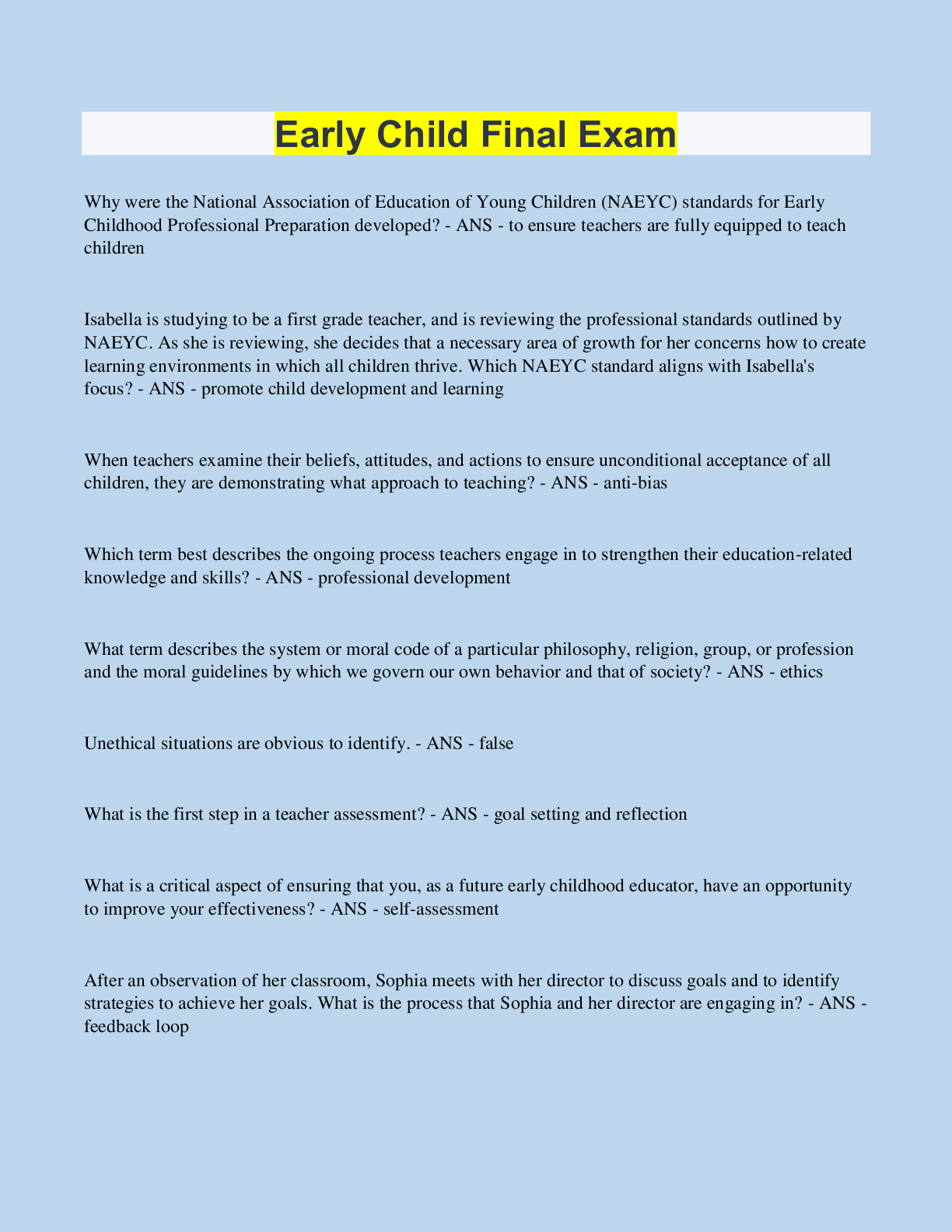
Early Child Final Exam
Why were the National Association of Education of Young Children (NAEYC) standards for Early
Childhood Professional Preparation developed? - ANS - to ensure teachers are fully equipped to teach
...
Early Child Final Exam
Why were the National Association of Education of Young Children (NAEYC) standards for Early
Childhood Professional Preparation developed? - ANS - to ensure teachers are fully equipped to teach
children
Isabella is studying to be a first grade teacher, and is reviewing the professional standards outlined by
NAEYC. As she is reviewing, she decides that a necessary area of growth for her concerns how to create
learning environments in which all children thrive. Which NAEYC standard aligns with Isabella's
focus? - ANS - promote child development and learning
When teachers examine their beliefs, attitudes, and actions to ensure unconditional acceptance of all
children, they are demonstrating what approach to teaching? - ANS - anti-bias
Which term best describes the ongoing process teachers engage in to strengthen their education-related
knowledge and skills? - ANS - professional development
What term describes the system or moral code of a particular philosophy, religion, group, or profession
and the moral guidelines by which we govern our own behavior and that of society? - ANS - ethics
Unethical situations are obvious to identify. - ANS - false
What is the first step in a teacher assessment? - ANS - goal setting and reflection
What is a critical aspect of ensuring that you, as a future early childhood educator, have an opportunity
to improve your effectiveness? - ANS - self-assessment
After an observation of her classroom, Sophia meets with her director to discuss goals and to identify
strategies to achieve her goals. What is the process that Sophia and her director are engaging in? - ANS -
feedback loop
To provide an unbiased assessment, a teacher evaluator must have the same or a similar cultural
background as the teacher. - ANS - false
What three elements inform the guidance triangle? - ANS - child, adult, situation
in early childhood terms, what does discipline mean? - ANS - everything adults do and say to influence
children's behavior
What must a teacher understand for any guidance technique to be successful? - ANS - reasons why
children behave the way they do
Which guidance technique is considered the most intervening according to the guidance continuum? -
ANS - physical intervention
What is the key ingredient to planning developmentally appropriate guidance strategies? - ANS - Start
where children are and help them reach their potential.
Which of the following guidance techniques involves helping children to solve disagreements
nonviolently and to explore alternative ways to reach their goals? - ANS - conflict resolution
What process holds children accountable for their actions and stresses reasoning and problem-solving
skills to help them understand the impact of their behavior on others? - ANS - inductive guidance
When is the best use of a time out? - ANS - when a child needs to be protected from him- or herself or
others
Which are good reasons to set limits for children? - ANS - a. to prevent the destruction of property,
materials, or equipment
b. to prevent children from injuring themselves or others
What should an adult do when engaging a child in active problem solving? - ANS - pose open-ended
questions
A parent provides a lot of warmth and affection but little control when parenting his or her child. What
type of parental style does this describe? - ANS - permissive
Family communication styles are identical across all cultures. - ANS - false
What program was founded as a parent cooperative and remains an example of successful school-family
partnerships? - ANS - Schools of Reggio Emilia
Classroom newsletters are a common way teachers involve and inform parents. - ANS - true
A family-centered approach to building home-school relationships involves: - ANS - recognizing the
needs and interests of the family and supporting their values and culture.
Children's achievement is positively affected when parents are involved in their education. - ANS - true
The more involved families become in the workings of the school, such as volunteering in the office,
classroom, or on fieldtrips, the more important it becomes to: - ANS - c. establish guidelines for
protecting all families' privacy
A parent wants to be involved in his or her child's education but doesn't want a high level of
commitment. What would be an appropriate suggestion to this parent? - ANS - Visit your child's class
and help with an activity.
According to the chapter, what do parents most need to know about their child's brain development? -
ANS - a. the significant role of the parent/family/caregiver
b. the significant role of the environment
What does a learning environment with an anti-bias focus encourage children and adults to do? - ANS -
a. explore the similarities and differences that make up our individual and group identities
b. develop skills for identifying and countering the hurtful impact of bias on themselves and peers
When a teacher provides alternative ways for children with disabilities to complete activities, what is
that called? - ANS - making accommodations
Which are examples of ways an early childhood educator helps to ensure a sanitary environment? - ANS
- a. All children and adults must wash their hands before eating.
b. Wash dress-up clothing, pillows, and cuddle toys at school or home.
Health and safety issues are the responsibility of directors and principals, not the early childhood
teacher. - ANS - false
A teacher wishes to ensure that her classroom environment reflects her beliefs that autonomy and
independence are important. What kind of environment would reflect her beliefs? - ANS - self-help
What toys should early childhood educators avoid when selecting materials for their classroom? - ANS -
a. toys that make electronic technology the sole focus of play
b. toys that encourage girls to focus on appearance.
c. toys that model violent and sexualized language or behavior.
What should the temporal environment of a classroom reflect? - ANS - the children's age and individual
interests
Which of the following are recommended areas to include in classrooms for children 2 through 8 years
old? - ANS - a. bathroom
b. interest areas
c. food service
Who has the largest role in determining the atmosphere of the group in a classroom environment? - ANS
- teacher
What aspect of the early childhood program creates the format for how children experience the events of
the day? - ANS - daily schedule
When is a play-based curriculum most effective? - ANS - when children physically manipulate materials
What type of curriculum is based on observations and interactions with children as they play? - ANS -
play-based curriculum
Curriculum includes only the planned activities in a child's day. - ANS - false
Sarah and Trina, first grade teachers, are preparing to teach a unit on families. When planning the
upcoming curriculum, they are intentional in their representation of the varying family types and
structures. What kind of curriculum model does this describe? - ANS - transformative
Assessing curriculum should occur at the end of the curriculum. - ANS - false
In Kevin's first grade class, he tailors his instruction to meet the children's preferred methods of
integrating knowledge and experiences. What is Kevin considering when planning his curriculum? -
ANS - children's learning styles
How do the early learning standards benefit children? - ANS - a. They help teachers create appropriate
expectations for children.
b. They professionalize the field of early childhood education.
c. When they are linked to primary grade standards, they ensure school readiness.
Miranda, a teacher in a toddler class, is creating an outline of the activity, time, materials, and resources
needed to implement a learning experience. What is Miranda most likely creating? - ANS - lesson plan
Over the course of two weeks, a group of first graders are participating in an in-depth study about
oceans. As they do this, the children work in small groups to generate questions to research further.
What type of learning does this best describe? - ANS - project-approach
When a teacher uses the thematic approach to develop curriculum, what should primarily guide the
choice of themes? - ANS - children's interests and abilities
[Show More]





















![Preview of [SOLVED] EDCO 740 / EDCO740 Quiz 1 (LATES 2021/2022 Graded A)](https://scholarfriends.com/storage/EDCO_740_Quiz_1.png)

