major segmentation variables (4) - ANSWER (1) geographic, (2) demographic, (3) psychographic, (4) behavioral
penetrated market - ANSWER set of customers who are buying the company's product
target market - ANSWER q
...
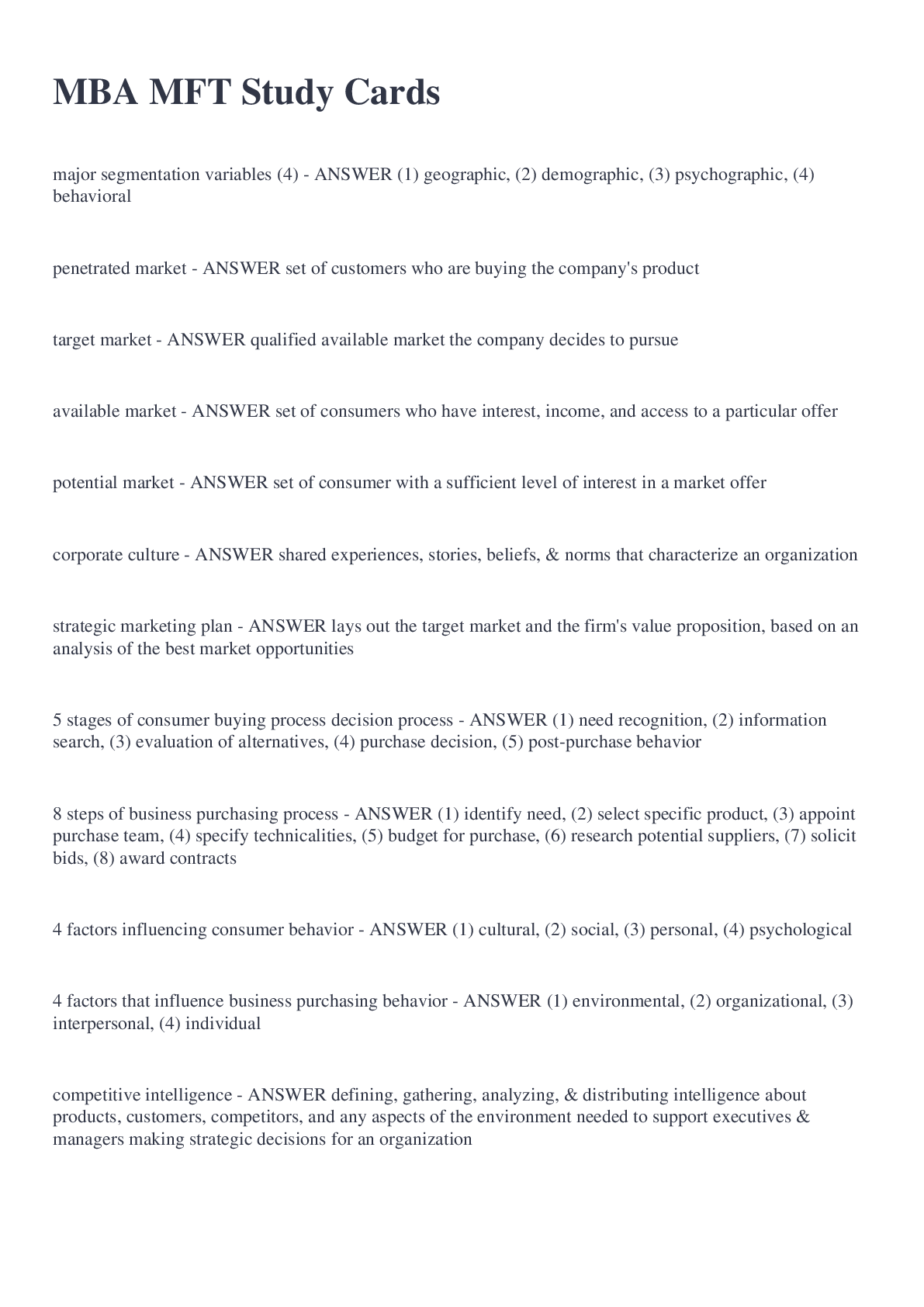
major segmentation variables (4) - ANSWER (1) geographic, (2) demographic, (3) psychographic, (4) behavioral
penetrated market - ANSWER set of customers who are buying the company's product
target market - ANSWER qualified available market the company decides to pursue
available market - ANSWER set of consumers who have interest, income, and access to a particular offer
potential market - ANSWER set of consumer with a sufficient level of interest in a market offer
corporate culture - ANSWER shared experiences, stories, beliefs, & norms that characterize an organization
strategic marketing plan - ANSWER lays out the target market and the firm's value proposition, based on an analysis of the best market opportunities
5 stages of consumer buying process decision process - ANSWER (1) need recognition, (2) information search, (3) evaluation of alternatives, (4) purchase decision, (5) post-purchase behavior
8 steps of business purchasing process - ANSWER (1) identify need, (2) select specific product, (3) appoint purchase team, (4) specify technicalities, (5) budget for purchase, (6) research potential suppliers, (7) solicit bids, (8) award contracts
4 factors influencing consumer behavior - ANSWER (1) cultural, (2) social, (3) personal, (4) psychological
4 factors that influence business purchasing behavior - ANSWER (1) environmental, (2) organizational, (3) interpersonal, (4) individual
competitive intelligence - ANSWER defining, gathering, analyzing, & distributing intelligence about products, customers, competitors, and any aspects of the environment needed to support executives & managers making strategic decisions for an organization
managerial decision making process steps (6) - ANSWER (1) establish the objective, (2) define the problem, (3) identify possible solutions, (4) evaluate alternative courses of action, (5) implement the decision, (6) acquire feedback
8 major models of marketing communication - ANSWER (1) advertising, (2) sales promotion, (3) events & experiences, (4) public relations & publicity, (5) direct marketing, (6) interactive marketing, (7) word-of-mouth marketing, (8) personal selling
pull strategy - ANSWER the manufacturer uses advertising and other communication to persuade consumers to demand the product from intermediaries, thus inducing intermediaries to order it
push strategy - ANSWER uses the manufacturer's sales force, trade promotion money, or other means to induce intermediaries to carry, promote, & sell the product to end users
points-of-parity (POPs) - ANSWER attributes or benefit associations that are not necessarily unique to the brand but may be shared with other brands
points-of-difference (PODs) - ANSWER attributes of benefits that consumers strongly associate with a brand, positively evaluate, and believe they could NOT find to the same extent with a competitive brand
posititioning - ANSWER the act of designing a company's offering and image to occupy a distinctive place in the minds of the target market
supersegment - ANSWER set of segments sharing some exploitable similarity
5 key criteria market segments must rate favorably on to be useful - ANSWER (1) measurable, (2) sustainable, (3) accessible, (4) differentiable, (5) actionable
pyschographic - ANSWER the science of using psychology & demographics to better understand consumers
variables of demographic segmentation (6) - ANSWER (1) age and life-cycle stage, (2) life stage, (3) gender, (4) income, (5) generation, (6) race & culture
investment banking - ANSWER a specific division of banking related to the creation of capital for other companies, governments, and entities
weak form - ANSWER assumes that all info contained in past price movements is reflected in the current market price. info about recent trends in a stock price is no use in selecting a stock
semi-strong form - ANSWER states the current market price reflects all publicly available information. to gain abnormal returns insider info is needed
information efficiency - ANSWER all relevant information about a stock is reflected in its price (this is in a perfect world)
strong form efficient - ANSWER all info -- public and insider -- is reflected in the market price. no abnormal returns
market efficiency - ANSWER the degree to which stock prices reflect all available relevant information
money market - ANSWER a segment of the financial market in which financial instruments with high liquidity and very short maturities are traded
capital markets - ANSWER markets for buying and selling equity and debt instruments
security - ANSWER a financial instrument that represents an ownership in a publicly-traded corporation (stock), a creditor relationship with governmental body or corporation (bond) or rights to an ownership as represented by an option
most common underlying assets of derivatives - ANSWER stocks, bonds, commodities, currencies, interest rates, market indexes
derivative - ANSWER a security with a price that is dependent upon or derived from one or more underlying assets. its value is determined by fluctuations in the underlying assets
futures - ANSWER financial contracts obligating the buyer to purchase an asset (or the seller to sell an asset) at a predetermined future date and price
option - ANSWER a financial derivative that represents a contract sold by one party (option writer) to another party (option holder). the contract offers the buyer the right to call or put a security at an agreed upon price (strike price) during a certain period of time or on the exercise date
2 types of financial instruments - ANSWER (1) cash instruments, (2) derivative instruments
financial instruments - ANSWER assets that can be traded
INVENTORY TURNOVER = - ANSWER SALES/INVENTORY
AVERAGE COLLECTION PERIOD = - ANSWER DAYS (ACCOUNTS RECEIVABLE)/CREDIT SALES
WORKING CAPITAL RATIO= - ANSWER CURRENT ASSETS/CURRENT LIABILITIES
working capital managment - ANSWER a company's managerial accounting strategy designed to monitor and utilize the 2 component of working capital -- current assets and current liabilities
3 main dividend policies - ANSWER (1) residual dividend policy, (2) dividend stability policy, (3) hybrid dividend policy
dividend policy - ANSWER a set of guidelines a company uses to decide how much of its earnings it will pay out to shareholders
WACC = - ANSWER WdRd(1=T) + WpsRps + WsRs
cost of capital - ANSWER the opportunity cost of making a certain investment
capital budgeting - ANSWER the whole process of analyzing projects and deciding whether they should be included in the planned expenditures on fixed assets
what are some types of real options? - ANSWER (1) investment timing options, (2) growth options, (3) abandonment options, (4) flexibility options
real options - ANSWER exist when managers can influence the size and risk of a project's cash flows by taking different actions during the project's life in response to changing market conditions
what 3 types of risk are relevant in capital budgeting? - ANSWER (1) stand alone risk, (2) corporate risk, (3) market [beta] risk
steps in capital budgeting - ANSWER (1) estimate cash flows, (2) assess risk of cash flows, (3) determine r [WACC], (4) evaluate cash flows
THE DUPONT EQUATION - ANSWER (1) ROA = [NY/SALES] [SALES/TA] = NY/TA
(2) ROE = [NY/TA] [TA/EQUITY] = NY/EQUITY
components of risk - ANSWER (1) default risk, (2) maturity risk premium, (3) liquidity premium
why would a company have a target capital structure? - ANSWER recognize debt is cheaper, but too much debt increases cost of debt, which increases default risk and looks bad
efficient frontier - ANSWER the set of optimal portfolios that offers the highest expected return for a defined level of risk or the lowest risk for a expected level of return
WACC (definition) - ANSWER the weighted average of the after-tax components cost of capital -- debt, preferred stock, and common equity
byproduct - ANSWER a product of relatively small total value produced simultaneously with a product of greater total value
methods of byproduct costing - ANSWER (1) byproducts could be valued at the split-off point at their net realizable value
(2) none of the common costs is assigned to the byproducts
job costing vs. process costing - ANSWER - job costing is used for unique products, process costing is for standardized
- job costing is for small production runs, process costing for large production runs
- job costing is more likely to be used for billing to customers
activity based costing (ABC) - ANSWER firm assigns costs to the activities that are the real cause of the overhead, then assigns the costs of those activities only to the products that are actually demanding the activities
absorption vs. variable costing - ANSWER absorption includes all costs, including fixed costs, in figuring the cost of production, while variable costing only includes the variable costs related to production
UNITS FOR TARGET PROFIT = - ANSWER X = (TFC/[UP-UVC]) + TP
cost behavior - ANSWER the change in total costs in response to the change in some activity
- costs that vary proportionately with the changes in the level of activity are variable costs, unaffected are fixed costs
options for transfer pricing (4) - ANSWER (1) market based, (2) variable-cost, (3) full-cost, (4) negotiated
TOTAL COST - ANSWER TC = UVC(UNITS) + TFC
BREAK EVEN POINT = - ANSWER BEP = TFC/(UP - UVC) or... TFC/UCM
variance analysis - ANSWER the quantitative investigation of the difference between actual and planned behavior
cash budget - ANSWER financial budget prepared to calculate the budgeted cash inflows and outflows during a period and the budgeted cash balance at the end of the period
3 ways to analyze sell-or-process further - ANSWER (1) incremental (or differential), (2) opportunity cost, (3) total project approach
sell-or-process further - ANSWER whether to sell a joint product at split-off point or to process it further and sell it in a more refined form
special orders - ANSWER a one-time customer order, often involving a large quality and a low price
theory of constraints (TOC) - ANSWER a management paradigm that views any manageable system as being limited in achieving more of its goals by a very small number of constraints
leadership - ANSWER the process by which an individual exerts influence over other people and inspires, motivates, and directs them their activities
key elements of leadership - ANSWER (1) Influence (2) Organizational Objectives (3) People (4) (4) Change (5) Leaders-Followers
are all leaders managers? - ANSWER (1) Manager= formal title and authority (2) Leader= person (manager or non-manager with influence (3) Follower= person influenced by a leader
the four leadership theory: - ANSWER (1) Trait (2) Behavioral (3) Integrative (4) Contingency
teams - ANSWER a. Leads to desirable performance improvements, most of the time
b. Have a sense of shared mission
c. Make decisions that support each individual to do his or her own job better
conflict - ANSWER a. exists whenever people are in disagreement and opposition
b. is inevitable
dysfunctional conflict vs. functional conflict - ANSWER - dysfunctional conflict is when conflict prevents the achievement of organizational objectives
- functional conflict is when disagreement and opposition supports the achievement of organizational behaviors
4 types of conflict management styles - ANSWER (1) Accommodating conflict style: High Concern for Others' Needs
(2) Avoiding conflict style: Low Concern for Others' and Own Needs
(3) Forcing Conflict Style: High concern for own needs
(4) Collaborating Conflict Style: high concern for others' and own needs
negotiation - ANSWER -Is a process in which two or more parties are in conflict working to reach an agreement
-Is a core competency
-Is often a zero-sum game--> one party's gain is the other party's loss
the negotiation process - ANSWER (1) Plan (2) Negotiations—can result in an agreement or no agreement (3) Postponement
quantitative decision making models (3) - ANSWER (1) decision tree
(2) payback analysis
(3) simulations
decision tree - ANSWER shows a complete picture of a potential decision and allows a manager to graph alternative decision paths
payback analysis - ANSWER the time required for the amount invested in an asset to be repaid by the net cash outflow generated by the asset
simulation - ANSWER a broad term indicated any type of activity that attempts to imitate an existing system or situation in a simplified manner
employee development - ANSWER the combination of formal education, job experiences, relationships, and assessment of personality and abilities to help employees prepare for the future of their careers
development and training - ANSWER prepares employees for other jobs/positions and increases their ability to move into jobs that may not exist yet, prepares employees for changes in responsibilities and requirements
approaches to employee development - ANSWER Formal education
assessment
job experiences
interpersonal relationships
formal education - ANSWER Workshops
short courses from consultants
MBA programs
company training and development centers
assessment - ANSWER collecting information and providing feedback to employees about their behavior communication style or skills
must be shared with employee being assessed for it to support development
methods of assessment - ANSWER appraisal
psychological tests
360 degree assessments
logistics - ANSWER refers to activities within a single organization
supply chain - ANSWER refer to networks of companies that work together
Myers Briggs - ANSWER identifies individuals preferences for source of energy, information gather, decision making, lifestyle
integrated logistics steps (5) - ANSWER (1) customer service, (2) purchasing, (3) production planning, (4) warehouse, (5) transport
what does generic supply chain consist of? (4) - ANSWER (1) supplier, (2) manufacturer, (3) wholesale, (4) retailer
DiSC - ANSWER Identifies behavioral patters in terms of dominance influence steadiness and conscientiousness
assessment centers - ANSWER multiple raters evaluate employees performance on a number of exercises at an off site location as they work in a group
leaderless group discussion - ANSWER a team of 5-7 employees is assigned a problem and must work together to solve it with a certain time period
appraisals - ANSWER formal process for measuring employee performance
Must tell employees specifically about their performance problems and ways to improve
360 degree feedback - ANSWER performance measurement by the employee's supervisor, peers, employees, and customers
- multiple perspectives and formal communication
-demands a lot of time, facilitator needed to interpret results
job experiences - ANSWER the combination of relationships, problems, demands, tasks, and other features of an employee's job
job enlargement - ANSWER adding challenges or new respobilities to employees current job. makes a job more interesting and creates an opportunity for employees to develop new skills
job rotation - ANSWER moving employees through a series of job assignments in one or more functional areas
transfers - ANSWER organization assigns employee to position in different area of the company, lateral move
downward move - ANSWER employee is given less responsibility and authority, demoted due to poor performance
promotion - ANSWER moving an employee into a position with greater challenges, more responsibility, and more authority
temporary assignments - ANSWER employers can benefit from the skills an employee can learn at another organization
externship - ANSWER full time temporary position at another organization
interpersonal relationships - ANSWER relationships used for employee development
mentor - ANSWER an experienced productive senior employee who helps develop a less experienced employee - protege
service management - ANSWER the process of aligning enterprise services with business and a primary focus on the delivery of best services to end users
group mentoring - ANSWER 4-6 proteges with one senior. proteges can learn from each other
protean career - ANSWER career that frequently changes based on changes in a persons interests abilities and values in the work environment
career management - ANSWER helps employees select development activities that prepare them to meet their career goals
operations management planning - ANSWER the development of plans and strategies that will allow your business to effectively seize opportunities and meet challenges head
[Show More]