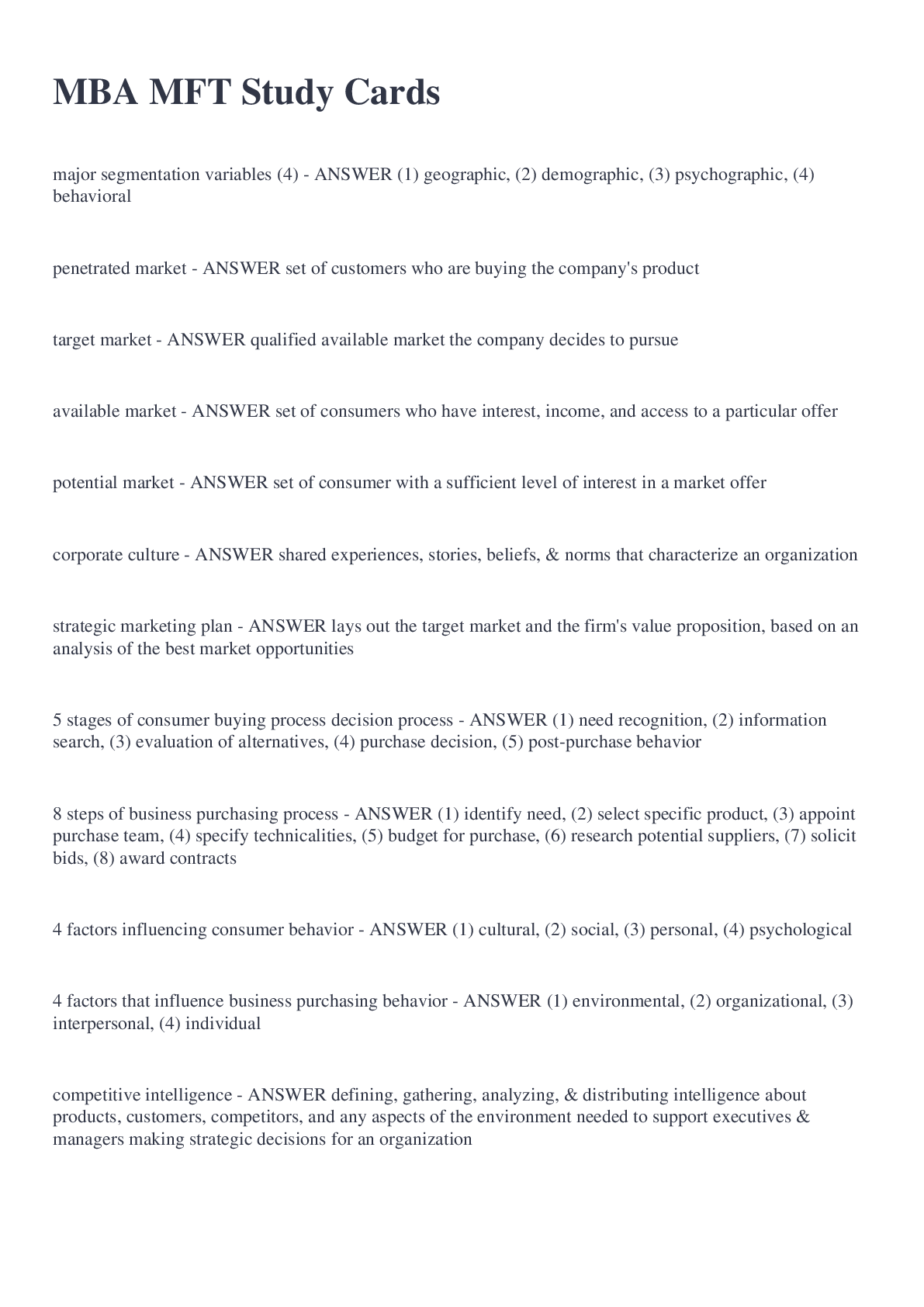
major segmentation variables (4) - ANSWER (1) geographic, (2) demographic, (3) psychographic, (4) behavioral
penetrated market - ANSWER set of customers who are buying the company's product
target market - ANSWER q
...
major segmentation variables (4) - ANSWER (1) geographic, (2) demographic, (3) psychographic, (4) behavioral
penetrated market - ANSWER set of customers who are buying the company's product
target market - ANSWER qualified available market the company decides to pursue
available market - ANSWER set of consumers who have interest, income, and access to a particular offer
potential market - ANSWER set of consumer with a sufficient level of interest in a market offer
corporate culture - ANSWER shared experiences, stories, beliefs, & norms that characterize an organization
strategic marketing plan - ANSWER lays out the target market and the firm's value proposition, based on an analysis of the best market opportunities
5 stages of consumer buying process decision process - ANSWER (1) need recognition, (2) information search, (3) evaluation of alternatives, (4) purchase decision, (5) post-purchase behavior
8 steps of business purchasing process - ANSWER (1) identify need, (2) select specific product, (3) appoint purchase team, (4) specify technicalities, (5) budget for purchase, (6) research potential suppliers, (7) solicit bids, (8) award contracts
4 factors influencing consumer behavior - ANSWER (1) cultural, (2) social, (3) personal, (4) psychological
4 factors that influence business purchasing behavior - ANSWER (1) environmental, (2) organizational, (3) interpersonal, (4) individual
competitive intelligence - ANSWER defining, gathering, analyzing, & distributing intelligence about products, customers, competitors, and any aspects of the environment needed to support executives & managers making strategic decisions for an organization
managerial decision making process steps (6) - ANSWER (1) establish the objective, (2) define the problem, (3) identify possible solutions, (4) evaluate alternative courses of action, (5) implement the decision, (6) acquire feedback
8 major models of marketing communication - ANSWER (1) advertising, (2) sales promotion, (3) events & experiences, (4) public relations & publicity, (5) direct marketing, (6) interactive marketing, (7) word-of-mouth marketing, (8) personal selling
pull strategy - ANSWER the manufacturer uses advertising and other communication to persuade consumers to demand the product from intermediaries, thus inducing intermediaries to order it
push strategy - ANSWER uses the manufacturer's sales force, trade promotion money, or other means to induce intermediaries to carry, promote, & sell the product to end users
points-of-parity (POPs) - ANSWER attributes or benefit associations that are not necessarily unique to the brand but may be shared with other brands
points-of-difference (PODs) - ANSWER attributes of benefits that consumers strongly associate with a brand, positively evaluate, and believe they could NOT find to the same extent with a competitive brand
posititioning - ANSWER the act of designing a company's offering and image to occupy a distinctive place in the minds of the target market
supersegment - ANSWER set of segments sharing some exploitable similarity
5 key criteria market segments must rate favorably on to be useful - ANSWER (1) measurable, (2) sustainable, (3) accessible, (4) differentiable, (5) actionable
pyschographic - ANSWER the science of using psychology & demographics to better understand consumers
variables of demographic segmentation (6) - ANSWER (1) age and life-cycle stage, (2) life stage, (3) gender, (4) income, (5) generation, (6) race & culture
investment banking - ANSWER a specific division of banking related to the creation of capital for other companies, governments, and entities
weak form - ANSWER assumes that all info contained in past price movements is reflected in the current market price. info about recent trends in a stock price is no use in selecting a stock
semi-strong form - ANSWER states the current market price reflects all publicly available information. to gain abnormal returns insider info is needed
information efficiency - ANSWER all relevant information about a stock is reflected in its price (this is in a perfect world)
strong form efficient - ANSWER all info -- public and insider -- is reflected in the market price. no abnormal returns
market efficiency - ANSWER the degree to which stock prices reflect all available relevant information
money market - ANSWER a segment of the financial market in which financial instruments with high liquidity and very short maturities are traded
capital markets - ANSWER markets for buying and selling equity and debt instruments
security - ANSWER a financial instrument that represents an ownership in a publicly-traded corporation (stock), a creditor relationship with governmental body or corporation (bond) or rights to an ownership as represented by an option
most common underlying assets of derivatives - ANSWER stocks, bonds, commodities, currencies, interest rates, market indexes
derivative - ANSWER a security with a price that is dependent upon or derived from one or more underlying assets. its value is determined by fluctuations in the underlying assets
futures - ANSWER financial contracts obligating the buyer to purchase an asset (or the seller to sell an asset) at a predetermined future date and price
option - ANSWER a financial derivative that represents a contract sold by one party (option writer) to another party (option holder). the contract offers the buyer the right to call or put a security at an agreed upon price (strike price) during a certain period of time or on the exercise date
2 types of financial instruments - ANSWER (1) cash instruments, (2) derivative instruments
financial instruments - ANSWER assets that can be traded
INVENTORY TURNOVER = - ANSWER SALES/INVENTORY
AVERAGE COLLECTION PERIOD = - ANSWER DAYS (ACCOUNTS RECEIVABLE)/CREDIT SALES
WORKING CAPITAL RATIO= - ANSWER CURRENT ASSETS/CURRENT LIABILITIES
working capital managment - ANSWER a company's managerial accounting strategy designed to monitor and utilize the 2 component of working capital -- current assets and current liabilities
3 main dividend policies - ANSWER (1) residual dividend policy, (2) dividend stability policy, (3) hybrid dividend policy
dividend policy - ANSWER a set of guidelines a company uses to decide how much of its earnings it will pay out to shareholders
WACC = - ANSWER WdRd(1=T) + WpsRps + WsRs
cost of capital - ANSWER the opportunity cost of making a certain investment
capital budgeting - ANSWER the whole process of analyzing projects and deciding whether they should be included in the planned expenditures on fixed assets
what are some types of real options? - ANSWER (1) investment timing options, (2) growth options, (3) abandonment options, (4) flexibility options
real options - ANSWER exist when managers can influence the size and risk of a project's cash flows by taking different actions during the project's life in response to changing market conditions
what 3 types of risk are relevant in capital budgeting? - ANSWER (1) stand alone risk, (2) corporate risk, (3) market [beta] risk
steps in capital budgeting - ANSWER (1) estimate cash flows, (2) assess risk of cash flows, (3) determine r [WACC], (4) evaluate cash flows
THE DUPONT EQUATION - ANSWER (1) ROA = [NY/SALES] [SALES/TA] = NY/TA
(2) ROE = [NY/TA] [TA/EQUITY] = NY/EQUITY
components of risk - ANSWER (1) default risk, (2) maturity risk premium, (3) liquidity premium
why would a company have a target capital structure? - ANSWER recognize debt is cheaper, but too much debt increases cost of debt, which increases default risk and looks bad
efficient frontier - ANSWER the set of optimal portfolios that offers the highest expected return for a defined level of risk or the lowest risk for a expected level of return
WACC (definition) - ANSWER the weighted average of the after-tax components cost of capital -- debt, preferred stock, and common equity
byproduct - ANSWER a product of relatively small total value produced simultaneously with a product of greater total value
methods of byproduct costing - ANSWER (1) byproducts could be valued at the split-off point at their net realizable value
(2) none of the common costs is assigned to the byproducts
[Show More]

![Preview of eBook [PDF] Java A Beginner's Guide 9th Edition By Herbert Schildt](https://browseimages.nyc3.digitaloceanspaces.com/paper-images/2024/Aug/29/cAp1VB1M2024-08-29-12-5166d044a590695.png)
![Preview of [eBook] [PDF] Practice Makes Perfect English Conversation, Premium 4th Edition By Jean Yat](https://browseimages.nyc3.digitaloceanspaces.com/paper-images/2025/Jul/05/l7SpWiCL2025-07-05-03-3668691c49d1bd5.png)


![Preview of eBook [PDF] Glencoe Short Stories 1st Edition By Jeffrey D. Wilhelm et al](https://browseimages.nyc3.digitaloceanspaces.com/paper-thumbnails/2024/08/29/paper-425371-thumb-Ex6G3irWB1ubEsQh-6a23462793883.jpg)