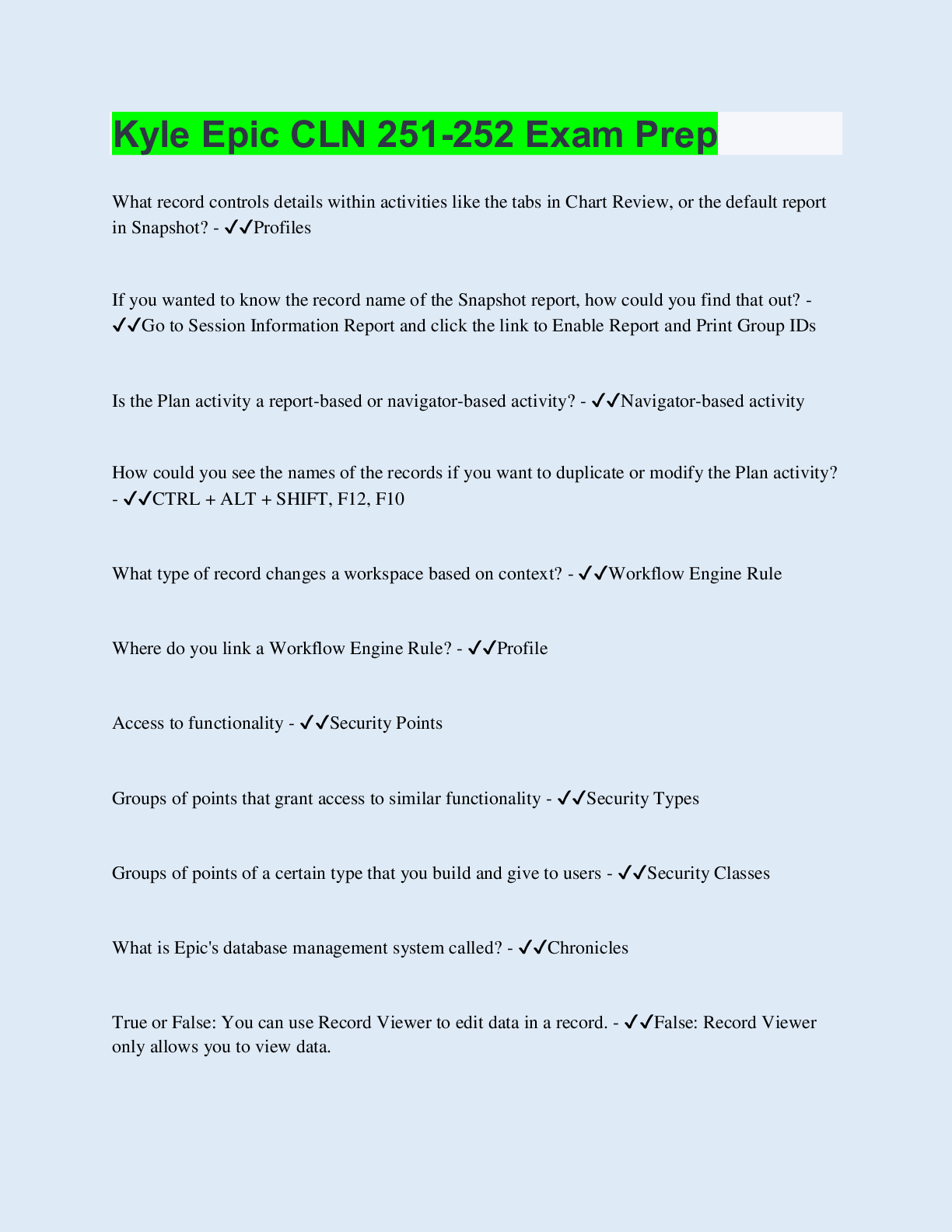
Digoxin levels need to be monitored closely when the following medication is started:
Question options:
Loratadine
Diphenhydramine
Ipratropium
Albuterol - ANSWER Albuterol
When educating patients who are
...
Digoxin levels need to be monitored closely when the following medication is started:
Question options:
Loratadine
Diphenhydramine
Ipratropium
Albuterol - ANSWER Albuterol
When educating patients who are starting on inhaled corticosteroids, the provider should tell them that:
Question options:
They need to get any live vaccines before starting the medication.
Inhaled corticosteroids need to be used daily during asthma exacerbations to be effective.
Patients should rinse their mouths out after using the inhaled corticosteroid to prevent thrush.
They can triple the dose number of inhalations of medication during colds to prevent
needing systemic steroids. - ANSWER Patients should rinse their mouths out after using the inhaled corticosteroid to prevent thrush.
Second-generation antihistamines such as loratadine (Claritin) are prescribed for seasonal allergies because they are:
Question options:
More effective than first-generation antihistamines
Less sedating than the first-generation antihistamines
Prescription products, therefore are covered by insurance
Able to be taken with central nervous system (CNS) sedatives, such as alcohol - ANSWER Less sedating than the first-generation antihistamines
Henry presents to clinic with a significantly swollen, painful great toe and is diagnosed with gout. Of the following, which would be the best treatment for Henry?
Question options:
High-dose colchicine
Low-dose colchicine
High-dose aspirin
Acetaminophen with codeine - ANSWER Low-dose colchicine
Patients whose total dose of prednisone will exceed 1 gram will most likely need a second prescription for:
Question options:
Metformin, a biguanide to prevent diabetes
Omeprazole, a proton pump inhibitor to prevent peptic ulcer disease
Naproxen, an NSAID to treat joint pain
Furosemide, a diuretic to treat fluid retention - ANSWER Omeprazole, a proton pump inhibitor to prevent peptic ulcer disease
Patients prescribed aspirin therapy require education regarding the signs of aspirin toxicity. An early sign of aspirin toxicity is:
Question options:
Black tarry stools
Vomiting
Tremors
Tinnitus - ANSWER Tinnitus
Prior to developing a plan for the treatment of asthma, the patient's asthma should be classified according to the NHLBI Expert Panel 3 guidelines. In adults mild-persistent asthma is classified as asthma symptoms that occur:
Question options:
Daily
Daily and limit physical activity
Less than twice a week
More than twice a week and less than once a day - ANSWER More than twice a week and less than once a day
Patients with a COPD exacerbation may require:
Question options:
Doubling of inhaled corticosteroid dose
Systemic corticosteroid burst
Continuous inhaled beta-2-agonists
Leukotriene therapy - ANSWER Systemic corticosteroid burst
Asthma exacerbations at home are managed by the patient by:
Question options:
Increasing frequency of beta-2-agonists and contacting their provider
Doubling inhaled corticosteroid doses
Increasing frequency of beta-2-agonists
Starting montelukast (Singulair) - ANSWER Increasing frequency of beta-2-agonists and contacting their provider
The most common bacterial pathogen in community-acquired pneumonia is:
Question options:
Haemophilus influenzae
Staphylococcus aureus
Mycoplasma pneumoniae
Streptococcus pneumonia - ANSWER Streptococcus pneumonia
The first-line antibiotic choice for a patient with comorbidities or who is immunosuppressed who has pneumonia and can be treated as an outpatient would be:
Question options:
Levofloxacin
Amoxicillin
Ciprofloxacin
Cephalexin - ANSWER Levofloxacin
Wing-Sing is a 4-year-old patient who has suspected bacterial pneumonia. He has a temperature of 102°F, oxygen saturation level of 95%, and is taking fluids adequately. What would be appropriate initial treatment for his pneumonia?
Question options:
Ceftriaxone
Azithromycin
Cephalexin
Levofloxacin - ANSWER Ceftriaxone
Instructions for a patient who is starting nicotine replacement therapy include:
Question options:
Smoke less than 10 cigarettes a day when starting nicotine replacement.
Nicotine replacement will help with the withdrawal cravings associated with quitting tobacco.
Nicotine replacement can be used indefinitely.
Nicotine replacement therapy is generally safe for all patients. - ANSWER Nicotine replacement will help with the withdrawal cravings associated with quitting tobacco.
If prescribing bupropion (Zyban) for tobacco cessation, the instructions to the patient include:
Question options:
Bupropion (Zyban) is started 1 to 2 weeks before the quit date.
Nicotine replacement products should not be used with bupropion.
If they smoke when taking bupropion they may have increased anxiety and insomnia.
Because they are not using bupropion as an antidepressant, they do not need to worry about increased suicide ideation when starting therapy. - ANSWER Bupropion (Zyban) is started 1 to 2 weeks before the quit date.
The most appropriate smoking cessation prescription for pregnant women is:
Question options:
A nicotine replacement patch at the lowest dose available
Bupropion (Zyban)
Varenicline (Chantix)
Nonpharmacologic measures - ANSWER Nonpharmacologic measures
Drug resistant tuberculosis (TB) is defined as TB that is resistant to:
Question options:
Fluoroquinolones
Rifampin and isoniazid
Amoxicillin
Ceftriaxone - ANSWER Rifampin and isoniazid
Kaleb has extensively resistant tuberculosis (TB). Treatment for extensively resistant TB would include:
Question options:
INH, rifampin, pyrazinamide, and ethambutol for at least 12 months
INH, ethambutol, kanamycin, and rifampin
Treatment with at least two drugs to which the TB is susceptible
Levofloxacin - ANSWER Treatment with at least two drugs to which the TB is susceptible
Ezekiel is a 9-year-old patient who lives in a household with a family member newly diagnosed with tuberculosis (TB). To prevent Ezekiel from developing TB he should be treated with:
Question options:
6 months of Isoniazid (INH) and rifampin
2 months of INH, rifampin, pyrazinamide, and ethambutol, followed by 4 months of INH
9 months of INH
12 months of INH - ANSWER 9 months of INH
Myles is a 2-year-old patient who has been diagnosed with acute otitis media. He is afebrile and has not been treated with antibiotics recently. First-line treatment for his otitis media would include:
Question options:
Azithromycin
Amoxicillin
Ceftriaxone
Trimethoprim/sulfamethoxazole - ANSWER Amoxicillin
Jacob has been diagnosed with sinusitis. He is the parent of a child in daycare. Treatment for sinusitis in an adult who has a child in daycare is:
Question options:
Azithromycin 500 mg q day for 5 days
Amoxicillin-clavulanate 500 mg bid for 7 days
Ciprofloxacin 500 mg bid for 5 days
Cephalexin 500 mg qid for 5 days - ANSWER Amoxicillin-clavulanate 500 mg bid for 7 days
[Show More]











![Preview of THE TEFL ACADEMY LEVEL 5 - ASSIGNMENT C - AUTHENTIC MATERIAL [2026]](https://browseimages.nyc3.digitaloceanspaces.com/paper-images/2026/04/10/HpVkRcWV2026-04-10-11-5769d96426bd64f.png)