1 / 9
NATIONAL BOARD FOR CERTIFICATION IN OCCUPATIONAL
THERAPY (NBCOT®) Exam Practice Questions
1. A client in the mid-stage of Alzheimer's disease lives at home with a spouse as the primary
caregiver. The spouse wan
...
1 / 9
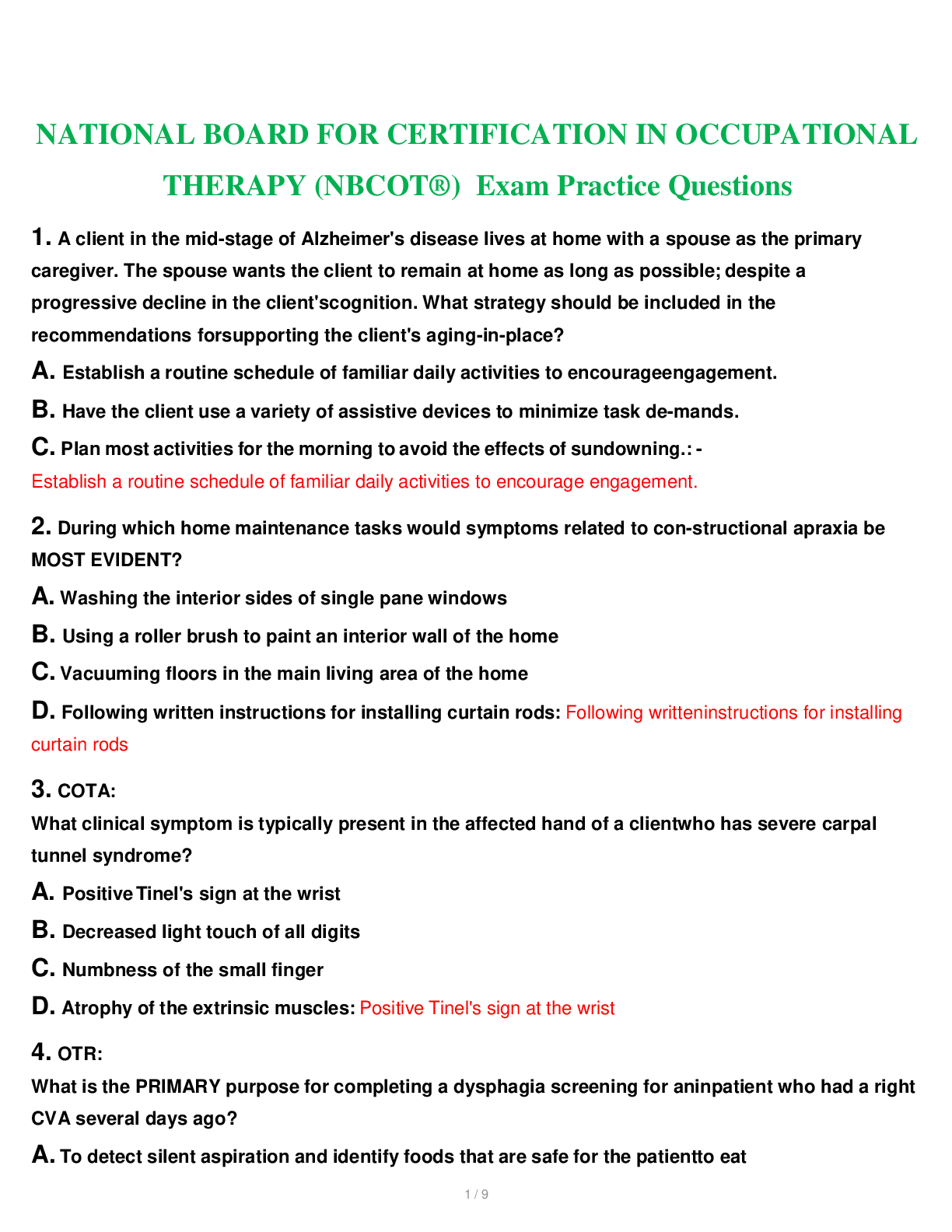
NATIONAL BOARD FOR CERTIFICATION IN OCCUPATIONAL
THERAPY (NBCOT®) Exam Practice Questions
1. A client in the mid-stage of Alzheimer's disease lives at home with a spouse as the primary
caregiver. The spouse wants the client to remain at home as long as possible; despite a
progressive decline in the client'scognition. What strategy should be included in the
recommendations forsupporting the client's aging-in-place?
A. Establish a routine schedule of familiar daily activities to encourageengagement.
B. Have the client use a variety of assistive devices to minimize task de-mands.
C. Plan most activities for the morning to avoid the effects of sundowning.: -
Establish a routine schedule of familiar daily activities to encourage engagement.
2. During which home maintenance tasks would symptoms related to con-structional apraxia be
MOST EVIDENT?
A. Washing the interior sides of single pane windows
B. Using a roller brush to paint an interior wall of the home
C. Vacuuming floors in the main living area of the home
D. Following written instructions for installing curtain rods: Following writteninstructions for installing
curtain rods
3. COTA:
What clinical symptom is typically present in the affected hand of a clientwho has severe carpal
tunnel syndrome?
A. Positive Tinel's sign at the wrist
B. Decreased light touch of all digits
C. Numbness of the small finger
D. Atrophy of the extrinsic muscles: Positive Tinel's sign at the wrist
4. OTR:
What is the PRIMARY purpose for completing a dysphagia screening for aninpatient who had a right
CVA several days ago?
A. To detect silent aspiration and identify foods that are safe for the patientto eat2 / 9
B. To identify causes for aspiration and the need for referral to speechtherapy
C. To observe the patient's oral motor control and determine a need forfurther evaluation
D.To determine the patient's tolerance to various food textures prior torequesting a modified
diet: To observe the patient's oral motor control anddetermine a need for further evaluation
5. OTR:
An OTR is facilitating a group for clients diagnosed with a polysubstance use disorder. During the
first group session, the OTR describes how triggerevents and irrational thinking can lead to
substance misuse.Which theoret-ical model does this approach exemplify?
A. Cognitive-behavioral
B. Psychodynamic
C. Human Occupation: Cognitive-behavioral
6. COTA:
A COTA witnesses an OT aide using a goniometer to measure a patient's upper extremity ROM.What
action should the COTA take in response to thisobservation?
A. Determine if the aide has established service competency for this task.
B. Show the aide how to use the instrument according to facility policies.
C. Ask the aide to stop the activity and discuss the situation with the supervisor.: Ask the aide to
stop the activity and discuss the situation with thesupervisor.
7. A client sustained a non-displaced distal radius fracture 8 weeks ago.TheOTR receives a consult
from the client's physician to initiate ultrasound andtherapeutic exercise. The state regulatory board
allows occupational thera-pists to use physical agent modalities (PAM), however, the OTR assigned
tothe client has not had PAM training. How should the OTR respond to this referral?
A. Follow the protocol for ultrasound as outlined in the instruction manual.
B. Refer the client to an occupational therapist who is experienced in ultra-sound.
C. Apply moist heat to the affected hand and wrist instead of ultrasound.: -
Refer the client
8. OTR:
An adolescent-age student has athetoid cerebral palsy and has been par- ticipating in schoolbased OT since pre-school. After transitioning to the sixth grade in a new school, the teachers3 / 9
report the student is not using assistive devices, is sullen, and does not interact with peers.What
INITIALaction should the OTR take in response to the teachers' reports about thisstudent?
A. Revise the IEP goals to focus on student preferences.
B. Establish new goals to work toward self-sufficiency.
C. Develop a transition plan for promoting autonomy.
D. Complete an evaluation using a top-down approach.: Complete an evalua-tion using a top-down
approach.
9. COTA:
A COTA is working with a student in the third grade who has a sensory processing deficit.
Intervention activities include providing sensory-based movement activities to facilitate an
appropriate level of arousal. Which re- sponses are common indicators that the activity is beginning
to exceed thestudent's sensory threshold?
Select the 3 BEST choices.
A. Uncontrollable jerky motions of the extremities during parachute games
B. Facial paleness while spinning in a net suspension swing
C. Fidgeting in a desk chair when participating in a board game
D. Irregular involuntary movement of both eyes while on a tilt and spin board
E. Holding on tightly when being gently pushed on a platform swing
F.Body language consistent with lethargy during a gross motor game: B, C,& E:
Facial paleness while spinning in a net suspension swing, fidgeting in a desk chairwhen participating in a
board game, and holding on tightly when being gently pushed on a platform swing.
10. OTR:
An OTR is evaluating the effectiveness of an OT home program for clients who have been
diagnosed with an anxiety disorder. Which qualitative mea- sure would be MOST BENEFICIAL to use
as part of this evaluation process?
A. Retrospective record reviews to measure the percentage of clients whoattained occupationbased goals
B. Occupational role checklists administered at the start and then severalmonths after4 / 9
completion of the program
C. Standardized, norm-referenced or criterion-referenced occupation-basedassessments:
Occupational role checklists administered at the start and then several months after completion of the
program
Rationale:This method provides the BEST qualitative evidence of the effectivenessof a program based on
client-specific occupational roles.
Incorrect Responses: A:These do not provide the BEST qualitative evidence of
the effectiveness of the program. C:These types of assessments yield quantitativeinformation.
11. A young adult on an inpatient surgical unit 4 days after the excision of a brain tumor is
medically stable and participates in therapy 3 hours per day. Currently, the patient requires
moderate assistance with BADL due toperceptual deficits and decreased balance. The patient will
be discharged from this facility in one day.Which transitional setting would BEST supportthe
patient's current level of function?
A. Assisted living center
B. Residential skilled nursing facility
C. Acute inpatient rehabilitation unit
D. Patient's home with outpatient therapy: Acute inpatient rehabilitation unit
12. OTR:
An OTR has completed an initial evaluation of an 18-month-old child who has hypotonicity. The
child's mother reports the child does not crawl and resists being placed in a hands and knees
crawling position. During the evaluation the child is able to maintain head control,roll,and sit
unsupportedfor several minutes. After the OTR places the child in a crawling position, thechild is able
to maintain the position for about 30 seconds. The child does not spontaneously initiate locomotion.
What statement accurately reflects the child's current motor skills?
A.The child exhibits tactile hypersensitivity that impacts the child's ability tomaintain postural
stability.
B.The child has decreased postural stability for completing developmentallyappropriate gross motor
tasks.5 / 9
C. The child has the ability to initiate transitional movement patterns andachieve
developmentally-appropriate locomotion.
D.The child has the potential to develop skills for engagement in age-ap- propriate childhood
occupations.: The child has decreased postural stability forcompleting developmentally appropriate gross
motor tasks.
13. COTA:
A client has severe peripheral neuropathy and a moderately weak grasp bilaterally.The COTA is
teaching the client adaptive homemaking techniques.Which recommendation would be MOST
BENEFICIAL for the client to use in
the kitchen?
A. Adhere Velcro® dots on appliance controls.
B. Install extended lever-type faucet handles.
C. Use a reacher to pick up items from the floor.: Install extended lever-typefaucet handles.
14. OTR:
A Level II fieldwork OT student and a supervising OTR are meeting a clientfor the first time. The OT
student greets the client by stating, "I am the occupational therapist who will be working with you."
The supervising OTRimmediately informs the client that the student is completing a fieldwork
rotation and has not yet graduated from an OT program. After the session, the OTR meets with the
student to review the professional code of ethics.
Which ethical principle directly relates to this situation?
A. Beneficence
B. Fidelity
C. Veracity: Veracity
15. COTA:
For which of the following conditions is the use of a static restriction orthosisTYPICALLY indicated?
Select the 3 BEST choices.
A. Swan-neck deformity
B. Flexor tendon repair
C. Extrinsic flexor tightness6 / 9
D. Radial nerve palsy
E. Ulnar nerve palsy
F. MCP joint arthritis: Swan-neck deformityUlnar nerve
palsy
MCP joint arthritis
16. OTR:
An OTR is completing a self-care assessment with a resident in a long term care facility. Nursing
staff referred the resident to OT after observinga decline in the resident's function following an
exacerbation of COPD one month ago. Medical history is also significant for residual cerebellar
symptoms secondary to an excision of a brain tumor 5 years ago.The clienthas Fair Plus (3+/5)
functional strength of bilateral upper extremities. Duringthe assessment, the OTR asks the resident
to "pick up your shirt from the night stand." When reaching for the shirt, the resident has to stabilize
the arm to prevent reaching beyond or short of the shirt. When documenting the session what term
should the OTR use to BEST describe the resident'saction?
A. Decreased motor planning
B. Dysmetria
C. Dysdiadochokinesia: Dysmetria
17. COTA:
A COTA is instructing a client who has paraplegia on methods for completing sliding board transfers.
What should the COTA do FIRST when initiating thistransfer with the client?
A. Position the knees in 90 degrees flexion with both feet stabilized on thefloor.
B. Remove both of the wheelchair foot rests and arm rests.
C. Position the wheelchair as close to the transfer surface as possible.: Po-sition the wheelchair as
close to the transfer surface as possible.
18. COTA:
A COTA is fabricating a thermosplastic splint as conservative treatment for a client who has early
symptoms of cubital tunnel syndrome.What would bethe PRIMARY purpose of this splint?
A. Substitute for absent muscle function
B. Prevent elbow flexion during hours of sleep
C. Block ring and small finger MCP joint hyperextension7 / 9
D. Minimize wrist flexion and extension during work: Prevent elbow flexionduring hours of sleep
19. OTR:
A client has difficulty swallowing secondary to multiple sclerosis.The OTRmanually assists the client
in performing a chin tuck prior to the client swallowing a bite of food. What is the PRIMARY benefit of
facilitating this position?
A. To hasten overal oral-motor responses for chewing and forming a bolusof food
B.To maximize tongue elevation when pushing the food bolus to the back ofthe mouth
C.To prevent food and secretions from entering the larynx below the level ofthe vocal cords: To
prevent food and secretions from entering the larynx below the level of the vocal cords
20. An occupational therapist reviews the use of the OT department's re- sources to determine
medical necessity and cost efficiency.Which servicemanagement task is the therapist performing?
A. Utilization review
B. Retrospective peer review
C. Total quality management
D. Risk Management: Utilization review
21. OTR:
An OTR is preparing to administer a standardized developmental screeningto a premature infant
who is at-risk for developmental delay. In addition to noting the assessment date and the infant's
birth date, what information MUST be gathered in order to calculate the infant's corrected age?
A. Original projected due date
B. Typical gestational age
C. Number of weeks premature: Number of weeks premature
22. COTA:
A client who has mild to moderate memory deficits secondary to demen-tia recently started
using prescription eyeglasses for near vision tasks.
The client frequently misplaces the glasses. The family reports the client becomes frustrated and
agitated when unable to locate the glasses.Whatoption should the COTA initially recommend to
the client for reducing theoccurrence of this problem?8 / 9
A. Store the glasses in the drawer of a bedside table after each use.
B. Fasten the eyeglass frames to an eyeglass chain to wear around the neck.
C. Give the eyeglasses to a family member or caregiver to store after eachuse.: Fasten the eyeglass
frames to an eyeglass chain to wear around the neck.
23. A patient in the early stages of amyotrophic lateral sclerosis (ALS) pre- sents with weakness in
the thenar eminence. During which ADL task wouldthe evaluating OTR® MOST LIKELY observe the
effect on function?
A. Transferring from the bed to the bedside commode
B. Taking a sip from a glass of water
C. Reaching overhead to don a T-shirt
D.Squeezing toothpaste onto a toothbrush: Squeezing toothpaste onto a tooth-brush
24. An OTR® completes a work tolerance screening with a worker at amanufacturing plant.
What should be included in the documentation?
A. Weight limits for various job tasks
B. Worker's reported desire to remain in the job
C. Worker's ability to perform ADLs
D. Financial issues the worker experiences: Weight limits for various job tasks
25. A COTA® is working toward service competency for adaptive feeding equipment instruction.
How would the OTR® BEST establish service com-petency?
A. Review the COTA®'s documentation of multiple patients whose feeding impairments warranted
adaptive equipment, then discuss the outcomes withthe COTA®.
B. Observe the COTA® educate clients on how to use adaptive feeding equipment to ensure
the COTA® instructs clients in the same manner aswould the OTR®.
C. Compare outcomes by rating the same client's performance with theadaptive feeding
equipment at the same level of independence.
D. Collect information from various sources, including other therapists, the COTA®'s
documentation, and feedback from clients, to determine competen-cy.: Compare outcomes by rating the
same client's performance with the adaptivefeeding equipment at the same level of independence.
Rationale:Service competency is defined as "the process of teaching, training, andevaluating in which the9 / 9
OTR® determines that the COTA® performs tasks in the same way that the OTR® would and achieves the
same outcomes" (Youngstrom,2009, p. 943). In this example, both the COTA® and OTR® observe the same
client performing a task and rate that performance in a similar manner. Comparingoutcomes helps to ensure
clients receive care of equal quality.
26. An OTR® is working with a client with Down syndrome to develop cookingskills. The client
successfully makes a peanut butter and jelly sandwich. Which therapeutic activity would be BEST
for the next treatment session?
A. A turkey-and-cheese sandwich
B. A microwavable dinner
C. A grilled cheese sandwich
D. A stir-fry vegetable dish over brown rice: A grilled cheese sandwich
27. An OTR® is working with a client with chronic obstructive pulmonary disease on therapeutic
exercise and how to measure exercise tolerance.Theclient is performing seated bilateral shoulder
flexion with 3-lb weights and rates this activity as "very, very easy." How would the OTR®
appropriately grade this activity?
A. Change the muscle groups used by switching to shoulder abduction.
B. Advise the client to perform the task in a standing position.
C. Switch the client to a resistance band.
D. Increase the number of repetitions and have the client perform the exer- cises while standing.:
Advise the client to perform the task in a standing position.
[Show More]