WGU C427 Technology Applications in
Healthcare – Already Passed
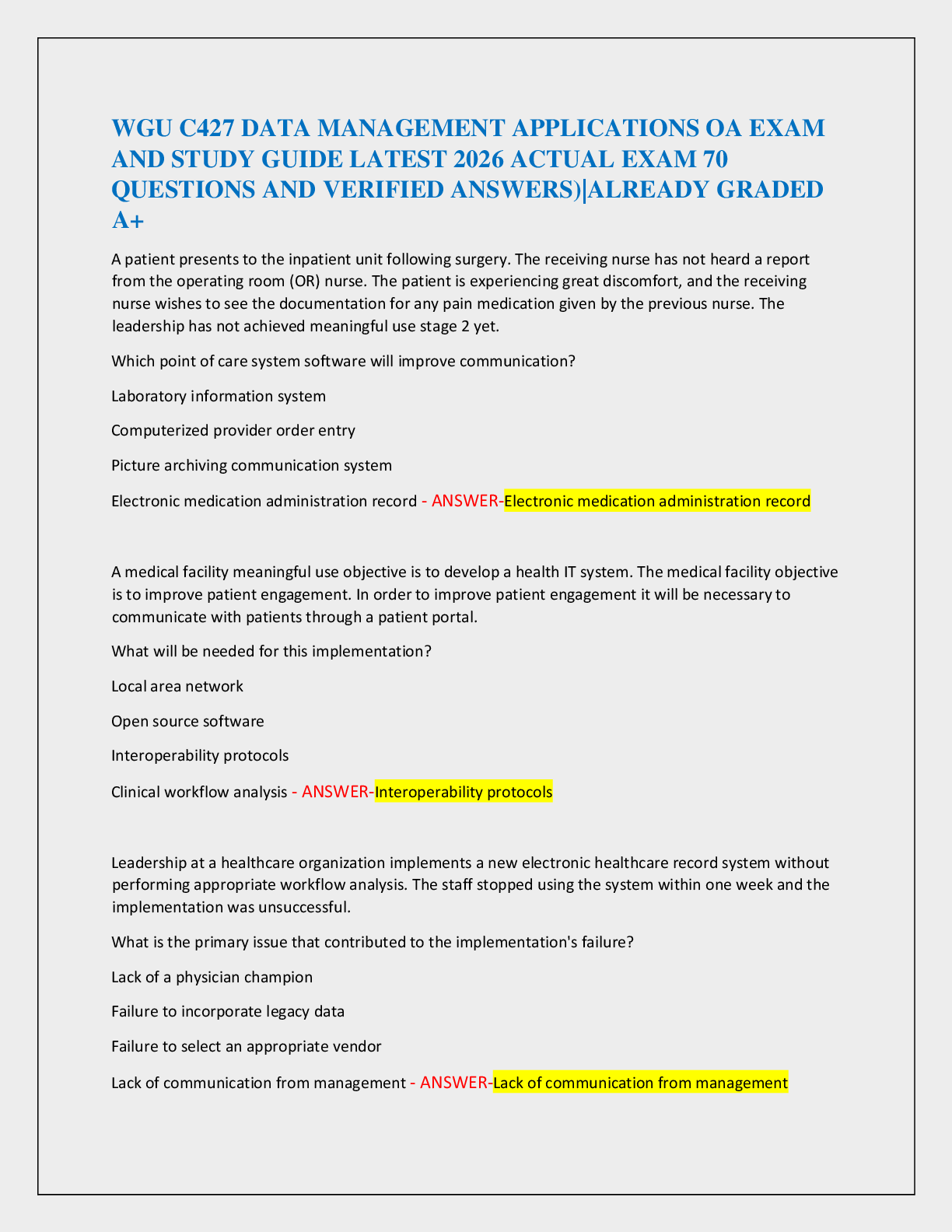
Healthcare Management Information System (HMIS) ✔✔A data collection system specifically
designed to support planning, management, and decision making in
...
WGU C427 Technology Applications in
Healthcare – Already Passed
Healthcare Management Information System (HMIS) ✔✔A data collection system specifically
designed to support planning, management, and decision making in health facilities and
organizations.
Protected Health Information (PHI) ✔✔The privacy rule is balanced so that it permits the
disclosure of personal health information needed for patient care and other purposes but gives
patients an array of rights with respect to that information.
HIPAA (Health Insurance Portability and Accountability Act) ✔✔It was enacted to improve the
privacy, confidentiality, integrity, and security aspects of personal health information, and to
simplify the movement of individual patients protected health information between healthcare
organizations and professionals.
Health Level 7 (HL7) ✔✔Its a nonprofit volunteer, vendor, and provider-supported organization
to encourage information scientists and various experts in the healthcare field to endeavor toward
the development of standards for the management, processing, integration, and exchange of
electronic healthcare information.
American National Standards Institute (ANSI) ✔✔An institute oversees the creation,
promulgation and use of thousands of norms and guidelines that directly impact businesses in
nearly every sector.
Health Information Exchange (HIE) ✔✔Allows doctors, nurses, pharmacists, other healthcare
providers and patients to appropriately access and securely share a patient's vital medical
information electronically- improving the speed, quality, safety, and cost of patient care.
Digital Imaging and Communications in Medicine (DICOM) ✔✔The standard for the
communication and management of medical imaging information and related data.
World Wide Web Consortium (W3C) ✔✔An international community that develops open
standards to ensure the long-term growth of the Web.
Health Information Technology for Economic and Clinical Health (HITECH) ✔✔It was created
to motivate the implementation of electronic health records (EHR) and supporting technology in
the U.S.
Clinical Decision Support Systems (CDSS) ✔✔Computer tools or applications to assist physicians
in clinical decisions by providing evidence-based knowledge in the context of patient specific data.
Computerized Physician Order Entry (CPOE) ✔✔A computer application that allows a physician's
orders for diagnostic and treatment services to be entered electronically instead of being recorded
on order sheets or prescription pads.
Laboratory Information Systems (LIS) ✔✔A software system that records, manages, and stores
data for clinical laboratories.
Logical Observation Identifiers Names and Codes (LOINC) ✔✔A classification system used for
identifying laboratory results and clinical observations.
Systematized Nomenclature of Medicine (SNOMED) ✔✔A coding scheme meant to integrate the
data accumulated from multi-provider care processes by mapping with ICD, LOINC, and various
other data classification standards.
Medical Information Bus (MIB) ✔✔An application of networking and information technology for
healthcare. Its purpose is to define a standard means of connectivity between critical care beside
medical devices and hospital host computers.
Healthcare Common Procedure Coding System (HCPCS) ✔✔A set of healthcare procedure codes
based on the American Medical Association's Current Procedural Terminology (CPT)
Office of the National Coordinator for Health Information Technology (ONC) ✔✔Its at the
forefront of the administration's health IT efforts and is a resource to the entire health system to
support the adoption of health information technology and the promotion of nationwide health
information exchange to improve health care.
Picture Archive and Communication System (PACS) ✔✔A medical imaging technology which
provides economical storage and convenient access to images from multiple modalities.
Physician Champion ✔✔An individual who assists in communicating and educating medical staff
in areas such as documentation procedures for accurate billing and appropriate EHR processes
Legacy Data ✔✔Information stored in an old or obsolete format or computer system that is
therefore difficult to access or process.
In-House Server ✔✔No third party has access to your information. No need to rely on an Internet
connection for access to data.
Longitudinal patient records ✔✔Incorporate information from over time and across systems to
provide a holistic view of a patient's medical history.
Clinical Workflow Analysis ✔✔A comprehensive assessment of an organization's process or
system for delivering care.
Interoperability ✔✔A system's ability to communicate with other digital library systems using
standard protocols in order to exchange data.
ICD 9 Diagnosis and Procedure Code ✔✔The official system of assigning codes to diagnoses and
procedures associated with hospital utilization in the U.S.
Vision ✔✔Forming a vision will allow a healthcare organization to better achieve its missions,
goals, and objectives.
Strategy ✔✔Growth, Diversification, turnaround, and compelling priorities will help minimize
challenges to an organization.
PODC Model ✔✔Provides a framework to identify and define specific actions aimed at meeting
the organizational goals, and aligning an HMIS strategy.
Change continuum ✔✔Managers must be aware of the change continuums on which the
effectiveness of an HMIS hinge on.
Data Stewardship ✔✔Obtaining accurate data is not enough; essential to ensuring that the right
info is delivered to the right person at the time.
Patient Centric Management ✔✔They are ultimately designed to elevate patient care by providing
caregivers with relevant, current, accurate, reliable, and complete information.
Patient Portal ✔✔Patients can collate their personal data previously entrusted to various care
providers, pharmacies, insurers, and even labs in a repository upon consent.
Electronic Medical Records (EMR) ✔✔An enterprise-wide system where patient medical histories
are captured in a single repository.
Electronic Document/Content Management (ED/CM) ✔✔Where form documents are captured,
streamlined, and managed.
Transmitting files through an EMR ✔✔Send and receive dictation and transcribed files through a
HIPAA-compliant transcription application service.
Meaningful Use ✔✔U.S. government standards for electronic health records (EHR), outlining how
clinical patient data should be exchanged between healthcare providers, between providers and
insurers and between providers and patients.
Supply Chain Management (SCM) ✔✔Optimize service quality in terms of an organization's
internal information flow processes, while reducing costs and delivering time; achieve increased
efficiencies with regard to information flow and exchanges between the organization and its
external parties.
Customer Relationship Management (CRM) ✔✔The system will enable patients to customize their
plans to their individual needs and budgets.
- locate physicians
- research info on medications and treatments
Enterprise Resource Planning (ERP) ✔✔An attempt to integrate all departmental and functional
processes throughout the enterprise into a single, integrated HMIS, enabling enterprise wide
information management and decision making on all organizational operations.
Tele-care ✔✔A set of services bringing care directly to the end-user at a remote location via ICT
deployment. (services patients)
Telemedicine ✔✔The practice of medical care using audio, visual, and data communications;
medical care delivery, consultation, diagnosis, treatment, education, and transfer of medical data.
(services patients and physicians)
Tele-health ✔✔The removal of time and distance barriers for the delivery of health cares services
or related health care activities. (services patients, physicians, and administrators)
E-health ✔✔The use of information and communication technologies (ICT) for health.
Stages of Meaningful Use ✔✔1. Electronic data capture and sharing.
2. Balance policy goals, charge management reality and clinical quality imperatives.
3. Outcomes improvements.
[Show More]
.png)
.png)

.png)
.png)
.png)
.png)