Which of the following would be considered the research design for Level V evidence?
Systematic review of randomized clinical trial studies
Well-designed controlled trials without randomization
Systematic revie
...
Which of the following would be considered the research design for Level V evidence?
Systematic review of randomized clinical trial studies
Well-designed controlled trials without randomization
Systematic reviews of descriptive or qualitative studies
Single descriptive or qualitative study - ANSWER Systematic reviews of descriptive or qualitative studies
The Symptom Management Model proposes to consider three dimensions as an advanced practice approach to care. Choose the three dimensions that are suggested.
Question options:
The symptom experience
The past medical history
Symptom Outcomes
Symptom management strategies - ANSWER The symptom experience
Symptom Outcomes
Symptom management strategies
Clinicians who use clinical guidelines are responsible for reviewing their usefulness in their practice.
Question options:
True
False - ANSWER True
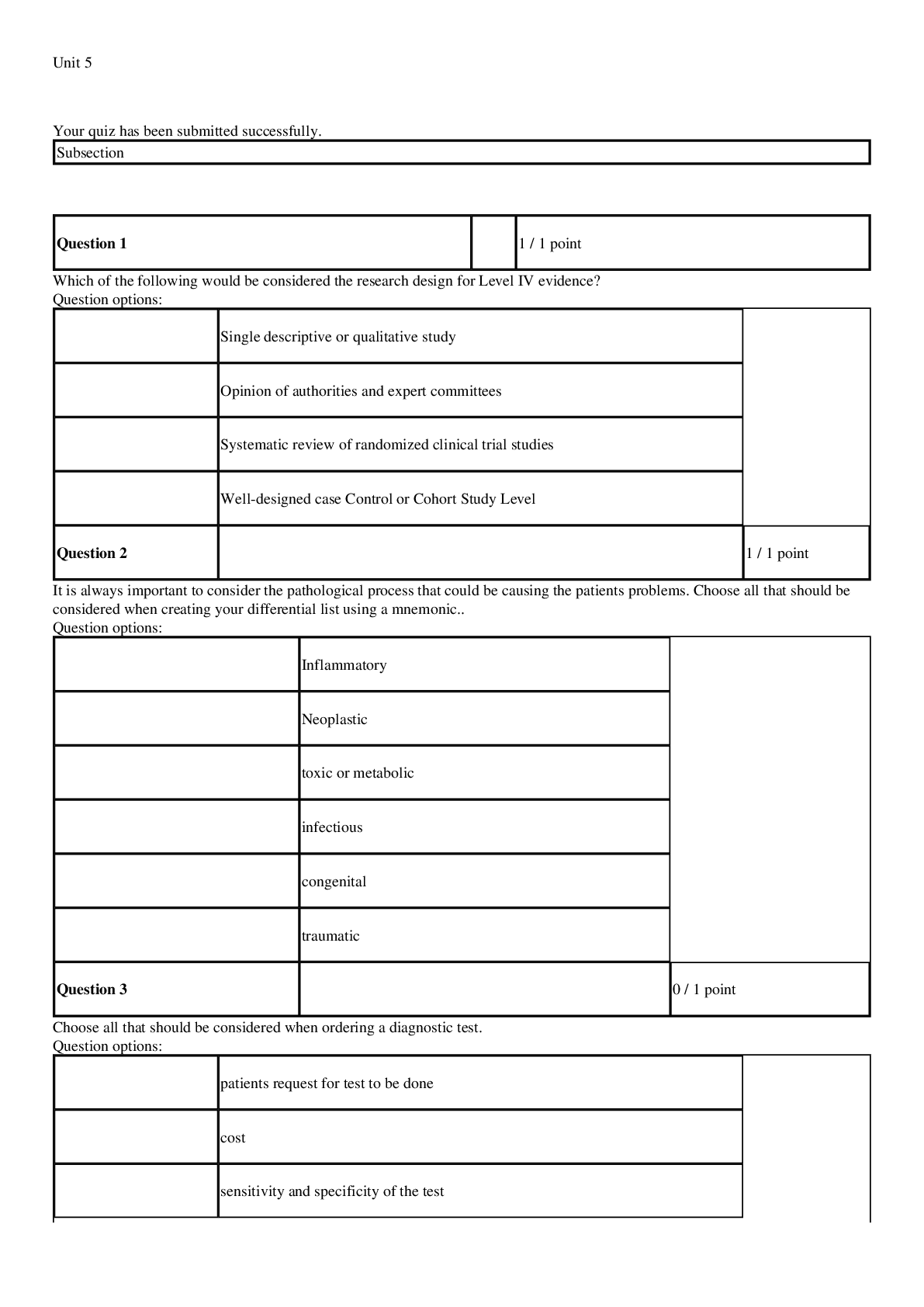
It is always important to consider the pathological process that could be causing the patients problems. Choose all that should be considered when creating your differential list using a mnemonic..
Question options:
Inflammatory
Neoplastic
toxic or metabolic
infectious
congenital
traumatic - ANSWER Inflammatory
Neoplastic
toxic or metabolic
infectious
congenital
traumatic
Different kinds of thinking and learning also include the Affective Domain. This model described by Krathwohl (1964), is :
Question options:
Complex to include conceptual knowledge
A metacognitive model
Based on an organized hierarchy
Based on an individual's commitment to living and valuing - ANSWER Based on an organized hierarchy
Based on an individual's commitment to living and valuing
Applying evidence at the point of care requires:
Question options:
Readily available evidence-based resources
Ability to review research literature
Single articles in journals
Current textbooks - ANSWER Readily available evidence-based resources
Which of the following is a crucial element of developing a guideline?
Question options:
Creating a physician expert panel
Reviewing the literature with ratings of available evidence
Conducting an external review of a guideline
Developing evidence-based tables - ANSWER Reviewing the literature with ratings of available evidence
Indicators that a headache can be the presenting symptom of a serious illness and may require neuroimaging include all the following except:
Question options:
Headaches that occur periodically in clusters
Increase frequency and severity of headaches
Headaches causing confusion, dizziness and or lack of coordination.
Headaches causing you to wake at night. - ANSWER Headaches that occur periodically in clusters
Formulating your differential diagnosis is a process that includes:
Question options:
Diagnostic tests
"shot-gun" finding
A physical
History of the present illness
Your personal experiences
Critical Thinking - ANSWER Diagnostic tests
A physical
History of the present illness
Your personal experiences
Critical Thinking
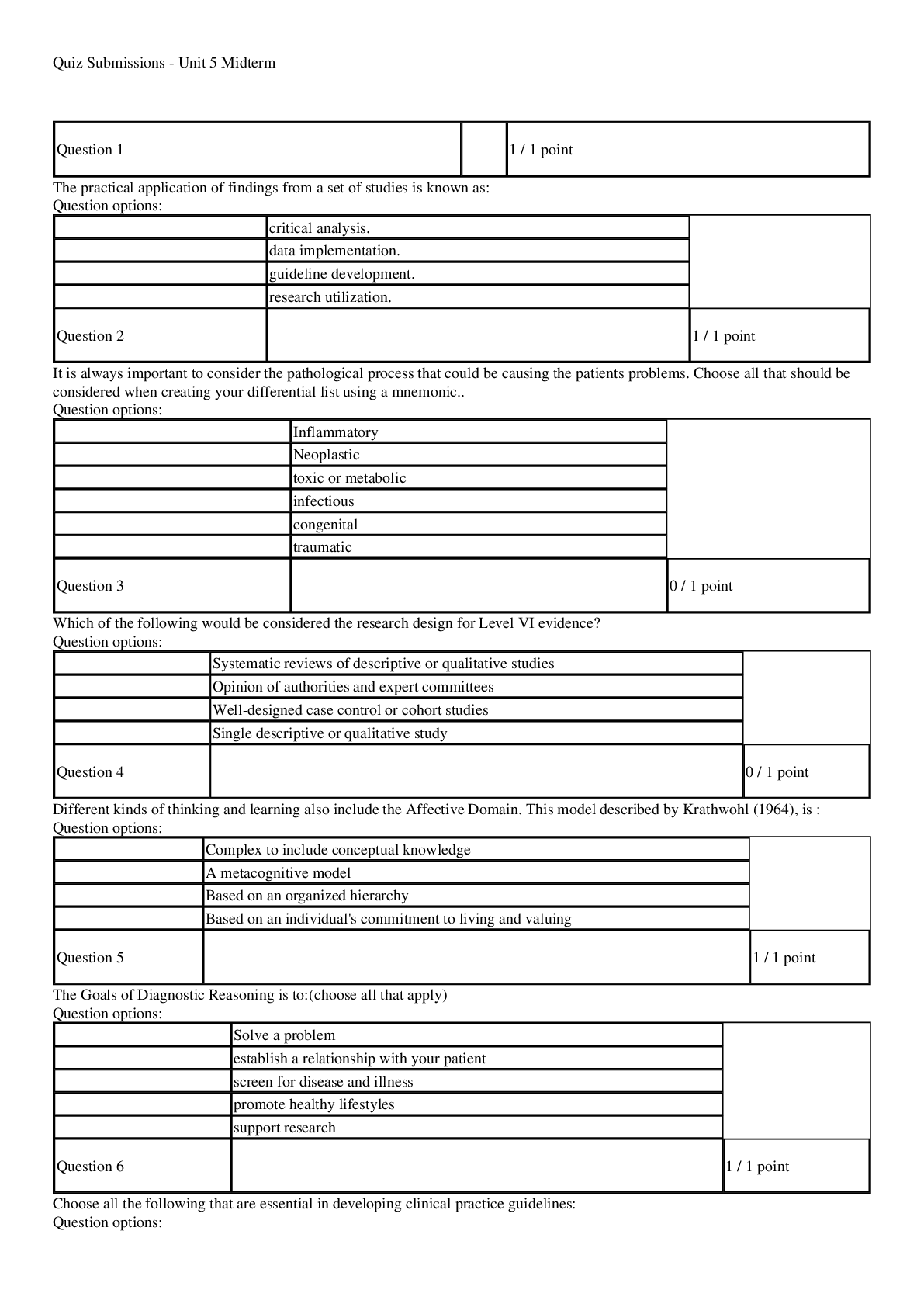
The practical application of findings from a set of studies is known as:
Question options:
critical analysis.
data implementation.
guideline development.
research utilization. - ANSWER research utilization.
Which of the following would be considered the research design for Level III evidence?
Question options:
Well-designed controlled trials without randomization
Systematic reviews of descriptive or qualitative studies
Systematic review of randomized clinical trial studies
Opinion of authorities and expert committees - ANSWER Well-designed controlled trials without randomization
What are the questions you should ask yourself before using clinical guidelines in your practice? All are correct except (mark the ones that apply)
Question options:
How strong are the recommendations
Are the guidelines applicable to my patients
Can I get reimbursed for using these guidelines
Are the guidelines clinically important
Are these guidelines from a reliable source
How old are these guidelines - ANSWER Can I get reimbursed for using these guidelines
Choose all the following that are essential in developing clinical practice guidelines:
Question options:
Identification of A topic
Enlist and expert panal
Review of literature 'D. Rate evidence
Draft a proposal
External review of draft
Revised draft based on recommendations - ANSWER Identification of A topic
Enlist and expert panal
Review of literature 'D. Rate evidence
Draft a proposal
External review of draft
Revised draft based on recommendations
Generalized patterns of nursing care are represented in The Circle of Caring Model as:(choose all that apply)
Question options:
self care
Patience
listening
courage
Authentic presence
advocacy
knowing
commitment - ANSWER Patience
courage
Authentic presence
advocacy
knowing
commitment
The Goals of Diagnostic Reasoning is to:(choose all that apply)
Question options:
Solve a problem
establish a relationship with your patient
screen for disease and illness
promote healthy lifestyles
support research - ANSWER
Which is the most important question to ask in nursing research?
Question options:
What findings constitute evidence?
How will the findings be used?
Is this a randomized controlled trial?
What theory is being utilized? - ANSWER How will the findings be used?
Which of the following would be considered the research design for Level II evidence?
Question options:
Single descriptive or qualitative study
Well-designed case control or cohort studies
Single, well-designed, randomized clinical trial
Systematic review of randomized clinical trial studies - ANSWER Single, well-designed, randomized clinical trial
The Circle of Caring Model is a new and more contemporary approach to medicine. Choose the characteristics that best describe this model of care in the primary care setting.
Question options:
AIl includes both traditional nursing as well as traditional medical practice
It is a transformative model
It considers both assessment and patient outcomes
It is a patient centered model
All of the Above - ANSWER All of the above
When evaluating a patient with a an acute headache all of the following observations would indicate the absence of a more serious underlying condition except:
Question options:
Onset of headache with exertion, coughing or sneezing
History of previous headaches
Supple neck
normal neurological examination result. - ANSWER Onset of headache with exertion, coughing or sneezing
Choose all that should be considered when ordering a diagnostic test.
Question options:
patients request for test to be done
cost
sensitivity and specificity of the test
convenience of test
Will the outcome of the test change your plan of care
diagnosis by exclusion - ANSWER cost
sensitivity and specificity of the test
convenience of test
Will the outcome of the test change your plan of care
diagnosis by exclusion
Understanding other factors that can be causing the patients problems include:. Choose all that should be considered
Question options:
Demographics
Age
Gender
weight
medications
education - ANSWER Demographics
Age
Gender
weight
medications
education
Diagnostic test should be the deciding factor when making your final diagnosis.
Question options:
True
False - ANSWER FALSE
Which of the following would be considered the research design for Level VI evidence?
Question options:
Systematic reviews of descriptive or qualitative studies
Opinion of authorities and expert committees
Well-designed case control or cohort studies
Single descriptive or qualitative study - ANSWER Single descriptive or qualitative study
Which of the following would be considered the research design for Level I evidence?
Question options:
Single, well-designed randomized clinical trial
Systematic review of randomized clinical trial studies
Well-designed controlled trials without randomization
Systematic reviews of descriptive or qualitative studies - ANSWER Systematic review of randomized clinical trial studies
Practice guidelines are designed to:
Question options:
Be inflexible
Be utilized in every circumstance
Provide a reference point for decision making
Be created by a professional organization to guide the practice of a profession - ANSWER Provide a reference point for decision making
Purpose of nursing research - ANSWER To contribute to nursing knowledge as an independent field
Using clinical guideline - ANSWER Look at date: Must at least be published within 2 years
Practice guidelines - ANSWER Created by professional organizations to guide the profession
Guidelines and patients - ANSWER Important that guidelines are applicable to patients
i.e. primary care providers should seek guidelines written for primary care providers.
Evidence-based practice - ANSWER How is the finding going to be used
Test for primary HTN - ANSWER Hct, Cr, & K
Not Uric acid
Evaluating organ damage r/t HTN - ANSWER LVH through echocardiography
Treatment guidelines for African Americans with HTN - ANSWER Polytherapy: HCTZ, lisinopril
Mono: CCB
JNC8 Guideline for HTN - ANSWER If a person with healthy BMI & BP is constantly 130/80, it is considered normal
First-line antihypertensive for a person without DM - ANSWER HCTZ, lisinopril, amlodipine, but not METOPROLOL
Asthma - ANSWER chronic airway inflammatory disorder with superimposed bronchospasms
Chronic cough - ANSWER lasts longer than 8 weeks
COPD recommended treatment - ANSWER inhaled corticosteroids to reduce inflammation
COPD and older patients- flu vaccine - ANSWER should received the inactivated flu- never the live
The clinician suspects that a patient seen in the office has hyperthyroidism. Which test should the clinician order on the initial visit?
a). Sensitive thyroid-stimulating hormone (TSH) assay and T4
b). Free T4 and serum calcium
c). Nuclear scintigraphy with radiolabeled iodine (123i)
d). Magnetic resonance imaging - ANSWER Answer:
A). Sensitive thyroid-stimulating hormone (TSH) assay and T4
A patient with type 2 diabetes comes to the clinic after reading about metformin in a magazine. Which condition that the patient also has would be a contraindication to take metformin?
a). Ulcerative colitis
b). Inflammatory bowel disease
c). Chronic obstructive pulmonary disease
d). Renal disease - ANSWER Answer:
D). Renal Disease
The clinician suspects a patient has Addison's disease. Which clinician manifestation would the clinician observe upon a physical examination?
a). Moon face
b). Central obesity
c). Hyperpigmentation
d). Myxedema coma - ANSWER Answer:
D). Hyperpigmentation
Which blood test would confirm a diagnosis of diabetes mellitus?
a). A1c 5.5%
b). Fasting plasma glucose level of 120 mg/dL
c). Oral glucose tolerance test 250 mg/dL (2-hour level)
d). Random plasma glucose level 175 mg/dL - ANSWER Answer:
C. Oral glucose tolerance test 250 mg/dL (2- hour level)
The patient has metabolic syndrome. The patient is at increased risk for which condition?
a). Anxiety disorder
b). Gallbladder disease
c). Diabetes mellitus
d). Hyperparathyroidism - ANSWER Answer:
C). Diabetes Mellitus
THA Indications - ANSWER OA
Inflamed Synovium (RA)
Non-union hip fractures
Avascular necrosis
Congenital hip dysplasia
Slipped capital femoral epiphysis
THA contraindications - ANSWER Infection
Injured or non-functional hip muscles
Neuromuscular disease
Skeletally immature
Poor quality bone
Poor skin coverage around the hip joint
Cemented - ANSWER 98% survivorship of implant after 10 years
95% survivorship of implant after 25 years
Cementless - ANSWER Similar to above numbers for femoral component, and better with acetabular component at 15 year mark
Now preferred method - especially in younger patients
THA Precautions- Posterior Approach - ANSWER Don't cross your legs or ankles
Don't raise your knee above hip
Don't bend at the waist >90
No ER if anterior
No IR if posterior
Don't sleep on your side without pillows between knees (adduction)
WHY? Through the glute muscle and the joint capsule → Combo Actions dislocate the hip
Complications of the THA - ANSWER DVT
Device failure: leg length issue
Leg length discrepancy
Component malalignment
Infection
Improper implant fixation to surrounding bone
Nerve Palsy
Prosthetic Hip Dislocation
Are precautions necessary? - ANSWER Study done with no restrictions → three dislocations within 6 weeks post-operative
Low early dislocation rate can be achieved using anterolateral approach without restrictions
Cumulative Long-term risk of dislocation - ANSWER Highest risk of first year status post- surgery
Usually hip precautions for three months
Late Dislocation - ANSWER Long-standing problem with prosthesis, trauma, neurologic decline, polyethylene wear or combination
Sports Activity Recommendations - ANSWER Recommended/Allowed
Walking, swimming
Allowed with experience
Canoeing, hiking, cross country skiing
Not recommended
HIIT, jogging
Pros for minimally invasive surgery - ANSWER Potential for quicker recovery
Better cosmesis
Less perceived invasion of the body
Increased satisfaction
Shorter Hospital stay
Patients are asking for MITHA
Cons for minimally invasive surgery - ANSWER Potential for increased complications
Smaller visual field
Learning curve
Difficult to perform studies without observer or selection bias
Are short term benefits worth increased risk
Why fix what isn't broken
Classic THA is awesome
Is it really minimally invascive
Risk vs Benefit of Inactivity - ANSWER Strong evidence exists that the total joints in an inactive persons will show less wear that that in an active person
But, exercise will decrease fall risk, increase bone density → prosthesis fixation
Obesity and TKA - ANSWER Conflicting evidence as to whether obese pateints have lower functional gains and higher complication reates
Extensor Mechanism and TKA - ANSWER 290 patients post TKA → 6 had extensor mechanism disruption
This group had overall worse functional outcomes, requiring intensive rehabilitation
Bilateral TKA - ANSWER Compared 12 patients with unilateral TKA to gender/age/BMI matched patients with bilateral TKAs
Short term and long term outcomes were qual by 12 weeks, except quad strength
Quad strength was equal by 52 weeks
Sports and Activity TKA - ANSWER Suitable: cycling, swimming, low resistance, etc.
Suitable but more risky, downhill skiing, speed walking, hunting, etc.
Avoid: baseball, basketball, football, hockey
Components of THA - ANSWER Acetabular Shell
Titanium alloy
Acetabular cup/liner
Cross linked polyethylenes, plastic, metal, ceramic
Femoral Stem
Ceramic or cobalt chrome
Femoral Head
Cement: methyl methacrylate
Total Hip Precautions; - ANSWER No flexion >90
No Internal Rotation
No adduction
Maintain for 6-12 weeks
Common complications of THA - ANSWER femoral neck fracture
Conditions that lead to TSA - ANSWER Osteoarthritis
RA
Osteonecrosis
Trauma
Symptoms Shoulder Arthroplasty - ANSWER Progressing stiffness to permanent loss of motion
Diffuse, achy, progressive pain
Loss of sleep and limitation of function
Pre-Operative Clinical Findings of TSA - ANSWER Lack of external rotation can play a role in gaining postoperative ROM
Any other source of referral pain has been cleared
Components of TSA - ANSWER Humeral stem
Humeral head
Glenoid cup
Reverse TSA - ANSWER Performed when there is poor or no rotator cuff musculature or tendon
Anterior deltoid now primary mover
Outcome is one that should allow basic pain-free, functional, ADL motion
Should be able to sleep pain free at night
Not a procedure to restore sport or heavy lifting
Post-OP conditions - ANSWER Talk to surgeon
ER to neutral
Full PROM immediately
Expected Outcomes of TSA - ANSWER Hand on top of head
Hand to opposite ear
Hand to rear belt loop
Pain reduction to allow sleep
Appropriate contributions of GHJ, STJ, thoracic spine
Pediatric vs Adult considerations - ANSWER Rapid Growth: new orthopedic issues
Peak 12 years girls
14 years boys
Open growth plates (physis)
NM recruitment/synaptic elimination
Decreased aerobic and anaerobic capacities
Difficulties with thermoregulation
Hormonal Development
Generalized joint hypermobility
Special Consideration: Cardiovascular - ANSWER Smaller heart - decreased cardiac output and increased HR
Smaller thoracic cavity with smaller vital capacity and increased respiratory rate
Greater energy per kg for walking and running
special considerations of musculoskeletal - ANSWER Decreased muscle hypertrophy due to decreased androgens
Epiphyseal plate → weak musculoskeletal link (apophyseal injuries)
Majority of bone density is acquired during adolescence (diet, malnutrition, and weight loss)
Relative tightening of the muscle -tendon units spanning rapidly growing bones are risk factors for overuse injuries
Beighton Hypermobility Score: simple system to quantify joint laxity and hypermobility - ANSWER Elbows Hyperextend <0
Knees hyperextend <0
Ankle dorsiflexes >45 degrees
Thumb touches forearm
Fingers hyperextend to be parallel to forearm
What is a greenstick fracture - ANSWER Greenstick: one side of the bone is fractured and the other is bent
occurs in children <10 years of age
What is avulsion - ANSWER piece of bone is torn away by ligament/tendon
growth plate fractures - ANSWER Injuries to the growth plate are more likely to occur than sprains/strains because of the greater structural strength and integrity of the ligaments than of the growth plate
Apophyseal Stress Reactions - ANSWER Little leaguer's shoulder elbow
ASIS/AIIS/Iliac Crest
Osgood schlatter
Sinding-Larsen Johansson
Sever, Iselin's
Present clinically with focal pain, inflammation, and callous bone formation
Radiograph to confirm diagnosis
Epiphyseal Plate injuries - ANSWER Mechanism: torsion, valgus/varus stress
Can arrest blood flow from epiphyseal surface
Salter Harris (five categories) - ANSWER Separation epiphysis: occurs due to shearing forces
Separation and triangular fracture of metaphysis (most common) : shearing and bending forces
Plate fracture extending into joint (distal tibia)
Same as 3 above, but also involves metaphysis
Crushing mechanism
Complications of Pediatric Fractures - ANSWER Growth
[Show More]