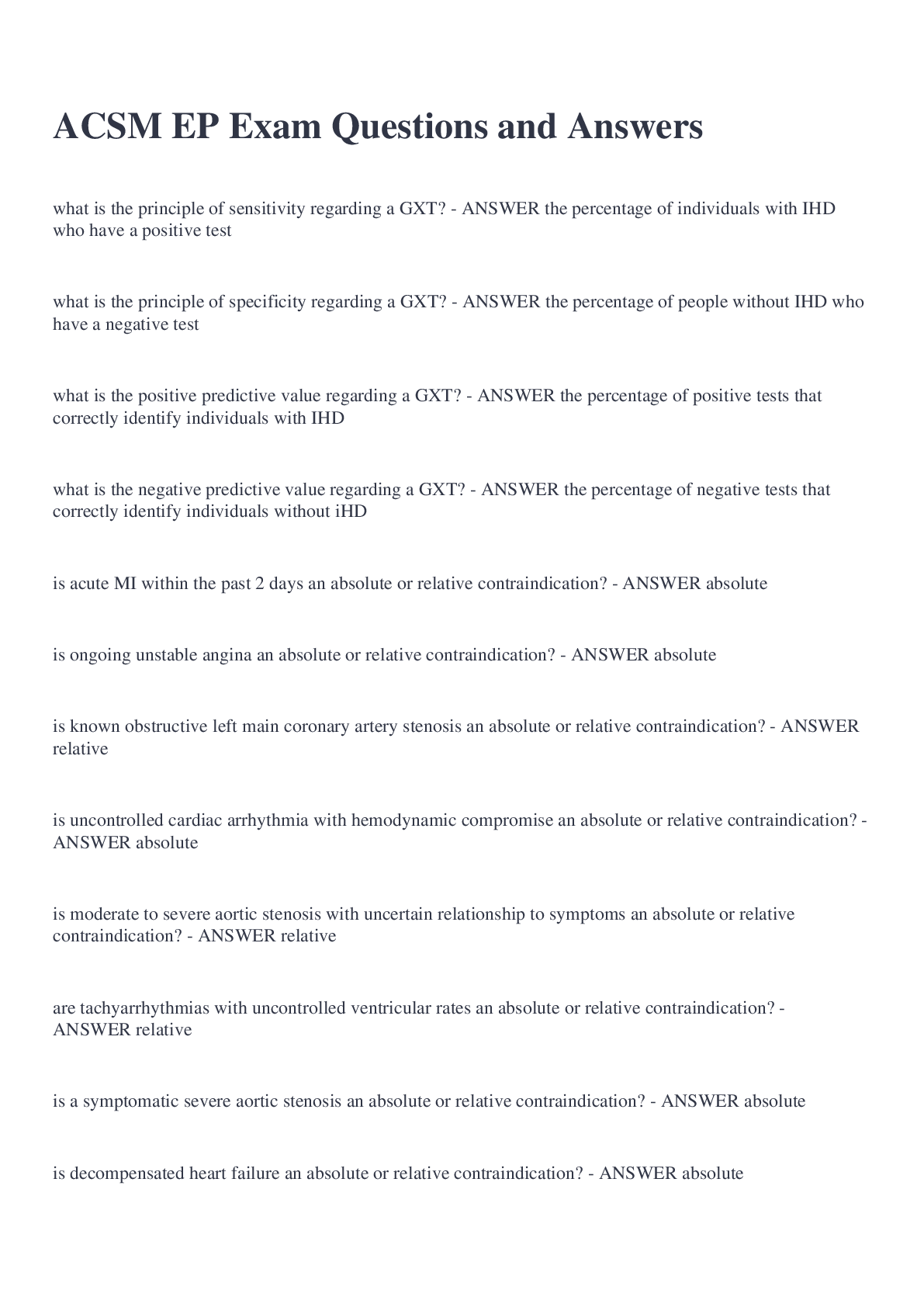
what is the principle of sensitivity regarding a GXT? - ANSWER the percentage of individuals with IHD who have a positive test
what is the principle of specificity regarding a GXT? - ANSWER the percentage of people wi
...
what is the principle of sensitivity regarding a GXT? - ANSWER the percentage of individuals with IHD who have a positive test
what is the principle of specificity regarding a GXT? - ANSWER the percentage of people without IHD who have a negative test
what is the positive predictive value regarding a GXT? - ANSWER the percentage of positive tests that correctly identify individuals with IHD
what is the negative predictive value regarding a GXT? - ANSWER the percentage of negative tests that correctly identify individuals without iHD
is acute MI within the past 2 days an absolute or relative contraindication? - ANSWER absolute
is ongoing unstable angina an absolute or relative contraindication? - ANSWER absolute
is known obstructive left main coronary artery stenosis an absolute or relative contraindication? - ANSWER relative
is uncontrolled cardiac arrhythmia with hemodynamic compromise an absolute or relative contraindication? - ANSWER absolute
is moderate to severe aortic stenosis with uncertain relationship to symptoms an absolute or relative contraindication? - ANSWER relative
are tachyarrhythmias with uncontrolled ventricular rates an absolute or relative contraindication? - ANSWER relative
is a symptomatic severe aortic stenosis an absolute or relative contraindication? - ANSWER absolute
is decompensated heart failure an absolute or relative contraindication? - ANSWER absolute
is acquired advanced or complete heart block an absolute or relative contraindication? - ANSWER relative
is a recent stroke or transient ischemic attack an absolute or relative contraindication? - ANSWER relative
is an an acute pulmonary embolism, pulmonary infarction, or deep venous thrombosis an absolute or relative contraindication? - ANSWER absolute
is acute myocarditis or pericarditis an absolute or relative contraindication? - ANSWER absolute
is a mental impairment with limited ability to cooperate an absolute or relative contraindication? - ANSWER relative
is resting hypertension with systolic >200mmHg or diastolic >110 mmHg an absolute or relative contraindication? - ANSWER relative
is an acute aortic dissection an absolute or relative contraindication? - ANSWER absolute
is a physical disability that precludes safe and adequate testing an absolute or relative contraindication? - ANSWER absolute
are uncorrected medical conditions, like significant anemia, important electrolyte imbalance, and hyperthyroidism an absolute or relative contraindication? - ANSWER relative
what are some key features of a cardiac disease that favor an ischemic origin? - ANSWER heaviness in the neck, cheeks, arms, or thorax
what are some key features of cardiac disease that do NOT favor an ischemic origin? - ANSWER sharp jabs in the left submammary area
what are some components of the medical history questionnairre? - ANSWER medical diagnoses and history of medical procedures, previous exam findings (arrhythmias, murmurs, abnormal heart sounds), laboratory findings (serum lipids, etc), history of symptoms; recent illness, hospitalization, new medical diagnoses, or surgery; orthopedic problems, other recreational drug use or caffeine use, exercise history, work history, and family history
how would you take the circumference of the abdomen region? - ANSWER standing, horizontal measure at height of illiac crest
how would you take the circumference of the arm region? - ANSWER standing, arms hanging freely at sides with hands facing thigh, horizontal measure taken midway between acromion and olecranon
how would you take the circumference of the buttocks/ hips? - ANSWER standing with feet together, horizontal measure taken at maximal circumference at the butt
how would you take the circumference of the calf? - ANSWER standing with feet 20cm apart, horizontal measure is taken at maximum circumference of the calf
how would you take the circumference of the hips/thigh? - ANSWER standing with legs slightly apart (less than 10 cm), horizontal measure at maximal circumference of the hip/ thigh just below gluteal fold
how would you take the circumference of the midthigh? - ANSWER standing with one foot on a bench so knee is at 90 degrees, take midway measure between inguinal crease and proximal border of the patella
how would you take the circumference of the waist? - ANSWER standing with arms at the sides and feet together and abdomen relaxed, horizontal measure taken at smallest part of the waist
what are the general indications to stop an exercise test? - ANSWER onset of angina/ angina-like symptoms
drop in SBP >10mmHg with increase of work rate or if SBP drops below pretest values
excessive rise in BP: SBP >250mmHg and DBP >115mmHg
shortness of breath, wheezing, leg cramps, claudication
signs of poor perfusion
failure of HR to increase with increased intensity
noticeable change in heart rhythm
individual requests to stop
physical or verbal manifestations of severe fatigue
failure of equipment
what is the astrand-rhyming cycle ergometer test? - ANSWER single-stage
6 mins long
pedal rate: 50rpm
goal: HR values between 125bpm and 170bpm
what are the starting work rates for men for the astrand-rhyming cycle ergometer GXT? - ANSWER unconditioned: 300-600kgm/min (50-100W)
conditioned: 600-900kgm/min (100-150W)
what are the starting work rates for women on the astrand-rhyming cycle ergometer GXT? - ANSWER unconditioned: 300-450kgm/min (50-75W)
conditioned: 450-600kgm/min (75-100W)
what is the YMCA protocol? - ANSWER uses two to four 3 min stages of continuous exercise
pedal rate: 50rpm
stage 1: .5kg resistance
progresses based off of HR
goal: HR at 110bpm - 70%HRR (85% HRmax)
for the ymca protocol, how is stage 2 determined? - ANSWER HR
<80bpm = increased resistance to 2.5kg
HR 80-89 = increase to 2kg
HR 90-100 = increase to 1.5kg
HR >100 = increase to 1kg
what do stages 3 and 4 look like for the YMCA protocol? - ANSWER increase resistance by .5 each stage until goal is reached
how do beta blockers impact the body and exercise? - ANSWER cardiac output: decrease or stays the same
HR: decreases
BP: decreases
exercise capacity: increases with those that have myocardial ischemia
how do ACE-1 impact the body and exercise? - ANSWER cardiac output: stays the same
HR: the same
BP: decreases
exercise: stays the same for performance
increased tolerance with those that have had heart failure
how do nitrates impact the body and exercise? - ANSWER HR: increase
BP: decrease
exercise: increases in individuals with angina
increase or stays the same with those with heart failure
how do bronchodilators impact the body and exercise? - ANSWER HR: no change
BP: no change
exercise: increase capacity
no change in VO2 max
how do antihistamines impact the body and exercise? - ANSWER HR: increase during rest, no change during exercise
exercise: no change
What is muscular fitness? - ANSWER muscular strength, endurance, and power
what is muscular strength? - ANSWER the amount of force a muscle can exert
what is the standard for a dynamic strength assessment? - ANSWER 1RM testing
how can you test muscular strength in individuals with high risk for CVD, pulmonary, and metabolic diseases? - ANSWER 10-15RM
what is muscular endurance? - ANSWER ability of a muscle group to execute repeated muscle actions over a period of time sufficient to cause muscular fatigue or maintain a specific percentage of 1RM for a prolonged period of time
what is an example of a muscular endurance field test? - ANSWER push-up test
what is muscular power? - ANSWER the rate of performing work
what is flexibility? - ANSWER ability to move a joint through its complete, pain-free ROM
how long does a sign and symptom limited GXT last? - ANSWER 8-12 minutes
when should HR, BP, and ECG be recorded in a GXT? - ANSWER during each minute or each stage, at peak exercise, and regularly for 6 minutes during recovery
what is the normal HR response to incremental exericse? - ANSWER increase in 10bpm per 1MET increase
what happens if the HR fails to decrease by 12bpm during the first minute or 22 bpm by two minutes? - ANSWER strong association between this and and increased risk of mortality
what is the normal BP response to incremental exercise? - ANSWER increase 10mmHg every 1 MET
what is a hypertensive response to exercise regarding BP? - ANSWER SBP >250mmHg is a relative indication to stop exercise
men: >210 mmHg women: >190mmHg for SBP is an exaggerated response
what BP response is predictive to resting hypertension? - ANSWER peak SBP >250mmHg or increase in SBP >140mmHg during exercise above pretest value
what is a hypotensive response regarding GXT for BP? - ANSWER decrease in SBP below pretest resting value or >10mmHg after a preliminary increase
what is a blunted BP response in regards to GXT? - ANSWER limited ability to augment Q, SBP will be slower than normal
what is the postexercise response to SBP regarding GXT? - ANSWER SBP returns to pretest values or slightly lower by 6 mins of recovery
what is rate pressure product? - ANSWER multiplying HR by SBP that occur AT THE SAME TIME during rest or exercise
what relationship do myocardial oxygen uptake, coronary blood flow, and exercise intensity have? - ANSWER linear
what is the normal response of the p-wave during exericse? - ANSWER increased magnitude among inferior leads
what is the normal response for the PR segment during exercise? - ANSWER shortens and slopes downward
what is the normal response for the QRS complex during exericse? - ANSWER duration decreases, Q waves increase among lateral leads, R waves decrease, and S waves increase
what is the normal response for the T wave during exercise? - ANSWER decreases amplitude during early exercise, during high intensity it returns to preexercise height
what is the normal QT interval response during exercise? - ANSWER absolute QT decreases
what are dysrhythmias that increase frequency or complexity with progressive exercise associated with? - ANSWER ischemia or hemodynamic instability
what value for VO2 determines that a person has reached their maximal effort? - ANSWER a plateau of VO2 with increased workload
what value for HR determines that a person has reached their maximal effort? - ANSWER failure of HR to increase with increasing workload
what lactate concentration shows that a person has reached their maximal effort? - ANSWER >8mmol/L
what RPE (both 20 and 10 scale) determines that a person has reached their maximal effort? - ANSWER 20: >17
10: >7
what RER value determines that a person has reached their maximal effort? - ANSWER >1.1
why is the warm-up/initiation phase important? - ANSWER allows body to adjust to changing demands on the physiological, biomechanical, and bioenergetic systems as well as improves ROM and decreases risk of injury
why are cool-downs useful? - ANSWER allows the body to return to near resting levels
what does cardiorespiratory fitness entail? - ANSWER functional capabilities of the heart, blood vessels, lungs, and skeletal muscles to transport and utilize oxygen to perform physical work
what is the FITT principle for cardiorespiratory exercise? - ANSWER F: at least 3 days a week (3-5)
I: moderate (40-59% HRR) to vigorous (60-89% HRR)
Ti: 30-60mins/day (150mins/week) of moderate or 20-60 mins of vigorous (75mins/week) or a combo of the two
Ty: continuous or rhythmic manner that involves major muscle groups
[Show More]





.png)