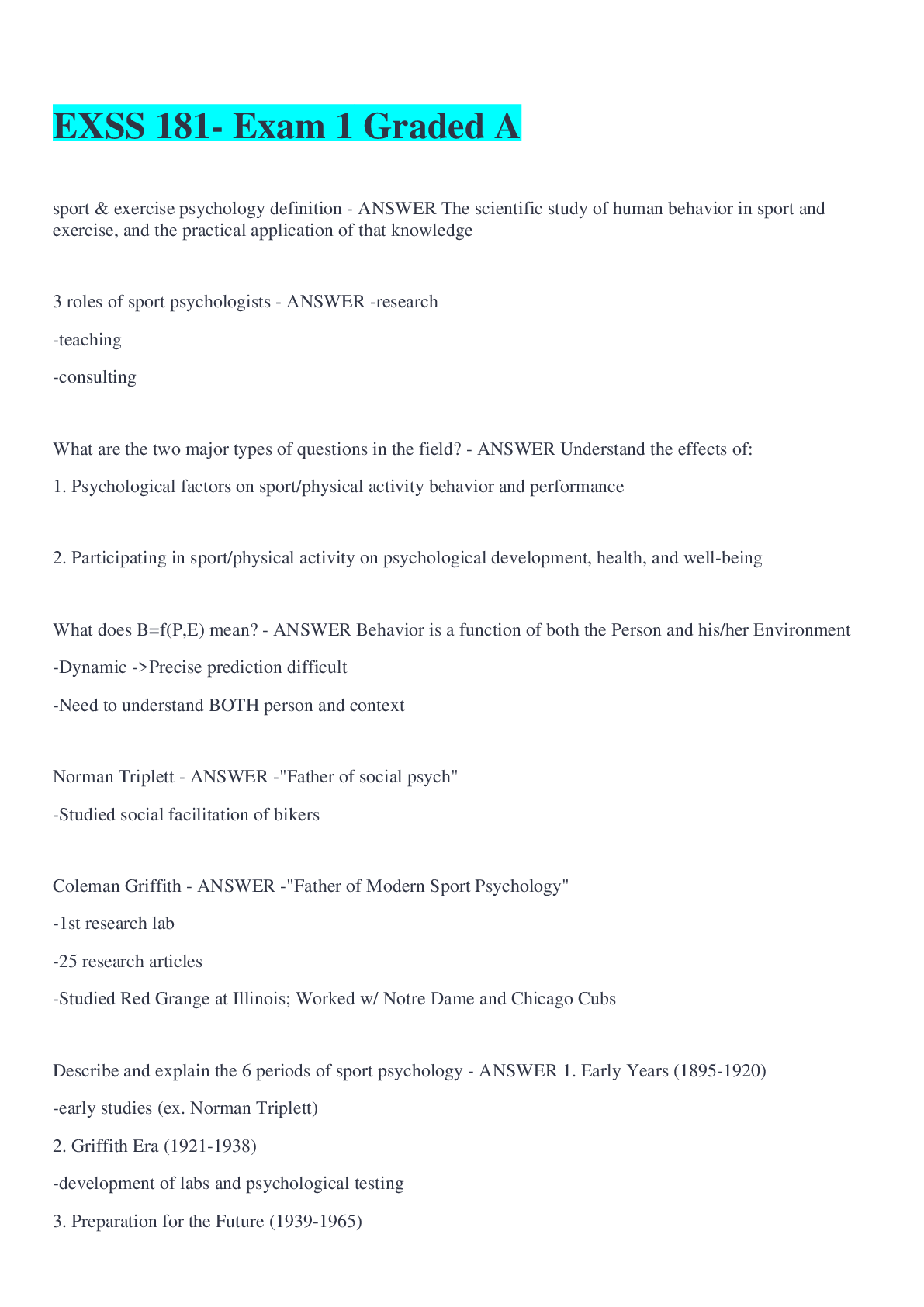
sport & exercise psychology definition - ANSWER The scientific study of human behavior in sport and exercise, and the practical application of that knowledge
3 roles of sport psychologists - ANSWER -research
-teachin
...
sport & exercise psychology definition - ANSWER The scientific study of human behavior in sport and exercise, and the practical application of that knowledge
3 roles of sport psychologists - ANSWER -research
-teaching
-consulting
What are the two major types of questions in the field? - ANSWER Understand the effects of:
1. Psychological factors on sport/physical activity behavior and performance
2. Participating in sport/physical activity on psychological development, health, and well-being
What does B=f(P,E) mean? - ANSWER Behavior is a function of both the Person and his/her Environment
-Dynamic ->Precise prediction difficult
-Need to understand BOTH person and context
Norman Triplett - ANSWER -"Father of social psych"
-Studied social facilitation of bikers
Coleman Griffith - ANSWER -"Father of Modern Sport Psychology"
-1st research lab
-25 research articles
-Studied Red Grange at Illinois; Worked w/ Notre Dame and Chicago Cubs
Describe and explain the 6 periods of sport psychology - ANSWER 1. Early Years (1895-1920)
-early studies (ex. Norman Triplett)
2. Griffith Era (1921-1938)
-development of labs and psychological testing
3. Preparation for the Future (1939-1965)
-Franklin Henry establishes grad program
4. Establishment of Academic Branch (1966-1977)
-1st NASPSPA conference
5. Multidisciplinary Research (1978-2000)
-New research and establishment of specialty journals and conferences
6. Contemporary (2000-Present)
Identify and explain 3 ways of knowing.
(advantages & disadvantages) - ANSWER 1. Common sense (Intuition, speculation)
(+) easy, quick
(-) not based on experience/data so greatest chance of being wrong
2. Practical Experience (Observations, case studies)
(+) holistic, immediate, innovative
(-) fails to explain mechanisms, susceptible to bias
3. Science (Systematic, controlled, empirical investigations of relationships among phenomena)
(+) Reliable, "objective and unbiased"
(-) reductionistic, slow to evolve, sometimes not practical
What are the 4 steps involved in the scientific method? - ANSWER 1.Develop the problem
2.Formulate hypotheses
3.Gather Data
4.Analyze and interpret results
What is a theory? - ANSWER set of interrelated facts that present a systematic view of a phenomenon in order to describe, explain, and predict its future occurrences
What are the individual ABCs of sport & exercise psychology? - ANSWER A = affect (feeling states)
B = behavior (actions)
C = cognition (thoughts)
A
-defintion
-research question ex. - ANSWER Affect: (state specific)
-Positive affect - optimal states of energy, concentration & pleasurable engagement
-Negative affect - sense of distress or unpleasant engagement
Emotion - affect & behavior congruent with, directed at particular stimulus
Mood - diffuse and global expressions of emotion/affect
How do anxiety or anger influence performance?
B
-defintion
-research question ex. - ANSWER Behavior:
Things athlete or exercisers do:
Effort/motivation
Skill/performance
Aggression
Sportsmanship
Communication
Why are some people so committed to a PA/training routine and others not?
C
-defintion
-research question ex. - ANSWER Cognition:
Self or other-referenced thoughts:
Informational
Motivational
Concentration/focus
Affect-related
Other-related
Why do some athletes choke under pressure?
Why do some athletes have negative thoughts during performance?
What were the primary take-home points from the Martinent et al. (2013 study)? - ANSWER Purpose: Identify affective profiles of athletes both before and during competition
- examine differences between these profiles on coping and goal attainment.
Participants: 306 French athletes, multiple sports, Ages 15-39 (average age = 22)
Measures: (self-report 2 hrs. before & after)
-Affective states (intensity & directionality)
-Coping strategies (task, distraction, disengagement)
-Sport goal attainment
Results:
1. High positive affect facilitators (n = 88, 81)
2. Facilitators (n = 75, 25)
3. Low affect debilitators (n = 83, 127)
4. High negative affect debilitators (n = 60, 73)
-Some consistency in profiles across time points.
What is personality? - ANSWER that pattern of characteristic thoughts, feelings, and behaviors that distinguishes one person from another and that persists over time and situations"
Hollander's model of personality - ANSWER -internal psychological core (internal & constant)
(ex. attitudes, values, interests, and beliefs about self)
-typical responses (middle)
(ex. shy, even-tempered, etc.)
-role-related behavior (external & dynamic)
Name the big 5 traits - ANSWER (OCEAN)
1.Openness to Experience
2.Conscientiousness
3. Extraversion/Introversion
4. Agreeableness
5. Neuroticism (Emotionality)
What is the iceberg profile? - ANSWER -characterization of successful athletes-> reflects (+) mental health
-above average vigor
-below average tension, depression, anger, fatigue, and confusion
Describe the trait approach to personality - ANSWER - imply that traits (those relatively stable attributes of a person) are:
1. Consistent: we expect behavior (thoughts/emotions) to be similar from one situation to the next
2. Generalizable: we expect people to behave similarly across contexts
Why are traits a poor predictor of behavior on their own? - ANSWER -no specific personality profile for an athlete
-can't assume cause and effect
behaviorism - ANSWER situation approach-> suggests people learn behaviors for specific situations via rewards and punishments
Social Learning theory - ANSWER situation approach-> suggests people learn behaviors for certain situations via observational learning/modeling
What does the interactionist approach to personality suggest about how personality develops? - ANSWER -Person factors (e.g., traits) and situation factors interact to determine behavior
-B = f(P,E)
-Combination of trait and situation theories
-Concept of STATE vs. TRAIT characteristics
problems w/ using personality testing in athletics - ANSWER problems:
-Using clinical tests that focus on abnormality to study average population
-Not sufficient evidence of reliability and validity
-Social desirability and some psychological skills can be learned
-Does not account for non-psychological factors which affect sport performance
-Not recommended to use personality tests to make decisions about sport participation (e.g., making the team)
What is the definition of motivation? - ANSWER the direction and intensity of effort
Direction - approach/avoid or attraction
Intensity - how much effort, persistence
competitiveness - ANSWER disposition to strive for satisfaction when making comparisons w/ some standard of excellence in the presence of evaluative others
What are attributions? How do they relate to success/failure? - ANSWER Interpretations or explanations individuals give for success or failure
i.e., Why you think you were successful or unsuccessful
What are the two key assumptions of attribution theory (Weiner, 1979, 1985)? - ANSWER 1. Motivation is influenced by attributions
2. There are some commonly cited reasons for success and failure
What are the 3 characteristics of attributions? - ANSWER 1. Stability (stable vs. unstable)
2. Causality (internal vs. external)
3. locus of control (in one's control vs. not)
What do the stability, causality, and control attributions mean in terms of psychological outcomes? - ANSWER Stability:
-stable -> greater expectations of outcome happening again
-unstable->lower expectation
Causality:
-internal ->greater pride/shame
-external ->lower pride/shame
Control:
-in one's control -> greater motivation
-out of one's control -> less motivation
self-serving bias - ANSWER Making attributions that help you increase or maintain your self-esteem and confidence
For success: internal and stable
For failure: external and unstable
learned helplessness - ANSWER A psychological state where people have learned that failure is inevitable and out of their control
Tend to attribute failure to uncontrollable, stable causes -> stop trying
What are the 2 assumptions of Achievement Goal Theory? - ANSWER 1.People are motivated to achieve competence.
2. Motivation is influenced by the personal meaning one assigns to success and failure
task vs. ego achievement perspectives - ANSWER -task:
- define success relative to your own past performance
-ego:
-define success Relative to other people
What are the 4 possible combinations of goal orientations? - ANSWER High task, low ego
High task, high ego
Low task, low ego
Low task, high ego
What are the common motivated/behavioral outcomes of task and ego involvement? - ANSWER -task:
Choose learning opportunities at risk of displaying mistakes
High effort
Persist in face of failure
Continue to problem solve when encountering failure
-ego:
Avoid learning opportunities that have risk of displaying error
Put in just enough effort to socially compare well; or to disguise poor ability
Give up in face of failure
Fewer problem-solving efforts in failure situations
What are the 3 predictors of goal involvement (state) from Achievement Goal Theory? Which one might be the most easily influenced by a practitioner? - ANSWER -goal orientation/disposition
-concept of ability
-motivational climate (most easily influenced)
What are the 2 conceptions of ability and what outcomes might they influence? - ANSWER 1. Undifferentiated concept of ability
an inability or a choice not to differentiate between ability and effort.
i.e., working hard = ability. (task-oriented)
2. Differentiated concept of ability
a person is able to, and chooses to, differentiate between ability and effort (ego/outcome)
What are the 2 types of motivational climate? What individuals in the achievement environment may influence these goals? - ANSWER Mastery climate:
emphasis on learning, effort, individual improvement, and cooperation tend to evoke task involvement
Performance (competitive) climate:
Emphasis on competition, winning, and social comparison tend to evoke ego involvement
-promoted by significant others (coaches, parents, etc.)
What is the TARGET acronym and how might it be used to influence motivational climate? - ANSWER Task
Authority
Recognition
Grouping
Evaluation
Timing
Define and explain the differences between intrinsic and extrinsic motivation? - ANSWER intrinsic: Behaviors demonstrated voluntarily, in the absence of constraints imposed by others
Performing an activity for its own sake
extrinsic:Behaviors displayed for the purpose of achieving some end and not for its own sake
Be able to describe the motivational continuum and each type of motivation on it. - ANSWER amotivation-extrinsic(external,introjected,identified,
integrated)-intrinsic
-becomes self-determined at identified
amotivation - ANSWER See no link between actions and outcomes
extrinsic motivation - ANSWER Performing an activity to receive a reward or avoid a punishment
introjected - ANSWER Performing a behavior to avoid guilt and anxiety
External regulation sources are internalized and behaviors are reinforced via internal pressures.
identified - ANSWER Performing the behavior to achieve some valued, extrinsic outcome
integrated - ANSWER Performing a behavior because it is part of your sense of self
intrinsic - ANSWER Performing an activity for its own sake
1. To gain knowledge or learn
2. To accomplish something, master the task
3. To experience pleasure, fun, excitement
What are the 3 psychological needs and how to influence more intrinsic/self-determined motivation? - ANSWER 1. Autonomy
The need to perceive that one has choice and are in control of one's own behavior
2. Competence
The need to feel effective at achieving desired outcomes
3. Relatedness
The need to authentically connect with others and feel involved in the social context.
What are the 2 aspects from Cognitive Evaluation Theory that affect an individual's interpretation of a reward? - ANSWER 1. Controlling Aspect
More controlling = undermine self-determination
Affects autonomy perceptions
2. Informational Aspect
More informational = enhance self-determination
Affects competence perceptions
Explain the findings of the Ryan (1977, 1980) scholarship studies? - ANSWER Scholarship < Non- Scholarship on IM (football)
Scholarship > Non- Scholarship on IM (women wrestling)
How can SDT be used to inform coaching/teaching practice to enhance self-determined motivation for athletes/exercisers? - ANSWER -Use small rewards as symbols of achievement, not to coerce or control
-Provide participants some choice
-Help all participants feel included in the group
Ryan & Deci (2000) - ANSWER -3 innate needs
-social contexts that create conflict between these needs -> alienation and psychopathology
3 key assumptions of competence motivation model? - ANSWER 1.Perceptions of control (over whether one can learn and perform skills) work along with self-worth and competence evaluations to influence motivation.
2. Perceptions of control , competence, self-esteem do not influence motivation directly.
3. Rather, these perceptions influence affective or emotional states (e.g., enjoyment, anxiety, pride, shame) that in turn influence motivation.
What are the importance of emotional states (e.g., enjoyment, anxiety, pride, shame) to this model? - ANSWER -perceptions influence affective or emotional states (e.g., enjoyment, anxiety, pride, shame) that in turn influence motivation.
[Show More]



.png)




.png)