NURS629 WEEK 9 MED CHALLENGER 2 WITH ANSWRS
1. A young child is diagnosed with Kawasaki disease. He is immediately started on high-dose aspirin and intravenous gammaglobulin. The goal of these therapies is to reduce
...
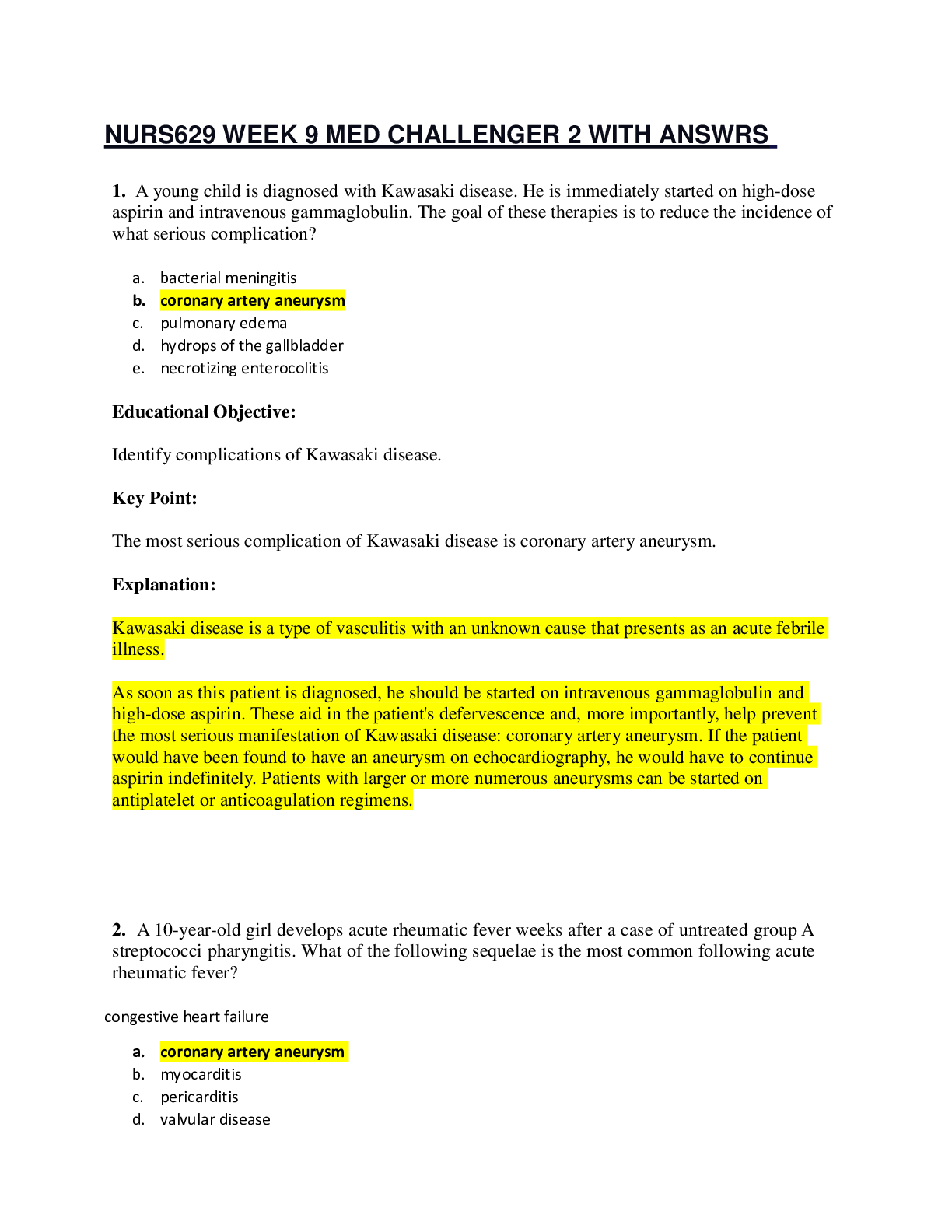
NURS629 WEEK 9 MED CHALLENGER 2 WITH ANSWRS
1. A young child is diagnosed with Kawasaki disease. He is immediately started on high-dose aspirin and intravenous gammaglobulin. The goal of these therapies is to reduce the incidence of what serious complication?
a. bacterial meningitis
b. coronary artery aneurysm
c. pulmonary edema
d. hydrops of the gallbladder
e. necrotizing enterocolitis
Educational Objective:
Identify complications of Kawasaki disease.
Key Point:
The most serious complication of Kawasaki disease is coronary artery aneurysm.
Explanation:
Kawasaki disease is a type of vasculitis with an unknown cause that presents as an acute febrile illness.
As soon as this patient is diagnosed, he should be started on intravenous gammaglobulin and high-dose aspirin. These aid in the patient's defervescence and, more importantly, help prevent the most serious manifestation of Kawasaki disease: coronary artery aneurysm. If the patient would have been found to have an aneurysm on echocardiography, he would have to continue aspirin indefinitely. Patients with larger or more numerous aneurysms can be started on antiplatelet or anticoagulation regimens.
2. A 10-year-old girl develops acute rheumatic fever weeks after a case of untreated group A streptococci pharyngitis. What of the following sequelae is the most common following acute rheumatic fever?
congestive heart failure
a. coronary artery aneurysm
b. myocarditis
c. pericarditis
d. valvular disease
Educational Objective:
Recognize the sequelae of rheumatic fever.
Key Point:
The most common complication of rheumatic fever is valvular heart disease.
Explanation:
Acute rheumatic fever can be a sequela of untreated group A pharyngitis. The most significant of the complications caused by acute rheumatic fever are cardiac in nature. Patients with rheumatic fever who develop carditis may develop long-lasting heart dysfunction. Oftentimes, the mitral valve or the aortic valve is affected, and, if a patient's condition is not responsive to medications, then surgical valve replacement may become necessary. Atrial fibrillation (irregular fast heart rate) and heart failure can also occur. Sydenham chorea can be the most difficult complication to treat, and individuals with this complication may see their disease recur.
3. An 8-year-old boy has recent symptoms of dyspnea and dizziness. His examination findings show an overactive precordial impulse and an apical-blowing murmur.
Two months later, he experiences sudden death during an episode of strenuous play. What is the most likely etiology of his symptoms and death?
a. muscular ventricular septal defect
b. persistence of truncus arteriosus
c. hypertrophic obstructive ,cardiomyopathy atrial septal defect
d. Ebstein anomaly
Educational Objective:
Identify the symptoms of hypertrophic obstructive cardiomyopathy.
Key Point:
Hypertrophic obstructive cardiomyopathy can result in sudden death from ventricular outflow obstruction or by arrhythmia.
Explanation:
The most likely etiology of his symptoms and death is hypertrophic obstructive cardiomyopathy (also known as idiopathic hypertrophic subaortic stenosis). In cases of hypertrophic obstructive cardiomyopathy, there is disproportionate hypertrophy of the interventricular septum, which causes an outflow tract gradient. Left ventricular outflow tract obstruction occurs in 25% of patients.
Sudden death may result from ventricular outflow obstruction or arrhythmia--both ventricular and atrial--and especially following physical exertion.
[Show More]