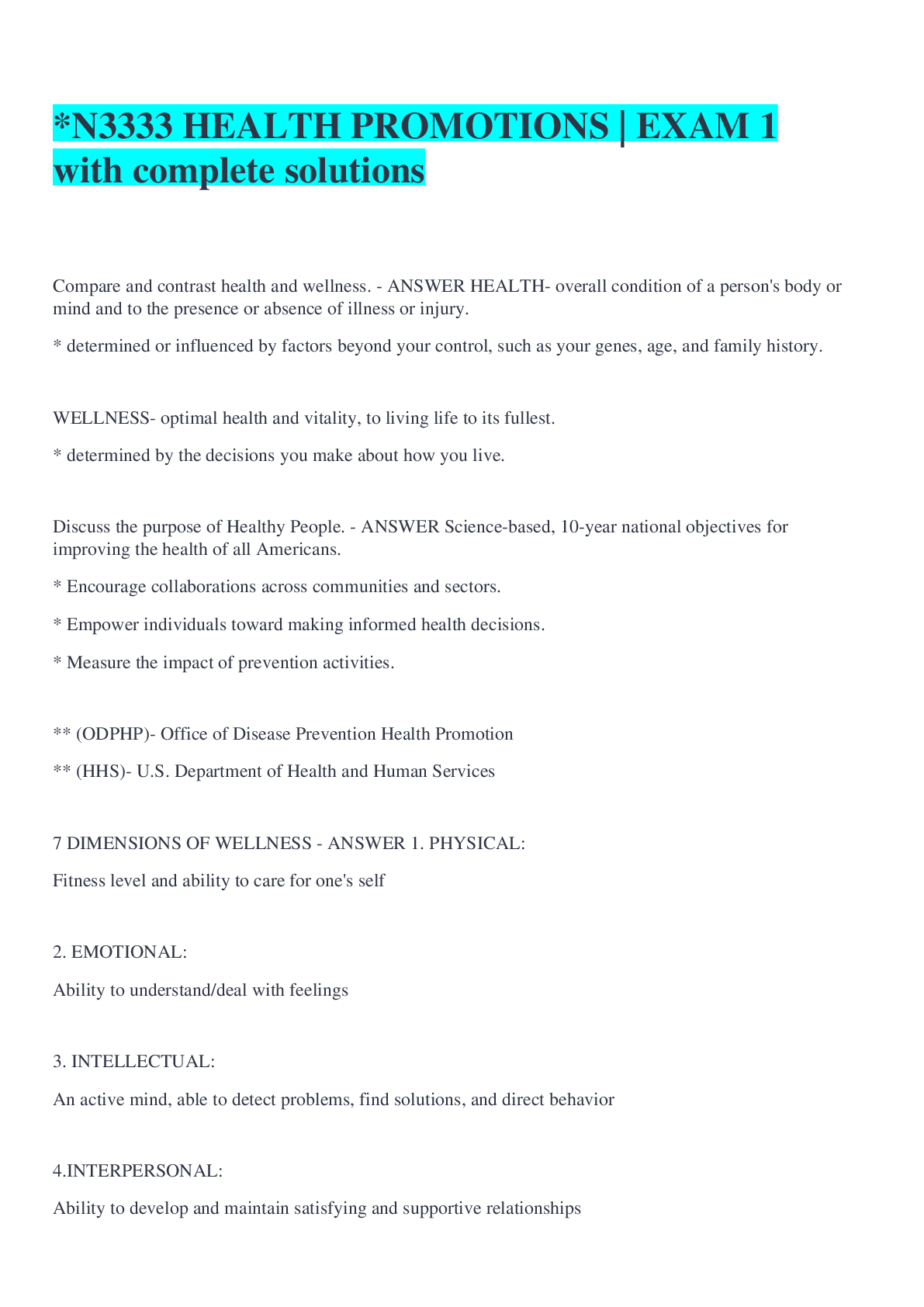
Compare and contrast health and wellness. - ANSWER HEALTH- overall condition of a person's body or mind and to the presence or absence of illness or injury.
* determined or influenced by factors beyond your control, suc
...
Compare and contrast health and wellness. - ANSWER HEALTH- overall condition of a person's body or mind and to the presence or absence of illness or injury.
* determined or influenced by factors beyond your control, such as your genes, age, and family history.
WELLNESS- optimal health and vitality, to living life to its fullest.
* determined by the decisions you make about how you live.
Discuss the purpose of Healthy People. - ANSWER Science-based, 10-year national objectives for improving the health of all Americans.
* Encourage collaborations across communities and sectors.
* Empower individuals toward making informed health decisions.
* Measure the impact of prevention activities.
** (ODPHP)- Office of Disease Prevention Health Promotion
** (HHS)- U.S. Department of Health and Human Services
7 DIMENSIONS OF WELLNESS - ANSWER 1. PHYSICAL:
Fitness level and ability to care for one's self
2. EMOTIONAL:
Ability to understand/deal with feelings
3. INTELLECTUAL:
An active mind, able to detect problems, find solutions, and direct behavior
4.INTERPERSONAL:
Ability to develop and maintain
satisfying and supportive relationships
5. SPIRITUAL
Guiding beliefs, principles, or values
that give meaning and purpose to life
6. ENVIRONMENTAL
Livability of surroundings
7. FINANCIAL
Ability to live within one's means and
manage money to gain peace of mind
-Occupational wellness:
Level of satisfaction gained from your work
Describe Smith's four health models. - ANSWER 1. CLINICAL MODEL
Absence of disease (no visible signs & symptoms)
Preventive care not as important
Wait until very ill to seek help
Personal responsibility for health not a value
2. ROLE PERFORMANCE
Ability to perform social roles (work, family, society)
Indicative of health
School & work physicals
Physician excused absences
3. ADAPTIVE MODEL
Ability to adapt positively (social, mental and physiological changes; indicative of health)
Game of Life
"The only thing constant in this world is change"
4. EUDAIMONISTIC
Exuberant well-being (indicative of health)
Integrative models of health (complementary therapies)
Holistic view
Discuss three prevention levels and related nursing interventions. - ANSWER 1. PRIMARY PREVENTION
Prevent disease/ injury before they occur
Health Promotion- lifestyle
Health Protection- regulatory measures
* Nursing role: Education
2. SECONDARY PREVENTION
Early diagnosis (early disease stage)
Prompt treatment
Limit disability
- Minimize negative effects
* Nursing role: Screening & teaching
3. TERTIARY PREVENTION
Occurs after a disorder develops
Restoration & rehabilitation
Maximizes recovery after injury or illness
(may include continued care)
Return to optimal level of functioning
* Nursing role: Resources / Rehabilitation teaching /
Physical care giving
Define wellness diagnosis - ANSWER a WELLNESS DIAGNOSIS describes human responses to levels of wellness in an individual, family or community that have the potential for enhancement to a higher state. This document will focus on writing wellness diagnoses for the community. Indicates or shows that the client wants to reach a higher level of wellness in one or more areas of function.
* Similar to the risk nursing diagnosis, a wellness diagnosis is composed of the diagnostic label preceded by the phrase, "readiness for enhanced".
Nursing diagnosis - ANSWER a NURSING DIAGNOSIS is a clinical judgment concerning a human response to health conditions/life processes, or a vulnerability for that response, by an individual, family, group or community. A nursing diagnosis provides the basis for selection of nursing interventions to achieve outcomes for which the nurse has accountability.
* Limits the diagnostic process to those diagnoses that represent individual responses to actual or potential health problems that nurses are licensed to treat. Outcomes are usually noticeable within a designated time frame.
Describe examples of wellness diagnoses. - ANSWER
Compare the difference between wellness and problem-oriented (NANDA) diagnoses. - ANSWER
Describe nurse's role in health promotion. - ANSWER
HOLISTIC HEALTH - ANSWER views disease as a process upon which the emphasis is healing. The difference here is the nurse or practitioner function more as an educator than an authoritarian. We as nurses believe this model gives the patient the power to be an active participant. The ultimate goal for holistic medicine is healing, which may not always result in curing the condition.
HOLISM - ANSWER attention to the whole person, including the physical, spiritual, psychological, and ecological dimensions of healing.
ALLOPATHIC HEALTH - ANSWER ALLOPATHIC medicine views disease as an entity where the emphasis is primarily on the cure.
HOLISTIC:
*LIFESTYLE Oriented
Disease as *PROCESS
Emphasis is on *HEALING
Practitioner as *EDUCATOR
Patient as source of healing *ACTIVE - ANSWER ALLOPATHIC:
*CRISIS Oriented
Disease as *ENTITY
Emphasis is on *CURE
Practitioner as *AUTHORITY
Patient as a *PASSIVE recipient
Discuss various complementary therapies and their use today. - ANSWER
COMPLEMENTARY ALTERNATIVE METHODS (CAM) - ANSWER * COMPLEMENTARY:
Is used TOGETHER WITH CONVENTIONAL medicine
** ALTERNATIVE:
REPLACES CONVENTIONAL medicine
*** INTEGRATIVE
COMBINES CONVENTIONAL medicine with CAM
(high-quality scientific evidence of safety and
effectiveness)
Describe the social trends (allopathic & holistic) that led to the increased use of complementary therapies. - ANSWER
Examine personal value systems with regard to holistic therapies. - ANSWER
Promote empowerment of clients in seeking optimum health - ANSWER
STRESS - ANSWER collective PHYSIOLOGICAL and EMOTIONAL RESPONSES to any stimulus that disturbs and individual's HOMEOSTASIS; situations that trigger physical and emotional reactions and the reactions themselves, general physical and emotional state that accompanies the stress response.
STRESSOR - ANSWER SITUATION that triggers physical and emotional reactions and the term STRESS RESPONSE for those reactions.
STRESS + STRESSOR = STRESS RESPONSE - ANSWER STRESS RESPONSES are the physiological changes associated with stress. The thoughts (i.e. anxiety, fear) and actions (i.e. withdrawal, preparation, motivation) you feel inside you in response to demands.
EUSTRESS - ANSWER stress triggered by a POSITIVE stressor.
*(EU)STRESS = (EU)PHORIC
DISTRESS - ANSWER stress triggered by a NEGATIVE stressor.
GENERAL ADAPTATION SYNDROME - ANSWER STAGES OF GAS:
- Alarm = fight-or-flight reaction
- Resistance = new level of homeostasis characterized by increased resistance to stress
- Exhaustion = life-threatening physiological exhaustion
PHYSICAL stressors - ANSWER excessive or not enough exercise, physical exertion, lack of rest, sleep, relaxation, obesity or starvation, rapid dieting or under-eating, chronic pain/injury, disease, smoking, excessive drinking, drugs.
PSYCHOLOGICAL stressors - ANSWER child abuse, bullying, violence, trauma (like a war or earthquake), death of a loved one.
SOCIAL stressors - ANSWER Humiliation, Gossip / cliques, Teasing / bullying
Impressing others, Peer pressure, Online social life
Pregnancy
BEHAVIORAL stressors - ANSWER physical and mental negative reactions caused by using substances such as alcohol and drugs. Never getting out or exercising will also cause this.
* SOMATIC nervous system (SNS)
CONCIOUS actions
** Effective behavioral responses such as talking, laughing, exercising, meditating, learning time-management skills, and becoming more assertive
Ineffective behavioral responses to stressors include overeating; expressing hostility; and using tobacco, alcohol, or other drugs.
PATHOPHYSIOLOGY OF STRESS RESPONSE and effects on health and illness. - ANSWER AUTONOMIC nervous system (ANS) + endocrine system.
SYMPATHETIC nervous system (SNS) mobilizes the body and activates endocrine system = FIGHT OR FLIGHT.
PARASYMPATHETIC nervous system (PNS) returns the body to HOMEOSTASIS.
Describe stress management interventions that can be used in nursing practice - ANSWER incorporate a number of modalities (e.g., cognitive restructuring, stress management, visualization, aromatherapy, therapeutic touch) with conventional nursing interventions.
anxiety reduction, stress management, calming techniques, emotional support, exercise and nutrition promotion, smoking cessation, patient contracting, resiliency promotion, forgiveness facilitation, hope installation, presence, journaling, counseling, cognitive therapy, self-help, spiritual support, and environmental management.
Describe the importance of exercise to health promotion and disease prevention. - ANSWER * people who exercise regularly react with milder physical stress responses before, during, and after exposure to stressors and that their overall sense of well-being increases as well.
** physically active people who exercise 2.5-7.5 hours per week are about 25-30% less likely to feel distressed than inactive people.
Define the major components of an exercise prescription. - ANSWER * Type of exercise or activity (eg, walking, swimming, cycling)
** Specific workloads (eg, watts, walking speed)
*** Duration and frequency of the activity or exercise session
**** Intensity guidelines - Target heart rate (THR) range and estimated rate of perceived exertion (RPE)
***** Precautions regarding certain orthopedic (or other) concerns or related comments
Discuss exercise recommendations for special populations, including coronary heart disease, diabetes, obesity, and respiratory conditions. - ANSWER DM: insulin / blood sugar / skin
CHD: moderate intensity / blood pressure / RPE (rated perceived exertion)
OBESITY: non-low weight bearing / strength training / heat intolerance
RESPIRATORY: self-paced / asthmatics /
Discuss learning principles that affect health education. - ANSWER 1. Variety of Methods
2. Active Involvement
3. Conducive learning environment
4. Learner readiness
5. Relevant information
6. Repetition
7. Positive experience
8. Simple to complex
9. Variety of settings
10. Pace of learning
[Show More]