*NURSING  >  HESI  >  PN Exit Hesi / Rationales (All)

PN Exit Hesi / Rationales

Document Content and Description Below

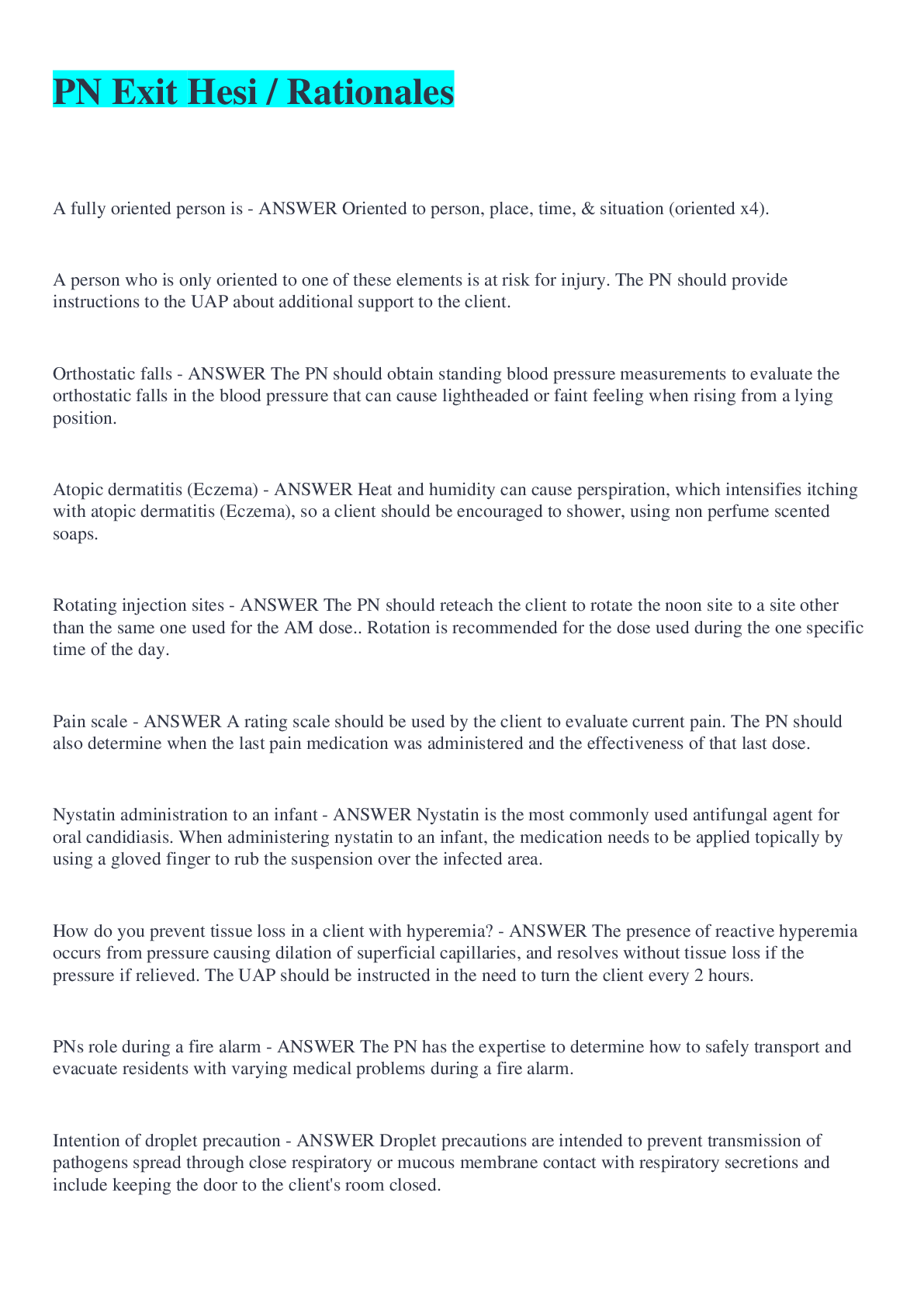
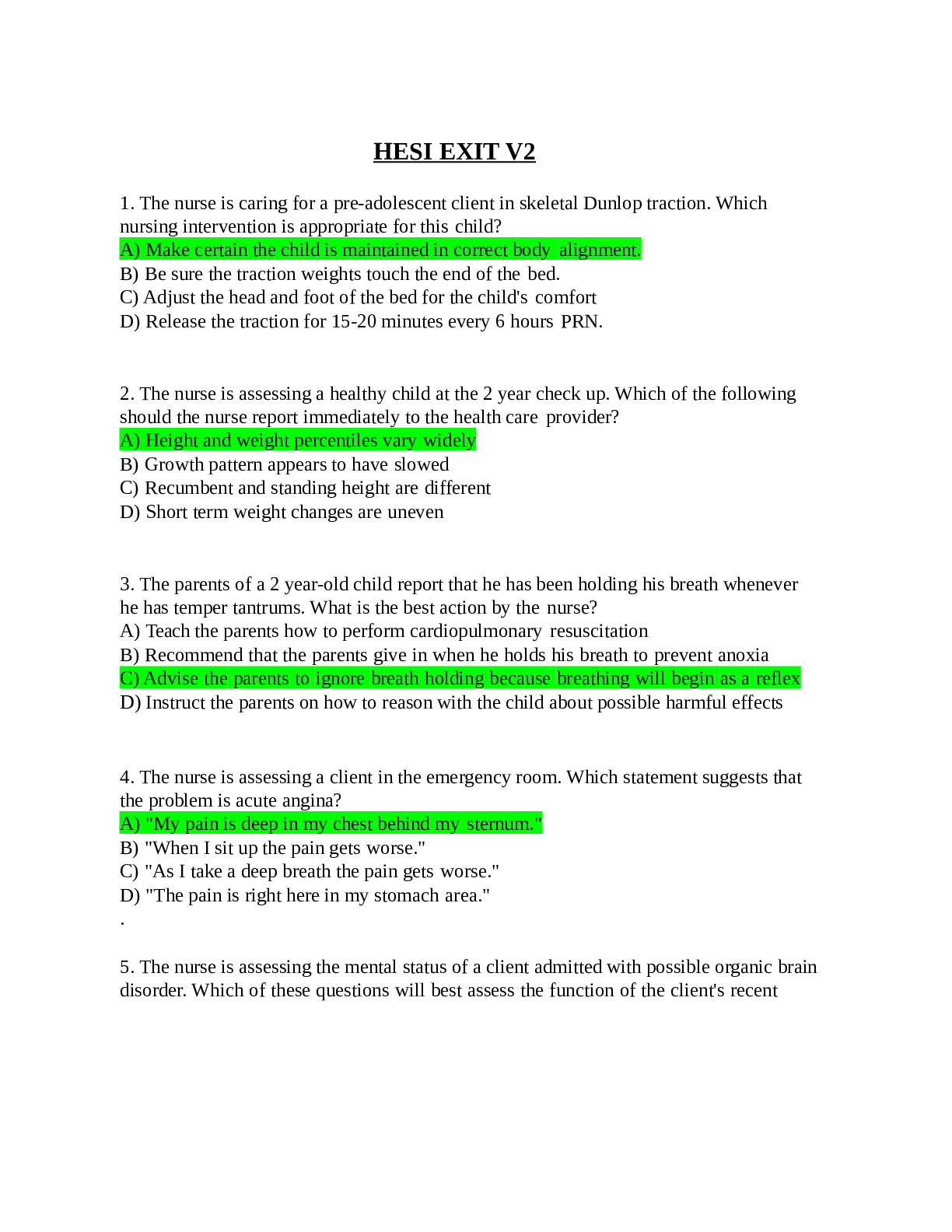
A fully oriented person is - ANSWER Oriented to person, place, time, & situation (oriented x4). A person who is only oriented to one of these elements is at risk for injury. The PN should provide ... instructions to the UAP about additional support to the client. Orthostatic falls - ANSWER The PN should obtain standing blood pressure measurements to evaluate the orthostatic falls in the blood pressure that can cause lightheaded or faint feeling when rising from a lying position. Atopic dermatitis (Eczema) - ANSWER Heat and humidity can cause perspiration, which intensifies itching with atopic dermatitis (Eczema), so a client should be encouraged to shower, using non perfume scented soaps. Rotating injection sites - ANSWER The PN should reteach the client to rotate the noon site to a site other than the same one used for the AM dose.. Rotation is recommended for the dose used during the one specific time of the day. Pain scale - ANSWER A rating scale should be used by the client to evaluate current pain. The PN should also determine when the last pain medication was administered and the effectiveness of that last dose. Nystatin administration to an infant - ANSWER Nystatin is the most commonly used antifungal agent for oral candidiasis. When administering nystatin to an infant, the medication needs to be applied topically by using a gloved finger to rub the suspension over the infected area. How do you prevent tissue loss in a client with hyperemia? - ANSWER The presence of reactive hyperemia occurs from pressure causing dilation of superficial capillaries, and resolves without tissue loss if the pressure if relieved. The UAP should be instructed in the need to turn the client every 2 hours. PNs role during a fire alarm - ANSWER The PN has the expertise to determine how to safely transport and evacuate residents with varying medical problems during a fire alarm. Intention of droplet precaution - ANSWER Droplet precautions are intended to prevent transmission of pathogens spread through close respiratory or mucous membrane contact with respiratory secretions and include keeping the door to the client's room closed. How should the PN respond to an RN who requested the PN to administer unlabeled medication that the PN did not draw? - ANSWER The PN can respond in an assertive manner by refusing to administer the medication but offering to assist the RN with another task. An aggressive response is refusing to administer the drug while not offering to help in another way. Slight bleeding during stoma care - ANSWER While providing stoma care with a client, it is a normal occurrence to see a little blood on a washcloth due to the stoma being a very vascular site. Upright positioning - ANSWER Sitting upright facilities diaphragm excursion and enhances thoracic and abdominal expansion. What outdoor game provides socialization for older clients? - ANSWER An outdoor team game of ring-toss provides opportunities for socialization, as well as exercise. The activity addresses the older clients' psychosocial, interpersonal and physical needs. Where is the center of gravity in an elderly client? - ANSWER The center of gravity changes as a person age from the hips to the UPPER TORSO. Where can hospice care be provided? - ANSWER Hospice care can be provided anywhere the client lives, including in the home, and focuses on comfort, dignity and emotional support. A living will - ANSWER Describes the clients desires regarding end-of life care, but does not provide specifics regarding hospice care. Under hospice care, medications are used for symptom control but also for routine medical management or treatment of medical problems. The client should plan to make decisions, in collaboration with family members as desired by the client. Presbycusis in older clients - ANSWER Hearing loss. The PN should determine if the client's hearing problem is new or gradual chronic condition. How should the PN approach a elderly client adjusting the a new nursing facility? - ANSWER Relocation often results in confusion among elderly clients during times of adjustment to new surroundings. The PN should remind the client which day it is when she forgets or becomes confused. Airway clearance - ANSWER Airway clearance is the highest priority nursing intervention, and further resuscitative efforts are effective only when the airway is patent. Suctioning clears passages and prevents mucus or feedings from obstructing the airway during resuscitation. The fetal heart rate is 180, what action should the PN take? - ANSWER Although a fetal heart rate of 180 (Normal Range is 110-160) may be an acceleration secondary to fetal movement, this finding should be reported immediately to the RN it indicates tachycardia which requires further assessment. A pregnant client reports contractions that are 7-15 minutes apart, lasting 20-30 seconds with mild intensity. What should the PN instruct her to do? - ANSWER The contractions of true labor generally begin in the back and radiate to the front of the abdomen, and become increasingly regular, stronger and longer-lasting. The client is not yet in active labor and would probably be more comfortable at home until she is in labor. Which food options would you offer a vegetarian client in need of foods high in iron? - ANSWER The client should be encouraged to increase her intake of green leafy vegetables such as Spinach, Broccoli, Kale and other vegetarian sources of iron, such as oatmeal, lentils and black beans. A postpartum client is shaking and states that she is cold. Which action should the PN take? - ANSWER Maternal Vasomotor instability after delivery is usually manifested by uncomfortable shaking and reports of being cold. The PN should apply warmed blankets to provide external warmth. What interventions should be used for a newborn with signs of hypoglycemia? - ANSWER For a newborn who is exhibiting signs of hypoglycemia (Normal Glucose 70-110 mg/Dl or less than 6.1mmol/l or SI units) which is common in infants born to mothers with gestational diabetes, early and prompt feeding should begin to alleviate hypoglycemia. A postpartum clients fundus is elevated above the umbilicus. What action should the PN take? - ANSWER A fundus that is dextroverted (Up to the right) and elevated above the umbilicus is indicative of bladder distension and urine retention. The PN should ensure that the client empties her bladder before the post-partum exam. What should the PN monitor in a pregnant client who received an epidural? - ANSWER Epidural anesthesia can cause peripheral vasodilation. Maternal hypotension is the most serious adverse effect of epidural anesthesia during labor, which can reduce both maternal and fetal oxygenation. Minimizing damage to the skin - ANSWER Keeping fingernails short with rough edges filed help minimize excoriation from scratching the pruritic (Itch area). An immunocompromised client is displaying multiple symptoms suggesting an infection is occurring. What action should the PN take? - ANSWER Since the client has other symptoms of an infection: Cough and yellow tinged sputum. The priority action is to notify the charge nurse of the findings so that the health care provider can be contacted and medical treatment can be initiated. A client is found unresponsive. What should the PN do? - ANSWER When a client is found unresponsive, the PN should first obtain emergency help, a task that can be assigned to the UAP. What is the purpose of the Glasgow coma scale? - ANSWER The purpose of the Glasgow coma scale is to determine the level of consciousness. Although the status of the cranial nerves and the ability to respond verbally is evaluated using this scale. The primary assessment is to determine the level of consciousness. Where are the submandibular nodes located? - ANSWER The submandibular nodes are found beneath the mandible or lower jaw. What is an indication that a myocardial infarction occurred? - ANSWER Elevations in the serum troponin 1 and Ck-MD indicated Myocardial cell damage which can cause and instability of the Myocardial cell membrane and can be precipitate life. The incidence of dysthymias in the immediate post-MI period is the greatest complication. Troponin 1, CK, CK-MB, and myoglobin. Evisceration - ANSWER Evisceration is the complete separation of a wound with protrusion of the viscera, which usually occurs 7-10 days Post Operative. A client is in buck's skin traction, where should the PN assess for infection? - ANSWER Insertion of a pin into bone places the client at risk for infection of the bone and surrounding tissues. It is most important for the PN to asses the area surrounding the skeletal pin insertion for signs of inflammation. What should be monitored in a client with hydrocephalus? - ANSWER The effectiveness of the shunt is determined by monitoring the daily head circumference, body temperature and intake and output. Glomerulonephritis and hematuria - ANSWER Presents with urine color changes due to hematuria, proteinuria and renal dysfunction that causes fluid retention edema and hypertension without or without oliguria. The typical motivator for the parents to seek medical help for a child is hematuria. What intervention should the PN use to help decrease the stress of a pediatric client? - ANSWER Common fears of toddlers include the loss of parents and fear of strangers. Allowing the child to be held by the primary caregiver is likely to help reduce the child's stress. Medication and photosensitivity - ANSWER Medications that cause photosensitivity increase sensitivity to sun light. The client should be reminded to protect skin from sunlight. A persistent dry cough is a side effect of what drug(s)? - ANSWER A persistent dry cough is a side effect of the antihypertensive agent quinapril, an angiotensin- Converting enzyme (ACE Inhibitor). What should the PN monitor in a client who is on antibiotics? - ANSWER The PN should monitor the clients WBC and the presence of specific microorganisms in sputum and their sensitivity to the anti-infective is determined by the sputum culture and sensitivity analysis. How should the PN determine which client to see first? - ANSWER When deciding which client to assess first, the priority is the client who is at highest risk for rapid deterioration due to cardiac dysfunction and hypoxia. The legal standard of care applied in nursing malpractice cases is - ANSWER What a reasonably prudent nurse would have done under similar circumstances. What is a PNs scope of practice limited to? - ANSWER The PN's scope of practice is limited to demonstrations, explanations, and reinforcement of teaching to clients. Professionalism on the hospital unit floor - ANSWER Professionalism respects the boundaries of self, the profession and others. The best action for the peer nurse to do is stop the inappropriate behavior in the amicable manner and redirect the PN to take the discussion to a non- public area. Such as NURSES LOUNGE. What should the PN evaluate in a client with a low serum sodium level? - ANSWER An excessively low serum sodium level (Normal 135-145 ME/Q/L) May be the result of water intoxication. The PN Should evaluate the client's daily consumption of ice or water. Why is distraction used during some procedures? - ANSWER Distraction is used to direct the client's attention to something other than the pain. Thereby reducing awareness of the pain for a period of time as talking about a favorite past event. Comfort measures - ANSWER Comfort measures such as repositioning and a back rub, are the least invasive and should be initiated before other interventions are implemented Neglect syndrome - ANSWER Neglect syndrome occurs following a stroke when the client loses awareness of the side of the body affected by the stroke. It is important that caregivers protect the affected side since the client has lost this awareness. Neglect syndrome is not related to abuse or neglect by caregivers. Bone repair and callus formation - ANSWER Callus formation is visualized on X- Ray and is a normal stage of bone repair that indicates osteoblasts, blood vessels, and fibroblasts are surrounding the fracture site and inflating cartilage synthesis, bone formation and healing. The PN should explain this NORMAL HEALING PROCESS. A client taking an SSRI presents with restlessness, tachycardia, fever, and elevated blood pressure. What should the PN do first? - ANSWER The PN should first contact the health care provider immediately and hold all paroxetine doses until further prescriptions are provided. Supporting a client after a mastectomy. What to do if the client doesn't want to talk? - ANSWER Accepting the client's refusal and offering to be available when the client is ready to talk about the mastectomy displays the PN's sensitivity, understanding and support of the client without judging or dismissing the clients attempt to cope. What should the PN expect from a client going through cocaine withdrawal? - ANSWER During cocaine withdrawal the PN should expect the client to experience intense cravings and a pattern of withdrawal symptoms described as a "Crash" Locations to check O2 saturation - ANSWER A finger or toe clip-on probe is most commonly used, but adhesive sensors can be applied to the nose or the forehead. A clip-on probe is available for use on an earlobe or an infant's foot. Live immunizations and steroids - ANSWER No live immunizations should be administered during therapy with steroids. Buck's skin traction - ANSWER Be sure the weights are hanging free. If the weights are resting on or against any support, such as the foot of the bed or the floor, the purpose of the traction is defeated. Pediatric patient and medication administration - ANSWER Be honest when talking to the child; tell the child it is medicine, not "juice" or "candy." Pediatric IM injection sites - ANSWER In infants, the lateral thigh (vastus lateralis muscle) should be used. In toddlers and preschoolers, the ventrogluteal area is the preferred site (lateral thigh can also be used). In older children and adolescents, other regularly used injection sites may be used (ventrogluteal muscle is the safest; deltoid and dorsogluteal muscles may also be used). Dehiscence - ANSWER Dehiscence is a partial or complete separation of the outer wound layers, sometimes described as a "splitting open of the wound." Position for patients in cardiogenic shock - ANSWER Patients in cardiogenic shock are placed in Fowler's position to lower the diaphragm and increase oxygenation as long as they do not become too hypotensive. Vitamin D - ANSWER Found in fortified milk and margarine, cod liver oil, fatty fish, and eggs Vitamin K - ANSWER Found in leafy green vegetables and liver; synthesized by bacteria in the colon Vitamin B12 - ANSWER Found in muscle and organ meats, eggs, shellfish, and dairy products When should the PN contact the health care provider? - ANSWER Falls Deteriorate significantly or dies Has critical lab results Needs a prescription that requires clarification Leave against medical advice (AMA) or runs away Refuses key treatments Cancer of the larynx risk factors - ANSWER Men Smoking Chewing tabaco Alcohol When auscultating lungs with no air movement what should the PN expect to hear? - ANSWER Diminished or absent breath sounds. What could NG suctioning lead to? - ANSWER Metabolic Alkalosis. What is the plan of care for someone who experiences musculoskeletal pain? - ANSWER Monitoring for changes at the injured site, complications, and outcomes of analgesics. [Show More]

Last updated: 3 years ago

Preview 1 out of 10 pages

Buy Now

Instant download

We Accept:

Payment methods accepted on Scholarfriends (We Accept)
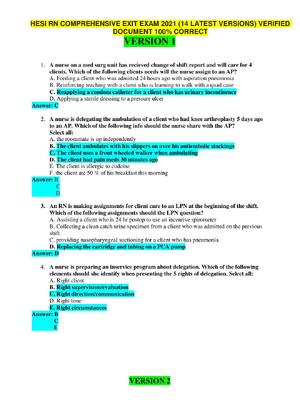
Preview image of PN Exit Hesi / Rationales document

Buy this document to get the full access instantly

Instant Download Access after purchase

Buy Now

Instant download

We Accept:

Payment methods accepted on Scholarfriends (We Accept)

Reviews( 0 )

$6.00

Buy Now

We Accept:

Payment methods accepted on Scholarfriends (We Accept)

Instant download

Can't find what you want? Try our AI powered Search

63
0

Document information


Connected school, study & course


About the document


Uploaded On

Oct 03, 2022

Number of pages

10

Written in

All

Seller


Profile illustration for Nancylect
Nancylect

Member since 3 years

102 Documents Sold

Reviews Received
9
2
1
0
4
Additional information

This document has been written for:

Uploaded

Oct 03, 2022

Downloads

 0

Views

 63

Document Keyword Tags

Recommended For You

Get more on HESI »

$6.00
What is Scholarfriends

Scholarfriends.com Online Platform by Browsegrades Inc. 651N South Broad St, Middletown DE. United States.

We are here to help

We're available through e-mail, Twitter, Facebook, and live chat.
 FAQ
 Questions? Leave a message!

Follow us on
 Twitter

Copyright © Scholarfriends · High quality services·