*NURSING > QUESTIONS & ANSWERS > Chapter 30--Assessment of Respiratory Function (All)
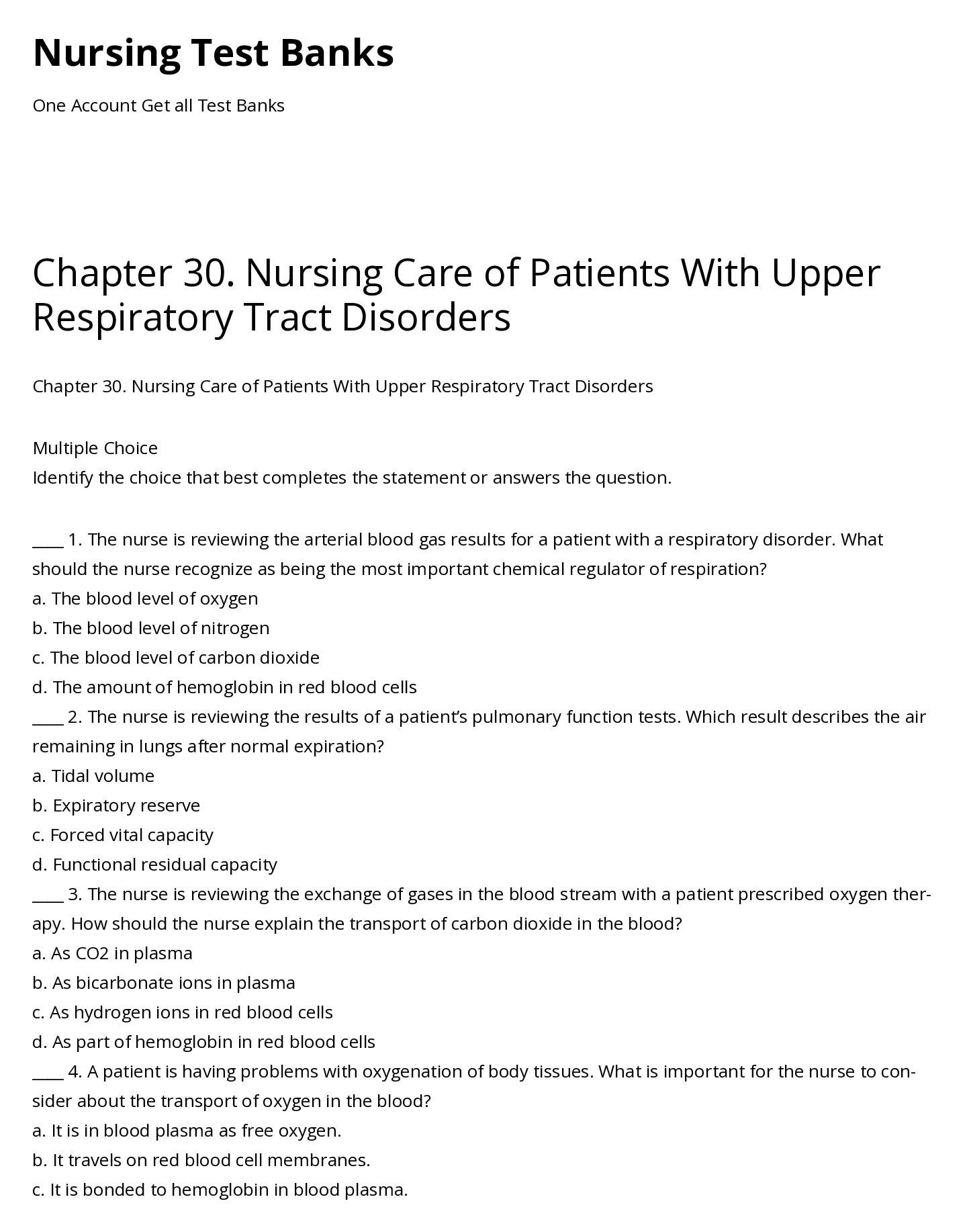
Chapter 30--Assessment of Respiratory Function MULTIPLE CHOICE 1. A client is experiencing the ventilation-perfusion mismatch termed shunting. The nurse realizes that the client most likely is ... not experiencing which of the following disorders? 1. Hemothorax 2. Intrapulmonary fistulas 3. Pneumothorax 4. Pulmonary embolus PTS: 1 DIF: Analyze REF: Ventilation-Perfusion Dysfunction 2. A client has a slight shift to the left on the oxygen-hemoglobin dissociation curve. Which of the following assessment findings will support this curve configuration? 1. Arterial pH less than 7.35 2. Increased levels of 2,3-diphosphoglycerate 3. Hyperthermia 4. Hypothermia PTS: 1 DIF: Analyze REF: Oxygen-Hemoglobin Dissociation Curve 3. A client, experiencing an acid-base imbalance, demonstrates signs of full compensation within 3 days. The nurse realizes that the full compensation was accomplished by which of the following systems? 1. Extracellular buffer 2. Intracellular buffer 3. Pulmonary 4. Renal PTS: 1 DIF: Analyze REF: Compensatory Mechanisms 4. A client with a nasogastric tube connected to low continuous suction has the following arterial blood gas (ABG) results: pH 7.49, PaO2 91, PaCO2 42, and HCO3 31. Interpreting these result, the nurse concludes that the client is in: 1. metabolic acidosis. 2. metabolic alkalosis. 3. respiratory acidosis. 4. respiratory alkalosis. PTS: 1 DIF: Analyze REF: Arterial Blood Gas Analysis 5. A client is demonstrating signs of respiratory alkalosis. The nurse realizes that this alteration is least likely caused by which of the following? 1. Diarrhea 2. Fever 3. Pain 4. Severe anemia PTS: 1 DIF: Analyze REF: Table 30-1 Causes of Acid-Base Imbalances 6. A client has a productive cough that produces green sputum with a musty odor. The nurse realizes that the client may be experiencing: 1. emphysema. 2. pneumococcal pneumonia. 3. Pseudomonas infection. 4. pulmonary edema. PTS: 1 DIF: Analyze REF: Table 30-2 Sputum in Pulmonary Conditions 7. A client is experiencing a gradual increase of pleuritic pain. In which of the following pulmonary conditions would the nurse expect to see this type of pain? 1. Pneumococcal pneumonia 2. Pneumothorax 3. Pulmonary embolism 4. Tuberculosis PTS: 1 DIF: Analyze REF: Assessment: History Taking 8. The nurse is assessing a client diagnosed with emphysema. Which of the following will most likely be assessed during the client’s physical examination? 1. Barrel chest 2. Pectus carinatum 3. Pectus excavatum 4. Scoliosis PTS: 1 DIF: Apply REF: Skeletal Deformities 9. The nurse is assessing an adult patient experiencing hypoxia. Which of the following findings would be considered a late sign of hypoxia? 1. Confusion 2. Cyanosis 3. Drowsiness 4. Headache PTS: 1 DIF: Analyze REF: Signs of Respiratory Distress 10. A client is diagnosed with a large pneumothorax. The percussion note the nurse would expect to find is: 1. dullness. 2. flatness. 3. resonant. 4. tympany. PTS: 1 DIF: Apply REF: Table 30-3 Percussion Notes and Associated Conditions 11. A client is demonstrating a crescendo-decrescendo pattern of breathing with periods of apnea. The nurse would document this breathing pattern as being: 1. Cheyne-Stokes. 2. apnea. 3. bradypnea. 4. Kussmaul. PTS: 1 DIF: Apply REF: Figure 30-14 Rhythms of Breathing 12. The nurse, assessing a client’s breath sounds, has the stethoscope placed over the second intercostal space next to the sternum. The sound the nurse is most likely going to hear would be: 1. vesicular. 2. bronchovesicular. 3. bronchial. 4. absent. PTS: 1 DIF: Analyze REF: Table 30-4 Normal Breath Sounds 13. A client is determined to be a candidate for a low-flow oxygen delivery system. Which of the following will the nurse most likely assess in this client? 1. Active bleeding 2. Change in level of consciousness 3. Cardiac arrhythmias 4. Respiratory rate of 16, unlabored breathing PTS: 1 DIF: Apply REF: Oxygen Delivery Systems MULTIPLE RESPONSE 1. The nurse is assessing a client for decreased fremitus. Which of the following conditions are associated with decreased fremitus? (Select all that apply.) 1. Atelectasis 2. Emphysema 3. Pneumonia 4. Pneumothorax 5. Pulmonary fibrosis 6. Pulmonary infarction PTS: 1 DIF: Analyze REF: Fremitus 2. The nurse is documenting that a client has adventitious breath sounds. Which of the following would be considered this type of sound? (Select all that apply.) 1. Rales 2. Vesicular 3. Rhonchi 4. Wheeze 5. Bronchovesicular 6. Pleural friction rub PTS: 1 DIF: Analyze REF: Table 30-5 Adventitious Breath Sounds 3. The nurse is assessing the thorax of an elderly client. Which of the following would be considered normal age-related changes in this client’s respiratory system? (Select all that apply.) 1. Hyperresonance 2. Pain with inspiration 3. Vital capacity reduced 4. Hemoptysis 5. Productive cough 6. Wheezes PTS: 1 DIF: Analyze REF: Age-Related Changes in the Respiratory System 4. A client is scheduled for a ventilation-perfusion scan. The nurse realizes that this diagnostic test is used to diagnose which of the following? (Select all that apply.) 1. Pulmonary emboli 2. Congestive heart failure 3. Bronchitis 4. Asthma 5. Pneumonia 6. COPD PTS: 1 DIF: Analyze REF: Ventilation-Perfusion Scan 5. A client is prescribed a bedside diagnostic test to assess pulmonary status. The nurse will prepare to administer which of the following to the client? (Select all that apply.) 1. Capnography 2. Thoracentesis 3. Oximetry 4. Bronchoscopy 5. Polysomnography 6. Lung biopsy PTS: 1 DIF: Apply REF: Bedside Monitoring Diagnostic Tests [Show More]
Last updated: 3 years ago
Preview 1 out of 5 pages
Buy this document to get the full access instantly
Instant Download Access after purchase
Buy NowInstant download
We Accept:
Can't find what you want? Try our AI powered Search
Connected school, study & course
About the document
Uploaded On
Jan 28, 2020
Number of pages
5
Written in
All
This document has been written for:
Uploaded
Jan 28, 2020
Downloads
0
Views
46
Scholarfriends.com Online Platform by Browsegrades Inc. 651N South Broad St, Middletown DE. United States.
We're available through e-mail, Twitter, and live chat.
FAQ
Questions? Leave a message!
Copyright © Scholarfriends · High quality services·