Adolescent breast development competence
1. stimulation of...
2. breast development: _____ years of Tanner Staging
3. Menarche
4. Temporary asymmetry of breasts - ANSWER 1. estrogen
2. 8-10
Pregnant women bre
...
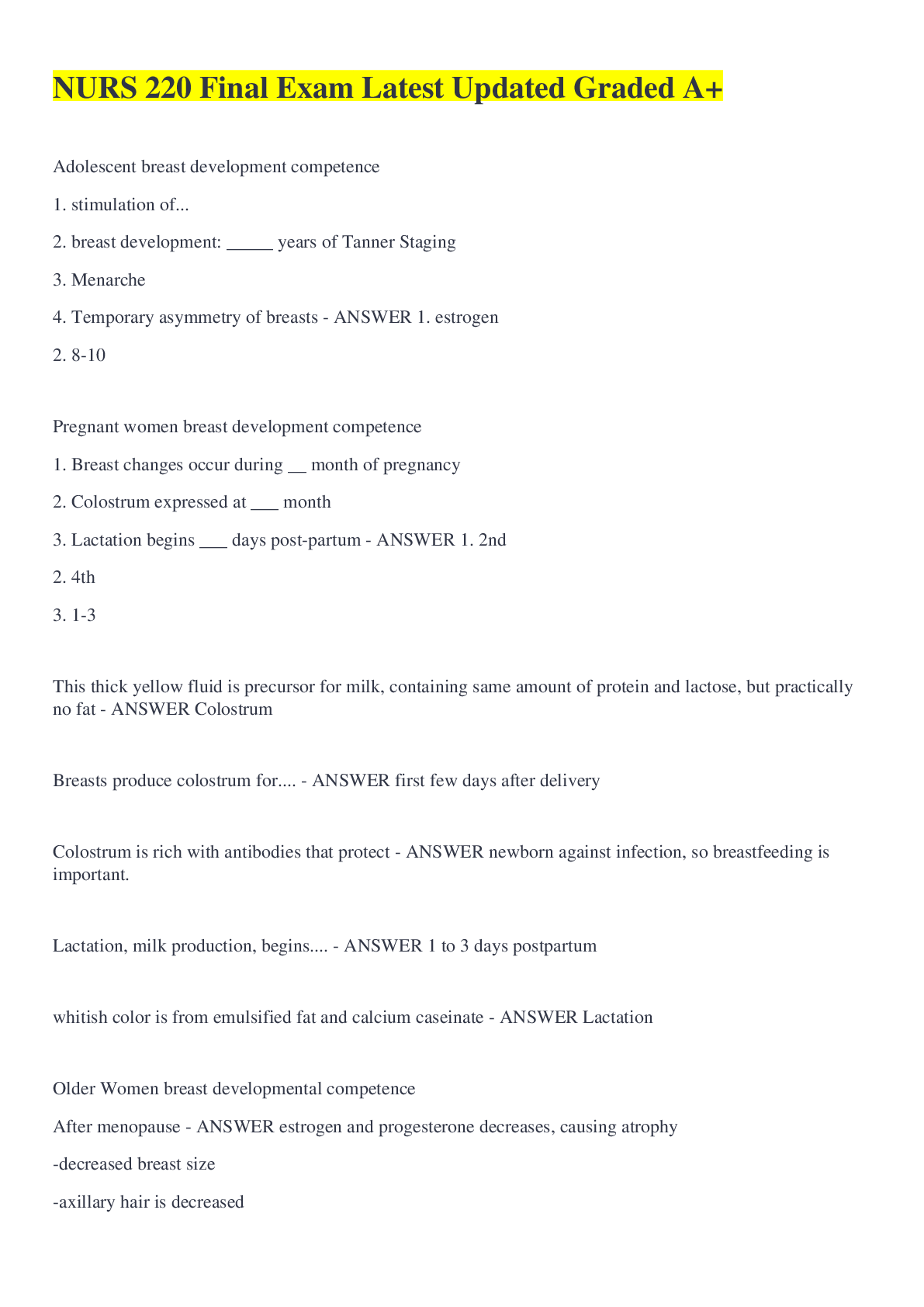
Adolescent breast development competence
1. stimulation of...
2. breast development: _____ years of Tanner Staging
3. Menarche
4. Temporary asymmetry of breasts - ANSWER 1. estrogen
2. 8-10
Pregnant women breast development competence
1. Breast changes occur during __ month of pregnancy
2. Colostrum expressed at ___ month
3. Lactation begins ___ days post-partum - ANSWER 1. 2nd
2. 4th
3. 1-3
This thick yellow fluid is precursor for milk, containing same amount of protein and lactose, but practically no fat - ANSWER Colostrum
Breasts produce colostrum for.... - ANSWER first few days after delivery
Colostrum is rich with antibodies that protect - ANSWER newborn against infection, so breastfeeding is important.
Lactation, milk production, begins.... - ANSWER 1 to 3 days postpartum
whitish color is from emulsified fat and calcium caseinate - ANSWER Lactation
Older Women breast developmental competence
After menopause - ANSWER estrogen and progesterone decreases, causing atrophy
-decreased breast size
-axillary hair is decreased
-A lump that may be present for years may appear
-Around nipple, the lactiferous ducts are more palpable and feel firm and stringy because of fibrosis and calcification
Male Breast Developmental Competence
-Rudimentary structure consisting... (1)
-(2) during adolescent is common (usually unilateral and temporary).This may reappear in aging male and may be due to testosterone deficiency - ANSWER (1) of a thin disk of undeveloped tissue underlying nipple
(2)Gynecomastia
Onset of Puberty
-Research data indicate age differences in onset of puberty according to different... (1)
- (2) contributes to early onset of puberty
-Menses began at an average age of (3) years for black girls and age (3) for white girls. - ANSWER (1) ethnic groups.
(2) Obesity
(3) 12.16, 13
second major cancer death cause in women - ANSWER breast cancer
what has increased rate of survival for breast cancer - ANSWER early detection and improved treatment
Women who inherit mutations of BRCA 1 and BRCA 2 on one or both sides are at an increased risk for developing... - ANSWER breast or ovarian cancer.
Women's Health Initiative (WHI) study looked at increased risk linkage with use of combined... - ANSWER hormone replacement therapy (HRT) and development of breast cancer.
Screening mammography annual screening is recommended starting at age - ANSWER 40
Lifestyle risk factors relate to risk of breast cancer - ANSWER -Alcohol has dose-dependent effect.
-Continuation of physical exercise during aging helps reduce risk.
-Postmenopausal weight gain negates effects of physical exercise.
Factors contributing to breast health care access include - ANSWER low income, lack of health insurance, geographic, cultural and language barriers, and racial bias.
"Alcohol/Western" dietary pattern linked to increased risk of... - ANSWER breast cancer, especially with estrogen or progesterone + tumors
"Mediterranean" dietary pattern linked to a modest protective effect against - ANSWER breast cancer
Risk is different depending on type: combination HRT - increases risk by _____ even when only for a short period of time (Pempro); estrogen only HRT increases risk by ____ but only when used for more than 10 years - ANSWER 75%
10%
is asymmetry in breast size common - ANSWER yes, left breast is slightly larger than the right
Inspection of skin of breast - ANSWER -Normally smooth and of even color
-Note any localized areas of redness, bulging, or dimpling; also any skin lesions or focal vascular pattern.
-Fine blue vascular network visible during pregnancy; pale linear striae, or stretch marks, follow pregnancy.
-Normally no edema is present.
Inspection of Nipple (normal findings) - ANSWER Normal nipple inversion may be unilateral or bilateral and usually can be pulled out.
No scaling, any fissure or ulceration, and bleeding or other discharge
Supernumerary nipple - ANSWER -normal variation
-An extra nipple along embryonic "milk line" on thorax or abdomen is congenital finding.
-Usually below breast near midline and has no associated glandular tissue; looks like a mole, although a close look reveals a tiny nipple and areola.
As breast cancer advances, it can cause... - ANSWER skin dimpling (shortening of tissue) and retraction (of nipple)
fibroadenoma - ANSWER non-cancerous tumor
A pigskin-like or orange-peel appearance results from edema, which is seen in metastatic breast disease. (true or false) - ANSWER true
Gynecomastia - ANSWER is a benign growth of this breast tissue, making it distinguishable from other tissues in chest wall.
Feels like a smooth, firm, movable disk
Gynecomastia occurs normally during... - ANSWER puberty and is temporary
Gynecomastia in older adults can be a side effect of certain medication such as - ANSWER spironolactone.
Examine axillae while woman is - ANSWER sitting
Inspection & Palpitation of Axilla:
Reach fingers high into axilla; move them firmly down in four directions - particular attention to.... - ANSWER upper outer quadrant, site of most lumps
Palpation of Breast help woman into __________ position - ANSWER supine
how do you palpate breasts? - ANSWER Use pads of your first three fingers and make a gentle rotary motion on breast; vary pressure palpating light, medium, and deep tissue in each location.
what pattern is currently recommended to detect a breast mass? - ANSWER vertical strip pattern
ALSO: From the nipple palpating out to periphery as if following spokes on a wheel & Palpating in concentric circles out to periphery
In nulliparous women, normal breast tissue feels ________. After pregnancy, tissue feels _________. - ANSWER firm, smooth, and elastic.
softer and looser
Premenstrual engorgement is normal from - ANSWER increasing hormones
If woman reports spontaneous nipple discharge.... - ANSWER press areola inward with your index finger; repeat from a few different directions; note color and consistency of any discharge
If woman mentions a breast lump that she has discovered herself, examine what first? - ANSWER examine unaffected breast first to learn a baseline of normal consistency for this woman.
Characteristics of Lump or Mass - ANSWER Location
Size
Shape
Consistency
Movability
Distinctness
Nipple
Note skin over lump
Tenderness
Lymphadenopathy
Location of Lump - ANSWER as with clock face, describe distance in centimeters from nipple; or diagram breast in woman's record and mark in location of lump.
Size of Lump - ANSWER judge in centimeters in three dimensions: width, length, and thickness.
Shape of Lump - ANSWER state whether lump is oval, round, lobulated, or indistinct.
Consistency of Lump - ANSWER state whether lump is soft, firm, or hard.
Movability of Lump - ANSWER is lump freely movable or fixed when you try to slide it over chest wall?
Distinctness of Lump - ANSWER is lump solitary or multiple?
Nipple (Lump) - ANSWER is it displaced or retracted?
Note skin over lump - ANSWER is it erythematous, dimpled, or retracted?
Tenderness of lump - ANSWER is lump tender to palpation?
[Show More]