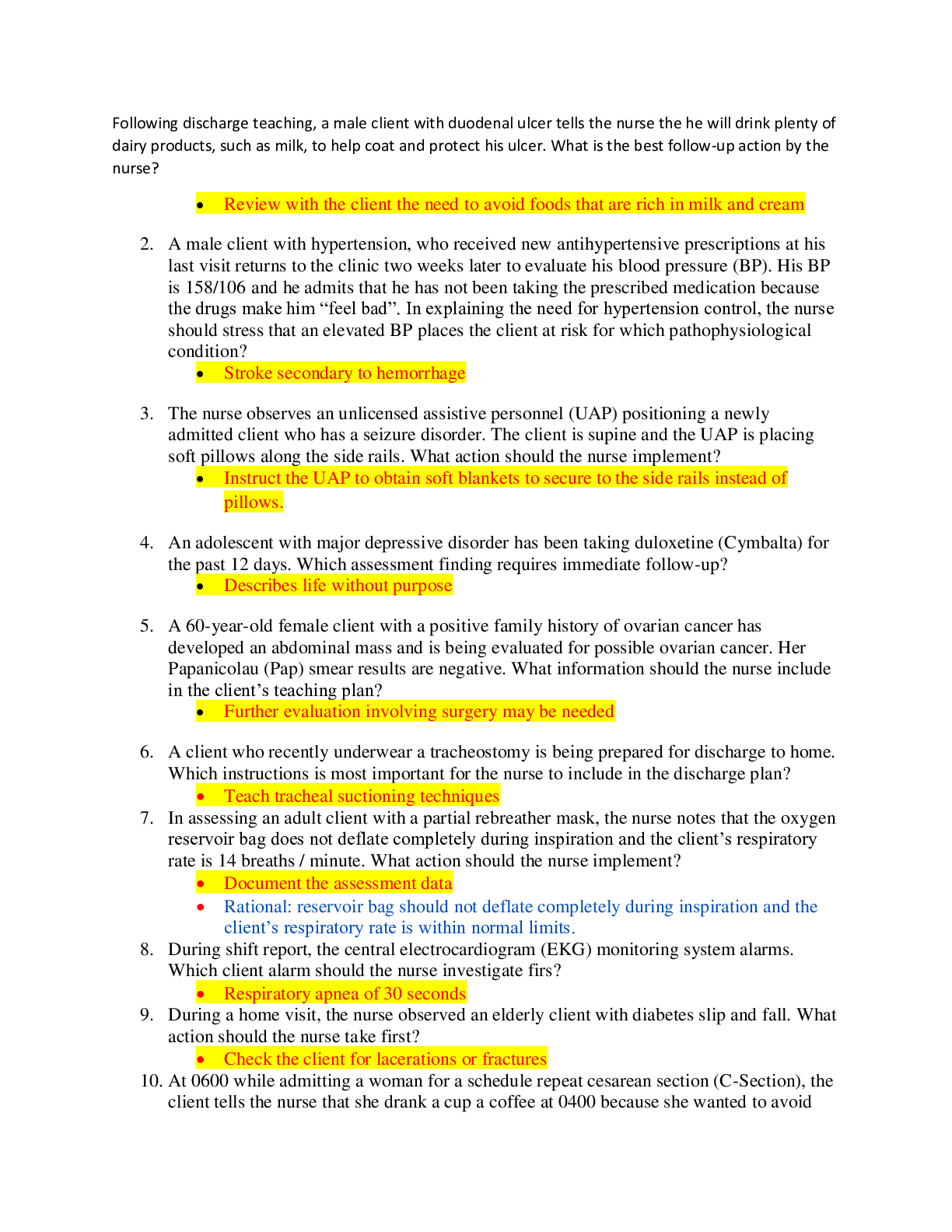
Review questions chapter one from Evolve.
1. It is true that a eukaryotic cell
2. The function of a histone found in a eukaryote cell focuses on cellular
3.An organelle that is responsible for the metabolism
...
Review questions chapter one from Evolve.
1. It is true that a eukaryotic cell
2. The function of a histone found in a eukaryote cell focuses on cellular
3.An organelle that is responsible for the metabolism of cellular energy is referred to as a/an
4.Which statement best describes a desmosome?
5.Which statement describes the function of a second messenger?
6.Which statement is correct regarding cellular energy?
7. Movement of a solute molecule from an area of high concentration to an area of low concentration is called
8. Which is an example of an energy-releasing process?
9. Which describes an amphipathic molecule?
10. Which are the roles of relay chains in signal transduction?
11. which are functions of a protein?
CHAPTER 2 STUDY QUESTIONS
1.
1. What is a collection of blood that is located between the skull and the dura is called?
A. Epidural hematoma
B. Contusion
C. Subdural hematoma
D. Subarachnoid hemorrhage
2. 2.
The possible diagnosis of shaken baby syndrome is supported when an infant brought to the emergency department is found to have which type of cerebral hematoma?
A. Epidural
B. Subdural
C. Subarachnoid
D. Avulsion
3. 3.
Which term describes a tear or rip of the skin with a jagged and irregular edge?
A. Abrasion
B. Incision
C. Laceration
D. Incised wound
4. 4.
Which term describes oxygen failing to reach the blood?
A. Suffocation
B. Strangulation
C. Drowning
D. Petechiae
5. 5.
What is the physiologic mechanism associated with heat exhaustion?
A. Peripheral vasoconstriction
B. Degenerative changes in the myelin sheath
C. Hemoconcentration from salt and water loss
D. Significantly increased blood volume
6. 6.
Which statement regarding altitude and illness is true?
A. Caisson disease occurs when descending too quickly while diving.
B. Pulmonary edema is the result of hypoxia and increased pulmonary hypertension.
C. Gas emboli are caused by oxygen bubbles.
D. Altitude sickness occurs from blast injuries.
7. 7.
Which form of necrosis is associated with tuberculous infections?
A. Coagulative
B. Liquefactive
C. Fat
D. Caseous
8. 8.
Which are causes of cellular injury? (Select all that apply.)
A. Antioxidants
B. Chemical agents
C. Hypoxia
D. Mechanical factors
9. 9.
Which are the most common risks of lead exposure in children? (Select all that apply.)
A. Slowed growth
B. Psychosis
C. Reduced IQ
D. Attention-deficit/hyperactivity disorder (ADHD)
10. 10.
Which statements are true regarding apoptosis? (Select all that apply.)
A. An active process of cellular self-destruction
B. A process that deletes cells during embryonic development
C. Local cell death after severe and sudden injury
D. Causes cell loss in proliferating cell populations
CHAPTER 3 STUDY QUESTIONS
1.when considering water balance, which statement demonstrates the correct balance?
A. Isotonic fluids cause increased cellular swelling.
B. Hypertonic fluid causes increased cellular swelling.
C. Hypotonic fluid causes cellular swelling.
D. Hypernatremia causes cellular swelling.
2.Which statement is true regarding hyperchloremia?
E. Occurs with a deficit of sodium
F. Occurs with an excess of bicarbonate
G. Has specific symptoms such as thirst
H. Requires treatment of the underlying disorder
2. 3.
Which statement is true regarding hyponatremia?
A. Is commonly caused by inadequate sodium intake
B. Can occur with a decrease in total body water (TBW)
C. Never occurs with burns, vomiting, or diarrhea
D. Occurs when sodium drops below 135 mEq/L
3. 4.
Which statement is true regarding potassium balance?
A. Potassium is the major extracellular electrolyte.
B. During acidosis, potassium shifts into the cell.
C. Aldosterone is secreted when potassium is decreased.
D. Insulin causes the movement of potassium into the cell.
4. 5.
Which statement is true regarding hypokalemia?
A. Hypokalemia occurs when the serum level is below 45 mEq/L.
B. One cause of hypokalemia is diabetic ketoacidosis.
C. Dietary causes of hypokalemia are common.
D. Diuretics do not cause hypokalemia.
5. 6.
Hypernatremia is defined as levels above
A. 145 mEq/L.
B. 5.0 mEq/L.
C. 105 mEq/L.
D. 9.0 mg/dL.
6. 7.
Which statement is true regarding magnesium?
A. Hypomagnesemia occurs with a concentration greater than 2.5 mEq/L.
B. Magnesium is a major extracellular cation.
C. Thirty percent is stored in the muscle and bone.
D. Symptoms of hypomagnesemia include weakness and depression.
7. 8.
Which statement describes acidemia?
A. State in which the pH of arterial blood is greater than 7.45
B. State in which the pH of arterial blood is less than 7.35
C. Systemic decrease in hydrogen ion concentration
D. Systemic excess of base
8. 9.
Common causes of edema formation (increased filtration of fluid from capillaries and lymph into surrounding tissues) include which of the following? (Select all that apply.)
A. Decreased capillary hydrostatic pressure
B. Decreased capillary oncotic pressure
C. Increased capillary membrane permeability
D. Lymphatic obstruction
E. Sodium retention
9. 10.
Which are clinical manifestations of hypokalemia? (Select all that apply.)
A. Decreased insulin secretion
B. Impaired renal function
C. Decreased neuromuscular excitability
D. Increased contractility of skeletal muscle
10. 11.
Which treatments are appropriate for hyperkalemia? (Select all that apply.)
A. Calcium gluconate
B. Treating the contributing cause
C. Glucagon
D. Buffered solutions
WEEK 7 STUDY QUESTIONS
1.
1. 1.
Which of the following is an example of a physical barrier?
A. Antibacterial fatty acids
B. Lysozymes in tears
C. Epithelial cells
D. Earwax
2. 2.
Which statement is true regarding the inflammatory response?
A. Inflammatory response is the third line of defense.
B. Inflammatory response relies on cellular components only.
C. Inflammatory response generates a nonspecific response.
D. Inflammatory response occurs in nonvascular tissue.
3. 3.
Which complement factor is considered an anaphylatoxin?
A. C3a
B. C1
C. C7
D. C9
4. 4.
Which receptor is expressed on macrophages and facilitates recognition and phagocytosis of bacterial pathogens?
A. Complement receptors
B. Scavenger receptors
C. Toll-like receptors
D. Pattern recognition receptors
5. 5.
Which statement regarding mast cells is true?
A. Histamine causes vasoconstriction.
B. Mast cells are found only in blood vessels.
C. Snake bites, bee venoms, and toxins may cause activation.
D. Mast cells are not involved in allergic reactions.
6. 6.
Which term describes an acidic sulfur-containing lipid that produces effects similar to histamine?
A. Leukotriene
B. Prostaglandin
C. Adhesion molecule
D. Phagocyte
7. 7.
Which statement is true regarding neutrophils?
A. Neutrophils are agranular.
B. Neutrophils are the predominant phagocytes of early inflammation.
C. Neutrophils are the largest blood cells.
D. Neutrophils enter the site of injury after lymphocytes and macrophages.
8. 8.
What biochemical messenger is produced by macrophages and lymphocytes in response to a bacterial pathogen?
A. Interleukins
B. Interferons
C. Chemokines
D. Tumor necrosis factor
9. 9.
Chronic inflammation is characterized by a(an)
A. lack of giant cells.
B. absence of exudate.
C. dense infiltrate of lymphocytes and macrophages.
D. inflammation that lasts less than 2 weeks.
10. 10.
Which are not natural barriers?
A. Physical
B. Resistance
C. Biochemical
D. Mechanical
11. 11.
Which characteristics are observable of vascular injury and inflammation? (Select all that apply.)
A. Redness
B. Coolness to the touch
C. Warmth to the touch
D. Increased swelling
E. Pain
12. 12.
Which pathways activate the complement system? (Select all that apply.)
A. Antigen antibody
B. Classical
C. Lectin
D. Alternative
13. 13.
Which functions of the clotting system are exhibited at the site of injury or inflammation? (Select all that apply.)
A. Prevents the spread of infection to adjacent tissues
B. Traps microorganisms at the site of inflammation for removal
C. Prevents clot formation at the site of injury
D. Provides a framework for future repair and healing
14. 14.
Which are systemic effects of inflammation? (Select all that apply.)
A. Abscess formation
B. Fever
C. Leukocytosis
D. Increased levels of plasma proteins
E. Decreased levels of plasma proteins
CHAPTER 8 STUDY QUESTIONS
1.
1. .
A substance that is recognized as foreign or nonself is
A. immunoglobulins.
B. lymphocytes.
C. antibodies.
D. antigens.
2. 2.
Which statement is true regarding the immune response in humans?
A. Before birth, lymphocytes are not produced.
B. B lymphocytes come from the thymus.
C. The thymus releases mature lymphocytes.
D. Generation of clonal diversity occurs in primary lymphoid organs.
3. 3.
Which statement best describes the cells and their functions in the humoral arm of the immune system?
A. Cells undergo differentiation and develop into subpopulations.
B. Cells attack cancerous cells.
C. Antibodies are primarily responsible for protection.
D. Cells in the humoral arm are also called cellular immunity.
4. 4.
Which term describes the type of immunity that occurs when preformed antibodies are transferred from a donor to a recipient?
A. Passive
B. Active
C. Memory
D. Cellular
5. 5.
What is the precise portion of the antigen that is configured for recognition and binding of an antibody?
A. Paratope
B. Epitope
C. Self-antigen
D. Immunogen
6. 6.
Which antigen is too small to initiate an immune response?
A. Carrier
B. Allergen
C. Hapten
D. Self-antigen
7. 7.
Which statement is true regarding immunoglobulin A (IgA) antibodies?
A. IgA-2 is predominantly found in blood.
B. IgA-1 is predominantly found in the body’s secretions.
C. The J chain anchors together the IgA molecules.
D. IgA is the most predominant immunoglobulin.
8. 8.
It is true that immunoglobulin E (IgE) is
A. designed to protect the host from large viruses.
B. the primary cause of common allergies.
C. the only inflammatory cell that can damage a virus.
D. normally found at high concentrations in the circulation.
9. 9.
Which statement is true regarding aging and the immune system function?
A. Older adults have decreased circulating antibodies.
B. T-cell function is increased.
C. Antibody production to specific antigens is inferior.
D. Response to infection is rapid.
10. 10.
Which criteria influence the degree of immunogenicity? (Select all that apply.)
A. Foreignness to the host
B. Appropriate size
C. Appropriate quantity
D. Chemical simplicity
E. Chemical complexity
11. 11.
Which are molecular classes of immunoglobulins? (Select all that apply.)
A. IgC
B. IgD
C. IgE
D. IgM
E. IgN
CHAPTER 9 STUDY QUESTIONS
1. 1.
Which definition is true?
A. Allergy means the deleterious effects of hypersensitivity.
B. Immunity means an altered immunologic response.
C. Hypersensitivity means the protective response to an antigen.
D. Autoimmunity means the normal response to foreign antigens.
2. 2.
Which statement is true regarding hypersensitivity reactions?
A. They require sensitization against a particular antigen.
B. They occur after the primary immune response.
C. Reactions are always delayed.
D. The most delayed reaction is anaphylaxis.
3. 3.
Which statement best describes a type I reaction?
A. Most type I reactions are mediated by IgA.
B. Most type I reactions are allergic.
C. Most occur against medications.
D. Rarely does this type of reaction contribute to autoimmune diseases.
4. 4.
What antibody binds to a mast cell?
A. Cytotropic
B. Allergen
C. Antigen
D. Fc
5. 5.
Which statement is true regarding atopic individuals?
A. If one parent has allergies, then a 4% chance exists that the offspring will have similar allergies.
B. If two parents have allergies, then a 50% chance exists that their offspring will have similar allergies.
C. Atopic individuals tend to produce higher quantities of IgE.
D. No genes are associated with an atopic state.
6. 6.
Which statement is true of serum sickness?
A. Immune complexes are formed and deposited in target issues.
B. Immune complexes are formed and deposited in the blood vessels.
C. It is considered a Type II hypersensivity response.
D. Cytotoxic T lymphocytes are responsible for the condition.
7. 7.
The Arthus reaction is an example of which type of sensitivity reaction?
A. I
B. II
C. III
D. IV
8. 8.
Which statement is true regarding a type IV allergic reaction?
A. Is immediate in its action
B. Is infiltrated with B cells
C. Is mediated by antibody production
D. Can be transferred by cells
9. 9.
Which is an example of an alloimmune disease?
A. Tuberculin reaction
B. Graves disease
C. Contact dermatitis
D. Penicillin allergy
10. 10.
Which statement is true regarding unmatched packed red blood cell (RBC) transfusions?
A. Only three different RBC antigens have been identified.
B. Approximately 80 major carbohydrate antigens exist.
C. People with O type blood have neither A or B antigens.
D. A person with type A blood contains anti-O antibodies.
11. 11.
Histamine release leads to which of the following? (Select all that apply.)
A. Bronchial smooth muscle contraction
B. Bronchoconstriction
C. Decreased vascular permeability
D. Vasoconstriction
E. Edema
[Show More]





.png)


.png)