Bates’ Guide to Physical Examination and History Taking, 12th Edition
Chapter 1: Overview: Physical Examination and History Taking
Multiple Choice
1. For which of the following patients would a comprehensive health hi
...
Bates’ Guide to Physical Examination and History Taking, 12th Edition
Chapter 1: Overview: Physical Examination and History Taking
Multiple Choice
1. For which of the following patients would a comprehensive health history be appropriate?
A) A new patient with the chief complaint of “I sprained my ankle”
B) An established patient with the chief complaint of “I have an upper respiratory infection”
C) A new patient with the chief complaint of “I am here to establish care”
D) A new patient with the chief complaint of “I cut my hand”
Ans: C
Chapter: 01
Page and Header: 4, Patient Assessment: Comprehensive or Focused
Feedback: This patient is here to establish care, and because she is new to you, a comprehensive
health history is appropriate.
2. The components of the health history include all of the following except which one?
A) Review of systems
B) Thorax and lungs
C) Present illness
D) Personal and social items
Ans: B
Chapter: 01
Page and Header: 4, Patient Assessment: Comprehensive or Focused
Feedback: The thorax and lungs are part of the physical examination, not part of the health
history. The others answers are all part of a complete health history.
3. Is the following information subjective or objective?
Mr. M. has shortness of breath that has persisted for the past 10 days; it is worse with activity
and relieved by rest.
A) Subjective
B) Objective
Ans: A
Chapter: 01
Page and Header: 6, Differences Between Subjective and Objective Data
Feedback: This is information given by the patient about the circumstances of his chief
complaint. It does not represent an objective observation by the examiner.
4. Is the following information subjective or objective?
Mr. M. has a respiratory rate of 32 and a pulse rate of 120.
A) Subjective
B) Objective
Ans: B
Chapter: 01
Page and Header: 6, Differences Between Subjective and Objective Data
Feedback: This is a measurement obtained by the examiner, so it is considered objective data.
The patient is unlikely to be able to give this information to the examiner.
5. The following information is recorded in the health history: “The patient has had abdominal
pain for 1 week. The pain lasts for 30 minutes at a time; it comes and goes. The severity is 7 to 9
on a scale of 1 to 10. It is accompanied by nausea and vomiting. It is located in the midepigastric area.”
Which of these categories does it belong to?
A) Chief complaint
B) Present illness
C) Personal and social history
D) Review of systems
Ans: B
Chapter: 01
Page and Header: 6, The Comprehensive Adult Health History
Feedback: This information describes the problem of abdominal pain, which is the present
illness. The interviewer has obtained the location, timing, severity, and associated manifestations
of the pain. The interviewer will still need to obtain information concerning the quality of the
pain, the setting in which it occurred, and the factors that aggravate and alleviate the pain. You
will notice that it does include portions of the pertinent review of systems, but because it relates
directly to the complaint, it is included in the history of present illness.
6. The following information is recorded in the health history: “The patient completed 8th grade.
He currently lives with his wife and two children. He works on old cars on the weekend. He
works in a glass factory during the week.”
Which category does it belong to?
A) Chief complaint
B) Present illness
C) Personal and social history
D) Review of systems
Ans: C
Chapter: 01
Page and Header: 6, The Comprehensive Adult Health History
Feedback: Personal and social history information includes educational level, family of origin,
current household status, personal interests, employment, religious beliefs, military history, and
lifestyle (including diet and exercise habits; use of alcohol, tobacco, and/or drugs; and sexual
preferences and history). All of this information is documented in this example.
7. The following information is recorded in the health history: “I feel really tired.”
Which category does it belong to?
A) Chief complaint
B) Present illness
C) Personal and social history
D) Review of systems
Ans: A
Chapter: 01
Page and Header: 6, The Comprehensive Adult Health History
Feedback: The chief complaint is an attempt to quote the patient's own words, as long as they
are suitable to print. It is brief, like a headline, and further details should be sought in the present
illness section. The above information is a chief complaint.
8. The following information is recorded in the health history: “Patient denies chest pain,
palpitations, orthopnea, and paroxysmal nocturnal dyspnea.”
Which category does it belong to?
A) Chief complaint
B) Present illness
C) Personal and social history
D) Review of systems
Ans: D
Chapter: 01
Page and Header: 6, The Comprehensive Adult Health History
Feedback: Review of systems documents the presence or absence of common symptoms related
to each major body system. The absence of cardiac symptoms is listed in the above example.
9. The following information is best placed in which category?
“The patient has had three cesarean sections.”
A) Adult illnesses
B) Surgeries
C) Obstetrics/gynecology
D) Psychiatric
Ans: B
Chapter: 01
Page and Header: 9, Past History
Feedback: A cesarean section is a surgical procedure. Approximate dates or the age of the patient
at the time of the surgery should also be recorded.
10. The following information is best placed in which category?
“The patient had a stent placed in the left anterior descending artery (LAD) in 1999.”
A) Adult illnesses
B) Surgeries
C) Obstetrics/gynecology
D) Psychiatric
Ans: A
Chapter: 01
Page and Header: 9, Past History
Feedback: The adult illnesses category is reserved for chronic illnesses, significant
hospitalizations, significant injuries, and significant procedures. A stent is a major procedure but
does not involve a surgeon.
11. The following information is best placed in which category?
“The patient was treated for an asthma exacerbation in the hospital last year; the patient has
never been intubated.”
A) Adult illnesses
B) Surgeries
C) Obstetrics/gynecology
D) Psychiatric
Ans: A
Chapter: 01
Page and Header: 9, Past History
Feedback: This is information about a significant hospitalization and should be placed in the
adult illnesses section. If the patient is being seen for an asthma exacerbation, you may consider
placing this information in the present illness section, because it relates to the chief complaint at
that visit.
Bates’ Guide to Physical Examination and History Taking, 12th Edition
Chapter 2: Clinical Reasoning, Assessment, and Recording Your Findings
Multiple Choice
1. A patient presents for evaluation of a sharp, aching chest pain which increases with breathing.
Which anatomic area would you localize the symptom to?
A) Musculoskeletal
B) Reproductive
C) Urinary
D) Endocrine
Ans: A
Chapter: 02
Page and Header: 27, Assessment and Plan: The Process of Clinical Reasoning
Feedback: Chest pain may be due to a musculoskeletal condition, such as costochondritis or
intercostal muscle cramp. This would be worsened by motion of the chest wall. Pleuritic chest
pain is also a sharp chest pain which increases with a deep breath. This type of pain can occur
with inflammation of the pleura from pneumonia or other conditions and pulmonary embolus.
2. A patient comes to the emergency room for evaluation of shortness of breath. To which
anatomic region would you assign the symptom?
A) Reproductive
B) Urinary
C) Cardiac
D) Hematologic
Ans: C
Chapter: 02
Page and Header: 27, Assessment and Plan: The Process of Clinical Reasoning
Feedback: Cardiac disorders such as congestive heart failure are the most likely on this list to
result in shortness of breath. There are cases within the other categories which may also result in
shortness of breath, such as anemia in the hematologic category, pregnancy in the reproductive
category, or sepsis with UTI in the urinary category. This demonstrates the “tension” in clinical
reasoning between making sure all possibilities are covered, while still being able to pick the
most likely cause.
3. A patient presents for evaluation of a cough. Which of the following anatomic regions can be
responsible for a cough?
A) Ophthalmologic
B) Auditory
C) Cardiac
D) Endocrine
Ans: C
Chapter: 02
Page and Header: 27, Assessment and Plan: The Process of Clinical Reasoning
Feedback: The cardiac system can cause a cough if the patient has congestive heart failure. This
results in fluid buildup in the lungs, which in turn can cause a cough that produces pink, frothy
sputum. A foreign body in the ear may also cause a cough by stimulating Arnold's branch of the
vagus nerve, but this is less likely to be seen clinically than heart failure.
4. A 22-year-old advertising copywriter presents for evaluation of joint pain. The pain is new,
located in the wrists and fingers bilaterally, with some subjective fever. The patient denies a rash;
she also denies recent travel or camping activities. She has a family history significant for
rheumatoid arthritis. Based on this information, which of the following pathologic processes
would be the most correct?
A) Infectious
B) Inflammatory
C) Hematologic
D) Traumatic
Ans: B
Chapter: 02
Page and Header: 27, Assessment and Plan: The Process of Clinical Reasoning
Feedback: The description is most consistent with an inflammatory process, although all the
other etiologies should be considered. Lyme disease is an infection which commonly causes
arthritis, hemophilia is a hematologic condition which can cause bleeding in the joints, and
trauma can obviously cause joint pain. Your clinical reasoning skills are important for sorting
through all of the data to arrive at the most likely conclusion.
5. A 47-year-old contractor presents for evaluation of neck pain, which has been intermittent for
several years. He normally takes over-the-counter medications to ease the pain, but this time they
haven't worked as well, and he still has discomfort. He recently wallpapered the entire second
floor in his house, which caused him great discomfort. The pain resolved with rest. He denies
fever, chills, rash, upper respiratory symptoms, trauma, or injury to the neck. Based on this
description, what is the most likely pathologic process?
A) Infectious
B) Neoplastic
C) Degenerative
D) Traumatic
Ans: C
Chapter: 02
Page and Header: 27, Assessment and Plan: The Process of Clinical Reasoning
Feedback: The description is most consistent with degenerative arthritis in the neck. The patient
has had intermittent symptoms and the questions asked to elicit pertinent negative and positive
findings are negative for infectious, traumatic, or neoplastic disease.
6. A 15-year-old high school sophomore comes to the clinic for evaluation of a 3-week history
of sneezing; itchy, watery eyes; clear nasal discharge; ear pain; and nonproductive cough. Which
is the most likely pathologic process?
A) Infection
B) Inflammation
C) Allergic
D) Vascular
Ans: C
Chapter: 02
Page and Header: 27, Assessment and Plan: The Process of Clinical Reasoning
Feedback: This description is most consistent with allergic rhinitis.
7. A 19-year-old-college student presents to the emergency room with fever, headache, and neck
pain/stiffness. She is concerned about the possibility of meningococcal meningitis. Several of
her dorm mates have been vaccinated, but she hasn't been. Which of the following physical
examination descriptions is most consistent with meningitis?
A) Head is normocephalic and atraumatic, fundi with sharp discs, neck supple with full range of
motion
B) Head is normocephalic and atraumatic, fundi with sharp discs, neck with paraspinous muscle
spasm and limited range of motion to the right
C) Head is normocephalic and atraumatic, fundi with blurred disc margins, neck tender to
palpation, unable to perform range of motion
D) Head is normocephalic and atraumatic, fundi with blurred disc margins, neck supple with full
range of motion
Ans: C
Chapter: 02
Page and Header: 27, Assessment and Plan: The Process of Clinical Reasoning
Feedback: Blurred disc margins are consistent with papilledema, and neck tenderness and lack
of range of motion are consistent with neck stiffness, which in this scenario is likely to be caused
by meningeal inflammation. Later, you will learn about Kernig's and Brudzinski's signs, which
are helpful in testing for meningeal irritation on examination.
8. A 37-year-old nurse comes for evaluation of colicky right upper quadrant abdominal pain. The
pain is associated with nausea and vomiting and occurs 1 to 2 hours after eating greasy foods.
Which one of the following physical examination descriptions would be most consistent with the
diagnosis of cholecystitis?
A) Abdomen is soft, nontender, and nondistended, without hepatosplenomegaly or masses.
B) Abdomen is soft and tender to palpation in the right lower quadrant, without rebound or
guarding.
C) Abdomen is soft and tender to palpation in the right upper quadrant with inspiration, to the
point of stopping inspiration, and there is no rebound or guarding.
D) Abdomen is soft and tender to palpation in the mid-epigastric area, without rebound or
guarding.
Ans: C
Chapter: 02
Page and Header: 27, Assessment and Plan: The Process of Clinical Reasoning
Feedback: In cholecystitis, the pain, which originates from the gallbladder, is located in the right
upper quadrant. Severity of pain with inspiration that is sufficient to stop further inhalation is
also known as Murphy's sign, which, if present, is further indicative of inflammation of the
gallbladder.
9. A 55-year-old data entry operator comes to the clinic to establish care. She has the following
symptoms: headache, neck pain, sinus congestion, sore throat, ringing in ears, sharp brief chest
pains at rest, burning abdominal pain with spicy foods, constipation, urinary frequency that is
worse with coughing and sneezing, and swelling in legs. This cluster of symptoms is explained
by:
A) One disease process
B) More than one disease process
Ans: B
Chapter: 02
Page and Header: 38, The Challenges of Clinical Data
Feedback: The patient appears to have several possible conditions: allergic rhinitis, arthritis,
conductive hearing loss, pleuritic chest pains, heartburn, stress urinary incontinence, and venous
stasis, among other conditions. Although we always try, it is very difficult to assign all of these
symptoms to one cohesive diagnosis.
10. A 62-year-old teacher presents to the clinic for evaluation of the following symptoms: fever,
headache, sinus congestion, sore throat, green nasal discharge, and cough. This cluster of
symptoms is best explained by:
A) One disease process
B) More than one disease process
Ans: A
Chapter: 02
Page and Header: 38, The Challenges of Clinical Data
Feedback: This cluster of symptoms is most consistent with sinusitis. The chance that all of
these symptoms are caused by multiple synchronous conditions in the same patient is much less
than the possibility of having one problem which accounts for all of them.
11. Steve has just seen a 5-year-old girl who wheezes when exposed to cats. The patient's
family history is positive for asthma. You think the child most likely has asthma. What have you
just accomplished?
A) You have tested your hypothesis.
B) You have developed a plan.
C) You have established a working diagnosis.
D) You have created a hypothesis.
Ans: D
Chapter: 02
Page and Header: 27, Assessment and Plan: The Process of Clinical Reasoning
Feedback: As you go through a history and examination, you will start to generate ideas to
explain the patient's symptoms. It is best to keep an open mind and make as many hypotheses as
you can, to avoid missing a possibility. A common mistake is to latch onto one idea too early.
Once you have committed your mind to a diagnosis, it is difficult to change to another. To think
about looking for wheezes on examination would be an example of testing your new hypothesis.
Starting a patient on an inhaled medicine would be a plan. It is too early to commit to a working
diagnosis, given the amount of information you have gathered.
12. Ms. Washington is a 67-year-old who had a heart attack last month. Now she complains of
shortness of breath and not being able to sleep in a flat position (orthopnea). On examination
you note increased jugular venous pressure, an S3 gallop, crackles low in the lung fields, and
swollen ankles (edema). This is an example of a:
A) Pathophysiologic problem
B) Psychopathologic problem
Ans: A
Chapter: 02
Page and Header: 38, The Challenges of Clinical Data
Feedback: This is an example of a pathophysiologic problem because Ms. Washington's
symptoms are consistent with a pathophysiologic process. The heart attack reduced the ability of
her heart to handle her volume status and subsequently produced the many features of congestive
heart failure.
13. On the way to see your next patient, you glance at the calendar and make a mental note to
buy a Mother's Day card. Your patient is Ms. Hernandez, a 76-year-old widow who lost her
husband in May, two years ago. She comes in today with a headaches, abdominal pain, and
general malaise. This happened once before, about a year ago, according to your detailed office
notes. You have done a thorough evaluation but are unable to arrive at a consistent picture to tie
these symptoms together. This is an example of a:
A) Pathophysiologic problem
B) Psychopathologic problem
Ans: B
Chapter: 02
Page and Header: 38, The Challenges of Clinical Data
Feedback: It is not uncommon for patients to experience psychopathologic symptoms around the
anniversary of a traumatic event. The time of year and the lack of an obvious connection
between Ms. Hernandez's symptoms would make you consider this as a possibility. You will
note that although this might have been an early consideration in your hypothesis generation, it is
key to convince yourself that there is not a physiologic explanation for these symptoms, by
performing a careful history and examination.
14. Mr. Larson is a 42-year-old widowed father of two children, ages 4 and 11. He works in a
sales office to support his family. Recently he has injured his back and you are thinking he
would benefit from physical therapy, three times a week, for an hour per session. What would be
your next step?
A) Write the physical therapy prescription.
B) Have your office staff explain directions to the physical therapy center.
C) Discuss the plan with Mr. Larson.
D) Tell Mr. Larson that he will be going to physical therapy three times a week.
Ans: C
Chapter: 02
Page and Header: 30, Develop a Plan Agreeable to the Patient
Feedback: You should discuss your proposed plan with the patient before implementing it. In
this case, you and Mr. Larson will need to weigh the benefit of physical therapy against the
ability to provide for his family. You may need to consider other ways of helping the patient,
perhaps through prescribed back exercises he can do at home. It is a common mistake to
implement a plan without coming to an agreement with the patient first.
15. You are seeing an elderly man with multiple complaints. He has chronic arthritis, pain from
an old war injury, and headaches. Today he complains of these pains, as well as dull chest pain
under his sternum. What would the order of priority be for your problem list?
A) Arthritis, war injury pain, headaches, chest pain
B) War injury pain, arthritis, headaches, chest pain
C) Headaches, arthritis, war injury pain, chest pain
D) Chest pain, headaches, arthritis, war injury pain
Ans: D
Chapter: 02
Page and Header: 37, Generating the Problem List
Feedback: The problem list should have the most active and serious problem first. This new
complaint of chest pain is almost certainly a higher priority than his other, more chronic
problems.
16. You are excited about a positive test finding you have just noticed on physical examination
of your patient. You go on to do more examination, laboratory work, and diagnostic tests, only
to find that there is no sign of the disease you thought would correlate with the finding. This
same experience happens several times. What should you conclude?
A) Consider not doing this test routinely.
B) Use this test when you have a higher suspicion for a certain correlating condition.
C) Continue using the test, perhaps doing less laboratory work and diagnostics.
D) Omit this test from future examinations.
Ans: C
Chapter: 02
Page and Header: 38, The Challenges of Clinical Data
Feedback: This is an example of a sensitive physical finding that lacks specificity. This does not
make this a useless test, because the purpose of a screening physical is to find disease. This
finding made you consider the associated condition as one of your hypotheses, and this in itself
has value. Other possibilities are that you may be doing the maneuver incorrectly or using it on
the wrong population. It is important to ask for hands-on help from your instructor when you
have a question about a maneuver. Make sure that your information about the maneuver comes
from a reliable source as well. All of this information also applies to history questions.
17. You are growing fatigued of performing a maneuver on examination because you have never
found a positive and are usually pressed for time. How should you next approach this
maneuver?
A) Use this test when you have a higher suspicion for a certain correlating condition.
B) Omit this test from future examinations.
C) Continue doing the test, but rely more heavily on laboratory work and diagnostics.
D) Continue performing it on all future examinations.
Ans: A
Chapter: 02
Page and Header: 38, The Challenges of Clinical Data
Feedback: This is an example of a specific test that lacks sensitivity. With this scenario, when
you finally find a positive, you might be very certain that a given condition is present. We
generally develop our examinations to fit our clinical experiences. Sensitive tests are performed
routinely on the screening examination, while specific tests are usually saved for the detailed or
“branched” examinations. Branched examinations are further maneuvers we can perform to
investigate positive findings on our screening examinations. Save this type of maneuver to
confirm your hypothesis. All of this information also applies to history questions.
18. You have recently returned from a medical missions trip to sub-Saharan Africa, where you
learned a great deal about malaria. You decide to use some of the same questions and maneuvers
in your “routine” when examining patients in the midwestern United States. You are
disappointed to find that despite getting some positive answers and findings, on further workup,
none of your patients has malaria except one, who recently emigrated from Ghana. How should
you next approach these questions and maneuvers?
A) Continue asking these questions in a more selective way.
B) Stop asking these questions, because they are low yield.
C) Question the validity of the questions.
D) Ask these questions of all your patients.
Ans: A
Chapter: 02
Page and Header: 38, The Challenges of Clinical Data
Feedback: The predictive value of a positive finding depends upon the prevalence of a given
disease in a population. The prevalence of malaria in the Midwest is almost zero, except in
people immigrating from areas of high prevalence. You will waste time and resources applying
these questions and maneuvers to all patients. It would be wise to continue applying what you
learned to those who are from areas of high prevalence of a given disease. Likewise, physicians
from Ghana should not ask about signs or symptoms of multiple sclerosis, as it is found almost
exclusively in northern latitudes. You will learn to tailor your examination to the population you
are serving.
Bates’ Guide to Physical Examination and History Taking, 12th Edition
Chapter 3: Interviewing and the Health History
Multiple Choice
1. You are running late after your quarterly quality improvement meeting at the hospital and
have just gotten paged from the nurses' station because a family member of one of your patients
wants to talk with you about that patient's care. You have clinic this afternoon and are doublebooked for the first appointment time; three other patients also have arrived and are sitting in the
waiting room. Which of the following demeanors is a behavior consistent with skilled
interviewing when you walk into the examination room to speak with your first clinic patient?
A) Irritability
B) Impatience
C) Boredom
D) Calm
Ans: D
Chapter: 03
Page and Header: 58, Getting Ready: The Approach to the Interview
Feedback: The appearance of calmness and patience, even when time is limited, is the hallmark
of a skilled interviewer.
2. Suzanne, a 25 year old, comes to your clinic to establish care. You are the student preparing to
go into the examination room to interview her. Which of the following is the most logical
sequence for the patient–provider interview?
A) Establish the agenda, negotiate a plan, establish rapport, and invite the patient's story.
B) Invite the patient's story, negotiate a plan, establish the agenda, and establish rapport.
C) Greet the patient, establish rapport, invite the patient's story, establish the agenda, expand and
clarify the patient's story, and negotiate a plan.
D) Negotiate a plan, establish an agenda, invite the patient's story, and establish rapport.
Ans: C
Chapter: 03
Page and Header: 60, Learning About the Patient: The Sequence of the Interview
Feedback: This is the most productive sequence for the interview. Greeting patients and
establishing rapport allows them to feel more comfortable before “inviting” them to relate their
story. After hearing the patient's story, together you establish the agenda regarding the most
important items to expand upon. At the end, together you negotiate the plan of diagnosis and
treatment.
3. Alexandra is a 28-year-old editor who presents to the clinic with abdominal pain. The pain is
a dull ache, located in the right upper quadrant, that she rates as a 3 at the least and an 8 at the
worst. The pain started a few weeks ago, it lasts for 2 to 3 hours at a time, it comes and goes, and
it seems to be worse a couple of hours after eating. She has noticed that it starts after eating
greasy foods, so she has cut down on these as much as she can. Initially it occurred once a week,
but now it is occurring every other day. Nothing makes it better. From this description, which of
the seven attributes of a symptom has been omitted?
A) Setting in which the symptom occurs
B) Associated manifestations
C) Quality
D) Timing
Ans: B
Chapter: 03
Page and Header: 65, The Seven Attributes of a Symptom
Feedback: The interviewer has not recorded whether or not the pain has been accompanied by
nausea, vomiting, fever, chills, weight loss, and so on. Associated manifestations are additional
symptoms that may accompany the initial chief complaint and that help the examiner to start
refining his or her differential diagnosis.
4. Jason is a 41-year-old electrician who presents to the clinic for evaluation of shortness of
breath. The shortness of breath occurs with exertion and improves with rest. It has been going on
for several months and initially occurred only a couple of times a day with strenuous exertion;
however, it has started to occur with minimal exertion and is happening more than a dozen times
per day. The shortness of breath lasts for less than 5 minutes at a time. He has no cough, chest
pressure, chest pain, swelling in his feet, palpitations, orthopnea, or paroxysmal nocturnal
dyspnea.
Which of the following symptom attributes was not addressed in this description?
A) Severity
B) Setting in which the symptom occurs
C) Timing
D) Associated manifestations
Ans: A
Chapter: 03
Page and Header: 65, The Seven Attributes of a Symptom
Feedback: The severity of the symptom was not recorded by the interviewer, so we have no
understanding as to how bad the symptom is for this patient. The patient could have been asked
to rate his pain on a 0 to 10 scale or used one of the other standardized pain scales available.
This allows the comparison of pain intensity before and after an intervention.
5. You are interviewing an elderly woman in the ambulatory setting and trying to get more
information about her urinary symptoms. Which of the following techniques is not a component
of adaptive questioning?
A) Directed questioning: starting with the general and proceeding to the specific in a manner
that does not make the patient give a yes/no answer
B) Reassuring the patient that the urinary symptoms are benign and that she doesn't need to
worry about it being a sign of cancer
C) Offering the patient multiple choices in order to clarify the character of the urinary symptoms
that she is experiencing
D) Asking her to tell you exactly what she means when she states that she has a urinary tract
infection
Ans: B
Chapter: 03
Page and Header: 68, Building a Therapeutic Relationship: The Techniques of Skilled
Interviewing
Feedback: Reassurance is not part of clarifying the patient's story; it is part of establishing
rapport and empathizing with the patient.
6. Mr. W. is a 51-year-old auto mechanic who comes to the emergency room wanting to be
checked out for the symptom of chest pain. As you listen to him describe his symptom in more
detail, you say “Go on,” and later, “Mm-hmmm.” This is an example of which of the following
skilled interviewing techniques?
A) Echoing
B) Nonverbal communication
C) Facilitation
D) Empathic response
Ans: C
Chapter: 03
Page and Header: 68, Building a Therapeutic Relationship: The Techniques of Skilled
Interviewing
Feedback: This is an example of facilitation. Facilitation can be posture, actions, or words that
encourage the patient to say more.
7. Mrs. R. is a 92-year-old retired teacher who comes to your clinic accompanied by her
daughter. You ask Mrs. R. why she came to your clinic today. She looks at her daughter and
doesn't say anything in response to your question. This is an example of which type of
challenging patient?
A) Talkative patient
B) Angry patient
C) Silent patient
D) Hearing-impaired patient
Ans: C
Chapter: 03
Page and Header: 75, Adapting Your Interview to Specific Situations
Feedback: This is one example of a silent patient. There are many possibilities for this patient's
silence: depression, dementia, the manner in which you asked the question, and so on.
8. Mrs. T. comes for her regular visit to the clinic. She is on your schedule because her regular
provider is on vacation and she wanted to be seen. You have heard about her many times from
your colleague and are aware that she is a very talkative person. Which of the following is a
helpful technique to improve the quality of the interview for both the provider and the patient?
A) Allow the patient to speak uninterrupted for the duration of the appointment.
B) Briefly summarize what you heard from the patient in the first 5 minutes and then try
to have her focus on one aspect of what she told you.
C) Set the time limit at the beginning of the interview and stick with it, no matter what occurs in
the course of the interview.
D) Allow your impatience to show so that the patient picks up on your nonverbal cue that the
appointment needs to end.
Ans: B
Chapter: 03
Page and Header: 75, Adapting Your Interview to Specific Situations
Feedback: You can also say, “I want to make sure I take good care of this problem because it is
very important. We may need to talk about the others at the next appointment. Is that okay with
you?” This is a technique that can help you to change the subject but, at the same time, validate
the patient's concerns; it also can provide more structure to the interview.
9. Mrs. H. comes to your clinic, wanting antibiotics for a sinus infection. When you enter the
room, she appears to be very angry. She has a raised tone of voice and states that she has been
waiting for the past hour and has to get back to work. She states that she is unimpressed by the
reception staff, the nurse, and the clinic in general and wants to know why the office wouldn't
call in an antibiotic for her. Which of the following techniques is not useful in helping to calm
this patient?
A) Avoiding admission that you had a part in provoking her anger because you were late
B) Accepting angry feelings from the patient and trying not to get angry in return
C) Staying calm
D) Keeping your posture relaxed
Ans: A
Chapter: 03
Page and Header: 75, Adapting Your Interview to Specific Situations
Feedback: In this scenario, the provider was 1 hour late in seeing the patient. The provider
should acknowledge that he was late and apologize for this, no matter the reason for being late.
It often helps to acknowledge that a patient's anger with you is understandable and that you
might be angry in a similar situation.
10. A 23-year-old graduate student comes to your clinic for evaluation of a urethral discharge.
As the provider, you need to get a sexual history. Which one of the following questions is
inappropriate for eliciting the information?
A) Are you sexually active?
B) When was the last time you had intimate physical contact with someone, and did that contact
include sexual intercourse?
C) Do you have sex with men, women, or both?
D) How many sexual partners have you had in the last 6 months?
Ans: A
Chapter: 03
Page and Header: 81, Sensitive Topics That Call For Specific Approaches
Feedback: This is inappropriate because it is too vague. Given the complaint, you should
probably assume that he is sexually active. Sometimes patients may respond to this question with
the phrase “No, I just lie there.” A specific sexual history will help you to assess this patient's
risk for other sexually transmitted infections.
11. Mr. Q. is a 45-year-old salesman who comes to your office for evaluation of fatigue. He has
come to the office many times in the past with a variety of injuries, and you suspect that he has a
problem with alcohol. Which one of the following questions will be most helpful in diagnosing
this problem?
A) You are an alcoholic, aren't you?
B) When was your last drink?
C) Do you drink 2 to 3 beers every weekend?
D) Do you drink alcohol when you are supposed to be working?
Ans: B
Chapter: 03
Page and Header: 81, Sensitive Topics That Call for Specific Approaches
Feedback: This is a good opening question that is general and neutral in tone; depending on the
timing, you will be able to ask for more specific information related to the patient's last drink.
The others will tend to stifle the conversation because they are closed-ended questions. Answer
D implies negative behavior and may also keep the person from sharing freely with you.
12. On a very busy day in the office, Mrs. Donelan, who is 81 years old, comes for her usual
visit for her blood pressure. She is on a low-dose diuretic chronically and denies any side
effects. Her blood pressure is 118/78 today, which is well-controlled. As you are writing her
script, she mentions that it is hard not having her husband Bill around anymore. What would you
do next?
A) Hand her the script and make sure she has a 3-month follow-up appointment.
B) Make sure she understands the script.
C) Ask why Bill is not there.
D) Explain that you will have more time at the next visit to discuss this.
Ans: C
Chapter: 03
Page and Header: 81, Sensitive Topics That Call for Specific Approaches
Feedback: Sometimes, the patient's greatest need is for support and empathy. It would be
inappropriate to ignore this comment today. She may have relied heavily upon Bill for care and
may be in danger. She may be depressed and even suicidal, but you will not know unless you
discuss this with her. Most importantly, you should empathize with her by saying something like
“It must be very difficult not to have him at home” and allow a pause for her to answer. You may
also ask “What did you rely on him to do for you?” Only a life-threatening crisis with another
patient should take you out of her room at this point, and you may need to adjust your office
schedule to allow adequate time for her today.
13. A patient is describing a very personal part of her history very quickly and in great detail.
How should you react to this?
A) Write down as much as you can, as quickly as possible.
B) Ask her to repeat key phrases or to pause at regular intervals, so you can get almost every
word.
C) Tell her that she can go over the notes later to make sure they are accurate.
D) Push away from the keyboard or put down your pen and listen.
Ans: D
Chapter: 03
Page and Header: 58, Getting Ready: The Approach to the Interview
Feedback: This is a common event in clinical practice. It is much more important to listen
actively with good eye contact at this time than to document the story verbatim. You want to
minimize interruption (e.g., answer B). It is usually not appropriate to ask a patient to go over
the written notes, but it would be a good idea to repeat the main ideas back to her. You should be
certain she has completed her story before doing this. By putting down your pen or pushing
away from the keyboard, you let the patient know that her story is the most important thing to
you at this moment.
14. You arrive at the bedside of an elderly woman who has had a stroke, affecting her entire
right side. She cannot speak (aphasia). You are supposed to examine her. You notice that the
last examiner left her socks at the bottom of the bed, and although sensitive areas are covered by
a sheet, the blanket is heaped by her feet at the bottom of the bed. What would you do next?
A) Carry out your examination, focusing on the neurologic portion, and then cover her properly.
B) Carry out your examination and let the nurse assigned to her “put her back together.”
C) Put her socks back on and cover her completely before beginning the evaluation.
D) Apologize for the last examiner but let the next examiner dress and cover her.
Ans: C
Chapter: 03
Page and Header: 58, Getting Ready: The Approach to the Interview
Feedback: It is crucial to make an effort to make a patient comfortable. In this scenario, the
patient can neither speak nor move well. Take a moment to imagine yourself in her situation. As
a matter of respect as well as comfort, you should cover the patient appropriately and consider
returning a little later to do your examination if you feel she is cold. While it is her nurse's job to
keep her comfortable, it is also your responsibility, and you should do what you can. It is
unacceptable to leave the patient in the same state in which you found her.
15. When you enter your patient's examination room, his wife is waiting there with him. Which
of the following is most appropriate?
A) Ask if it's okay to carry out the visit with both people in the room.
B) Carry on as you would ordinarily. The permission is implied because his wife is in the room
with him.
C) Ask his wife to leave the room for reasons of confidentiality.
D) First ask his wife what she thinks is going on.
Ans: A
Chapter: 03
Page and Header: 60, Learning About the Patient: The Sequence of the Interview
Feedback: Even in situations involving people very familiar with each other, it is important to
respect individual privacy. There is no implicit consent merely because he has allowed his wife
to be in the room with him. On the other hand, it is inappropriate to assume that his wife should
leave the room. Remember, the patient is the focus of the visit, so it would be appropriate to
allow him to control who is in the room with him and inappropriate to address his wife first.
Although your duty is to the patient, you may get optimal information by offering to speak to
both people confidentially. This situation is analogous to an adolescent's visit.
16. A patient complains of knee pain on your arrival in the room. What should your first
sentence be after greeting the patient?
A) How much pain are you having?
B) Have you injured this knee in the past?
C) When did this first occur?
D) Could you please describe what happened?
Ans: D
Chapter: 03
Page and Header: 60, Learning About the Patient: The Sequence of the Interview
Feedback: When looking into a complaint, it is best to start with an invitation for the patient to
tell you in his or her own words. More specific questions should be used later in the interview to
fill in any gaps.
17. You have just asked a patient how he feels about his emphysema. He becomes silent, folds
his arms across his chest and leans back in his chair, and then replies, “It is what it is.” How
should you respond?
A) “You seem bothered by this question.”
B) “Next, I would like to talk with you about your smoking habit.”
C) “Okay, let's move on to your other problems.”
D) “You have adopted a practical attitude toward your problem.”
Ans: A
Chapter: 03
Page and Header: 60, Learning About the Patient: The Sequence of the Interview
Feedback: You have astutely noted that the patient's body language changed at the time you
asked this question, and despite the patient's response, you suspect there is more beneath the
surface. Maybe he is afraid of being browbeaten about his smoking, maybe a relative has
recently died from this disorder, or maybe a friend told him 20 years ago that he would
eventually get emphysema. Regardless, by sharing your observation and leaving a pause, he
may begin to talk about some issues which are very important to him.
18. A patient tells you about her experience with prolonged therapy for her breast cancer. You
comment, “That must have been a very trying time for you.” What is this an example of?
A) Reassurance
B) Empathy
C) Summarization
D) Validation
Ans: D
Chapter: 03
Page and Header: 68, Building a Therapeutic Relationship: The Techniques of Skilled
Interviewing
Feedback: This is an example of validation to legitimize her emotional experience. “Now that
you have had your treatment, you should not have any further troubles” is an example of
reassurance. “I understand what you went through because I am a cancer survivor myself” is an
example of empathy. “So, you have had a lumpectomy and multiple radiation treatments” is an
example of summarization as applied to this vignette.
19. You are performing a young woman's first pelvic examination. You make sure to tell her
verbally what is coming next and what to expect. Then you carry out each maneuver of the
examination. You let her know at the outset that if she needs a break or wants to stop, this is
possible. You ask several times during the examination, “How are you doing, Brittney?” What
are you accomplishing with these techniques?
A) Increasing the patient's sense of control
B) Increasing the patient's trust in you as a caregiver
C) Decreasing her sense of vulnerability
D) All of the above
Ans: D
Chapter: 03
Page and Header: 68, Building a Therapeutic Relationship: The Techniques of Skilled
Interviewing
Feedback: These techniques minimize the effects of transitions during an examination and
empower the patient. Especially during a sensitive examination, it is important to give the
patient as much control as possible.
20. When using an interpreter to facilitate an interview, where should the interpreter be
positioned?
A) Behind you, the examiner, so that the lips of the patient and the patient's nonverbal cues can
be seen
B) Next to the patient, so the examiner can maintain eye contact and observe the
nonverbal cues of the patient
C) Between you and the patient so all parties can make the necessary observations
D) In a corner of the room so as to provide minimal distraction to the interview
Ans: B
Chapter: 03
Page and Header: 75, Adapting Your Interview to Specific Situations
Feedback: Interpreters are invaluable in encounters where the examiner and patient do not speak
the same language, including encounters with the deaf. It should be noted that deaf people from
different regions of the world use different sign languages. The priority is for you to have a good
view of the patient. Remember to use short, simple phrases while speaking directly to the patient
and ask the patient to repeat back what he or she understands.
Bates’ Guide to Physical Examination and History Taking, 12th Edition
Chapter 4: Beginning the Physical Examination: General Survey, Vital Signs, and Pain
Multiple Choice
1. A 15-year-old high school sophomore and her mother come to your clinic because the mother
is concerned about her daughter's weight. You measure her daughter's height and weight and
obtain a BMI of 19.5 kg/m2
. Based on this information, which of the following is appropriate?
A) Refer the patient to a nutritionist and a psychologist because the patient is anorexic.
B) Reassure the mother that this is a normal body weight.
C) Give the patient information about exercise because the patient is obese.
D) Give the patient information concerning reduction of fat and cholesterol in her diet because
she is obese.
Ans: B
Chapter: 04
Page and Header: 104, Health Promotion and Counseling
Feedback: The patient has a normal BMI; the range for a normal BMI is 18.5 to 24.9 kg/m2
.
You may be able to give the patient and her mother the lower limit of normal in pounds for her
daughter's height, or instruct her in how to use a BMI table.
2. A 25-year-old radio announcer comes to the clinic for an annual examination. His BMI is 26.0
kg/m2
. He is concerned about his weight. Based on this information, what is appropriate counsel
for the patient during the visit?
A) Refer the patient to a nutritionist because he is anorexic.
B) Reassure the patient that he has a normal body weight.
C) Give the patient information about reduction of fat, cholesterol, and calories because he is
overweight.
D) Give the patient information about reduction of fat and cholesterol because he is obese.
Ans: C
Chapter: 04
Page and Header: 104, Health Promotion and Counseling
Feedback: The patient has a BMI in the overweight range, which is 25.0 to 29.9 kg/m2
. It is
prudent to give him information about reducing calories, fat, and cholesterol in his diet to help
prevent further weight gain.
3. A 30-year-old sales clerk comes to your office wanting to lose weight; her BMI is 30.0 kg/m2
.
What is the most appropriate amount for a weekly weight reduction goal?
A) .5 to 1 pound per week
B) 1 to 2.5 pounds per week
C) 2.5 to 3.5 pounds per week
D) 3.5 to 4.5 pounds per week
Ans: A
Chapter: 04
Page and Header: 104, Health Promotion and Counseling
Feedback: Based on the NIH Obesity Guidelines, this is the weekly weight loss goal to strive for
to maintain long-term control of weight. More rapid weight loss than this does not result in a
better outcome at one year.
4. A 67-year-old retired janitor comes to the clinic with his wife. She brought him in because she
is concerned about his weight loss. He has a history of smoking 3 packs of cigarettes a day for 30
years, for a total of 90 pack-years. He has noticed a daily cough for the past several years, which
he states is productive of sputum. He came into the clinic approximately 1 year ago, and at that
time his weight was 140 pounds. Today, his weight is 110 pounds.
Which one of the following questions would be the most important to ask if you suspect that he
has lung cancer?
A) Have you tried to force yourself to vomit after eating a meal?
B) Do you have heartburn/indigestion and diarrhea?
C) Do you have enough food to eat?
D) Have you tried to lose weight?
Ans: D
Chapter: 04
Page and Header: 102, The Health History
Feedback: This is important: If the patient hasn't tried to lose weight, then this weight loss is
inadvertent and poses concern for a neoplastic process, especially given his smoking history.
5. Common or concerning symptoms to inquire about in the General Survey and vital signs
include all of the following except:
A) Changes in weight
B) Fatigue and weakness
C) Cough
D) Fever and chills
Ans: C
Chapter: 04
Page and Header: 102, The Health History
Feedback: This symptom is more appropriate to the respiratory review of systems.
6. You are beginning the examination of a patient. All of the following areas are important to
observe as part of the General Survey except:
A) Level of consciousness
B) Signs of distress
C) Dress, grooming, and personal hygiene
D) Blood pressure
Ans: D
Chapter: 04
Page and Header: 109, The General Survey
Feedback: Blood pressure is a vital sign, not part of the General Survey.
7. A 55-year-old bookkeeper comes to your office for a routine visit. You note that on a previous
visit for treatment of contact dermatitis, her blood pressure was elevated. She does not have prior
elevated readings and her family history is negative for hypertension. You measure her blood
pressure in your office today. Which of the following factors can result in a false high reading?
A) Blood pressure cuff is tightly fitted.
B) Patient is seated quietly for 10 minutes prior to measurement.
C) Blood pressure is measured on a bare arm.
D) Patient's arm is resting, supported by your arm at her mid-chest level as you stand to measure
the blood pressure.
Ans: A
Chapter: 04
Page and Header: 114, The Vital Signs
Feedback: A blood pressure cuff that is too tightly fitted can result in a false high reading. The
other answers are important to observe to obtain an accurate blood pressure reading. JNC-7 also
mentions the importance of having the back supported when obtaining blood pressure in the
sitting position.
8. A 49-year-old truck driver comes to the emergency room for shortness of breath and swelling
in his ankles. He is diagnosed with congestive heart failure and admitted to the hospital. You are
the student assigned to do the patient's complete history and physical examination. When you
palpate the pulse, what do you expect to feel?
A) Large amplitude, forceful
B) Small amplitude, weak
C) Normal
D) Bigeminal
Ans: B
Chapter: 04
Page and Header: 114, The Vital Signs
Feedback: Congestive heart failure is characterized by decreased stroke volume or increased
peripheral vascular resistance, which would result in a small-amplitude, weak pulse. Subtle
differences in amplitude are usually best detected in large arteries close to the heart, like the
carotid pulse. You may not be able to notice these in other locations.
9. An 18-year-old college freshman presents to the clinic for evaluation of gastroenteritis. You
measure the patient's temperature and it is 104 degrees Fahrenheit. What type of pulse would you
expect to feel during his initial examination?
A) Large amplitude, forceful
B) Small amplitude, weak
C) Normal
D) Bigeminal
Ans: A
Chapter: 04
Page and Header: 114, The Vital Signs
Feedback: Fever results in an increased stroke volume, which results in a large-amplitude,
forceful pulse. Later in the course of the illness, if dehydration and shock result, you may expect
small amplitude and weak pulses.
10. A 25-year-old type 1 diabetic clerk presents to the emergency room with shortness of breath
and states that his blood sugar was 605 at home. You diagnose the patient with diabetic
ketoacidosis. What is the expected pattern of breathing?
A) Normal
B) Rapid and shallow
C) Rapid and deep
D) Slow
Ans: C
Chapter: 04
Page and Header: 114, The Vital Signs
Feedback: This is the expected rate and depth in diabetic ketoacidosis. The body is trying to rid
itself of carbon dioxide to compensate for the acidosis. This is known as Kussmaul's breathing
and is seen in other causes of acidosis as well.
11. Mrs. Lenzo weighs herself every day with a very accurate balance-type scale. She has
noticed that over the past 2 days she has gained 4 pounds. How would you best explain this?
A) Attribute this to some overeating at the holidays.
B) Attribute this to wearing different clothing.
C) Attribute this to body fluid.
D) Attribute this to instrument inaccuracy.
Ans: C
Chapter: 04
Page and Header: 102, The Health History
Feedback: This amount of weight over a short period should make one think of body fluid
changes. You may consider a kidney problem or heart failure in your differential. The other
reasons should be considered as well, but this amount of weight gain over a short period usually
indicates causes other than excessive caloric intake. A rule of thumb for dieters is that an energy
excess of 3500 calories will cause a 1-pound weight gain, if the increase is to be attributed to
food intake.
12. Mr. Curtiss has a history of obesity, diabetes, osteoarthritis of the knees, HTN, and
obstructive sleep apnea. His BMI is 43 and he has been discouraged by his difficulty in losing
weight. He is also discouraged that his goal weight is 158 pounds away. What would you tell
him?
A) “When you get down to your goal weight, you will feel so much better.”
B) “Some people seem to be able to lose weight and others just can't, no matter how hard they
try.”
C) “We are coming up with new medicines and methods to treat your conditions every day.”
D) “Even a weight loss of 10% can make a noticeable improvement in the problems you
mention.”
Ans: D
Chapter: 04
Page and Header: 104, Health Promotion and Counseling
Feedback: Many patients trying to change a habit are overwhelmed by how far they are from
their goal. As the proverb says: “A journey of a thousand miles begins with one step.” Many
patients find it empowering to know that they can achieve a small goal, such as a loss of 1 pound
per week. They must be reminded that this process will take time and that slow weight loss is
more successful long-term. Research has shown that significant benefits often come with even a
10% weight loss.
13. Jenny is one of your favorite patients who usually shares a joke with you and is nattily
dressed. Today she is dressed in old jeans, lacks makeup, and avoids eye contact. To what do
you attribute these changes?
A) She is lacking sleep.
B) She is fatigued from work.
C) She is running into financial difficulty.
D) She is depressed.
Ans: D
Chapter: 04
Page and Header: 109, The General Survey
Feedback: It is important to use all of your skills and memory of an individual patient to guide
your thought process. She is not described as sleepy. Work fatigue would most likely not cause
avoidance of eye contact. Financial difficulties would not necessarily deplete a nice wardrobe.
It is most likely that she is depressed or in another type of difficulty.
14. You are seeing an older patient who has not had medical care for many years. Her vital
signs taken by your office staff are: T 37.2, HR 78, BP 118/92, and RR 14, and she denies pain.
You notice that she has some hypertensive changes in her retinas and you find mild proteinuria
on a urine test in your office. You expected the BP to be higher. She is not on any medications.
What do you think is causing this BP reading, which doesn't correlate with the other findings?
A) It is caused by an “auscultatory gap.”
B) It is caused by a cuff size error.
C) It is caused by the patient's emotional state.
D) It is caused by resolution of the process which caused her retinopathy and kidney problems.
Ans: A
Chapter: 04
Page and Header: 114, The Vital Signs
Feedback: The blood pressure is unusual in this case in that the systolic pressure is normal while
the diastolic pressure is elevated. Especially with the retinal and urinary findings, you should
consider that the BP may be much higher and that an auscultatory gap was missed. This can be
avoided by checking for obliteration of the radial pulse while the cuff is inflated. Although a
large cuff can cause a slightly lower BP on a patient with a small arm, this does not account for
the elevated DBP. Emotional upset usually causes elevation of the BP. Although a process
which caused the retinopathy and kidney problems may have resolved, leaving these findings, it
is a dangerous assumption that this is the sole cause of the problems seen in this patient.
15. Despite having high BP readings in the office, Mr. Kelly tells you that his readings at home
are much lower. He checks them twice a day at the same time of day and has kept a log. How do
you respond?
A) You diagnose “white coat hypertension.”
B) You assume he is quite nervous when he comes to your office.
C) You question the accuracy of his measurements.
D) You question the accuracy of your measurements.
Ans: C
Chapter: 04
Page and Header: 114, The Vital Signs
Feedback: It is not uncommon to see differences in a patient's home measurements and your
own in the office. Presuming that this is “white coat hypertension” can be dangerous because
this condition is not usually treated. This allows for the effects of a missed diagnosis of
hypertension to go unchecked. It is also very difficult to judge if a patient is outwardly nervous.
You should always consider that your measurements are not accurate as well, but the fact that
you and your staff are well-trained and perform this procedure on hundreds of patients a week
makes this less likely. Ideally, you would ask the patient to bring in his BP equipment and take a
simultaneous reading with you to make sure that he is getting an accurate reading.
16. You are observing a patient with heart failure and notice that there are pauses in his
breathing. On closer examination, you notice that after the pauses the patient takes progressively
deeper breaths and then progressively shallower breaths, which are followed by another apneic
spell. The patient is not in any distress. You make the diagnosis of:
A) Ataxic (Biot's) breathing
B) Cheyne-Stokes respiration
C) Kussmaul's respiration
D) COPD with prolonged expiration
Ans: B
Chapter: 04
Page and Header: 119, Respiratory Rate and Rhythm
Feedback: Cheyne-Stokes respiration can be seen in patients with heart failure and is usually not
a sign of an immediate problem. Ataxic breathing is very irregular in rhythm and depth and is
seen with brain injury. Kussmaul's respiration is seen in patients with a metabolic acidosis, as
they are trying to rid their bodies of carbon dioxide to compensate. Respirations in COPD are
usually regular and are not usually associated with apneic episodes.
17. Mr. Garcia comes to your office for a rash on his chest associated with a burning pain. Even
a light touch causes this burning sensation to worsen. On examination, you note a rash with
small blisters (vesicles) on a background of reddened skin. The rash overlies an entire rib on his
right side. What type of pain is this?
A) Idiopathic pain
B) Neuropathic pain
C) Nociceptive or somatic pain
D) Psychogenic pain
Ans: B
Chapter: 04
Page and Header: 121, Acute and Chronic Pain
Feedback: This vignette is consistent with a diagnosis of herpes zoster, or shingles. This is
caused by reemergence of dormant varicella (chickenpox) viruses from Mr. Garcia's nerve root.
The characteristic burning quality without a history of an actual burn makes one think of
neuropathic pain. It will most likely remain for months after the rash has resolved. There is no
evidence of physical injury and this is a peculiar distribution, making nociceptive pain less likely.
There is no evidence of a psychogenic etiology for this, and the presence of a rash makes this
possibility less likely as well. Because of your astute diagnostic abilities, the pain is not
idiopathic.
18. A 50-year-old body builder is upset by a letter of denial from his life insurance company. He
is very lean but has gained 2 pounds over the past 6 months. You personally performed his
health assessment and found no problems whatsoever. He says he is classified as “high risk”
because of obesity. What should you do next?
A) Explain that even small amounts of weight gain can classify you as obese.
B) Place him on a high-protein, low-fat diet.
C) Advise him to increase his aerobic exercise for calorie burning.
D) Measure his waist.
Ans: D
Chapter: 04
Page and Header: 104, Health Promotion and Counseling
Feedback: The patient most likely had a high BMI because of increased muscle mass. In this
situation, it is important to measure his waist. It is most likely under 40 inches, which makes
obesity unlikely (even to an insurance company). It is important that you personally contact the
company and explain your reasoning. Be prepared to back your argument with data. A special
diet is unlikely to be of much use, and more aerobic exercise, while probably a good idea for
most, is redundant for this individual.
19. Ms. Wright comes to your office, complaining of palpitations. While checking her pulse you
notice an irregular rhythm. When you listen to her heart, every fourth beat sounds different. It
sounds like a triplet rather than the usual “lub dup.” How would you document your
examination?
A) Regular rate and rhythm
B) Irregularly irregular rhythm
C) Regularly irregular rhythm
D) Bradycardia
Ans: C
Chapter: 04
Page and Header: 119, Heart Rate and Rhythm
Feedback: Because this unusual beat occurs every fourth set of heart sounds, it is regularly
irregular. This is most consistent with ventricular premature contractions (or VPCs). This is
generally a common and benign rhythm. An irregularly irregular rhythm is a classic finding in
atrial fibrillation. The rhythm is very random in character. Bradycardia refers to the rate, not the
rhythm.
Bates’ Guide to Physical Examination and History Taking, 12th Edition
Chapter 5: Behavior and Mental Status
Multiple Choice
1. A 19-year-old college student, Todd, is brought to your clinic by his mother. She is concerned
that there is something seriously wrong with him. She states for the past 6 months his behavior
has become peculiar and he has flunked out of college. Todd denies any recent illness or injuries.
His past medical history is remarkable only for a broken foot. His parents are both healthy. He
has a paternal uncle who had similar symptoms in college. The patient admits to smoking
cigarettes and drinking alcohol. He also admits to marijuana use but none in the last week. He
denies using any other substances. He denies any feelings of depression or anxiety. While
speaking with Todd and his mother you do a complete physical examination, which is essentially
normal. When you question him on how he is feeling, he says that he is very worried that
Microsoft has stolen his software for creating a better browser. He tells you he has seen a black
van in his neighborhood at night and he is sure that it is full of computer tech workers stealing
his work through special gamma waves. You ask him why he believes they are trying to steal his
programs. He replies that the technicians have been telepathing their intents directly into his
head. He says he hears these conversations at night so he knows this is happening. Todd's mother
then tells you, “See, I told you . . . he's crazy. What do I do about it?”
While arranging for a psychiatry consult, what psychotic disorder do you think Todd has?
A) Schizoaffective disorder
B) Psychotic disorder due to a medical illness
C) Substance-induced psychotic disorder
D) Schizophrenia
Ans: D
Chapter: 05
Page and Header: 162, Table 5–4
Feedback: Schizophrenia generally occurs in the late teens to early 20s. It often is seen in other
family members, as in this case. Symptoms must be present for at least 6 months and must have
at least two features of (1) delusions (e.g., Microsoft is after his programs), (2) hallucinations
(e.g., technicians sending telepathic signals), (3) disorganized speech, (4) disorganized behavior,
and (5) negative symptoms such as a flat affect.
2. A 24-year-old secretary comes to your clinic, complaining of difficulty sleeping, severe
nightmares, and irritability. She states it all began 6 months ago when she went to a fast food
restaurant at midnight. While she was waiting in her car a man entered through the passenger
door and put a gun to her head. He had her drive to a remote area, where he took her money and
threatened to kill her. When the gun jammed he panicked and ran off. Ever since this occurred
the patient has been having these symptoms. She states she jumps at every noise and refuses to
drive at night. She states her anxiety has had such a marked influence on her job performance she
is afraid she will be fired. She denies any recent illnesses or injuries. Her past medical history is
unremarkable. On examination you find a nervous woman appearing her stated age. Her physical
examination is unremarkable. You recommend medication and counseling.
What anxiety disorder to you think this young woman has?
A) Specific phobia
B) Acute stress disorder
C) Post-traumatic stress disorder
D) Generalized anxiety disorder
Ans: C
Chapter: 05
Page and Header: 161, Table 5–3
Feedback: Post-traumatic stress disorder is the fearful response (nightmares, avoidance of areas,
irritability) to an event that occurred at least 1 month prior to presentation. The patient's fears and
reactions cause marked distress and impair social and occupational functions.
3. A 75-year-old homemaker brings her 76-year-old husband to your clinic. She states that 4
months ago he had a stroke and ever since she has been frustrated with his problems with
communication. They were at a restaurant after church one Sunday when he suddenly became
quiet. When she realized something was wrong he was taken to the hospital by EMS. He spent 2
weeks in the hospital with right-sided weakness and difficulty speaking. After hospitalization he
was in a rehab center, where he regained the ability to walk and most of the use of his right hand.
He also began to speak more, but she says that much of the time “he doesn't make any sense.”
She gives an example that when she reminded him the car needed to be serviced he told her “I
will change the Kool-Aid out of the sink myself with the ludrip.” She says that these sayings are
becoming frustrating. She wants you to tell her what is wrong and what you can do about it.
While you write up a consult to neurology, you describe the syndrome to her.
What type of aphasia does he have?
A) Wernicke's aphasia
B) Broca's aphasia
C) Dysarthria
Ans: A
Chapter: 05
Page and Header: 145, Techniques of Examination
Feedback: With Wernicke's aphasia the patient can speak effortlessly and fluently, but his words
often make no sense. Words can be malformed or completely invented. Wernicke's area is found
on the temporal lobes.
4. A 32-year-old white female comes to your clinic, complaining of overwhelming sadness. She
says for the past 2 months she has had crying episodes, difficulty sleeping, and problems with
overeating. She says she used to go out with her friends from work but now she just wants to go
home and be by herself. She also thinks that her work productivity has been dropping because
she just is too tired to care or concentrate. She denies any feelings of guilt or any suicidal
ideation. She states that she has never felt this way in the past. She denies any recent illness or
injuries. Her past medical history consists of an appendectomy when she was a teenager;
otherwise, she has been healthy. She is single and works as a clerk in a medical office. She
denies tobacco, alcohol, or illegal drug use. Her mother has high blood pressure and her father
has had a history of mental illness. On examination you see a woman appearing her stated age
who seems quite sad. Her facial expression does not change while you talk to her and she makes
little eye contact. She speaks so softly you cannot always understand her. Her thought processes
and content seem unremarkable.
What type of mood disorder do you think she has?
A) Dysthymic disorder
B) Manic (bipolar) disorder
C) Major depressive episode
Ans: C
Chapter: 05
Page and Header: 160, Table 5–2
Feedback: Major depression occurs in a person with a previously normal state of mood. The
symptoms often consist of a combination of sadness, decreased interest, sleeping problems
(insomnia or hypersomnia), eating problems (decreased or increased appetite), feelings of guilt,
decreased energy, decreased concentration, psychomotor changes (retardation or agitation), and a
preoccupation with thoughts of death or suicide. There must be at least five symptoms for a
diagnosis of major depression. This patient has six: (1) sadness, (2) trouble sleeping, (3)
overeating, (4) fatigue, (5) difficulty with concentration, and (6) no interest in doing things.
5. A 27-year-old woman is brought to your office by her mother. The mother tells you that her
daughter has been schizophrenic for the last 8 years and is starting to decompensate despite
medication. The patient states that she has been taking her antipsychotic and she is doing just
fine. Her mother retorts that her daughter has become quite paranoid. When asked why, the
mother gives an example about the mailman. She says that her daughter goes and gets the mail
every day and then microwaves the letters. The patient agrees that she does this but only because
she sees the mailman flipping through the envelopes and she knows he's putting anthrax on the
letters. Her mother turns to her and says, “He's only sorting the mail!”
Which best describes the patient's abnormality of perception?
A) Illusion
B) Hallucination
C) Fugue state
Ans: A
Chapter: 05
Page and Header: 145, Techniques of Examination
Feedback: An illusion is merely a misinterpretation of real external stimuli. In this case, the
mailman is looking through the letters before he puts them in the box. The mother correctly
assumes he is sorting the mail but her schizophrenic daughter attributes his actions to being part
of a nefarious bioterrorism plot.
6. A 22-year-old man is brought to your office by his father to discuss his son's mental health
disorder. The patient was diagnosed with schizophrenia 6 months ago and has been taking
medication since. The father states that his son's dose isn't high enough and you need to raise it.
He states that his son has been hearing things that don't exist. You ask the young man what is
going on and he tells you that his father is just jealous because his sister talks only to him. His
father turns to him and says, “Son, you know your sister died 2 years ago!” His son replies
“Well, she still talks to me in my head all the time!”
Which best describes this patient's abnormality of perception?
A) Illusion
B) Hallucination
C) Fugue state
Ans: B
Chapter: 05
Page and Header: 145, Techniques of Examination
Feedback: A hallucination is a subjective sensory perception in the absence of real external
stimuli. The patient can hear, see, smell, taste, or feel something that does not exist in reality. In
this case, his sister has passed away and cannot be speaking to him, although in his mind he can
hear her. This is an example of an auditory hallucination, but hallucinations can occur with any
of the five senses.
7. A 26-year-old violinist comes to your clinic, complaining of anxiety. He is a first chair
violinist in the local symphony orchestra and has started having symptoms during performances,
such as sweating, shaking, and hyperventilating. It has gotten so bad that he has thought about
giving up his first chair status so he does not have to play the solo during one of the movements.
He says that he never has these symptoms during rehearsals or when he is practicing. He denies
having any of these symptoms at any other time. His past medical history is unremarkable. He
denies any tobacco use, drug use, or alcohol abuse. His parents are both healthy. On examination
you see a young man who appears worried. His vital signs and physical examination are
unremarkable.
What type of anxiety disorder best describes his situation?
A) Panic disorder
B) Specific phobia
C) Social phobia
D) Generalized anxiety disorder
Ans: C
Chapter: 05
Page and Header: 161, Table 5–3
Feedback: Social phobia is a marked, persistent fear of social or performance situations.
8. A 23-year-old ticket agent is brought in by her husband because he is concerned about her
recent behavior. He states that for the last 2 weeks she has been completely out of control. He
says that she hasn't showered in days, stays awake most of the night cleaning their apartment,
and has run up over $1,000 on their credit cards. While he is talking, the patient interrupts him
frequently and declares this is all untrue and she has never been so happy and fulfilled in her
whole life. She speaks very quickly, changing the subject often. After a longer than normal
interview you find out she has had no recent illnesses or injuries. Her past medical history is
unremarkable. Both her parents are healthy but the husband has heard rumors about an aunt with
similar symptoms. She and her husband have no children. She smokes one pack of cigarettes a
day (although she has been chain-smoking in the last 2 weeks), drinks four to six drinks a week,
and smokes marijuana occasionally. On examination she is very loud and outspoken. Her
physical examination is unremarkable.
Which mood disorder does she most likely have?
A) Major depressive episode
B) Manic episode
C) Dysthymic disorder
Ans: B
Chapter: 05
Page and Header: 160, Table 5–2
Feedback: Mania consists of a persistently elevated mood for at least 1 week with symptoms
such as inflated self-esteem, decreased need for sleep, pressured speech, racing thoughts, and
involvement in high-risk activities (such as drug use, spending sprees, and indiscriminate sexual
activity). In this case, the patient has racing thoughts and pressured speech, has a decreased need
for sleep, and is engaging in high-risk activities (spending sprees).
9. A 72-year-old African-American male is brought to your clinic by his daughter for a followup visit after his recent hospitalization. He had been admitted to the local hospital for speech
problems and weakness in his right arm and leg. On admission his MRI showed a small stroke.
The patient was in rehab for 1 month following his initial presentation. He is now walking with a
walker and has good use of his arm. His daughter complains, however, that everyone is still
having trouble communicating with the patient. You ask the patient how he thinks he is doing.
Although it is hard for you to make out his words you believe his answer is “well . . . fine . . .
doing . . . okay.” His prior medical history involved high blood pressure and coronary artery
disease. He is a widower and retired handyman. He has three children who are healthy. He denies
tobacco, alcohol, or drug use. He has no other current symptoms. On examination he is in no
acute distress but does seem embarrassed when it takes him so long to answer. His blood
pressure is 150/90 and his other vital signs are normal. Other than his weak right arm and leg his
physical examination is unremarkable.
What disorder of speech does he have?
A) Wernicke's aphasia
B) Broca's aphasia
C) Dysarthria
Ans: B
Chapter: 05
Page and Header: 145, Techniques of Examination
Feedback: In Broca's aphasia patients articulate very slowly and with a great deal of effort.
Nouns, verbs, and important adjectives are usually present and only small grammatical words are
dropped from speech. Broca's area is on the lateral portion of the frontal lobes.
10. A 35-year-old stockbroker comes to your office, complaining of feeling tired and irritable.
She also says she feels like nothing ever goes her way and that nothing good ever happens. When
you ask her how long she has felt this way she laughs and says, “Since when have I not?” She
relates that she has felt pessimistic about life in general since she was in high school. She denies
any problems with sleep, appetite, or concentration, and states she hasn't thought about killing
herself. She reports no recent illnesses or injuries. She is single. She smokes one pack of
cigarettes a day, drinks occasionally, and hasn't taken any illegal drugs since college. Her mother
suffers from depression and her father has high blood pressure. On examination her vital signs
and physical examination are unremarkable.
What mental health disorder best describes her symptoms?
A) Major depressive episode
B) Dysthymic disorder
C) Cyclothymic disorder
Ans: B
Chapter: 05
Page and Header: 160, Table 5–2
Feedback: Someone with dysthymia has a depressed mood and symptoms for most of the day,
more days than not, for at least 2 years. The disorder generally begins in adolescence and is fairly
stable throughout life. Although the symptoms are similar to those of major depression (in this
case, fatigue and irritability), they are milder and fewer.
11. Susanne is a 27-year-old who has had headaches, muscle aches, and fatigue for the last 2
months. You have completed a thorough history, examination, and laboratory workup but have
not found a cause. What would your next action be?
A) A referral to a neurologist
B) A referral to a rheumatologist
C) To tell the patient you can't find anything
D) To screen for depression
Ans: D
Chapter: 05
Page and Header: 136, Symptoms and Behavior
Feedback: Although you may consider referrals to help with the diagnosis and treatment for this
patient, screening is a time-efficient way to recognize depression. This will allow her to be
treated more expediently. You may tell the patient you have not found an answer yet, but you
must also tell her that you will not stop looking until you have helped her.
12. You ask a patient to draw a clock. He fills in all the numbers on the right half of the circle.
What do you suspect?
A) Hemianopsia
B) Fatigue
C) Oppositional defiant disorder
D) Depression
Ans: A
Chapter: 05
Page and Header: 145, Techniques of Examination
Feedback: You should suspect a visual problem because there is no writing on one half of the
circle. This is consistent with a hemianopsia, sometimes seen in stroke. These patients may also
eat food on only one half of their plate. The other conditions would not account for this pattern.
13. A young woman comes to you with a cut on her finger caused by the lid of a can she was
opening. She is pacing about the room, crying loudly, and through her sobs she says, “My career
as a pianist is finished!” Which personality type exhibits these features?
A) Narcissistic
B) Paranoid
C) Histrionic
D) Avoidant
Ans: C
Chapter: 05
Page and Header: 136, Symptoms and Behavior
Feedback: The theatrical nature of her behavior as well as her overreaction leads to a diagnosis
of histrionic character disorder.
14. Adam is a very successful 15-year-old student and athlete. His mother brings him in today
because he no longer studies, works out, or sees his friends. This has gone on for a month and a
half. When you speak with him alone in the room, he states it “would be better if he were not
here.” What would you do next?
A) Tell him that he has a very promising career in anything he chooses and soon he will feel
better.
B) Tell him that he needs an antidepressant and it will take about 4 weeks to work.
C) Speak with his mother about getting him together more with his friends.
D) Assess his suicide risk.
Ans: D
Chapter: 05
Page and Header: 142, Health Promotion and Counseling
Feedback: His lack of interest in usual activities and duration of symptoms should make you
suspicious for depression. Despite his very successful academic and athletic performance, you
should recognize this last phrase indicating suicide risk. You could ask if he has had thoughts
about hurting himself and, if so, how he would carry this out. Ask about firearms and other
weapons at home. Adam needs immediate psychiatric referral if these risks are found, or
admission to the hospital for observation if referral is not available in a timely fashion.
15. A 29-year-old woman comes to your office. As you take the history, you notice that she is
speaking very quickly, and jumping from topic to topic so rapidly that you have trouble
following her. You are able to find some connections between ideas, but it is difficult. Which
word describes this thought process?
A) Derailment
B) Flight of ideas
C) Circumstantiality
D) Incoherence
Ans: B
Chapter: 05
Page and Header: 145, Techniques of Examination
Feedback: This represents flight of ideas because the ideas are connected in some logical way.
Derailment, or loosening of associations, has more disconnection within clauses.
Circumstantiality is characterized by the patient speaking “around” the subject and using
excessive detail, though thoughts are meaningfully connected. Incoherence lacks meaningful
connection and often has odd grammar or word use. Although severe flight of ideas can produce
this condition, evidence is not present in this vignette.
16. In obtaining a history, you note that a patient uses the word “largely” repeatedly, to the point
of being a distraction to your task. Which word best describes this speech pattern?
A) Clanging
B) Echolalia
C) Confabulation
D) Perseveration
Ans: D
Chapter: 05
Page and Header: 145, Techniques of Examination
Feedback: Perseveration is the repetition of words or ideas. Echolalia differs in that the patient
repeats what is said to him. Clanging is the repetition of the same sounds in different words.
Confabulation is making up a story in response to a question. This is sometimes seen in chronic
alcohol use with Korsakoff's syndrome.
Bates’ Guide to Physical Examination and History Taking, 12th Edition
Chapter 6: The Skin, Hair, and Nails
Multiple Choice
1. A 35-year-old archaeologist comes to your office (located in Phoenix, Arizona) for a regular
skin check-up. She has just returned from her annual dig site in Greece. She has fair skin and
reddish-blonde hair. She has a family history of melanoma. She has many freckles scattered
across her skin. From this description, which of the following is not a risk factor for melanoma in
this patient?
A) Age
B) Hair color
C) Actinic lentigines
D) Heavy sun exposure
Ans: A
Chapter: 06
Page and Header: 165, Health Promotion and Counseling
Feedback: The risk for melanoma is increased in people over the age of 50; our patient is 35
years old. The other answers represent known risk factors for melanoma. Especially with a
family history of melanoma, she should be instructed to keep her skin covered when in the sun
and use strong sunscreen on exposed areas.
2. You are speaking to an 8th grade class about health prevention and are preparing to discuss
the ABCDEs of melanoma. Which of the following descriptions correctly defines the ABCDEs?
A) A = actinic; B = basal cell; C = color changes, especially blue; D = diameter >6 mm; E =
evolution
B) A = asymmetry; B = irregular borders; C = color changes, especially blue; D = diameter >6
mm; E = evolution
C) A = actinic; B = irregular borders; C = keratoses; D = dystrophic nails; E = evolution
D) A = asymmetry; B = regular borders; C = color changes, especially orange; D = diameter >6
mm; E = evolution
Ans: B
Chapter: 06
Page and Header: 165, Health Promotion and Counseling
Feedback: This is the correct description for the mnemonic.
3. You are beginning the examination of the skin on a 25-year-old teacher. You have previously
elicited that she came to the office for evaluation of fatigue, weight gain, and hair loss. You
strongly suspect that she has hypothyroidism. What is the expected moisture and texture of the
skin of a patient with hypothyroidism?
A) Moist and smooth
B) Moist and rough
C) Dry and smooth
D) Dry and rough
Ans: D
Chapter: 06
Page and Header: 168, Techniques of Examination
Feedback: A patient with hypothyroidism is expected to have skin that is dry as well as rough.
This is a good example of how the skin can give clues to systemic diseases.
4. A 28-year-old patient comes to the office for evaluation of a rash. At first there was only one
large patch, but then more lesions erupted suddenly on the back and torso; the lesions itch. On
physical examination, you note that the pattern of eruption is like a Christmas tree and that there
are a variety of erythematous papules and macules on the cleavage lines of the back. Based on
this description, what is the most likely diagnosis?
A) Pityriasis rosea
B) Tinea versicolor
C) Psoriasis
D) Atopic eczema
Ans: A
Chapter: 06
Page and Header: 176, Table 6–2
Feedback: This is a classic description of pityriasis rosea. The description of a large single or
“herald” patch preceding the eruption is a good way to distinguish this rash from other
conditions.
5. A 19-year-old construction worker presents for evaluation of a rash. He notes that it started on
his back with a multitude of spots and is also on his arms, chest, and neck. It itches a lot. He does
sweat more than before because being outdoors is part of his job. On physical examination, you
note dark tan patches with a reddish cast that has sharp borders and fine scales, scattered more
prominently around the upper back, chest, neck, and upper arms as well as under the arms. Based
on this description, what is your most likely diagnosis?
A) Pityriasis rosea
B) Tinea versicolor
C) Psoriasis
D) Atopic eczema
Ans: B
Chapter: 06
Page and Header: 176, Table 6–2
Feedback: This is a typical description of tinea versicolor. The information that the patient is
sweating more also helps support this diagnosis, because tinea is a fungal infection and is
promoted by moisture.
6. A 68-year-old retired farmer comes to your office for evaluation of a skin lesion. On the right
temporal area of the forehead, you see a flattened papule the same color as his skin, covered by a
dry scale that is round and feels hard. He has several more of these scattered on the forehead,
arms, and legs. Based on this description, what is your most likely diagnosis?
A) Actinic keratosis
B) Seborrheic keratosis
C) Basal cell carcinoma
D) Squamous cell carcinoma
Ans: A
Chapter: 06
Page and Header: 185, Table 6–9
Feedback: This is a typical description of actinic keratosis. Actinic keratosis may be easier to
feel than to see. If left untreated, approximately 1% of cases can develop into squamous cell
carcinoma.
7. A 58-year-old gardener comes to your office for evaluation of a new lesion on her upper
chest. The lesion appears to be “stuck on” and is oval, brown, and slightly elevated with a flat
surface. It has a rough, wartlike texture on palpation. Based on this description, what is your
most likely diagnosis?
A) Actinic keratosis
B) Seborrheic keratosis
C) Basal cell carcinoma
D) Squamous cell carcinoma
Ans: B
Chapter: 06
Page and Header: 185, Table 6–9
Feedback: This is a typical description for seborrheic keratosis. The “stuck on” appearance and
the rough, wartlike texture are key features for the diagnosis. They often produce a greasy scale
when scratched with a fingernail, which further helps to distinguish them from other lesions.
Frequently, these benign lesions actually meet several of the ABCDEs of melanoma, so it is
important to distinguish these lesions to prevent unnecessary biopsy. It is important to consider
biopsy whenever there is any doubt, though.
8. A 72-year-old teacher comes to a skilled nursing facility for rehabilitation after being in the
hospital for 6 weeks. She was treated for sepsis and respiratory failure and had to be on the
ventilator for 3 weeks. You are completing your initial assessment and are evaluating her skin
condition. On her sacrum there is full-thickness skin loss that is 5 cm in diameter, with damage
to the subcutaneous tissue. The underlying muscle is not affected. You diagnose this as a pressure
ulcer. What is the stage of this ulcer?
A) Stage 1
B) Stage 2
C) Stage 3
D) Stage 4
Ans: C
Chapter: 06
Page and Header: 191, Table 6–13
Feedback: A stage 3 ulcer is a full-thickness skin loss with damage to or necrosis of
subcutaneous tissue that may extend to, but not through, the underlying muscle.
9. An 8-year-old girl comes with her mother for evaluation of hair loss. She denies pulling or
twisting her hair, and her mother has not noted this behavior at all. She does not put her hair in
braids. On physical examination, you note a clearly demarcated, round patch of hair loss without
visible scaling or inflammation. There are no hair shafts visible. Based on this description, what
is your most likely diagnosis?
A) Alopecia areata
B) Trichotillomania
C) Tinea capitis
D) Traction alopecia
Ans: A
Chapter: 06
Page and Header: 192, Table 6–14
Feedback: This is a typical description for alopecia areata. There are no risk factors for
trichotillomania or for traction alopecia. The physical examination is not consistent with tinea
capitis because the skin is intact.
10. A mother brings her 11 month old to you because her mother-in-law and others have told her
that her baby is jaundiced. She is eating and growing well and performing the developmental
milestones she should for her age. On examination you indeed notice a yellow tone to her skin
from head to toe. Her sclerae are white. To which area should your next questions be related?
A) Diet
B) Family history of liver diseases
C) Family history of blood diseases
D) Ethnicity of the child
Ans: A
Chapter: 06
Page and Header: 163, Anatomy and Physiology
Feedback: The lack of jaundice in the sclerae is an important clue. Typically, this is the first
place where one sees jaundice. This examination should also be carried out in natural light
(sunlight) as opposed to fluorescent lighting, which can alter perceived colors. Many infants this
age have a large proportion of carrots, tomatoes, and yellow squash, which are rich in carotene.
Liver and blood diseases can cause jaundice, but this should involve the sclerae. The ethnicity of
the child should not cause a perceived change from her usual skin tone.
11. A new mother is concerned that her child occasionally “turns blue.” On further questioning,
she mentions that this is at her hands and feet. She does not remember the child's lips turning
blue. She is otherwise eating and growing well. What would you do now?
A) Reassure her that this is normal
B) Obtain an echocardiogram to check for structural heart disease and consult cardiology
C) Admit the child to the hospital for further observation
D) Question the validity of her story
Ans: A
Chapter: 06
Page and Header: 163, Anatomy and Physiology
Feedback: This is an example of peripheral cyanosis. This is a very common and benign
condition which typically occurs when the child is slightly cold and his peripheral circulation is
adjusting to keep his core warm. Without other problems, there is no need for further workup. If
the lips or other central locations are involved, you must consider other etiologies.
12. You are examining an unconscious patient from another region and notice Beau's lines, a
transverse groove across all of her nails, about 1 cm from the proximal nail fold. What would
you do next?
A) Conclude this is caused by a cultural practice.
B) Conclude this finding is most likely secondary to trauma.
C) Look for information from family and records regarding any problems which occurred 3
months ago.
D) Ask about dietary intake.
Ans: C
Chapter: 06
Page and Header: 163, Anatomy and Physiology
Feedback: These lines can provide valuable information about previous significant illnesses,
some of which are forgotten or are not able to be reported by the patient. Because the fingernails
grow at about 0.1 mm per day, you would ask about an illness 100 days ago. This patient may
have been hospitalized for endocarditis or may have had another significant illness which should
be sought. Trauma to all 10 nails in the same location is unlikely. Dietary intake at this time
would not be related to this finding. Do not assume a finding is necessarily related to a patient's
culture unless you have good knowledge of that culture.
13. Dakota is a 14-year-old boy who just noticed a rash at his ankles. There is no history of
exposure to ill people or other agents in the environment. He has a slight fever in the office. The
rash consists of small, bright red marks. When they are pressed, the red color remains. What
should you do?
A) Prescribe a steroid cream to decrease inflammation.
B) Consider admitting the patient to the hospital.
C) Reassure the parents and the patient that this should resolve within a week.
D) Tell him not to scratch them, and follow up in 3 days.
Ans: B
Chapter: 06
Page and Header: 184, Table 6–8
Feedback: Although this may not be an impressive rash, the fact that they do not “blanch” with
pressure is very concerning. This generally means that there is pinpoint bleeding under the skin,
and while this can be benign, it can be associated with life-threatening illnesses like
meningococcemia and low platelet counts (thrombocytopenia) associated with serious blood
disorders like leukemia. You should always report this feature of a rash immediately to a
supervisor or teacher.
14. Mrs. Hill is a 28-year-old African-American with a history of SLE (systemic lupus
erythematosus). She has noticed a raised, dark red rash on her legs. When you press on the rash,
it doesn't blanch. What would you tell her regarding her rash?
A) It is likely to be related to her lupus.
B) It is likely to be related to an exposure to a chemical.
C) It is likely to be related to an allergic reaction.
D) It should not cause any problems.
Ans: A
Chapter: 06
Page and Header: 184, Table 6–8
Feedback: A “palpable purpura” is usually associated with a vasculitis. This is an inflammatory
condition of the blood vessels often associated with systemic rheumatic disease. It can cut off
circulation to any portion of the body and can mimic many other diseases in this manner. While
allergic and chemical exposures may be a possible cause of the rash, this patient's SLE should
make you consider vasculitis.
15. Jacob, a 33-year-old construction worker, complains of a “lump on his back” over his
scapula. It has been there for about a year and is getting larger. He says his wife has been able
to squeeze out a cheesy-textured substance on occasion. He worries this may be cancer. When
gently pinched from the side, a prominent dimple forms in the middle of the mass. What is most
likely?
A) An enlarged lymph node
B) A sebaceous cyst
C) An actinic keratosis
D) A malignant lesion
Ans: B
Chapter: 06
Page and Header: 178, Table 6–4
Feedback: This is a classic description of an epidermal inclusion cyst resulting from a blocked
sebaceous gland. The fact that any lesion is enlarging is worrisome, but the other descriptors are
so distinctive that cancer is highly unlikely. This would be an unusual location for a lymph node,
and these do not usually drain to the skin.
16. A young man comes to you with an extremely pruritic rash over his knees and elbows which
has come and gone for several years. It seems to be worse in the winter and improves with some
sun exposure. On examination, you notice scabbing and crusting with some silvery scale, and
you are observant enough to notice small “pits” in his nails. What would account for these
findings?
A) Eczema
B) Pityriasis rosea
C) Psoriasis
D) Tinea infection
Ans: C
Chapter: 06
Page and Header: 178, Table 6–4
Feedback: This is a classic presentation of plaque psoriasis. Eczema is usually over the flexor
surfaces and does not scale, whereas psoriasis affects the extensor surfaces. Pityriasis usually is
limited to the trunk and proximal extremities. Tinea has a much finer scale associated with it,
almost like powder, and is found in dark and moist areas.
17. Mrs. Anderson presents with an itchy rash which is raised and appears and disappears in
various locations. Each lesion lasts for many minutes. What most likely accounts for this rash?
A) Insect bites
B) Urticaria, or hives
C) Psoriasis
D) Purpura
Ans: B
Chapter: 06
Page and Header: 178, Table 6–4
Feedback: This is a typical case of urticaria. The most unusual aspect of this condition is that
the lesions “move” from place to place. This would be distinctly unusual for the other causes
listed.
18. Ms. Whiting is a 68-year-old who comes in for her usual follow-up visit. You notice a few
flat red and purple lesions, about 6 centimeters in diameter, on the ulnar aspect of her forearms
but nowhere else. She doesn't mention them. They are tender when you examine them. What
should you do?
A) Conclude that these are lesions she has had for a long time.
B) Wait for her to mention them before asking further questions.
C) Ask how she acquired them.
D) Conduct the visit as usual for the patient.
Ans: C
Chapter: 06
Page and Header: 184, Table 6–8
Feedback: These are consistent with ecchymoses, or bruises. It is important to ask about
antiplatelet medications such as aspirin, trauma history, and history of blood disorders in the
patient and her family. Because of the different ages of the bruises and the isolation of them to
the ulnar forearms, these may be a result of abuse or other violence. It is your duty to investigate
the cause of these lesions.
19. A middle-aged man comes in because he has noticed multiple small, blood-red, raised
lesions over his anterior chest and abdomen for the past several months. They are not painful
and he has not noted any bleeding or bruising. He is concerned this may be consistent with a
dangerous condition. What should you do?
A) Reassure him that there is nothing to worry about.
B) Do laboratory work to check for platelet problems.
C) Obtain an extensive history regarding blood problems and bleeding disorders.
D) Do a skin biopsy in the office.
Ans: A
Chapter: 06
Page and Header: 184, Table 6–8
Feedback: These represent cherry angiomas, which are very common, benign lesions. Further
workup such as laboratory work, skin biopsy, or even further questions are not necessary at this
time. It would be wise to ask the patient to report any changes in any of his skin lesions and tell
him that you would need to see him at that time.
Bates’ Guide to Physical Examination and History Taking, 12th Edition
Chapter 7: The Head and Neck
Multiple Choice
1. A 38-year-old accountant comes to your clinic for evaluation of a headache. The throbbing
sensation is located in the right temporal region and is an 8 on a scale of 1 to 10. It started a few
hours ago, and she has noted nausea with sensitivity to light; she has had headaches like this in
the past, usually less than one per week, but not as severe. She does not know of any inciting
factors. There has been no change in the frequency of her headaches. She usually takes an overthe-counter analgesic, and this results in resolution of the headache. Based on this description,
what is the most likely diagnosis of the type of headache?
A) Tension
B) Migraine
C) Cluster
D) Analgesic rebound
Ans: B
Chapter: 07
Page and Header: 196, The Health History
Feedback: This is a description of a common migraine (no aura). Distinctive features of a
migraine include phonophobia and photophobia, nausea, resolution with sleep, and unilateral
distribution. Only some of these features may be present.
2. A 29-year-old computer programmer comes to your office for evaluation of a headache. The
tightening sensation is located all over the head and is of moderate intensity. It used to last
minutes, but this time it has lasted for 5 days. He denies photophobia and nausea. He spends
several hours each day at a computer monitor/keyboard. He has tried over-the-counter
medication; it has dulled the pain but not taken it away. Based on this description, what is your
most likely diagnosis?
A) Tension
B) Migraine
C) Cluster
D) Analgesic rebound
Ans: A
Chapter: 07
Page and Header: 196, The Health History
Feedback: This is a description of a typical tension headache.
3. Which of the following is a symptom involving the eye?
A) Scotomas
B) Tinnitus
C) Dysphagia
D) Rhinorrhea
Ans: A
Chapter: 07
Page and Header: 196, The Health History
Feedback: Scotomas are specks in the vision or areas where the patient cannot see; therefore,
this is a common/concerning symptom of the eye.
4. A 49-year-old administrative assistant comes to your office for evaluation of dizziness. You
elicit the information that the dizziness is a spinning sensation of sudden onset, worse with head
position changes. The episodes last a few seconds and then go away, and they are accompanied
by intense nausea. She has vomited one time. She denies tinnitus. You perform a physical
examination of the head and neck and note that the patient's hearing is intact to Weber and Rinne
and that there is nystagmus. Her gait is normal. Based on this description, what is the most likely
diagnosis?
A) Benign positional vertigo
B) Vestibular neuronitis
C) Ménière's disease
D) Acoustic neuroma
Ans: A
Chapter: 07
Page and Header: 252, Table 7–3
Feedback: This is a classic description of benign positional vertigo. The vertigo is episodic,
lasting a few seconds to minutes, instead of continuous as in vestibular neuronitis. Also, there is
no tinnitus or sensorineural hearing loss as occurs in Ménière's disease and acoustic neuroma.
You may choose to learn about Hallpike maneuvers, which are also helpful in the evaluation of
vertigo.
5. A 55-year-old bank teller comes to your office for persistent episodes of dizziness. The first
episode started suddenly and lasted 3 to 4 hours. He experienced a lot of nausea with vomiting;
the episode resolved spontaneously. He has had five episodes in the past 1½ weeks. He does note
some tinnitus that comes and goes. Upon physical examination, you note that he has a normal
gait. The Weber localizes to the right side and the air conduction is equal to the bone conduction
in the right ear. Nystagmus is present. Based on this description, what is the most likely
diagnosis?
A) Benign positional vertigo
B) Vestibular neuronitis
C) Ménière's disease
D) Acoustic neuroma
Ans: C
Chapter: 07
Page and Header: 252, Table 7–3
Feedback: Ménière's disease is characterized by sudden onset of vertiginous episodes that last
several hours to a day or more, then spontaneously resolve; the episodes then recur. On physical
examination, sensorineural hearing loss is present. The patient does complain of tinnitus.
6. A 73-year-old nurse comes to your office for evaluation of new onset of tremors. She is not on
any medications and does not take herbs or supplements. She has no chronic medical conditions.
She does not smoke or drink alcohol. She walks into the examination room with slow
movements and shuffling steps. She has decreased facial mobility and a blunt expression,
without any changes in hair distribution on her face. Based on this description, what is the most
likely reason for the patient's symptoms?
A) Cushing's syndrome
B) Nephrotic syndrome
C) Myxedema
D) Parkinson's disease
Ans: D
Chapter: 07
Page and Header: 253, Table 7–4
Feedback: This is a typical description for a patient with Parkinson's disease. Facial mobility is
decreased, which results in a blunt expression—a “masked” appearance. The patient also has
decreased blinking and a characteristic stare with an upward gaze. In combination with the
findings of slow movements and a shuffling gait, the diagnosis of Parkinson's is almost clinched.
7. A 29-year-old physical therapist presents for evaluation of an eyelid problem. On observation,
the right eyeball appears to be protruding forward. Based on this description, what is the most
likely diagnosis?
A) Ptosis
B) Exophthalmos
C) Ectropion
D) Epicanthus
Ans: B
Chapter: 07
Page and Header: 255, Table 7–6
Feedback: Exophthalmos is the condition when the eyeball protrudes forward. If it is bilateral, it
suggests the presence of Graves' disease. If it is unilateral, it could still be caused by Graves'
disease. Alternatively, it could be caused by a tumor or inflammation in the orbit.
8. A 12-year-old presents to the clinic with his father for evaluation of a painful lump in the left
eye. It started this morning. He denies any trauma or injury. There is no visual disturbance. Upon
physical examination, there is a red raised area at the margin of the eyelid that is tender to
palpation; no tearing occurs with palpation of the lesion. Based on this description, what is the
most likely diagnosis?
A) Dacryocystitis
B) Chalazion
C) Hordeolum
D) Xanthelasma
Ans: C
Chapter: 07
Page and Header: 256, Table 7–7
Feedback: A hordeolum, or sty, is a painful, tender, erythematous infection in a gland at the
margin of the eyelid.
9. A 15-year-old high school sophomore presents to the emergency room with his mother for
evaluation of an area of blood in the left eye. He denies trauma or injury but has been coughing
forcefully with a recent cold. He denies visual disturbances, eye pain, or discharge from the eye.
On physical examination, the pupils are equal, round, and reactive to light, with a visual acuity of
20/20 in each eye and 20/20 bilaterally. There is a homogeneous, sharply demarcated area at the
lateral aspect of the base of the left eye. The cornea is clear. Based on this description, what is
the most likely diagnosis?
A) Conjunctivitis
B) Acute iritis
C) Corneal abrasion
D) Subconjunctival hemorrhage
Ans: D
Chapter: 07
Page and Header: 257, Table 7–8
Feedback: A subconjunctival hemorrhage is a leakage of blood outside of the vessels, which
produces a homogenous, sharply demarcated bright red area; it fades over several days, turning
yellow, then disappears. There is no associated eye pain, ocular discharge, or changes in visual
acuity; the cornea is clear. Many times it is associated with severe cough, choking, or vomiting,
which increase venous pressure. It is rarely caused by a serious condition, so reassurance is
usually the only treatment necessary.
10. A 67-year-old lawyer comes to your clinic for an annual examination. He denies any history
of eye trauma. He denies any visual changes. You inspect his eyes and find a triangular
thickening of the bulbar conjunctiva across the outer surface of the cornea. He has a normal
pupillary reaction to light and accommodation. Based on this description, what is the most likely
diagnosis?
A) Corneal arcus
B) Cataracts
C) Corneal scar
D) Pterygium
Ans: D
Chapter: 07
Page and Header: 258, Table 7-9
Feedback: A pterygium is a triangular thickening of the bulbar conjunctiva that grows slowly
across the outer surface of the cornea, usually from the nasal side. Reddening may occur, and it
may interfere with vision as it encroaches on the pupil. Otherwise, treatment is unnecessary.
11. Which of the following is a “red flag” regarding patients presenting with headache?
A) Unilateral headache
B) Pain over the sinuses
C) Age over 50
D) Phonophobia and photophobia
Ans: C
Chapter: 07
Page and Header: 196, The Health History
Feedback: A unilateral headache is often seen with migraines and may commonly be
accompanied by phonophobia and photophobia. Pain over the sinuses from sinus congestion
may also be unilateral and produce pain. Migraine and sinus headaches are common and
generally benign. A new severe headache in someone over 50 can be associated with more
serious etiologies for headache. Other red flags include acute onset, “the worst headache of my
life”; very high blood pressure; rash or signs of infection; known presence of cancer, HIV, or
pregnancy; vomiting; recent head trauma; and persistent neurologic problems.
12. A sudden, painless unilateral vision loss may be caused by which of the following?
A) Retinal detachment
B) Corneal ulcer
C) Acute glaucoma
D) Uveitis
Ans: A
Chapter: 07
Page and Header: 196, The Health History
Feedback: Corneal ulcer, acute glaucoma, and uveitis are almost always accompanied by pain.
Retinal detachment is generally painless, as is chronic glaucoma.
13. Sudden, painful unilateral loss of vision may be caused by which of the following
conditions?
A) Vitreous hemorrhage
B) Central retinal artery occlusion
C) Macular degeneration
D) Optic neuritis
Ans: D
Chapter: 07
Page and Header: 196, The Health History
Feedback: In multiple sclerosis, sudden painful loss of vision may accompany optic neuritis.
The other conditions are usually painless.
14. Diplopia, which is present with one eye covered, can be caused by which of the following
problems?
A) Weakness of CN III
B) Weakness of CN IV
C) A lesion of the brainstem
D) An irregularity in the cornea or lens
Ans: D
Chapter: 07
Page and Header: 196, The Health History
Feedback: Double vision in one eye alone points to a problem in “processing” the light rays of
an incoming image. The other causes of diplopia result in a misalignment of the two eyes.
15. A patient complains of epistaxis. Which other cause should be considered?
A) Intracranial hemorrhage
B) Hematemesis
C) Intestinal hemorrhage
D) Hematoma of the nasal septum
Ans: B
Chapter: 07
Page and Header: 196, The Health History
Feedback: Although the source of epistaxis may seem obvious, other bleeding locations should
be on the differential. Hematemesis can mimic this and cause delay in life-saving therapies if not
considered. Intracranial hemorrhage and septal hematoma are instances of contained bleeding.
Intestinal hemorrhage may cause hematemesis if there is obstruction distal to the bleeding, but
this is unlikely.
16. Glaucoma is the leading cause of blindness in African Americans and the second leading
cause of blindness overall. What features would be noted on funduscopic examination?
A) Increased cup-to-disc ratio
B) AV nicking
C) Cotton wool spots
D) Microaneurysms
Ans: A
Chapter: 07
Page and Header: 201, Health Promotion and Counseling
Feedback: It is important to screen for glaucoma on funduscopic examination. The cup and disc
are among the easiest features to find. AV nicking and cotton wool spots are seen in
hypertension. Microaneurysms are seen in diabetes.
17. Very sensitive methods for detecting hearing loss include which of the following?
A) The whisper test
B) The finger rub test
C) The tuning fork test
D) Audiometric testing
Ans: D
Chapter: 07
Page and Header: 201, Health Promotion and Counseling
Feedback: While it is important to screen for hearing complaints with methods available to you,
it should be realized that some physical examination techniques are limited. Nonetheless, you
should be comfortable performing these tests, as audiometric testing is not always available.
18. Which area of the fundus is the central focal point for incoming images?
A) The fovea
B) The macula
C) The optic disk
D) The physiologic cup
Ans: A
Chapter: 07
Page and Header: 205, The Eyes
Feedback: The fovea is the area of the retina which is responsible for central vision. It is
surrounded by the macula, which is responsible for more peripheral vision. The optic disc and
physiologic cup are where the optic nerve enters the eye.
19. A light is pointed at a patient's pupil, which contracts. It is also noted that the other pupil
contracts as well, though it is not exposed to bright light. Which of the following terms describes
this latter phenomenon?
A) Direct reaction
B) Consensual reaction
C) Near reaction
D) Accommodation
Ans: B
Chapter: 07
Page and Header: 205, The Eyes
Feedback: The constriction of the contralateral pupil is called the consensual reaction. The
response of the ipsilateral eye is the direct response. The dilation of the pupil when focusing on
a close object is the near reaction. Accommodation is the changing of the shape of the lens to
sharply focus on an object.
20. A patient is assigned a visual acuity of 20/100 in her left eye. Which of the following is
true?
A) She obtains a 20% correct score at 100 feet.
B) She can accurately name 20% of the letters at 20 feet.
C) She can see at 20 feet what a normal person could see at 100 feet.
D) She can see at 100 feet what a normal person could see at 20 feet.
Ans: C
Chapter: 07
Page and Header: 205, The Eyes
Feedback: The denominator of an acuity score represents the line on the chart the patient can
read. In the example above, the patient could read the larger letters corresponding with what a
normal person could see at 100 feet.
21. On visual confrontation testing, a stroke patient is unable to see your fingers on his entire
right side with either eye covered. Which of the following terms would describe this finding?
A) Bitemporal hemianopsia
B) Right temporal hemianopsia
C) Right homonymous hemianopsia
D) Binasal hemianopsia
Ans: C
Chapter: 07
Page and Header: 211, Techniques of Examination
Feedback: Because the right visual field in both eyes is affected, this is a right homonymous
hemianopsia. A bitemporal hemianopsia refers to loss of both lateral visual fields. A right
temporal hemianopsia is unilateral and binasal hemianopsia is the loss of the nasal visual fields
bilaterally.
22. You note that a patient has anisocoria on examination. Pathologic causes of this include
which of the following?
A) Horner's syndrome
B) Benign anisocoria
C) Differing light intensities for each eye
D) Eye prosthesis
Ans: A
Chapter: 07
Page and Header: 211, Techniques of Examination
Feedback: Anisocoria can be associated with serious pathology. Remember to exclude benign
causes before embarking on an intensive workup. Testing the near reaction in this case may help
you to find an Argyll Robertson or tonic (Adie's) pupil.
23. A patient is examined with the ophthalmoscope and found to have red reflexes bilaterally.
Which of the following have you essentially excluded from your differential?
A) Retinoblastoma
B) Cataract
C) Artificial eye
D) Hypertensive retinopathy
Ans: D
Chapter: 07
Page and Header: 211, Techniques of Examination
Feedback: Hypertensive retinopathy requires a careful examination of the optic fundus. It
cannot be diagnosed or excluded merely from the red reflex. Typically, the red reflex would be
normal in this case. The other conditions are all associated with an abnormal red reflex.
24. A patient presents with ear pain. She is an avid swimmer. The history includes pain and
drainage from the left ear. On examination, she has pain when the ear is manipulated, including
manipulation of the tragus. The canal is narrowed and erythematous, with some white debris in
the canal. The rest of the examination is normal. What diagnosis would you assign this patient?
A) Otitis media
B) External otitis
C) Perforation of the tympanum
D) Cholesteatoma
Ans: B
Chapter: 07
Page and Header: 225, Techniques of Examination
Feedback: These are classic history and examination findings for a patient suffering from
external otitis. Otitis media would not usually have pain with movement of the external ear, nor
drainage unless the eardrum was perforated. In this case the examination of the eardrum is
recorded as normal. Cholesteatoma is a growth behind the eardrum and would not account for
these symptoms. Otitis media would classically be accompanied by a bulging, erythematous
eardrum.
25. A patient with hearing loss by whisper test is further examined with a tuning fork, using the
Weber and Rinne maneuvers. The abnormal results are as follows: bone conduction is greater
than air on the left, and the patient hears the sound of the tuning fork better on the left. Which of
the following is most likely?
A) Otosclerosis of the left ear
B) Exposure to chronic loud noise of the right ear
C) Otitis media of the right ear
D) Perforation of the right eardrum
Ans: A
Chapter: 07
Page and Header: 271, Table 7–21
Feedback: The above pattern is consistent with a conductive loss on the left side. Causes would
include: foreign body, otitis media, perforation, and otosclerosis of the involved side.
26. A young man is concerned about a hard mass he has just noticed in the midline of his palate.
On examination, it is indeed hard and in the midline. There are no mucosal abnormalities
associated with this lesion. He is experiencing no other symptoms. What will you tell him is the
most likely diagnosis?
A) Leukoplakia
B) Torus palatinus
C) Thrush (candidiasis)
D) Kaposi's sarcoma
Ans: B
Chapter: 07
Page and Header: 274, Table 7–23
Feedback: Torus palatinus is relatively common and benign but can go unnoticed by the patient
for many years. The appearance of a bony mass can be concerning. Leukoplakia is a white
lesion on the mucosal surfaces corresponding to chronic mechanical or chemical irritation. It can
be premalignant. Thrush is usually painful and is seen in immunosuppressed patients or those
taking inhaled steroids for COPD or asthma. Kaposi's sarcoma is usually seen in HIV-positive
individuals and is classically a deep purple.
27. A young woman undergoes cranial nerve testing. On touching the soft palate, her uvula
deviates to the left. Which of the following is likely?
A) CN IX lesion on the left
B) CN IX lesion on the right
C) CN X lesion on the left
D) CN X lesion on the right
Ans: D
Chapter: 07
Page and Header: 231, Mouth and Pharynx
Feedback: The failure of the right side of the palate to rise denotes a problem with the right 10th
cranial nerve. The uvula deviates toward the properly functioning side.
28. A college student presents with a sore throat, fever, and fatigue for several days. You notice
exudates on her enlarged tonsils. You do a careful lymphatic examination and notice some
scattered small, mobile lymph nodes just behind her sternocleidomastoid muscles bilaterally.
What group of nodes is this?
A) Submandibular
B) Tonsillar
C) Occipital
D) Posterior cervical
Ans: D
Chapter: 07
Page and Header: 236, The Neck
Feedback: The group of nodes posterior to the sternocleidomastoid muscle is the posterior
cervical chain. These are common in mononucleosis.
29. You feel a small mass that you think is a lymph node. It is mobile in both the up-and-down
and side-to-side directions. Which of the following is most likely?
A) Cancer
B) Lymph node
C) Deep scar
D) Muscle
Ans: B
Chapter: 07
Page and Header: 236, The Neck
Feedback: A useful maneuver for discerning lymph nodes from other masses in the neck is to
check for their mobility in all directions. Many other masses are mobile in only two directions.
Cancerous masses may also be “fixed,” or immobile.
30. You are conducting a pupillary examination on a 34-year-old man. You note that both pupils
dilate slightly. Both are noted to constrict briskly when the light is placed on the right eye. What
is the most likely problem?
A) Optic nerve damage on the right
B) Optic nerve damage on the left
C) Efferent nerve damage on the right
D) Efferent nerve damage on the left
Ans: B
Chapter: 07
Page and Header: 211, Techniques of Examination
Feedback: Because both pupils can constrict, efferent nerve damage is unlikely. When the light
is placed on the left eye, neither a direct nor a consensual response is seen. This indicates that
the left eye is not perceiving incoming light.
Bates’ Guide to Physical Examination and History Taking, 12th Edition
Chapter 8: The Thorax and Lungs
Multiple Choice
1. A 21-year-old college senior presents to your clinic, complaining of shortness of breath and a
nonproductive nocturnal cough. She states she used to feel this way only with extreme exercise,
but lately she has felt this way continuously. She denies any other upper respiratory symptoms,
chest pain, gastrointestinal symptoms, or urinary tract symptoms. Her past medical history is
significant only for seasonal allergies, for which she takes a nasal steroid spray but is otherwise
on no other medications. She has had no surgeries. Her mother has allergies and eczema and her
father has high blood pressure. She is an only child. She denies smoking and illegal drug use but
drinks three to four alcoholic beverages per weekend. She is a junior in finance at a local
university and she has recently started a job as a bartender in town. On examination she is in no
acute distress and her temperature is 98.6. Her blood pressure is 120/80, her pulse is 80, and her
respirations are 20. Her head, eyes, ears, nose, and throat examinations are essentially normal.
Inspection of her anterior and posterior chest shows no abnormalities. On auscultation of her
chest, there is decreased air movement and a high-pitched whistling on expiration in all lobes.
Percussion reveals resonant lungs.
Which disorder of the thorax or lung does this best describe?
A) Spontaneous pneumothorax
B) Chronic obstructive pulmonary disease (COPD)
C) Asthma
D) Pneumonia
Ans: C
Chapter: 08
Page and Header: 296, Techniques of Examination
Feedback: Asthma causes shortness of breath and a nocturnal cough. It is often associated with a
history of allergies and can be made worse by exercise or irritants such as smoke in a bar. On
auscultation there can be normal to decreased air movement. Wheezing is heard on expiration
and sometimes inspiration. The duration of wheezing in expiration usually correlates with
severity of illness, so it is important to document this length (e.g., wheezes heard halfway
through exhalation). Realize that in severe asthma, wheezes may not be heard because of the
lack of air movement. Paradoxically, these patients may have more wheezes after treatment,
which actually indicates an improvement in condition. Peak flow measurements help to discern
this.
2. A 47-year-old receptionist comes to your office, complaining of fever, shortness of breath, and
a productive cough with golden sputum. She says she had a cold last week and her symptoms
have only gotten worse, despite using over-the-counter cold remedies. She denies any weight
gain, weight loss, or cardiac or gastrointestinal symptoms. Her past medical history includes type
2 diabetes for 5 years and high cholesterol. She takes an oral medication for both diseases. She
has had no surgeries. She denies tobacco, alcohol, or drug use. Her mother has diabetes and high
blood pressure. Her father passed away from colon cancer. On examination you see a middleaged woman appearing her stated age. She looks ill and her temperature is elevated, at 101. Her
blood pressure and pulse are unremarkable. Her head, eyes, ears, nose, and throat examinations
are unremarkable except for edema of the nasal turbinates. On auscultation she has decreased air
movement, and coarse crackles are heard over the left lower lobe. There is dullness on
percussion, increased fremitus during palpation, and egophony and whispered pectoriloquy on
auscultation.
What disorder of the thorax or lung best describes her symptoms?
A) Spontaneous pneumothorax
B) Chronic obstructive pulmonary disease (COPD)
C) Asthma
D) Pneumonia
Ans: D
Chapter: 08
Page and Header: 318, Table 8–5
Feedback: Pneumonia is usually associated with dyspnea, cough, and fever. On auscultation
there can be coarse or fine crackles heard over the affected lobe. Percussion over the affected
area is dull and there is often an increase in fremitus. Egophony and pectoriloquy are heard
because of increased transmission of high-pitched components of sounds. These higher
frequencies are usually filtered out by the multiple air-filled chambers of the alveoli.
3. A 17-year-old high school senior presents to your clinic in acute respiratory distress. Between
shallow breaths he states he was at home finishing his homework when he suddenly began
having right-sided chest pain and severe shortness of breath. He denies any recent traumas or
illnesses. His past medical history is unremarkable. He doesn't smoke but drinks several beers on
the weekend. He has tried marijuana several times but denies any other illegal drugs. He is an
honors student and is on the basketball team. His parents are both in good health. He denies any
recent weight gain, weight loss, fever, or night sweats. On examination you see a tall, thin young
man in obvious distress. He is diaphoretic and is breathing at a rate of 35 breaths per minute. On
auscultation you hear no breath sounds on the right side of his superior chest wall. On percussion
he is hyperresonant over the right upper lobe. With palpation he has absent fremitus over the
right upper lobe.
What disorder of the thorax or lung best describes his symptoms?
A) Spontaneous pneumothorax
B) Chronic obstructive pulmonary disease (COPD)
C) Asthma
D) Pneumonia
Ans: A
Chapter: 08
Page and Header: 314, Table 8–2
Feedback: Spontaneous pneumothorax occurs suddenly, causing severe dyspnea and chest pain
on the affected side. It is more common in thin young males. On auscultation of the affected side
there will be no breath sounds and on percussion there is hyperresonance or tympany. There will
be an absence of fremitus to palpation. Given this young man's habitus and pneumothorax, you
may consider looking for features of Marfan's syndrome. Read more about this condition.
4. A 62-year-old construction worker presents to your clinic, complaining of almost a year of
chronic cough and occasional shortness of breath. Although he has had worsening of symptoms
occasionally with a cold, his symptoms have stayed about the same. The cough has occasional
mucous drainage but never any blood. He denies any chest pain. He has had no weight gain,
weight loss, fever, or night sweats. His past medical history is significant for high blood pressure
and arthritis. He has smoked two packs a day for the past 45 years. He drinks occasionally but
denies any illegal drug use. He is married and has two children. He denies any foreign travel. His
father died of a heart attack and his mother died of Alzheimer's disease. On examination you see
a man looking slightly older than his stated age. His blood pressure is 130/80 and his pulse is 88.
He is breathing comfortably with respirations of 12. His head, eyes, ears, nose, and throat
examinations are unremarkable. His cardiac examination is normal. On examination of his chest,
the diameter seems enlarged. Breath sounds are decreased throughout all lobes. Rhonchi are
heard over all lung fields. There is no area of dullness and no increased or decreased fremitus.
What thorax or lung disorder is most likely causing his symptoms?
A) Spontaneous pneumothorax
B) Chronic obstructive pulmonary disease (COPD)
C) Asthma
D) Pneumonia
Ans: B
Chapter: 08
Page and Header: 314, Table 8–2
Feedback: This disorder is insidious in onset and generally affects the older population with a
smoking history. The diameter of the chest is often enlarged like a barrel. Percussing the chest
elicits hyperresonance, and during auscultation there are often distant breath sounds. Coarse
breath sounds of rhonchi are also often heard. It is important to quantify this patient's exercise
capacity because it may affect his employment and also allows you to follow for progression of
his disease. You must offer smoking cessation as an option.
5. A 36-year-old teacher presents to your clinic, complaining of sharp, knifelike pain on the left
side of her chest for the last 2 days. Breathing and lying down make the pain worse, while sitting
forward helps her pain. Tylenol and ibuprofen have not helped. Her pain does not radiate to any
other area. She denies any upper respiratory or gastrointestinal symptoms. Her past medical
history consists of systemic lupus. She is divorced and has one child. She denies any tobacco,
alcohol, or drug use. Her mother has hypothyroidism and her father has high blood pressure. On
examination you find her to be distressed, leaning over and holding her left arm and hand to her
left chest. Her blood pressure is 130/70, her respirations are 12, and her pulse is 90. On
auscultation her lung fields have normal breath sounds with no rhonchi, wheezes, or crackles.
Percussion and palpation are unremarkable. Auscultation of the heart has an S1 and S2 with no S3
or S4. A scratching noise is heard at the lower left sternal border, coincident with systole; leaning
forward relieves some of her pain. She is nontender with palpation of the chest wall.
What disorder of the chest best describes this disorder?
A) Angina pectoris
B) Pericarditis
C) Dissecting aortic aneurysm
D) Pleural pain
Ans: B
Chapter: 08
Page and Header: 312, Table 8–1
Feedback: The pain from pericarditis is usually sharp and knifelike and is located over the left
side of the chest. Change of position, breathing, and coughing often make the pain worse,
whereas leaning forward improves the pain. Pericarditis is often seen in rheumatologic diseases
such as systemic lupus and in patients with chronic kidney disease. Patients also experience this
after a myocardial infarction. You can read more about Dressler's syndrome.
6. A 68-year-old retired postman presents to your clinic, complaining of dull, intermittent leftsided chest pain over the last few weeks. The pain occurs after he mows his lawn or chops wood.
He says that the pain radiates to the left side of his jaw but nowhere else. He has felt light-headed
and nauseated with the pain but has had no other symptoms. He states when he sits down for
several minutes the pain goes away. Ibuprofen, Tylenol, and antacids have not improved his
symptoms. He reports no recent weight gain, weight loss, fever, or night sweats. He has a past
medical history of high blood pressure and arthritis. He quit smoking 10 years ago after smoking
one pack a day for 40 years. He denies any recent alcohol use and reports no drug use. He is
married and has two healthy children. His mother died of breast cancer and his father died of a
stroke. His younger brother has had bypass surgery. On examination you find him healthyappearing and breathing comfortably. His blood pressure is 140/90 and he has a pulse of 80. His
head, eyes, ears, nose, and throat examinations are unremarkable. His lungs have normal breath
sounds and there are no abnormalities with percussion and palpation of the chest. His heart has a
normal S1 and S2 and no S3 or S4. Further workup is pending.
Which disorder of the chest best describes these symptoms?
A) Angina pectoris
B) Pericarditis
C) Dissecting aortic aneurysm
D) Pleural pain
Ans: A
Chapter: 08
Page and Header: 312, Table 8–1
Feedback: Angina causes dull chest pain felt in the retrosternal area or anterior chest. It often
radiates to the shoulders, arms, neck, and jaw. It is associated with shortness of breath, nausea,
and sweating. The pain is generally relieved by rest or medication after several minutes. This
patient needs to be admitted to the hospital for further workup for his accelerating symptoms.
7. A 75-year-old retired teacher presents to your clinic, complaining of severe, unrelenting
anterior chest pain radiating to her back. She describes it as if someone is “ripping out her heart.”
It began less than an hour ago. She states she is feeling very nauseated and may pass out. She
denies any trauma or recent illnesses. She states she has never had pain like this before. Nothing
seems to make the pain better or worse. Her medical history consists of difficult-to-control
hypertension and coronary artery disease requiring two stents in the past. She is a widow. She
denies any alcohol, tobacco, or illegal drug use. Her mother died of a stroke and her father died
of a heart attack. She has one younger brother who has had bypass surgery. On examination you
see an elderly female in a great deal of distress. She is lying on the table, curled up, holding her
left and right arms against her chest and is restless, trying to find a comfortable position. Her
blood pressure is 180/110 in the right arm and 130/60 in the left arm, and her pulse is 120. Her
right carotid pulse is bounding but the left carotid pulse is weak. She is afebrile but her
respirations are 24 times a minute. On auscultation her lungs are clear and her cardiac
examination is unremarkable. You call EMS and have her taken to the hospital's ER for further
evaluation.
What disorder of the chest best describes her symptoms?
A) Angina pectoris
B) Pericarditis
C) Dissecting aortic aneurysm
D) Pleural pain
Ans: C
Chapter: 08
Page and Header: 312, Table 8–1
Feedback: A dissecting aortic aneurysm is associated with a ripping or tearing sensation that
radiates to the neck, back, or abdomen. Because blood supply to the brain and extremities is
disrupted, syncope and paraplegia or hemiplegia can occur. Blood pressure will usually be
different between the two arms, and the carotid pulses often show an asymmetry. This is
because the aneurysm decreases flow distally and causes inequality of flow between sides.
8. A 25-year-old accountant presents to your clinic, complaining of intermittent lower rightsided chest pain for several days. He describes it as knifelike and states it only lasts for 3 to 5
seconds, taking his breath away. He states he feels like he has to breathe shallowly to keep it
from recurring. The only thing that makes it better is lying quietly on his right side. It is much
worse when he takes a deep breath. He has taken some Tylenol and put a heating pad on his side
but neither has helped. He remembers that 2 weeks ago he had an upper respiratory infection
with a severe hacking cough. He denies any recent trauma. His past medical history is
unremarkable. His parents and siblings are in good health. He has recently married, and his wife
has a baby due in 2 months. He denies any smoking or illegal drug use. He drinks two to three
beers once a month. He states that he eats a healthy diet an
[Show More]











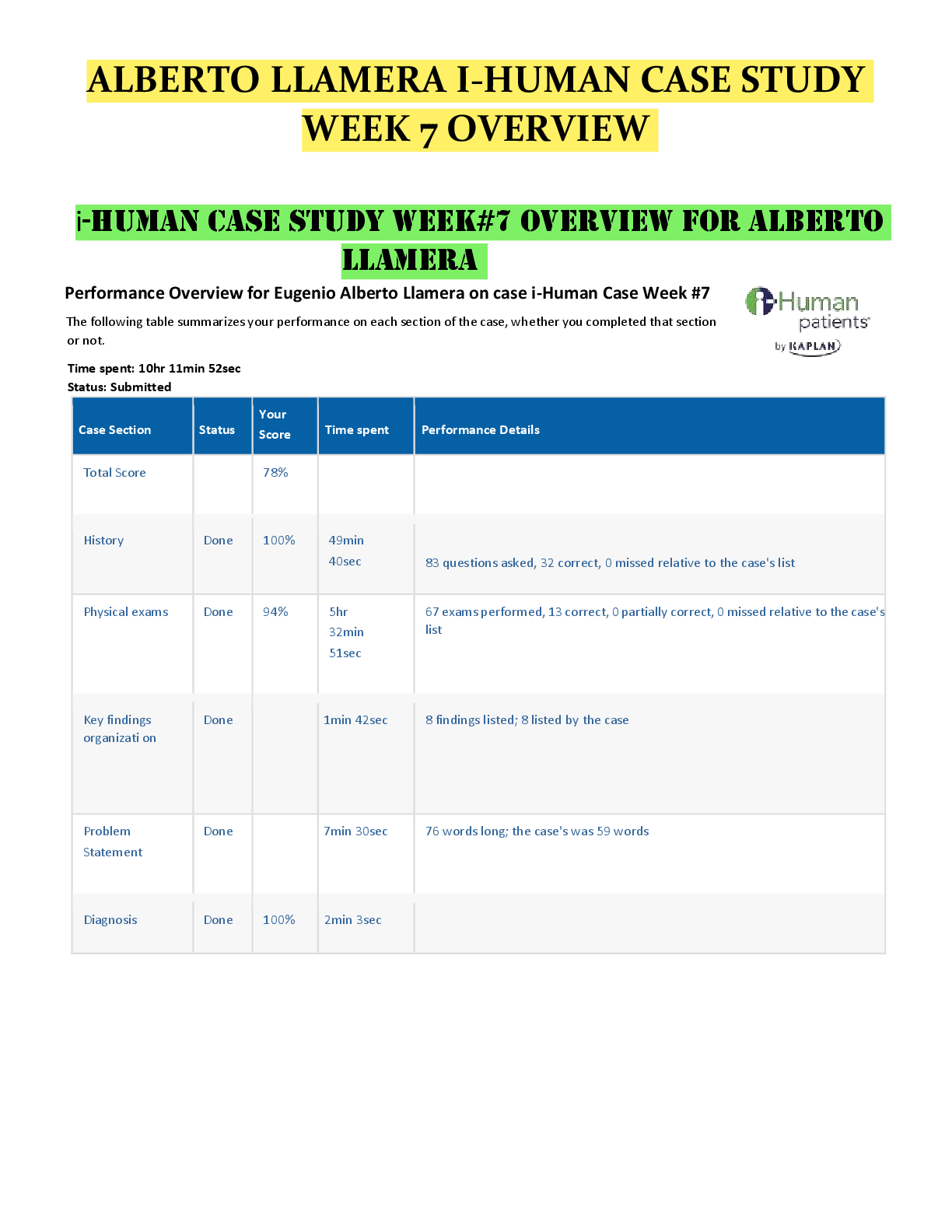



_merged.png)


