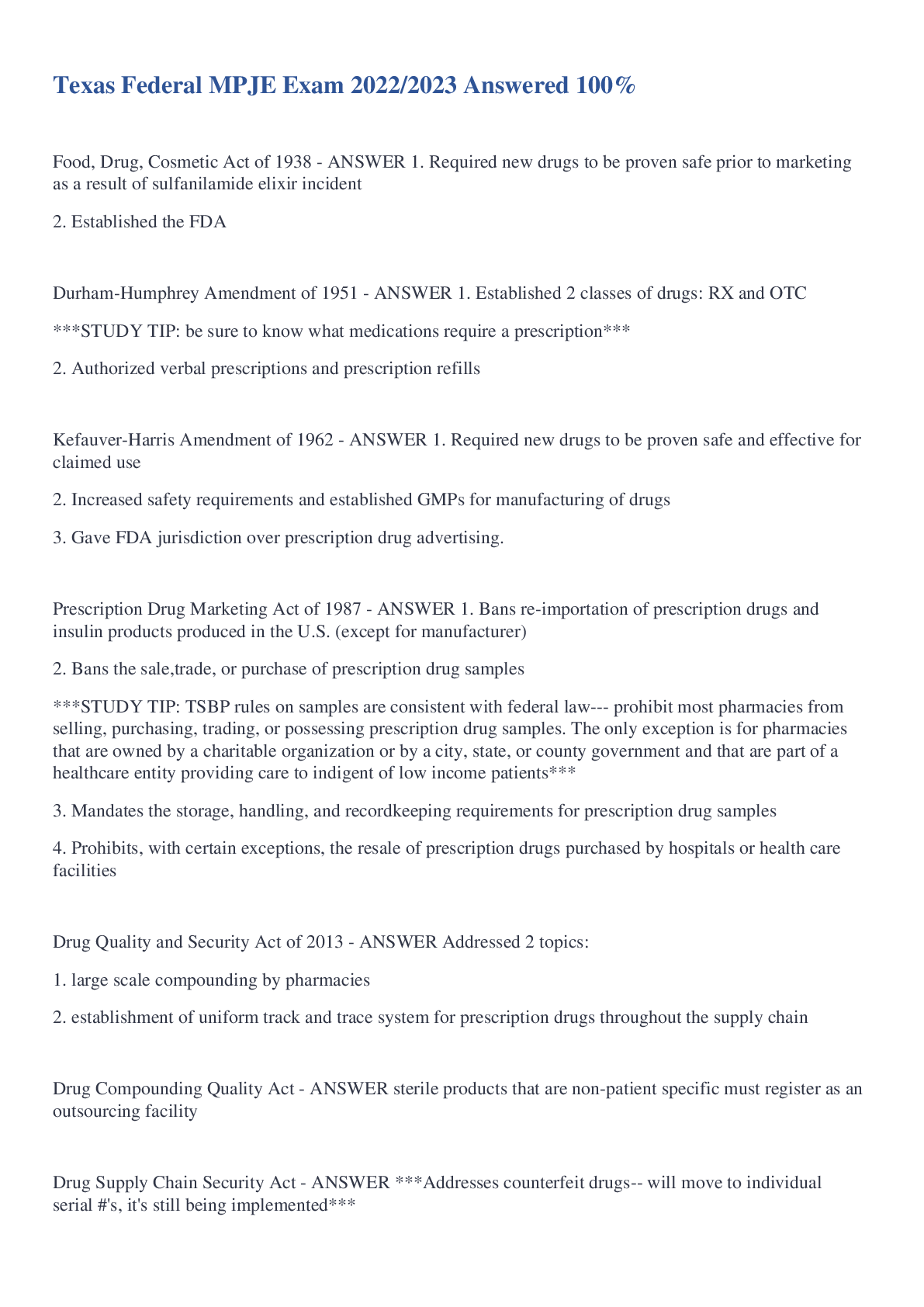
Food, Drug, Cosmetic Act of 1938 - ANSWER 1. Required new drugs to be proven safe prior to marketing as a result of sulfanilamide elixir incident
2. Established the FDA
Durham-Humphrey Amendment of 1951 - ANSWER 1. E
...
Food, Drug, Cosmetic Act of 1938 - ANSWER 1. Required new drugs to be proven safe prior to marketing as a result of sulfanilamide elixir incident
2. Established the FDA
Durham-Humphrey Amendment of 1951 - ANSWER 1. Established 2 classes of drugs: RX and OTC
***STUDY TIP: be sure to know what medications require a prescription***
2. Authorized verbal prescriptions and prescription refills
Kefauver-Harris Amendment of 1962 - ANSWER 1. Required new drugs to be proven safe and effective for claimed use
2. Increased safety requirements and established GMPs for manufacturing of drugs
3. Gave FDA jurisdiction over prescription drug advertising.
Prescription Drug Marketing Act of 1987 - ANSWER 1. Bans re-importation of prescription drugs and insulin products produced in the U.S. (except for manufacturer)
2. Bans the sale,trade, or purchase of prescription drug samples
***STUDY TIP: TSBP rules on samples are consistent with federal law--- prohibit most pharmacies from selling, purchasing, trading, or possessing prescription drug samples. The only exception is for pharmacies that are owned by a charitable organization or by a city, state, or county government and that are part of a healthcare entity providing care to indigent of low income patients***
3. Mandates the storage, handling, and recordkeeping requirements for prescription drug samples
4. Prohibits, with certain exceptions, the resale of prescription drugs purchased by hospitals or health care facilities
Drug Quality and Security Act of 2013 - ANSWER Addressed 2 topics:
1. large scale compounding by pharmacies
2. establishment of uniform track and trace system for prescription drugs throughout the supply chain
Drug Compounding Quality Act - ANSWER sterile products that are non-patient specific must register as an outsourcing facility
Drug Supply Chain Security Act - ANSWER ***Addresses counterfeit drugs-- will move to individual serial #'s, it's still being implemented***
1. provides uniform national framework for an electronic track and trace system
2. manufacturers are required to provide "transaction data" for each product sold
3. transaction data includes:
-transaction information
-transaction history
-transaction statement
4. distributing pharmacies must have a wholesale distribution license and must pass DSCSA transaction data with that distribution--- EXCEPTION:
- when distribution is between 2 entities that are affiliated or under common ownership
-when dispenser is providing product to another dispenser on patient specific basis
-dispenser is distributing under emergency medical reasons
-dispenser is distributing "minimal quantities" to licensed practitioner for office use
Transaction Information - ANSWER product name, strength, dosage form, NDC, container size and number or containers, date of transaction, name and address of the person from whom ownership is being transferred and to which ownership is being transferred
Transaction History - ANSWER paper/electronic statement that includes prior transaction information
Transaction Statement - ANSWER paper/electronic statement stating that the seller is licensed, received the product from an authorized person, received transaction information and history from prior owner if required, did not knowingly ship a suspect or illegitimate product, has systems and processes to comply with verification requirements, and did not knowingly give false transaction info
Distributing - ANSWER defined as providing drug to anyone other than the consumer/patient
***STUDY TIP: if product strength is less than what is represented on a label*** - ANSWER it could be classified as both misbranded and adulterated
Adulteration - ANSWER ***think cleanliness, purity, and strength***
1. contains any filthy, putrid, decomposed substance
2. it is contaminated
3. methods of manufacture does not conform to cGMP
4. the container is composed of poisonous or deleterious substance
5. contains unsafe color additive
6. its strength differs from or quality or purity falls below compendium standard (unless difference is clearly stated on label)
7. it is not in compendium and its strength differs or quality falls below what is represents (also considered misbranded)
8. it is mixed or packed with any substance which reduces its strength or quality or the drug has been substituted in whole or in part
Misbranding - ANSWER 1. labeling is false or misleading in any way (includes advertisement and info provided from drug rep)
2. it is a prescription drug and the manufacturer's label fails to have required information
3. it is an OTC and fails to contain required information
4. it is a drug liable to deterioration unless it's packaged or labeled accordingly
5. container is made, formed, or filled as to be misleading
6. drug is an exact imitation of another drug or offered for sale under the name of another drug
7. it is dangerous to health when used in the dosage or manner suggested in the labeling
8. it is packaged or labeled in violation of the Poison Prevention Packaging Act
Manufacturing Label Requirements - ANSWER -name and address of the manufacturer, packer, or distributor,
-name of drug
-net quantity (weight, quantity, dosage units)
- weight of active ingredient per dosage unit
-federal legend- RX only
-specific route of administration
-special storage instructions
-lot number (manufacturer's control number)
-expiration date
- adequate information for use (package insert)
OTC Requirements - ANSWER -principal display panel (statement of identity of the product)
-name and address of manufacturer,packer, or distributor
-net quantity of contents
-cautions and warnings needed to protect user
-adequate directions for safe and effective use for layperson
OTC Label Requirements - ANSWER -active ingredients
-purpose
-use/indications
-warnings
-directions
-other information
-inactive ingredients (alphabetical order)
-questions- followed by telephone number (OPTIONAL)
Yellow No. 5 and No.6 - ANSWER must disclose presence and provide warning in "precautions" section of the label that may cause allergic reaction in certain susceptible persons
Special Warning Requirements in FDCA
***STUDY TIP: normally the manufacturer's label would include these warnings, but you should be familiar with these requirements*** - ANSWER
Aspartame - ANSWER precautions section must contain to the following effect:
phenylketonurics: contains phenylalanine ___ mg per ___ (dosage unit)
Sulfites - ANSWER must contain an allergy warning in the warnings sections
Mineral Oil - ANSWER requires warning to only be taken at bedtime and not be used in infants unless under advice of a physician. label also cannot encourage use during pregnancy
Wintergreen Oil (methyl salicylate) - ANSWER any drug containing more than 5% methyl salicylate must include warning that use other than directed (often used as flavoring agent) may be dangerous and should be kept away from children
Sodium Phosphates - ANSWER limits amount of sodium phosphate oral solution to not more than 90 mL per OTC container; also requires specific warnings
Isoproterenol inhalation - ANSWER requires warning not to exceed dose prescribed and to contact physician if difficulty breathing
Potassium Salt for oral ingestion - ANSWER requires warning regarding nonspecific small bowel lesions consisting of stenosis, with or without ulceration, associated with administration of enteric coated thiazides with potassium salts
Ipecac Syrup - ANSWER 1. the following statement in boxed and red letters must appear: "For emergency use to cause vomiting in poisoning. Before using, call physician, the poison prevention center, or hospital emergency room immediately for advice."
2. following warning must appear: "Warning: keep out of reach of children. Do not use in unconscious person"
3. dosage must appear--- usual dosage is 1 tablespoon (15 mL) in individuals over 1 year of age
4. may only be sold in 1 oz (30 mL) containers
Phenacetine (acetophenetidin) - ANSWER must contain warning about possible kidney damage if use large amounts or for long period of time
Salicylates - ANSWER 1. must have special warning for use in children in regards to reye's syndrome
2. retail containers of 1.25 grain (pediatric) ASA cannot be sold in container holding more than 36 tablets
Alcohol - ANSWER analgesics and antipyretics including APAP, ASA, ibuprofen, naproxen, ketoprofen, etc. are required to have a warning for persons consuming 3 or more alcoholic beverages per day and to consult with doctor before taking
APAP - ANSWER 1. must have acetaminophen prominently displayed
2. must warn about liver toxicity
3. must warn not to use with other products containing APAP and to talk to a doctor or pharmacist before taking with warfarin
NSAIDs - ANSWER 1. must include term "NSAID" prominently on label
2. must contain stomach bleeding warning
Additional OTC requirements - ANSWER
Tamper-evident packaging - ANSWER manufacturers and packagers of OTC drugs (except dermatological, dentrifice, insulin, or lozenge products) for sale retail must package products in a tamper-evident package
Repackaging of OTC - ANSWER a pharmacist that repackages OTC products would be subject to cGMP requirements
When OTC product is prescribed - ANSWER the prescription drug labeling requirements would apply and would include the prescriber's direction for use
FDA Drug/Device Recall Class I - ANSWER reasonable probability product will cause either serious adverse effects or death
FDA Drug/Device Recall Class II - ANSWER may cause temporary or medically reversible adverse effects or where probability of serious adverse effects is remote
FDA Drug/Device Recall Class III - ANSWER not likely to cause adverse health consequences
***STUDY TIP: FDA does not technically have the legal authority to order a recall or a drug/device; because FDA can take other action including seizing products, most companies will comply when FDA requests them to recall a drug, and these classifications apply to drugs and medical devices*** - ANSWER
Prescription drug advertising is regulated by the - ANSWER FDA
OTC drug advertising is regulated by the - ANSWER Federal Trade Commission
Advertising of prescription drug prices is considered reminder advertising under FDA regulations; However such advertising is exempt from FDA advertising regulations provided that the following conditions are met: - ANSWER -only purpose of advertising is to provide information on price
-advertising contains proprietary name of the drug, generic name of the drug, drug's strength, dosage form, and price charged for a specific quantity of the drug
-advertising may include the availability of professional or other types of services, as long as it is not misleading
-price stated shall include all charges to the consumer; mailing and delivery fees, if any may be stated separately
[Show More]