Kaplan Nursing Practice Test Questions
The nurse does preoperative teaching with the client scheduled to have a transurethral
prostatectomy (TURP) under spinal anesthesia. Which statement about the result of the spinal
...
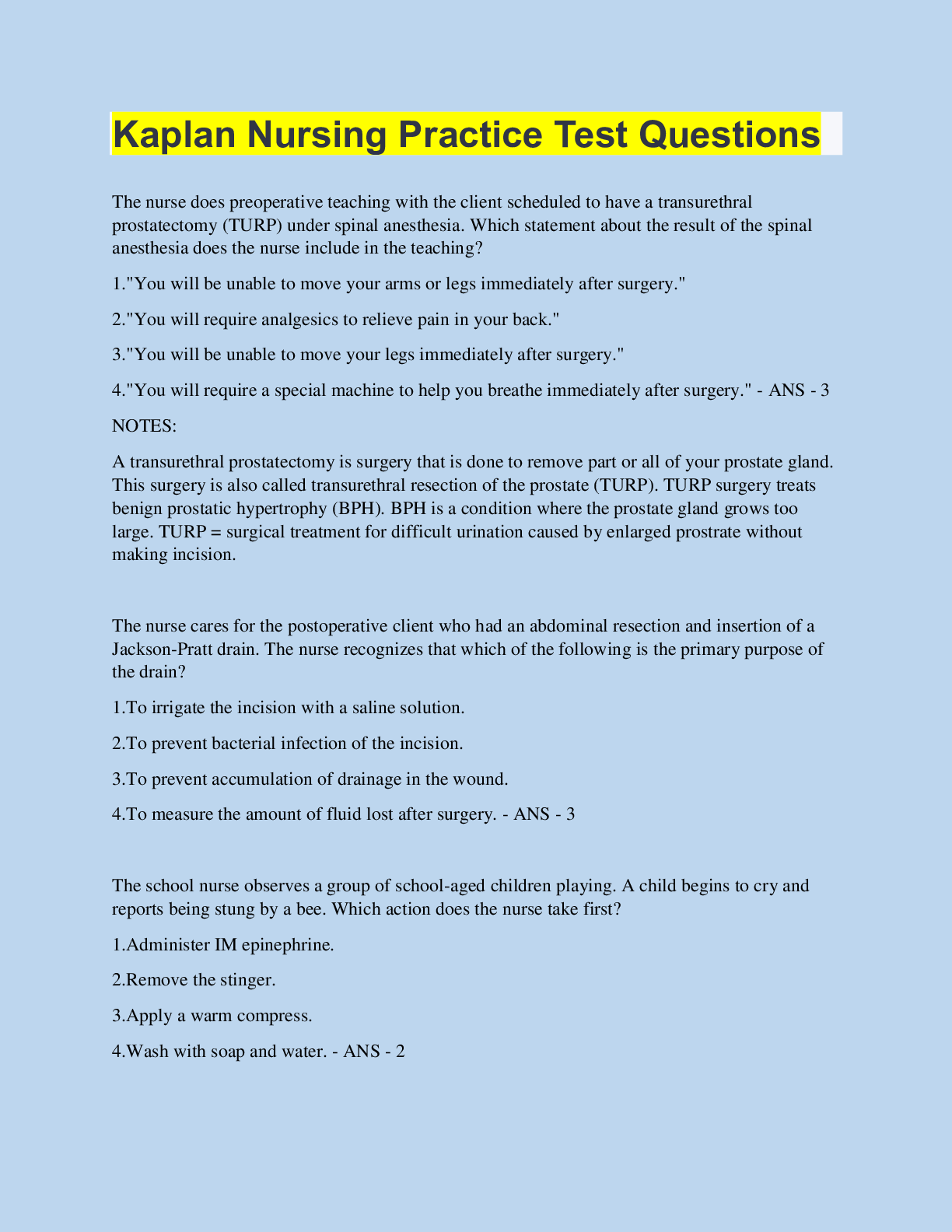
Kaplan Nursing Practice Test Questions
The nurse does preoperative teaching with the client scheduled to have a transurethral
prostatectomy (TURP) under spinal anesthesia. Which statement about the result of the spinal
anesthesia does the nurse include in the teaching?
1."You will be unable to move your arms or legs immediately after surgery."
2."You will require analgesics to relieve pain in your back."
3."You will be unable to move your legs immediately after surgery."
4."You will require a special machine to help you breathe immediately after surgery." - ANS - 3
NOTES:
A transurethral prostatectomy is surgery that is done to remove part or all of your prostate gland.
This surgery is also called transurethral resection of the prostate (TURP). TURP surgery treats
benign prostatic hypertrophy (BPH). BPH is a condition where the prostate gland grows too
large. TURP = surgical treatment for difficult urination caused by enlarged prostrate without
making incision.
The nurse cares for the postoperative client who had an abdominal resection and insertion of a
Jackson-Pratt drain. The nurse recognizes that which of the following is the primary purpose of
the drain?
1.To irrigate the incision with a saline solution.
2.To prevent bacterial infection of the incision.
3.To prevent accumulation of drainage in the wound.
4.To measure the amount of fluid lost after surgery. - ANS - 3
The school nurse observes a group of school-aged children playing. A child begins to cry and
reports being stung by a bee. Which action does the nurse take first?
1.Administer IM epinephrine.
2.Remove the stinger.
3.Apply a warm compress.
4.Wash with soap and water. - ANS - 2
The nurse cares for a 19-year-old client admitted to the emergency department after an
automobile accident. Even though the client denies drinking alcohol, the nurse notes that the
client's breath smells of alcohol, speech is slurred, reflexes are diminished, and the client has
difficulty recalling the events of the evening. The health care provider prescribes a magnetic
resonance imaging (MRI) scan. Which of these actions should the nurse take first?
1.Explain the MRI procedure and let the client sign the consent.
2.Instruct the client to remove his wrist watch.
3.Contact the client's next of kin to give consent for the MRI.
4.Restrict food and fluid intake for 4 hours. - ANS - 2
The parents of the 6-month-old bring the infant to the pediatrician's office for a routine
immunization. The nurse is to administer the immunization by intramuscular (IM) injection.
Which of these is the preferred site for an IM injection in an infant?
1.Deltoid.
2.Vastus lateralis.
3.Dorsogluteal.
4.Gluteus maximus. - ANS - 2
The nurse in the well child clinic receives a call from a parent stating the parent's child attended a
birthday party the day before with a child who had a facial rash and erythema infectiosum (fifth
disease). The parent is concerned that the child may develop the disease. Which of these
responses by the nurse is best?
1."Your child will not develop the disease."
2."Look for a rash in 4 to 14 days."
3."Bring your child into the clinic this afternoon."
4."Does your child have a facial rash now?" - ANS - 4
NOTES:
Fifth disease is a viral disease that often results in a red rash on the arms, legs, and cheeks. For
this reason, it's also known as "slapped cheek disease." Fifth disease is contagious in the earliest
phase of the infection, before telltale symptoms like a rash appear. It's transmitted through
respiratory secretions, such as saliva or sputum. These fluids are commonly produced with a
runny nose and sneezing, which are early symptoms of fifth disease
[Show More]






.png)