Lifeguard Certification Review
What is the primary responsibility of a lifeguard - ANS - to ensure patient's safety and protect
lives
what are characteristics of a lifeguard - ANS - knowledgable and skilled, reliable,
...
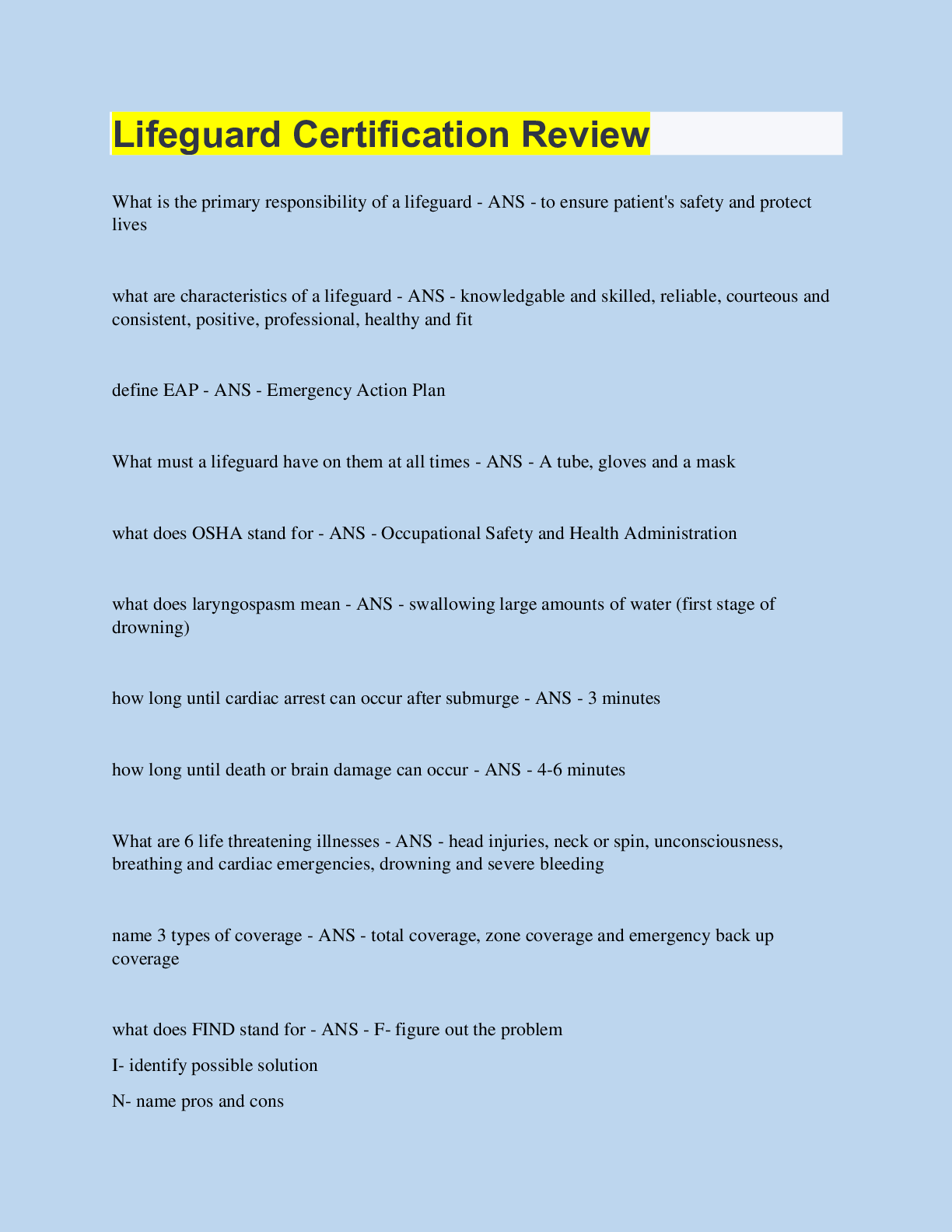
Lifeguard Certification Review
What is the primary responsibility of a lifeguard - ANS - to ensure patient's safety and protect
lives
what are characteristics of a lifeguard - ANS - knowledgable and skilled, reliable, courteous and
consistent, positive, professional, healthy and fit
define EAP - ANS - Emergency Action Plan
What must a lifeguard have on them at all times - ANS - A tube, gloves and a mask
what does OSHA stand for - ANS - Occupational Safety and Health Administration
what does laryngospasm mean - ANS - swallowing large amounts of water (first stage of
drowning)
how long until cardiac arrest can occur after submurge - ANS - 3 minutes
how long until death or brain damage can occur - ANS - 4-6 minutes
What are 6 life threatening illnesses - ANS - head injuries, neck or spin, unconsciousness,
breathing and cardiac emergencies, drowning and severe bleeding
name 3 types of coverage - ANS - total coverage, zone coverage and emergency back up
coverage
what does FIND stand for - ANS - F- figure out the problem
I- identify possible solution
N- name pros and cons
D- decide which is the best and act on it
What does MSDS mean - ANS - Material Safety Data Sheet
define PPE - ANS - Personal Protective Equiptment
how do you check for a pulse on an adult - ANS - the carotid (for 10 seconds)
how do you check for pulse on an infant - ANS - the brachial (for 10 seconds)
What is HAINES - ANS - High Arm In Endangered Spine
What is BSI - ANS - Body Substance Isolation
when do you use 2 initial breaths - ANS - when it's a child or infant or you bring the patient out
of the water
what does AED stand for - ANS - Automated External Defibulator
what is the purpose of primary assesment - ANS - to identify any life threatening illnesses
what is the purpose for secondary assesment - ANS - to identify any non life threatening illnesses
what does PPE stand for - ANS - Personal Protective Equiptment
what are 3 ways to open an airway - ANS - 1. head tilt/chin lift
2. jaw thrust maneuver (with extension)
3. jaw thrust maneuver (without head extension)
what does LOC stand for - ANS - Level Of Consciousness
how many cycles of rescue breathing do you do for an adult - ANS - 24
how many cycles of rescue breathing do you use for an infant or child - ANS - 40
reasons to stop CPR - ANS - AED arrives, too tired, signs of life, EMS takes over, someone
takes over, scene becomes unsafe
what does CPR stand for - ANS - Cardiopulmonary Resuscitation
pulse but not breathing - ANS - rescue breathing or unconscious choking
no pulse and no breathing - ANS - CPR
ratio of ventilations for an adult - ANS - 1:5
ratio of ventilations for a child or infant - ANS - 1:3
define hypoxia - ANS - insufficient oxygen reaches the cells
what are the 3 steps of unconscious choking - ANS - 1. ventilations
2. compressions
3. check
where do you place the AED pads - ANS - on the top right and the bottom left
what does SAMPLE stand for - ANS - S- signs and symptoms
A- allergies
M- medications
P- patient's past medical history
L- last oral intake
E- events leading up to incident
(secondary assessment)
What is RICE - ANS - R- rest
I- immobilize
C- cold
E- elevate
(used for caring for muscle, bone, and joint injuries)
define hypoglycemia - ANS - low blood sugar
define hyperglycimia - ANS - high blood sugar (worse)
what does FAST mean - ANS - F- face
A- arm
S- speech
T- time
what percent do you spend on surveillance than actually saving life's - ANS - 96%
sources of burns - ANS - heat, electricity, radiation (sun), chemical
poison control's number is - ANS - 1-800-222-1222
heat related illnesses - ANS - heat cramps, heat exhaustion, heat stroke
open wounds - ANS - abrasion, laceration, avulsion, puncture
types of splints - ANS - anatomic splint, soft splint, rigid splint
what don't you give to people with a suspected stroke - ANS - food or drinks
[Show More]




.png)