Health Care > QUESTIONS & ANSWERS > Life Coaching Certification Test (All)
Life Coaching Certification Test
Document Content and Description Below
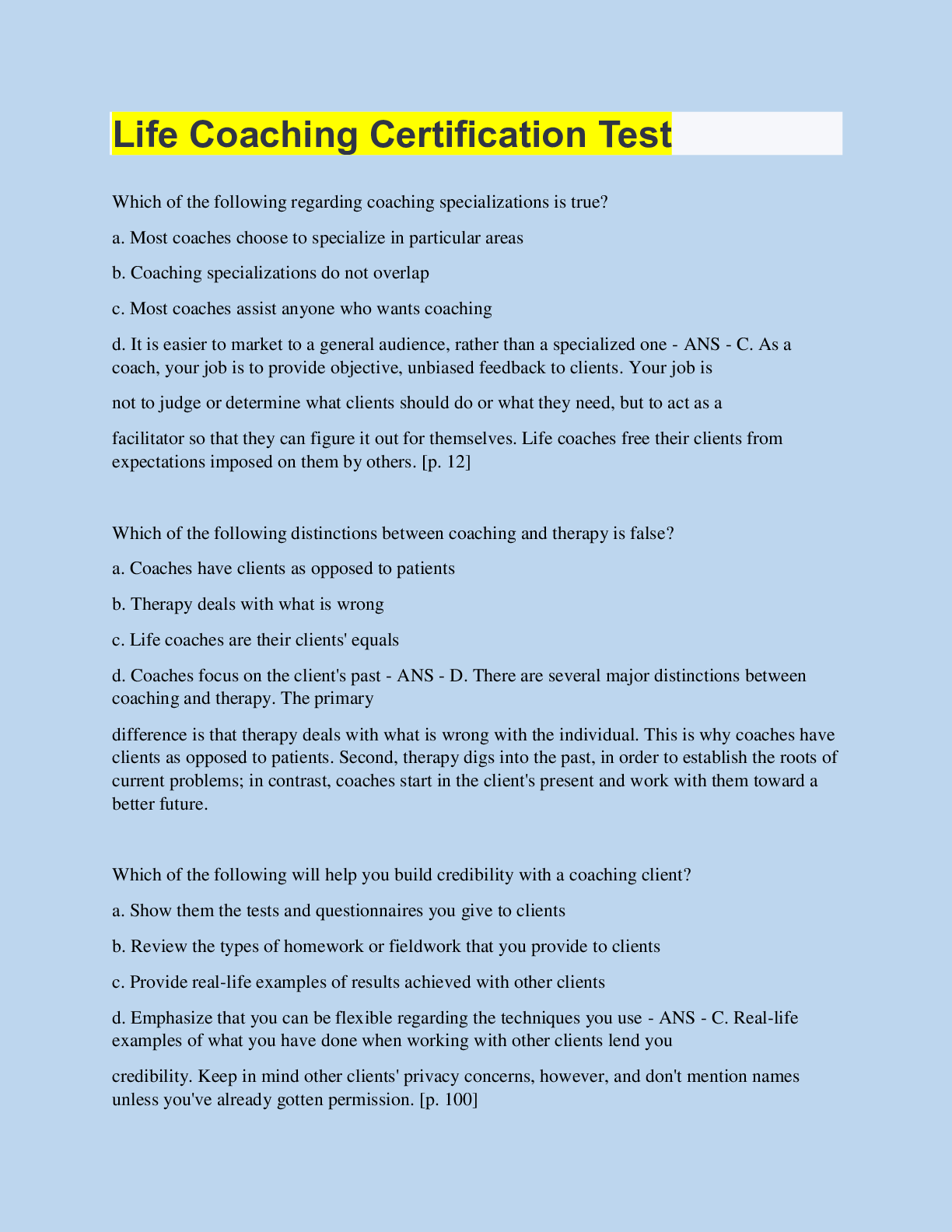
Life Coaching Certification Test Which of the following regarding coaching specializations is true? a. Most coaches choose to specialize in particular areas b. Coaching specializations do not overl ... ap c. Most coaches assist anyone who wants coaching d. It is easier to market to a general audience, rather than a specialized one - ANS - C. As a coach, your job is to provide objective, unbiased feedback to clients. Your job is not to judge or determine what clients should do or what they need, but to act as a facilitator so that they can figure it out for themselves. Life coaches free their clients from expectations imposed on them by others. [p. 12] Which of the following distinctions between coaching and therapy is false? a. Coaches have clients as opposed to patients b. Therapy deals with what is wrong c. Life coaches are their clients' equals d. Coaches focus on the client's past - ANS - D. There are several major distinctions between coaching and therapy. The primary difference is that therapy deals with what is wrong with the individual. This is why coaches have clients as opposed to patients. Second, therapy digs into the past, in order to establish the roots of current problems; in contrast, coaches start in the client's present and work with them toward a better future. Which of the following will help you build credibility with a coaching client? a. Show them the tests and questionnaires you give to clients b. Review the types of homework or fieldwork that you provide to clients c. Provide real-life examples of results achieved with other clients d. Emphasize that you can be flexible regarding the techniques you use - ANS - C. Real-life examples of what you have done when working with other clients lend you credibility. Keep in mind other clients' privacy concerns, however, and don't mention names unless you've already gotten permission. [p. 100] If a coaching client indicates strong resistance about a particular topic, which of the following should you do? a. Continue to press the client for more information, so that they can achieve a breakthrough b. Ask them why the subject bothers them so much, but tread lightly when doing so c. Move directly on to the next topic, ignoring the resistance d. Relay to the client what you think is the root cause of their resistance - ANS - B. You will need to tread lightly with clients when discussing certain issues. If a client indicates strong resistance about a particular topic, you might follow up with "Why does that subject bother you so much?" or "Is there a reason that you don't want to go there?" But if the answer is still "I don't want to talk about it," then respect that and don't press any further. [pp. 102-103] Which of the following coaching techniques works for almost any area of life or business? A. Challenging the client's assumptions B. Helping the client figure out who to hold accountable C. Convincing the client to adopt your line of thinking D. Aligning yourself with the client's patterns of thinking - ANS - (a) Challenging assumptions is an important concept in life coaching and goes hand in hand with identifying problems. By challenging clients' assumptions about different areas in their lives, coaches help clients to overcome their self-imposed limitations. Often, a client's assumptions about what causes a certain problem become barriers to solving the problem. [pp. 106-107] Which of the following is the most important part of Laser Coaching? a. Remembering that the conclusion is often a mystery to the coach b. Keeping the focus on long-term solutions to long-term problems c. Allowing the client to vent d. Getting to the heart of the issue as quickly as possible - ANS - (d) The most important part of laser coaching is that you get to the heart of the issue as quickly as possible. The central difficulty in laser coaching is keeping clients focused by not letting them wander from the main problems they want to deal with. [p. 125] When setting up group coaching sessions, which of the following group sizes works best? a. Three to five b. Five to ten c. Ten to fifteen d. Fifteen to twenty - ANS - (b) For group coaching, a group size of between five and ten works best. With fewer than that, participants don't get a wide variety of viewpoints and perspectives, and with more than that, time constraints can pose a problem. [p. 133] Which of the following regarding coaching specializations is true? a. Most coaches choose to specialize in particular areas b. Coaching specializations do not overlap c. Most coaches assist anyone who wants coaching d. It is easier to market to a general audience, rather than a specialized one - ANS - (a) As a life coach you may decide to assist anyone who wants coaching, in any area of life. However, most coaches choose to specialize in particular areas; in addition, it's important to note that specializations may overlap. For example, if you're doing executive coaching for a client, issues of time management and work/life balance may arise. Also, specializing in a particular area may help you market your business more effectively than if you were to sell services to everyone. Which type of coaching is particularly rare? a. Corporate coaching b. Couples coaching c. Carbon coaching d. Career coaching - ANS - (c) Carbon coaching is a relatively new sphere of coaching, but one that has great potential for someone starting out in a career in life coaching. Since they are rare, carbon coaching is a wide-open field. While you don't have to be a scientist, you will need a good understanding of the issues surrounding global warming and ways in which individuals can alter their "carbon footprint." Which type of coaching can also be known as "outplacement consulting"? a. Carbon coaching b. Career coaching c. Corporate coaching d. Executive coaching - ANS - (b) With layoffs and downsizing commonplace, career coaches are also often hired by companies to assist workers in finding new jobs. This type of career coaching is often referred to as outplacement consulting. The coaches may help displaced employees prepare a resume, re-assess goals and values, or practice interviewing techniques. [p. 29] Which of the following client statements would indicate a need for therapy, rather than coaching? A. "I'm feeling unsure about my relationship, and want to figure out how to communicate better with my partner" B. "I'm dissatisfied with my life, and I'm thinking of ending it" C. "I'm not satisfied with the direction my career is going, and I'd like to make a transition" d. "I'm not pleased with my current weight, and would like to lose 30 pounds" - ANS - (b) You should avoid clients who seem depressed, have low self-esteem or are angry with the world; they would be better candidates for therapy. A client who tells you "I'm dissatisfied with my career, and I'd like to make a transition," is acceptable. One who tells you, "I'm dissatisfied with my life, and I'm thinking of ending it," is not. [p. 97] The standard coaching session typically la [Show More]
Last updated: 3 years ago
Preview 1 out of 18 pages
Buy this document to get the full access instantly
Instant Download Access after purchase
Buy NowInstant download
We Accept:

Reviews( 0 )
$10.00
Can't find what you want? Try our AI powered Search
Document information
Connected school, study & course
About the document
Uploaded On
Oct 05, 2022
Number of pages
18
Written in
All

Additional information
This document has been written for:
Uploaded
Oct 05, 2022
Downloads
0
Views
86




.png)