A patient with chest pain should receive oxygen at __ LPM. - ANSWER 15
When performing one-rescuer CPR on an infant, compressions are performed with: - ANSWER two fingers
A patient who is not breathing should recei
...
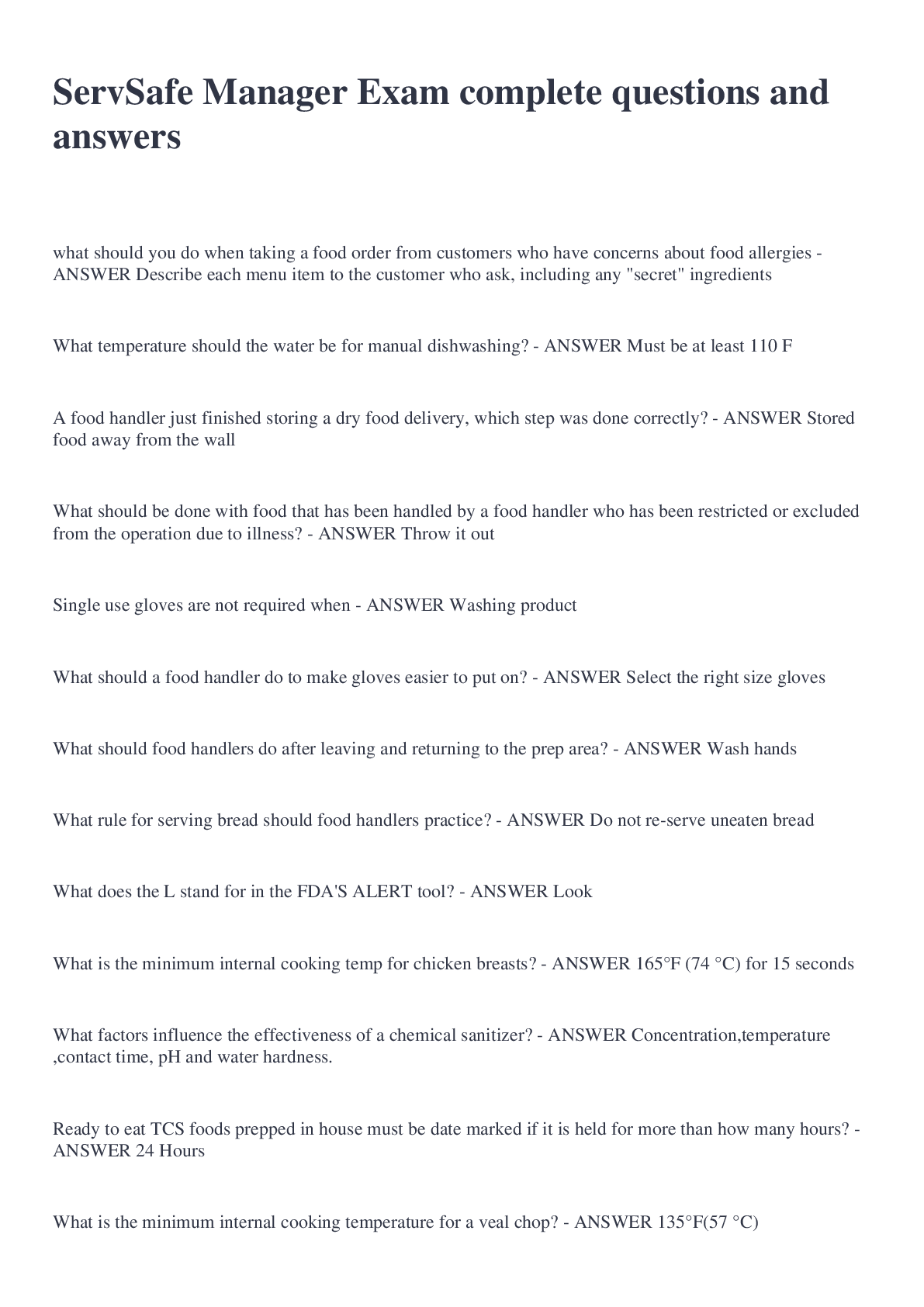
A patient with chest pain should receive oxygen at __ LPM. - ANSWER 15
When performing one-rescuer CPR on an infant, compressions are performed with: - ANSWER two fingers
A patient who is not breathing should receive oxygen via: - ANSWER bag valve mask
The maximum depth of compression for an infant is: - ANSWER 1/3 to 1/2 the depth of the chest
When administering oxygen to a patient via nasal cannula, the maximum LPM flow is __ - ANSWER 6
The compression rate for two rescuer CPR compares to one rescuer CPR - ANSWER at the same rate
A bag valve mask with supplemental oxygen will deliver __ percent oxygen. - ANSWER 90-100
The flow meter - ANSWER allows the provider to regulate the rate of oxygen flowing to
the patient
The goal is to begin automated defillibration within __ of the time that the patient collapses - ANSWER 3-5 minutes
Treat a mild airway obstruction as if it were a severe airway obstruction in cases where the patient is: - ANSWER unable to cough forcefully
You and your partner observe a female collapsed at a local market. You conform that she is apneic and pulseless. You decide to: - ANSWER begin CPR while your partner gets the AED and notifies ALS
You should assess an unresponsiveness patient to see if he/she is breathing for at least: - ANSWER 5-10 seconds
During basic adult two-rescuer CPR, you and our partner should perform a ratio of __ compressions to ___ breaths. - ANSWER 30:2
Your patient is unresponsive, but you think he has a gag reflex. You should use this airway adjunct. - ANSWER NPA
During CPR, you notice that the patient's abdomen begins to swell. This is most likely due to: - ANSWER ventilations that are too forceful/fast
A pregnant woman is choking. You should perform: - ANSWER chest thrust
The compression rate for two rescuer CPR compares to one rescuer CPR is preformed ate the __ rate - ANSWER same
Which of the following would you perform on a infant who has a severe airway obstructions? - ANSWER chest thrust
The advantage of two rescuer CPR over one-rescuer CPR is that: - ANSWER the job is shared between the two rescuers, thus reducing rescuer fatigue
You and your partner decide to stop at a local restaurant to have lunch. A family sitting across from you sees to be having fun while joking with their children. All of the sudden you hear a shriek and see the mother lifting a child from a high chair. The other screams, "My baby can't breathe!" The 11-month-old boy is conscious and not making any noises. His eyes are wide open, and his skin is turning blue around his lips. Which of the following would you perform on an infant who has a SEVERE airway obstruction? - ANSWER back slaps followed by chest thrust
The ratio of chest compressions to vetilations for an infant with two rescuers is: - ANSWER 15:2
You and your partner decide to stop at a local restaurant to have lunch. A family sitting across fro you seems to be having fun while joking with their children. All of the sudden you hear a shriek and see the mother lifting a child from a high chair. The mother screams, "My baby can't breathe!" The 11-month-old boy is conscious nd not making any noises. His eyes are wide open, and his skin is turning blue around his lps. While attending to the 11-month-old boy who has a suspected severe airway obstruction, you open the airway and attempt to give the child a breath. The child's chest did not rise. The next step you should take is to do what? - ANSWER reposition and try to give another breath
The automated external defibrillator (AED) is brought to the scene. Before you place it on the patient you should: - ANSWER turn it on
You and your partner are responding to a patient who passed out in a store. Your patent is a 21-year-old male who stated to a friend that he was feeling light-headed. Upon arrival, you find your patient on the floor. He has a respiratory rate of 6 with heavy breathing, and his teeth are clenched. The best device to use on this patient is a: - ANSWER bag valve mask
Once the AED is placed on the patient, it will display this message if the patient has no pulse: - ANSWER shock advised
You and your partner arrive at a construction site where one of the workers has fallen off so scaffolding. The patient is lying supine of the ground, and the other workers are standing around him. During your assessment, you find he has a patent airway, and a respiratory rate of 14. He has a pulse that is weak and thread, and there are no obvious signs of bleeding. The patient's skin feels cool and clammy to the touch, and his capillary refill is slow. You determine this patient's priority is: - ANSWER high/urgent
Once the patient’s pulse and breathing return after the first shock, you should: - ANSWER monitor the patient's breathing and pulse
Once the patient's pulse and breathing return after the first shock, you should: - ANSWER monitor the patient's breathing and pulse
You are taking a SAMPLE history of a patient. The S stands for: - ANSWER signs and symptoms
You and your partner are eating dinner at a restaurant after a long shift at work. As you look over your shoulder, you see an stand up, grab his chest, and fall to the floor. Before you assist the patient, you must: - ANSWER ensure scene safety
When you assess a patient's mental status, you should check to see if your patient is: - ANSWER aware of his name, where he/she is, and what day/time it is
You and your partner are responding to a chest pain call when the dispatcher advises you that the patient has collapsed. You arrive at the scene one minute later and ind a 57-year-old male patient unresponsive, apneic, and pulseless. Your partner begins CPR while you get the AED. After giving the initial shock with the AED, you give the patient breaths and compressions for two minutes. The AED then advises, "No shock advised." You should: - ANSWER resume compressions and ventilations
You have a patient who fell 16ft off a ladder while cleaning the gutters of a roof. The patient is supine in the drive and does not respond to verbal or painful stimuli. After assessing the scene and immobilizing the patient's spine, you should proceed with the: - ANSWER primary assessment
When a patient has an adequate supply of oxygenated blood to all parts of the body, this is called: - ANSWER perfusion
You are called to the residence of a 64 year old female who says she has chest pain. This is referred to as the patient's - ANSWER chief complaint
Ambulance 110 and Engine 11 are called for a person who was by a car. Upon your arrival, you find a person lying in the street. To check his mental status, you would use the acronym - ANSWER AVPU
You ad you partner are dispatched to a crime scene where there is a tabbing victim. Your first priority is to: - ANSWER perform a scene size-up
Engine 131 is called for a possible overdose. Upon arrival, you find a person sitting in a chair staring out into space. When you check your patient's pupils, you should use the acronym: - ANSWER PERL
You and your partner are called to the scene of a motor vehicle accident. When you arrive, you find a patient who is bleeding from the head. In your primary assessment, this would be the: - ANSWER mechanism of injury
Determing a blood pressure by FEELING is called: - ANSWER palpation
When you perform a focused physical exam on a patient, the first information you should obtain is: - ANSWER Baseline vital signs
The first set of vital signs you obtain on a patient are referred to as: - ANSWER Baseline
You and your partner are called to the home of an elderly couple. You find a 70 year old male on the ground. His wife tells you that he fell out of a tree. The patient states that his hip and chest hurt. You can use this acronym to assess the patient's mental status: - ANSWER AVPU
The pulse of an infant is assessed at the: - ANSWER upper arm
You arrive on the scene of a construction accident. The patient is lying in a supine position and responds with a groan when you rub his sternum. Which element of the acronym AVPU have assessed? - ANSWER P
The patient you are attending to is able to tell you how she feels and what her complain is. You know that thi letter of the AVPU acronym measures the patient's level of consciousness. - ANSWER A
When measuring the radial pulse on a patient, you should check for: - ANSWER
whether the pulse is fast or slow
If an Emergency Medical Responder uses a blood pressure cuff that is too large for the patient, the blood pressure reading would be: - ANSWER too low
When using the SAMPLE acronym, the A stands for: - ANSWER Allergies
For an unconscious patient, you should assess the pulse at the - ANSWER Carotid artery
During your assessment of the patient's past history, you rake a SAMPLE history. The m represents: - ANSWER medications
[Show More]



![Preview of AORN PERIOP 101 FINAL EXAM 2026 QUESTIONS AND VERIFIED ANSWERS [LATEST UPDATE]](https://browseimages.nyc3.digitaloceanspaces.com/paper-images/2026/04/07/sGJvJ3aH2026-04-07-04-5869d464cbba16f.png)