RN- MOBILITY NCLEX QUESTIONS AND ANSWERS 2022
To assess the joints, a nurse asks a client to perform various movements. As the
client moves his arm away from the midline, the nurse evaluates his ability to
perform:
...
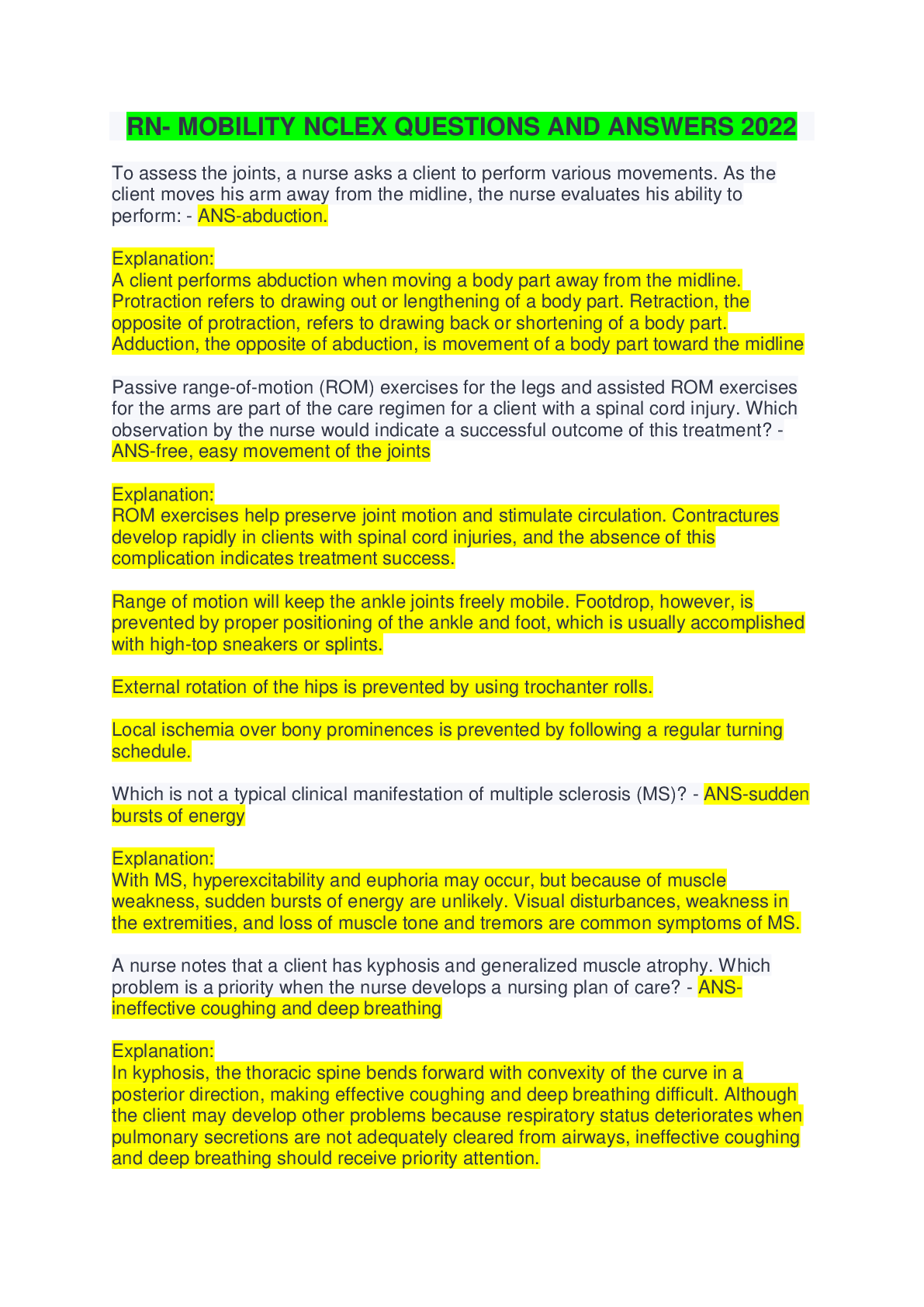
RN- MOBILITY NCLEX QUESTIONS AND ANSWERS 2022
To assess the joints, a nurse asks a client to perform various movements. As the
client moves his arm away from the midline, the nurse evaluates his ability to
perform: - ANS-abduction.
Explanation:
A client performs abduction when moving a body part away from the midline.
Protraction refers to drawing out or lengthening of a body part. Retraction, the
opposite of protraction, refers to drawing back or shortening of a body part.
Adduction, the opposite of abduction, is movement of a body part toward the midline
Passive range-of-motion (ROM) exercises for the legs and assisted ROM exercises
for the arms are part of the care regimen for a client with a spinal cord injury. Which
observation by the nurse would indicate a successful outcome of this treatment? -
ANS-free, easy movement of the joints
Explanation:
ROM exercises help preserve joint motion and stimulate circulation. Contractures
develop rapidly in clients with spinal cord injuries, and the absence of this
complication indicates treatment success.
Range of motion will keep the ankle joints freely mobile. Footdrop, however, is
prevented by proper positioning of the ankle and foot, which is usually accomplished
with high-top sneakers or splints.
External rotation of the hips is prevented by using trochanter rolls.
Local ischemia over bony prominences is prevented by following a regular turning
schedule.
Which is not a typical clinical manifestation of multiple sclerosis (MS)? - ANS-sudden
bursts of energy
Explanation:
With MS, hyperexcitability and euphoria may occur, but because of muscle
weakness, sudden bursts of energy are unlikely. Visual disturbances, weakness in
the extremities, and loss of muscle tone and tremors are common symptoms of MS.
A nurse notes that a client has kyphosis and generalized muscle atrophy. Which
problem is a priority when the nurse develops a nursing plan of care? - ANS�ineffective coughing and deep breathing
Explanation:
In kyphosis, the thoracic spine bends forward with convexity of the curve in a
posterior direction, making effective coughing and deep breathing difficult. Although
the client may develop other problems because respiratory status deteriorates when
pulmonary secretions are not adequately cleared from airways, ineffective coughing
and deep breathing should receive priority attention.
After surgery and insertion of a total hip prosthesis, a client develops severe sudden
pain and an inability to move the extremity. The nurse interprets these findings as
indicating: - ANS-joint dislocation.
Explanation:
The joint has dislocated when the client with a total joint prosthesis develops severe
sudden pain and an inability to move the extremity. Clinical manifestations of an
infection would include inflammation, redness, erythema, and possibly drainage and
separation of the wound. Bleeding could be external (e.g., blood visible from the
wound or on the dressing) or internal and manifested by signs of shock (e.g., pallor,
coolness, hypotension, tachycardia). The seepage of glue into soft tissue would have
occurred in the operating room, when the glue is still in the liquid form. The glue
dries into the hard, fixed form before the wound is closed.
Four days after surgery for internal fixation of a C3-C4 fracture, a nurse is moving a
client from the bed to the wheelchair. The nurse is checking the wheelchair for
correct features for this client. Which features of the wheelchair are appropriate for
the needs of this client? - ANS-• back and head that are high
• seat that is lower than normal
• chair controlled by the client's breath
Explanation:
The client with a C3-C4 fracture has neck control but may tire easily using sore
muscles around the incision area to hold up the head. Therefore, the head and neck
of the wheelchair should be high. The seat of the wheelchair should be lower than
normal to facilitate transfer from the bed to the wheelchair. When a client can use the
hands and arms to move the wheelchair, the placement of the back to the client's
scapula is necessary. This client cannot use the arms and will need an electric chair
with breath, chin, or voice control to manipulate movement of the chair. A firm or
hard cushion adds pressure to bony prominences; the cushion should instead be
padded to reduce the risk of pressure ulcers.
After undergoing surgery the previous day for a total knee replacement, a client
states that he doesn't feel ready to ambulate yet. What should the nurse do?
You selected: Discuss the complications that the client's may experience if he
doesn't cooperate with the care plan. - ANS-Discuss the complications that the
client's may experience if he doesn't cooperate with the care plan.
Explanation:
The nurse should discuss the care plan and its rationale with the client. Calling the
physician to report the client's noncompliance won't alter the client's degree of
participation and shouldn't be used to force the client to comply. Doing nothing isn't
acceptable. Although the client does have the right to make choices, it's the nurse's
responsibility to provide education to help the client make informed decisions.
Although the nurse should ultimately document the client's refusal, she should first
discuss the care plan with the client.
When developing a long term care plan for the client with multiple sclerosis, the
nurse should teach the client to prevent: - ANS-contractures.
Explanation:
Typical complications of multiple sclerosis include contractures, decubitus ulcers,
and respiratory infections. Nursing care should be directed toward the goal of
preventing these complications.
Ascites, fluid overload, and dry mouth are not associated with multiple sclerosis.
The nurse should assess which clients for risk for falling? Select all that apply. -
ANS-• client who is 45 years of age, in hospice with terminal cancer, and receiving
morphine every 2 hours
• client who is 62 years of age, recovering from breast biopsy in outpatient surgery,
and has a fear of falling
• client who is 80 years of age and in a locked facility for clients with cognitive
impairment
• client who is 75 years of age and recovering at home from hip replacement surgery
on the left hip
Explanation:
Clients who are at risk for falling include the client taking narcotics, the client with a
known fear of falling, the client with cognitive impairment, and the client with gait
problems. Age and setting are not necessarily risks for fallings.
Which indicates that performing passive range-of-motion (ROM) exercises on an
unconscious client has been successful? - ANS-maintenance of joint mobility
Explanation:
The goal of performing passive ROM exercises is to maintain joint mobility. Active
exercise is needed to preserve bone and muscle mass. Passive ROM movements
do not prevent bone demineralization or have a positive effect on the client's muscle
tone.
A public health nurse is providing an information session focusing on injury
prevention for young children diagnosed with juvenile arthritis. Of the information
offered below, what should be included in this session? - ANS-Daily range of motion
exercises are required to support joint mobility.
Explanation:
Daily range of motion exercises are required to help children with juvenile arthritis
strengthen their muscles and use their joints to their full range of motion. Children
should be encouraged to participate in as much of their own care as possible to keep
their joints fluid. Excessive exercise, as evidenced by running, jumping, and so on,
should be discouraged because it puts an excessive amount of pressure on the
joints. The children should also remain active and independent, but should not
overexert themselves. Home schooling is not required in this situation.
The nurse is caring for a child in Bryant's traction (see figure). The nurse should: -
ANS-provide frequent skin care.
Explanation:
The traction is positioned correctly; the nurse should provide frequent skin care to
the back and shoulder areas. The hips and buttocks should be lifted off the bed to
provide counter traction; the nurse should not adjust the weights. The nurse should
not place a pillow under the buttocks as this would prevent counter traction. The
elastic wraps should remain on the legs unless removal is prescribed by the health
care provider (HCP).
When the nurse is conducting a preoperative interview with a client who is having a
vaginal hysterectomy, the client states that she forgot to tell her surgeon that she
had a total hip replacement 3 years ago. The nurse communicates this information to
the perioperative nurse because: - ANS-the client should not have her hip externally
rotated when she is positioned for the procedure.
Explanation:
The nurse should notify the surgery department and document the past surgery in
the medical record in the preoperative notes so that the client's hip is not externally
rotated and the hip dislocated while she is in the lithotomy position. The prosthesis
should not be a problem as long as the perioperative nurse places the return
electrode away from the prosthesis site. The perioperative nurse will inform the rest
of the team, but the primary reason to inform the perioperative nurse is related to
safe positioning of the client. The surgeon should enter this information on the
client's medical record at this time.
When the client who has had a hip replacement is lying on the side, the nurse should
place pillows or an abductor splint between the legs to prevent: - ANS-adduction of
the hip joint.
Explanation:
After hip replacement surgery, the client should be positioned on the nonoperative
side with pillows or an abductor splint between the legs to help prevent adduction of
the operative leg. This positioning places the hip in proper alignment. Dislocation of
the hip can occur if the leg on the affected side is allowed to adduct.
Flexion of the knees is not contraindicated.
Abduction of the legs is the correct position.
Placing a pillow between the legs will not result in hyperextension of the knee.
Hyperextension of the knee is to be avoided in any case because it can result in
injury.
When assessing a client who reports a back injury, it is critical for the nurse to
question the client about: - ANS-mechanism of injury.
Explanation:
The mechanism of injury is always the most critical information to obtain from a client
with a musculoskeletal injury. In the event of a back injury, the mechanism of injury
provides the greatest clue as to the extent of injury and the proper treatment plan.
The other questions are important but will not give the critical information needed
related to this specific problem and injury.
A nurse prepares to transfer a client from a bed to a chair. Which principle
demonstrates safe body mechanics? - ANS-The nurse uses a rocking motion while
helping the client to stand.
Explanation:
Rocking provides extra force when pushing or pulling. The nurse should keep any
weight as close to her body as possible when lifting — not at arm's length. The nurse
should keep her knees slightly bent and her feet spread apart to provide a wide base
of support. Keeping the knees straight and stiff and bending at the waist and keeping
the feet close together aren't examples of safe body mechanics. These positions
could result in injury to the nurse or to the client.
An older infant who has been injured in an automobile accident is to wear a splint on
the injured leg. The mother reports that the infant has become mobile even while
wearing the splint. What should the nurse advise the mother to do? - ANS-Remove
any unsafe items from the area in which the infant is mobile.
Explanation:
Safety is the priority in caring for this infant. Infants adapt easily, increasing mobility
even with a splint in place. Therefore, the mother needs to ensure that the area in
which the infant is mobile is safe. There is no need to contact the HCP to alter the
treatment plan. Confining the infant to one room may not allow the child to achieve
normal development. The child needs different environments for maximum
development. The infant needs to wear the splint as prescribed by the HCP to
ensure optimal healing.
A client is being discharged following an open reduction and internal fixation of the
left ankle, and is to wear a non-weight-bearing cast for 2 weeks. What should the
nurse teach the client to do when using crutches? - ANS-Maintain two to three finger
widths between the axillary fold and underarm piece grip.
Explanation:
The nurse instructs the client to maintain two finger widths between the axillary fold
and the underarm piece grip of the crutches to prevent pressure on the brachial
plexus. The client is advised to use the three-point gait; in the four-point and two
point-gait there is partial weight bearing of both feet. The client is also advised to
keep the affected leg elevated when sitting to prevent swelling, and to use the arms,
not the axillae, to maintain balance and support.
Bone resorption is a possible complication of Cushing's disease. To help the client
prevent this complication, the nurse should recommend that the client: - ANS�maintain a regular program of weight-bearing exercise.
Explanation:
Osteoporosis is a serious outcome of prolonged cortisol excess because calcium is
resorbed out of the bone. Regular daily weight-bearing exercise (e.g., brisk walking)
is an effective way to drive calcium back into the bones. The client should also be
instructed to have a dietary or supplemental intake of calcium of 1,500 mg daily.
Potassium levels are not relevant to prevention of bone resorption. Vitamin D is
needed to aid in the absorption of calcium. Isometric exercises condition muscle tone
but do not build bones.
To help minimize calcium loss from a hospitalized client's bones, the nurse should: -
ANS-encourage the client to walk in the hall.
Explanation:
Calcium absorption diminishes with reduced physical activity because of decreased
bone stimulation. Therefore, encouraging the client to increase physical activity, such
as by walking in the hall, helps minimize calcium loss. Turning or repositioning the
client every 2 hours wouldn't increase activity sufficiently to minimize bone loss.
Providing dairy products and supplemental feedings wouldn't lessen calcium loss —
even if the dairy products and feedings contained extra calcium — because the
additional calcium doesn't increase bone stimulation or osteoblast activity.
The nurse is observing a client who is recovering from back strain lift a box as shown
in the accompanying image. What should the nurse do? - ANS-Praise the client for
using correct body mechanics.
Explanation:
The client is using correct body mechanics for lifting because she is keeping her
back as straight as possible and is holding the box close to her body. She is using
her large leg muscles to lift the box. She is using a broad base of support by placing
her feet as wide apart as possible. The other suggestions would cause the client to
put a strain on her back.
Which action should the nurse take for a client with a fiberglass cast on the left leg? -
ANS-Assess movement and sensation of the toes
Explanation:
Neurological checks to the left leg are essential to assess for complications such as
ischemia. Radial and brachial pulses are found in the upper extremities. A four-point
gait resembles normal walking and would involve weight bearing, which is
contraindicated. The fiberglass cast would be dry almost immediately after
application, so elevating it to dry is not necessary.
When performing an assessment, the nurse identifies the following signs and
symptoms in the client: decreased muscle strength, limited range of motion, and
reluctance to move. Based on these symptoms, the nurse should perform which of
the following interventions? Select all that apply. - ANS-• Encouraging client turning
and repositioning every 2 hours
• Having call bell within easy reach
• Initiating hospital fall risk protocols
Explanation:
The client with discoordination, decreased muscle strength, limited range of motion,
and reluctance to move is at risk for falls and also for pressure ulcers. The nurse
should encourage/assist the client in turning and repositioning every 2 hours and
ensure that the call bell is within easy reach. The hospital's fall risk protocols should
be initiated at this time. Having four-sided rails up is considered a restraint and is not
indicated at this time. Gowning and gloving when in the room is appropriate for
clients needing isolation precautions—these are not indicated at this time.
A client has a cast applied to the left leg after sustaining a femur fracture during a
skiing accident. Which interventions would the nurse provide to avoid complications
from the cast application? Select all that apply. - ANS-• Monitor distal pulses of the
affected extremity
• Maintain the leg elevated above the level of the heart.
• Administer anticoagulation per healthcare provider's order.
Explanation:
The nurse would monitor the tightness of the cast by assessing the distal pulses and
tightness of the cast. Edema can cause the cast to become tight and lead to
compartment syndrome. Unless contraindicated, the leg would be elevated above
the heart in order to increase venous return and decrease edema. Prophylactic
anticoagulation will decrease the risk of clot formation. The nurse would apply cool
compresses not warm. It is not within the nurse's scope of practice to cut the cast or
bivalve the cast.
A 74-year-old client receiving fluphenazine decanoate therapy develops
pseudoparkinsonism, and is ordered amantadine hydrochloride. With the addition of
this medication, the client reports feeling dizzy when standing. Which response by
the nurse is best?...
[Show More]