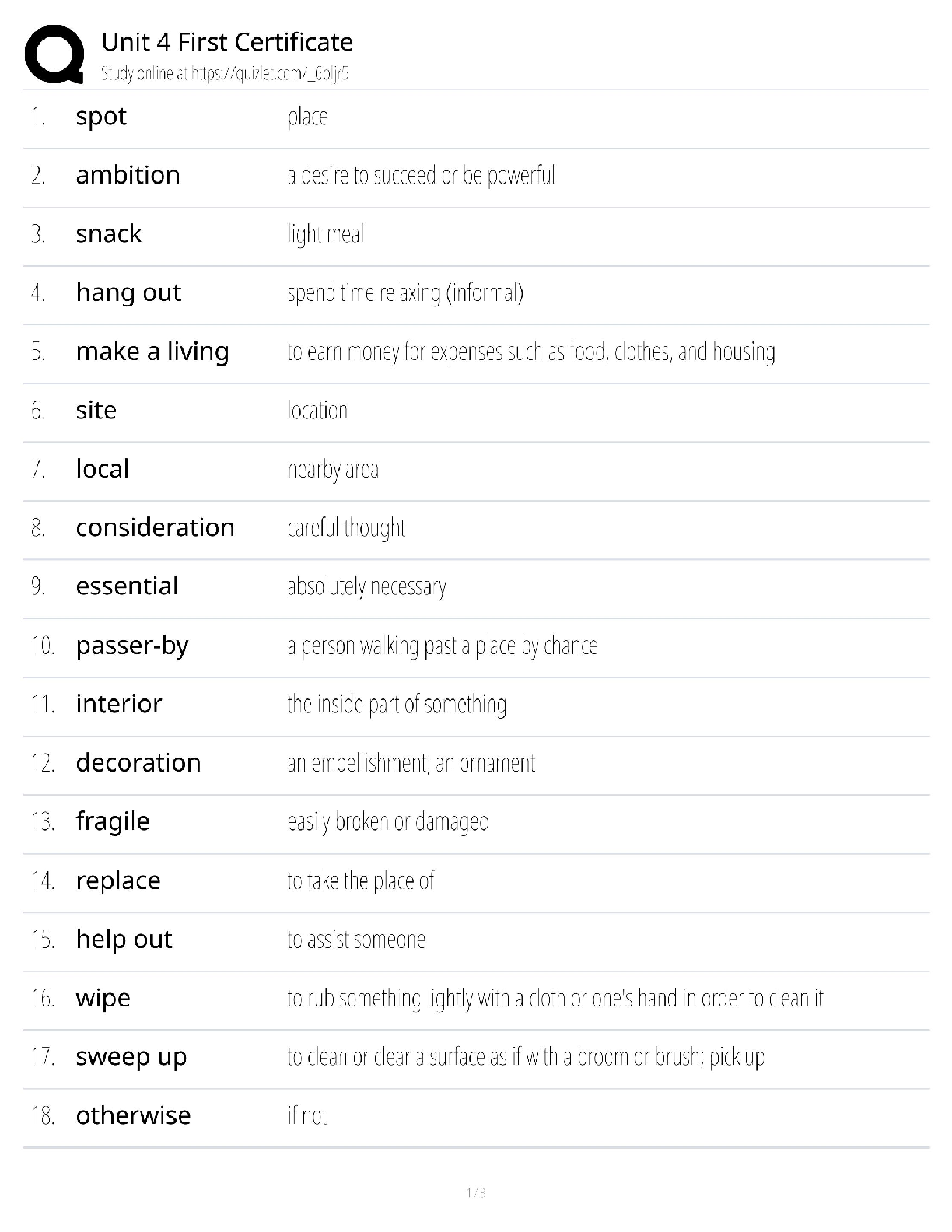
FCE Unit 4 Study Guide / Cambridge B2 First 2025 Exam Prep / Reading & Use of English Mastery
English Language > GCSE MARK SCHEME > GCSE (9–1) English Language J351/01: Communicating information and ideas General Certificate of Se (All)
GCSE (9–1) English Language J351/01: Communicating information and ideas General Certificate of Secondary Education Mark Scheme for November 2020 Oxford Cambridge and RSA Examinations GCSE (9� ... ��1) English Language J351/01: Communicating information and ideas General Certificate of Secondary Education Mark Scheme for November 2020Oxford Cambridge and RSA Examinations OCR (Oxford Cambridge and RSA) is a leading UK awarding body, providing a wide range of qualifications to meet the needs of candidates of all ages and abilities. OCR qualifications include AS/A Levels, Diplomas, GCSEs, Cambridge Nationals, Cambridge Technicals, Functional Skills, Key Skills, Entry Level qualifications, NVQs and vocational qualifications in areas such as IT, business, languages, teaching/training, administration and secretarial skills. It is also responsible for developing new specifications to meet national requirements and the needs of students and teachers. OCR is a not-for-profit organisation; any surplus made is invested back into the establishment to help towards the development of qualifications and support, which keep pace with the changing needs of today’s society. This mark scheme is published as an aid to teachers and students, to indicate the requirements of the examination. It shows the basis on which marks were awarded by examiners. It does not indicate the details of the discussions which took place at an examiners’ meeting before marking commenced. All examiners are instructed that alternative correct answers and unexpected approaches in candidates’ scripts must be given marks that fairly reflect the relevant knowledge and skills demonstrated. Mark schemes should be read in conjunction with the published question papers and the report on the examination. © OCR 2020J351/01 Mark Scheme November 2020 2 1. Annotations: Appropriate scoris annotations here Annotation Meaning to indicate explanations and analytical comment for explanations that are not fully clear AO1 Supporting detail Development of observation/argument AO2 Good analysis/use of language AO3 context AO1/AO3 link or comparison AO4 Evaluation AO2 Structure Relevance to question Not relevant to question Paraphrase or lifting Omission/needs development/needs example Blank Page AO6 Expandable vertical wavy line: errors of punctuation/lack of fluency AO6 Expandable horizontal wavy line: specific errors of spelling/grammarJ351/01 Mark Scheme November 2020 3 2. Subject-specific Marking Instructions INTRODUCTION Your first task as an Examiner is to become thoroughly familiar with the material on which the examination depends. This material includes: • the specification, especially the assessment objectives • the question paper and its rubrics • the unseen texts • the mark scheme. You should ensure that you have copies of these materials. You should ensure also that you are familiar with the administrative procedures related to the marking process. These are set out in the OCR booklet Instructions for Examiners. If you are examining for the first time, please read carefully Appendix 5 Introduction to Script Marking: Notes for New Examiners. Please ask for help or guidance whenever you need it. Your first point of contact is your Team Leader. Rubric Infringement Candidates may infringe the rubric in the following way: • answering two questions from Section B. If a candidate has written two answers for Section B, mark both answers and award the highest mark achieved.J351/01 Mark Scheme November 2020 4 ASSESSMENT OBJECTIVES Candidates are expected to demonstrate the following in the context of the content described: AO1 Identify and interpret explicit and implicit information and ideas. Select and synthesise evidence from different texts. AO2 Explain, comment on and analyse how writers use language and structure to achieve effects and influence readers, using relevant subject terminology to support their views. AO3 Compare writers’ ideas and perspectives, as well as how these are conveyed, across two or more texts. AO4 Evaluate texts critically and support this with appropriate textual references. AO5 Communicate clearly, effectively and imaginatively, selecting and adapting tone, style and register for different forms, purposes and audiences. Organise information and ideas, using structural and grammatical features to support coherence and cohesion of texts. AO6 Candidates must use a range of vocabulary and sentence structures for clarity, purpose and effect, with accurate spelling and punctuation.J351/01 Mark Scheme November 2020 8 WEIGHTING OF ASSESSMENT OBJECTIVES The relationship between the components and the assessment objectives of the scheme of assessment is shown in the following grid: % of GCSE (9–1) AO1 AO2 AO3 AO4 AO5 AO6 Total J351/01 Communicating Information and Ideas 6.25 7.5 3.75 7.5 15 10 50% J351/02 Exploring Effects and Impact 2.5 11.25 3.75 7.5 15 10 50% Total 8.75 18.75 7.5 15 30 20 100% USING THE MARK SCHEME Please study this Mark Scheme carefully. The Mark Scheme is an integral part of the process that begins with the setting of the question paper and ends with the awarding of grades. Question papers and Mark Schemes are developed in association with each other so that issues of differentiation and positive achievement can be addressed from the very start. This Mark Scheme is a working document; it is not exhaustive; it does not provide ‘correct’ answers. The Mark Scheme can only provide ‘best guesses’ about how the question will work out, and it is subject to revision after we have looked at a wide range of scripts. The Examiners’ Standardisation Meeting will ensure that the Mark Scheme covers the range of candidates’ responses to the questions, and that all Examiners understand and apply the Mark Scheme in the same way. The Mark Scheme will be discussed and amended at the meeting, and administrative procedures will be confirmed. Co-ordination scripts will be issued at the meeting to exemplify aspects of candidates’ responses and achievements; the co-ordination scripts then become part of this Mark Scheme. Before the Standardisation Meeting, you should read and mark in pencil a number of scripts, in order to gain an impression of the range of responses and achievement that may be expected. In your marking, you will encounter valid responses which are not covered by the Mark Scheme: these responses must be credited. You willJ351/01 Mark Scheme November 2020 9 encounter answers which fall outside the ‘target range’ of Level of Response Bands for the paper which you are marking. Please mark these answers according to the marking criteria. Please read carefully all the scripts in your allocation and make every effort to look positively for achievement throughout the ability range. Always be prepared to use the full range of marks. INFORMATION AND INSTRUCTIONS FOR EXAMINERS 1 The co-ordination scripts provide you with examples of the standard of each band. The marks awarded for these scripts will have been agreed by the Team Leaders and will be discussed fully at the Examiners’ Co-ordination Meeting. 2 The specific task-related notes on each question will help you to understand how the band descriptors may be applied. However, these comments do not constitute the mark scheme. They are some thoughts on what was in the setter’s mind when the question was formulated. It is hoped that candidates will respond to questions in a variety of ways and will give original and at times unexpected interpretations of texts. Rigid demands for ‘what must be a good answer’ would lead to a distorted assessment. 3 Candidates’ answers must be relevant to the question. Beware of prepared answers that do not show the candidate’s thought and which have not been adapted to the thrust of the question. Beware also of answers where candidates attempt to reproduce interpretations and concepts that they have been taught but have only partially understood. 4 Candidates’ answers should demonstrate knowledge and understanding of the texts. This knowledge will be shown in the range and detail of their references to the text. Re-telling sections of the text without commentary is of little or no value.J351/01 Mark Scheme November 2020 10 INSTRUCTIONS TO EXAMINERS: A INDIVIDUAL ANSWERS 1 The indicative content indicates the expected parameters for candidates’ answers, but be prepared to recognise and credit unexpected approaches where they show relevance. 2 Using ‘best-fit’, decide first which set of Level of Response Band Descriptors best describes the overall quality of the answer. Once the band is located, adjust the mark concentrating on features of the answer which make it stronger or weaker following the guidelines for refinement. • Highest mark: If clear evidence of all the qualities in the band descriptors is shown, the HIGHEST Mark should be awarded. • Lowest mark: If the answer shows the candidate to be borderline (i.e. they have achieved all the qualities of the bands below and show limited evidence of meeting the criteria of the band in question) the LOWEST mark should be awarded. • Middle mark: This mark should be used for candidates who are secure in the band. They are not ‘borderline’ but they have only achieved some of the qualities in the band descriptors. 3 Be prepared to use the full range of marks. Do not reserve (e.g.) high Level 6 marks ‘in case’ something turns up of a quality you have not yet seen. If an answer gives clear evidence of the qualities described in the band descriptors, reward appropriately. B TOTAL MARKS 1 Transfer the mark awarded to the front of the script. 2 The maximum mark for the paper is 80.J351/01 Mark Scheme November 2020 11 Question Answer Marks Guidance 1 a SKILLS: AO1i: Identify and interpret explicit and implicit information and ideas. Award one mark each for any two of the following: • Sewing (in the parlour) • Reading aloud • (Practising) music 2 Look again at lines 1-9. Give two activities which young ladies were expected to do. Quotations or explanations in the candidates’ own words are acceptable. Reading must be ‘aloud’. 1 b SKILLS: AO1i: Identify and interpret explicit and implicit information and ideas. Award one mark each for an explanation of any two of the following: • Martineau’s parents disapproved • Young women were not expected to study or read openly • She was always at risk of being sent for • She was expected to sew and practice music (in the parlour) • She did not have much time (to study in solitude) • She had study early in the morning or late at night 2 Explain why Harriet found it hard to do what her heart was set on.J351/01 Mark Scheme November 2020 12 Question 2 Both texts describe the experience of growing up. What are the similarities in the experiences described in each text? Draw on evidence from both texts to support your answer. (6 marks) AO1ii: Select and synthesise evidence from different texts. Where the candidate’s answer consistently meets the criteria, the higher mark should be awarded. Level 3 (5–6 marks) A detailed response which shows a secure ability to synthesise appropriate ideas and evidence from both texts, showing perceptive understanding of the experience of growing up, including conceptual ideas. Level 2 (3–4 marks) A response which shows some ability to make connections between ideas and evidence from both texts, showing clear awareness of the experience of growing up. The ideas and evidence selected may not be equal across both texts. Level 1 (1–2 marks) A response which shows limited ability to select and make connections between evidence from both texts, showing little awareness of the experience of growing up. The evidence selected is likely to focus on more obvious, surface features of the texts and may be imbalanced across the texts. 0 marks No response or no response worthy of credit. Question 2 Guidance Give credit for answers that synthesise evidence from both texts. Higher level responses will draw together and synthesise perceptive ideas, using appropriate evidence from both texts. Lower level responses will make straightforward connections between points and use some relevant evidence. Give credit for the quality of the response and the skill shown in the ability to synthesise appropriate ideas and evidence. Higher level responses will draw on conceptual ideas whereas lower level responses will select and comment on more obvious features. Candidates may refer to some of the following points: • The lives of both young women were difficult. • Both young women liked to read books. • There is some restriction in both texts on the young women’s freedom to read. • Both young women have to find opportunities to read when they are by themselves away from their parents. • Both women had to follow their passions in secret.J351/01 Mark Scheme November 2020 13 • Both women are encouraged by the books they read to express themselves more freely. • Both sets of parents fail to restrict their daughters completely. • Both became successful writers (allow one mark only because although this is mentioned in the introduction it is not evidenced in Text 2.J351/01 Mark Scheme November 2020 14 Question 3 Look again at lines 9-25. Explore how Jeanette Winterson uses language and structure to present how books set her free. Support your ideas by referring to the text, using relevant subject terminology. (12 marks) AO2: Explain, comment on and analyse how writers use language and structure to achieve effects and influence readers, using relevant subject terminology to support their views. Where the candidate’s answer consistently meets the criteria, the higher mark should be awarded. Level 6 (11–12 marks) • A skilled analysis which demonstrates a sophisticated appreciation of how the writer has used language and structure to achieve effects and influence the reader. Candidates’ analysis of both language and structure is consistent and detailed. • Preciselyselected and integrated subject terminology deployed to enhance the response. Level 5 (9–10 marks) • An analysis which demonstrates a perceptive understanding of how the writer has used language and structure to achieve effects and influence the reader. Candidates’ analysis of both language and structure is reasonably detailed and balanced. • Well–chosen subject terminology integrated into explanations. Level 4 (7–8 marks) • A developed explanation which shows a secure understanding of how the writer has used language and structure to achieve effects and influence the reader. Candidates comment on the effects of both language and structure, but the explanation may not be entirely balanced. • Relevant terminology should be used to develop ideas. Level 3 (5–6 marks) • A clear explanation which shows a general understanding of how the writer has used language and structure to achieve effects and influence the reader. Candidates refer to language and structure but may not give a full explanation of the effects of both. • Some use of relevant subject terminology to support ideas. Level 2 (3–4 marks) • A straightforward commentary which shows some understanding of how the writer has used language and structure to achieve effects and influence the reader. Candidates are likely to refer more fully to either language or structure and note some features without explaining the effects. • Some use of subject terminology, though it may not always be relevant. Level 1 (1–2 marks) • A descriptive response which shows limited awareness of how the writer has used language and structure to achieve effects and influence the reader. • Little or no use of subject terminology.J351/01 Mark Scheme November 2020 15 0 marks • No response or no response worthy of credit. Question 3 Guidance Give credit for answers that link aspects of language and structure with how they are used to convey how books set her free, supported by close and relevant reference to the text. Give credit for accurate use of relevant terminology integrated into responses, which shows a precise understanding of features and their effect in this text. Candidates must refer to the use of language and structure in their response. A response which does not achieve a reasonable balance between references to language and to structure cannot achieve the higher levels, as indicated in the level descriptors. Candidates may refer to some of the following points: Note: Do accept material from lines 26-28 as well. Winterson repeats the adverbial ‘more and more’ to convey the increasing use of her own words when she wrote down what she remembered from the books she had read. She compares herself to a ‘pirate’ to suggest that what she was doing was some kind of illicit adventure and then extends the metaphor by comparing her addition of extra words to the remembered text to a sailor varying their route across the sea by ‘tacking’. She begins the next paragraph with a rhetorical question to capture the increasing understanding her younger self had of how books were helping her to understand the opportunities available to her. By repeating the word ‘worlds’ she contrasts the ‘worlds’ she reads about in books to the possible ‘worlds’ she could explore in her future life. She evokes sympathy for her younger self by using the adjective ‘poor’ to describe herself when she was young. She forcefully dismisses the metaphorical ‘barriers’ that might prevent her from entering these ‘worlds’ by emphatically repeating the negating particle ‘not’ in the tricolon, ‘Not gender, not time, not circumstance’. She then uses the metaphor of a ‘door’ to describe how, by reading books, she can ‘pass freely’ into these new worlds. The adverb ‘freely’ shows how such an transition is made easy through her reading. She repeats the word ‘barriers’ at the start of the next paragraph when describing her mother whose appearance she unkindly mocks by using the adjective ‘ample’ to describe her body. She uses the metaphor of being ‘fed words’ to describe finding sermons in her packed lunch and being ‘shod’ with words to describe finding Bible verses in her hockey boots to show intensely her mother inflicted her religious views on her. Ironically, this helps the young Winterson to understand the ‘power of words’. She compares them to ‘clues’, perhaps picking up the pirate metaphor from earlier in the extract, and clues which she ‘hunted’ down. Using the verb ‘hunted’ conveys the determination with which she read in search of ‘something’ even though the indeterminate pronoun makes clear that she does not know what that ‘something’ is. Her repetition of something in the phrases, ‘something valuable, something beyond myself’ emphasizes the second item in the short list which is also the final phrase in the paragraph. The hopes expressed in this paragraph are in strong contrast with the references in the next paragraph to the way her mother treated her. Describing keeping books secretly as ‘harbouring’ suggests it is in some way an illicit activity. Winterson then explains clearly the effect of the books by contrasting the idea of a book that might ‘fall’ into her hands with the idea that she herself somehow ‘fell’ into books which suggests her discovery of books as an escapeJ351/01 Mark Scheme November 2020 16 Question 4 - ‘Both texts powerfully describe how families can make it difficult for young people to express themselves freely.’ How far do you agree with this statement? In your answer you should: discuss what the texts show us about how families can make free expression difficult; explain how far you agree that that the families in each text make free expression difficult; compare the ways the texts present the ways families make free expression difficult. Support your response with quotations from both texts. (18 marks). SKILLS: Mark the response out of 12 marks (AO4) and out of 6 marks (AO3) using the two sets of level descriptors below; add the two marks together to award a total mark out of 18. Where the candidate’s answer consistently meets the criteria, the higher mark should be awarded. AO4 (12 marks) Evaluate texts critically and support this with appropriate textual references. AO3 (6 marks) Compare writers’ ideas and perspectives as well as how these are conveyed across two or more texts. Level 6 (11–12 marks) • A sustained critical evaluation demonstrating a perceptive and considered response to the statement and a full explanation of the impact of the texts on the reader. • Comments are supported by apt, skilfully selected and integrated textual references. Level 6 (6 marks) A detailed, interwoven comparison which explores writers’ ideas and perspectives and how they are conveyed. Level 5 (9–10 marks) • An informed critical evaluation showing a thoughtful response to the statement and clear consideration of the impact of the texts on the reader. • Comments are supported by persuasive textual references. Level 5 (5 marks) A sustained comparison of writers’ ideas and perspectives and how they are conveyed. Level 4 (7–8 marks) • A response with developed evaluative comments addressing the statement and some comments about the impact on the reader. • Comments are supported by well–chosen textual references. Level 4 (4 marks) A developed comparison of writers’ ideas and perspectives and how they are conveyed. Level 3 (5–6 marks) • A response with clear evaluative comments and some awareness of the impact on the reader. • Comments are supported by appropriate textual references. Level 3 (3 marks) A clear comparison of writers’ ideas and perspectives which begins to consider how they are conveyed. Level 2 (3–4 marks) • A response with straightforward evaluative comments and a little awareness of the impact on the reader. • Comments are supported by some appropriate textual references. Level 2 (2 marks) A response which identifies main points of comparison between writers’ ideas and perspectives. from an unhappy childhood was a happy accident rather than a deliberate plan. She ends the extract with a series of metaphors to emphasise how books were a place of ‘safekeeping’ for her by comparing them to the slates at the start of the extract provide ‘a roof over my head’ under which she has ‘taken shelter’.J351/01 Mark Scheme November 2020 17 Level 1 (1–2 marks) • A limited description of content. • Comments are supported by copying or paraphrase. Level 1 (1 mark) A response which makes simple points of comparison between writers’ ideas and perspectives. 0 marks • No response or no response worthy of credit. 0 marks No response or no response worthy of credit. Question 4 Guidance This question assesses AO4 and AO3. AO4 is worth 12 marks and AO3 is worth 6 marks. The first two bullet points of the question prompt candidates to evaluate the text (AO4) and the third bullet point prompts candidates to compare the texts (AO3). Candidates may construct their answer in response to the bullet points in combination, and integrate their evaluative and comparative commentary throughout; this is a valid approach which may achieve the highest levels for AO4 and AO3. Give credit for critical evaluation of ‘how far’ the candidate agrees with the statement that the texts are powerful. Accept all valid evaluations which are supported by appropriate, integrated references to both texts. For example, some candidates may consider one text to be more powerful than the other. Candidates may evaluate these ideas in response to AO4: • In Text 1 the comment that it ‘not thought proper’ for young women to study suggests social convention restricted Harriet’s choices • There are clear rules about what Harriet is ‘expected’ to do, i.e. sew in the parlour and practise her music • However, she is not prevented from studying as long as it is not done ‘conspicuously’ and done ‘in the early morning or late at night’ • In Text 2 the mother’s concern about ‘harmful influences’ in what Jeanette is reading may be seen as reasonable by some students • Winterson is restricted by only being ‘allowed’ books for one week but the books are ‘doors’ that allow her to overcome ‘barriers’ in her life • Some students may find it ironic that the sermons and verses the mother gave to Winterson actually helped her understand the power of words Candidates may compare these points in response to AO3: • Both texts refer to limited freedoms – in Text 1 Harriet was ‘permitted’ to read and in Text 2 Jeanette was ‘allowed’ to read some books • In Text 1 Harriet studied during unsocial hours and in Text 2 Jeanette ‘fled the house’ • Both women were inspired by other authors – in Text 1 Harriet translates other authors and in Text 2 Jeanette copies out memorised texts • In Text 1 Harriet’s cousin and brother encourage her studies whereas Jeanette’s mother in Text 2 makes it difficult for Jeanette to read • Harriet in Text 1 is inspired and encouraged to do her own writing whereas Jeanette begins to write by adapting other writer’s ideas • In both texts the act of writing is a kind of liberation – in Text 1 Harriet feels she has become ‘an authoress’ and Jeanette talks about books ‘freeing’ her.J351/01 Mark Scheme November 2020 18J351/01 Mark Scheme November 2020 19 Question 5/6 EITHER ‘How I prefer to spend my time.’ Write the words of a talk to young people about your favourite activity. You should: • explain what your favourite activity is • describe what you do in your favourite activity • explain your thoughts and feelings about your favourite activity. OR Write a magazine article to persuade parents to allow their teenage children more freedom. You are not required to include any visual or presentational features. You should: • describe why teenage children might like more freedom • explain why parents might not like to give their teenage children more freedom • explain why parents should allow their teenage children more freedom.J351/01 Mark Scheme November 2020 20 SKILLS: Mark the response out of 24 marks (AO5) and out of 16 marks (AO6) using the two sets of level descriptors below; add the two marks together to award a total mark out of 40. Where the candidate’s answer consistently meets the criteria, the higher mark should be awarded. AO5: Communicate clearly, effectively and imaginatively, selecting and adapting tone, style and register for different forms, purposes and audiences. AO5: Organise information and ideas, using structural and grammatical features to support coherence and cohesion of texts. AO6: Use a range of vocabulary and sentence structures for clarity, purpose and effect, with accurate spelling and punctuation. Level 6 (21–24 marks) • The form is deliberately adapted to position the reader, showing a sophisticated control of purpose and effect. (AO5) • Tone, style and register are ambitiously selected and deployed to enhance the purpose of the task. (AO5) There is a skilfully controlled overall structure, with paragraphs and grammatical features used to support coherence and cohesion and achieve a range of effects. (AO5) Level 5 (17–20 marks) • The form is confidently adapted and shows a secure understanding of purpose and audience. (AO5). • There is a sustained use of tone, style and register to fulfil the purpose of the task. (AO5) • There is a controlled overall structure, with paragraphs and grammatical features used to support coherence and cohesion and achieve particular effects. (AO5) Level 4 (13–16 marks) • The form is adapted to show a clear understanding of purpose and audience. (AO5) • Tone, style and register are chosen to match the task. (AO5) Level 4 (13–16 marks) • An ambitious range of sentence structures is used to shape meaning and create impact. Accurate punctuation is used to enhance clarity and achieve particular effects. (AO6)J351/01 Mark Scheme November 2020 21 • There is a well–managed overall structure, with paragraphs and grammatical features used to support coherence and cohesion, and sometimes for effect. (AO5) • Vocabulary is precise and subtle, expressing complex ideas with clarity. Spelling of irregular and ambitious words is accurate, with very occasi • onal lapses. (AO6) Level 3 (9–12 marks) • The form is sustained and shows clear awareness of purpose and audience. (AO5) • Tone, style and register is appropriate for the task, with some inconsistences. (AO5) • There is a clear overall structure, with paragraphs and grammatical features used, mostly securely, to support coherence and cohesion. (AO5) Level 3 (9–12 marks) • A wide range of sentence structures is used for deliberate purpose and effect. Punctuation is consistently accurate and is used to achieve clarity. (AO6) • Vocabulary is sometimes ambitious and used convincingly for purpose and effect. Spelling, including complex regular words, is accurate; there may be occasional errors with irregular and ambitious words. (AO6) Level 2 (5–8 marks) • The form, which is mostly appropriate for purpose and audience, is generally maintained. (AO5) • There is an attempt to use a tone, style and register appropriate to the task. (AO5) • There is some evidence of overall structure, with some use of paragraphs and grammatical features to support coherence and cohesion. (AO5) Level 2 (5–8 marks) • A range of sentence structures is used, mostly securely, and sometimes for purpose and effect. Punctuation is generally accurate with occasional errors. (AO6) • Vocabulary is appropriate and shows some evidence of being selected for deliberate effect. Spelling is generally accurate with occasional errors with common and more complex words. (AO6) Level 1 (1–4 marks) • There is some attempt to use a form appropriate for purpose and audience. (AO5) • There is a limited attempt to use a tone, style and register appropriate for the task. (AO5) • There is some attempt to structure the response, with limited evidence of paragraphs or grammatical features to support coherence and cohesion. (AO5) Level 1 (1–4 marks) • Simple sentences are used with some attempt to use more complex structures. Some punctuation is used but there is a lack of control and consistency. (AO6) • Vocabulary is straightforward and relevant with mostly accurate spelling of simple words. (AO6) 0 marks • No response or no response worthy of credit. • 0 marks • No response or no response worthy of credit. •OCR (Oxford Cambridge and RSA Examinations) The Triangle Building Shaftesbury Road Cambridge CB2 8EA OCR Customer Contact Centre [Show More]
Last updated: 3 years ago
Preview 1 out of 21 pages
Buy this document to get the full access instantly
Instant Download Access after purchase
Buy NowInstant download
We Accept:

Can't find what you want? Try our AI powered Search
Connected school, study & course
About the document
Uploaded On
Oct 07, 2022
Number of pages
21
Written in
All
This document has been written for:
Uploaded
Oct 07, 2022
Downloads
0
Views
73
Scholarfriends.com Online Platform by Browsegrades Inc. 651N South Broad St, Middletown DE. United States.
We're available through e-mail, Twitter, Facebook, and live chat.
FAQ
Questions? Leave a message!
Copyright © Scholarfriends · High quality services·






.png)
.png)
.png)
.png)
.png)

