CFA 51: Fixed Income Securities:
Defining Elements
A 10-year bond was issued four years ago. The bond is denominated in US dollars, offers a
coupon rate of 10% with interest paid semi-annually, and is currently priced
...
CFA 51: Fixed Income Securities:
Defining Elements
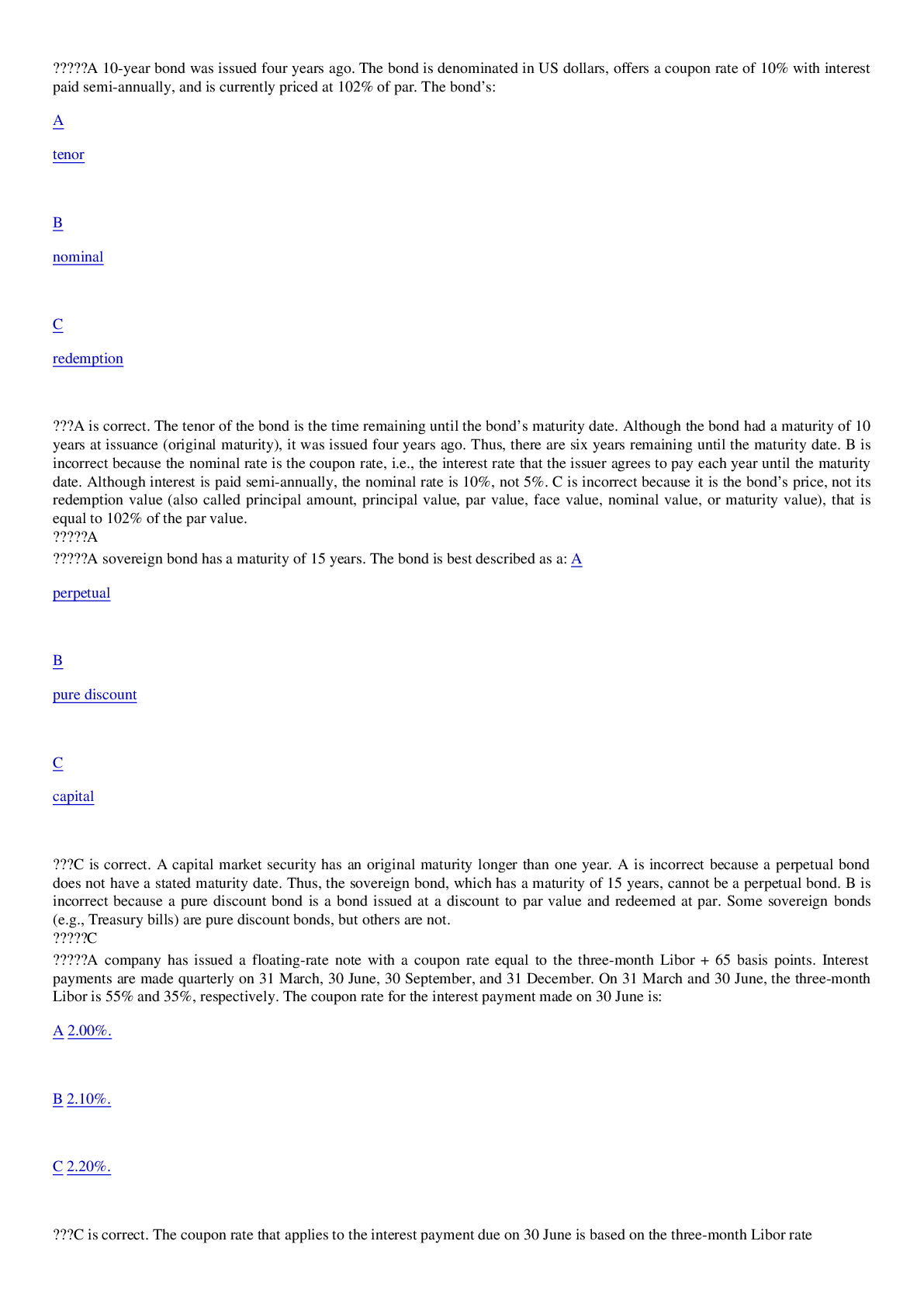
A 10-year bond was issued four years ago. The bond is denominated in US dollars, offers a
coupon rate of 10% with interest paid semi-annually, and is currently priced at 102% of par. The
bond's:
tenor is six years.
nominal rate is 5%.
redemption value is 102% of the par value. - ANS - A is correct. The tenor of the bond is the
time remaining until the bond's maturity date. Although the bond had a maturity of 10 years at
issuance (original maturity), it was issued four years ago. Thus, there are six years remaining
until the maturity date.
B is incorrect because the nominal rate is the coupon rate, i.e., the interest rate that the issuer
agrees to pay each year until the maturity date. Although interest is paid semi-annually, the
nominal rate is 10%, not 5%. C is incorrect because it is the bond's price, not its redemption
value (also called principal amount, principal value, par value, face value, nominal value, or
maturity value), that is equal to 102% of the par value.
A sovereign bond has a maturity of 15 years. The bond is best described as a:
perpetual bond.
pure discount bond.
capital market security. - ANS - C is correct. A capital market security has an original maturity
longer than one year.
A is incorrect because a perpetual bond does not have a stated maturity date. Thus, the sovereign
bond, which has a maturity of 15 years, cannot be a perpetual bond. B is incorrect because a pure
discount bond is a bond issued at a discount to par value and redeemed at par. Some sovereign
bonds (e.g., Treasury bills) are pure discount bonds, but others are not.
A company has issued a floating-rate note with a coupon rate equal to the three-month Libor +
65 basis points. Interest payments are made quarterly on 31 March, 30 June, 30 September, and
31 December. On 31 March and 30 June, the three-month Libor is 1.55% and 1.35%,
respectively. The coupon rate for the interest payment made on 30 June is:
2.00%.
2.10%.
2.20%. - ANS - C is correct. The coupon rate that applies to the interest payment due on 30 June
is based on the three-month Libor rate prevailing on 31 March. Thus, the coupon rate is 1.55% +
0.65% = 2.20%.
The legal contract that describes the form of the bond, the obligations of the issuer, and the rights
of the bondholders can be best described as a bond's:
covenant.
indenture.
debenture. - ANS - B is correct. The indenture, also referred to as trust deed, is the legal contract
that describes the form of the bond, the obligations of the issuer, and the rights of the
bondholders.
A is incorrect because covenants are only one element of a bond's indenture. Covenants are
clauses that specify the rights of the bondholders and any actions that the issuer is obligated to
perform or prohibited from performing. C is incorrect because a debenture is a type of bond. In
many jurisdictions, debentures are unsecured bonds.
[Show More]

.png)
.png)