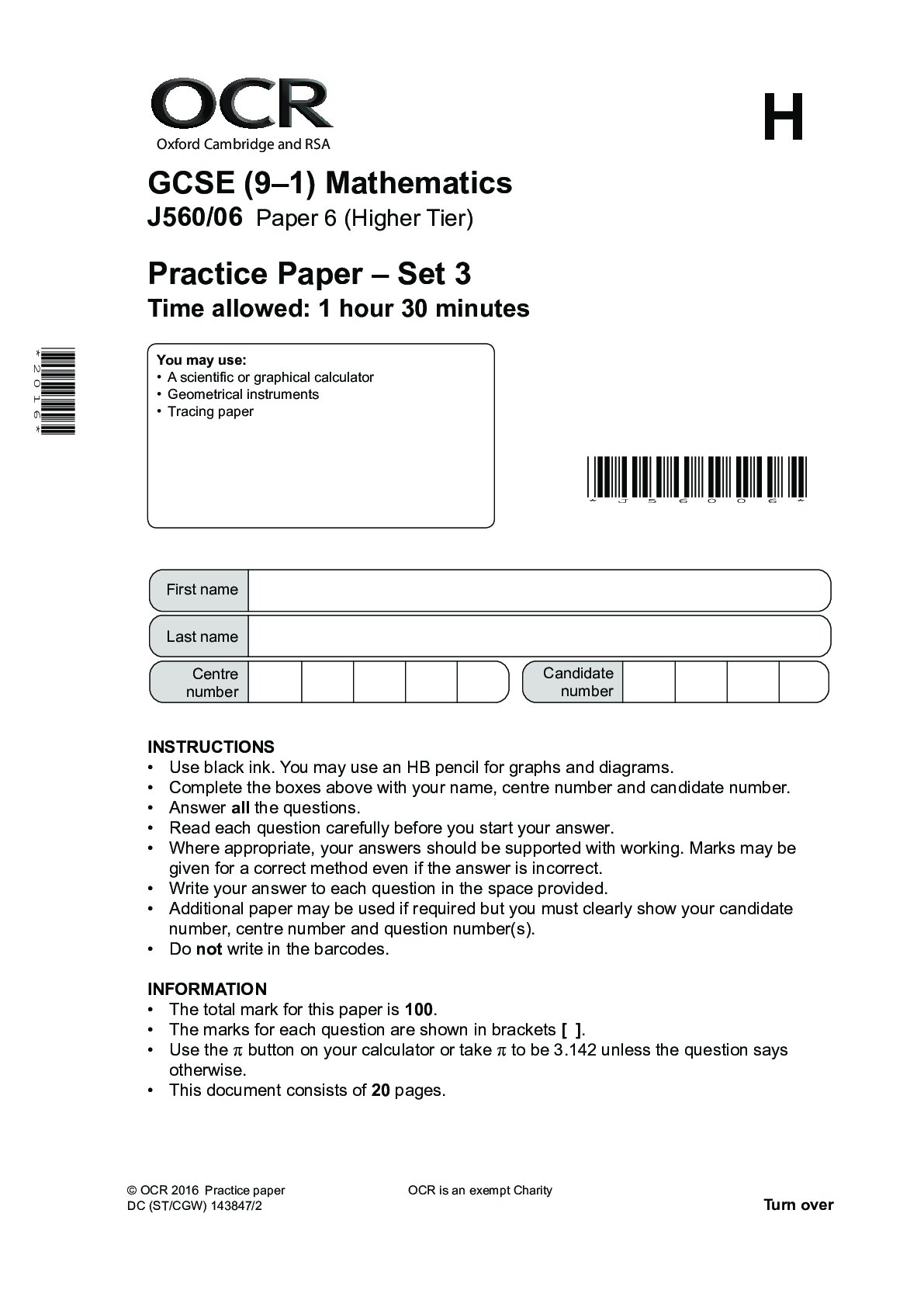
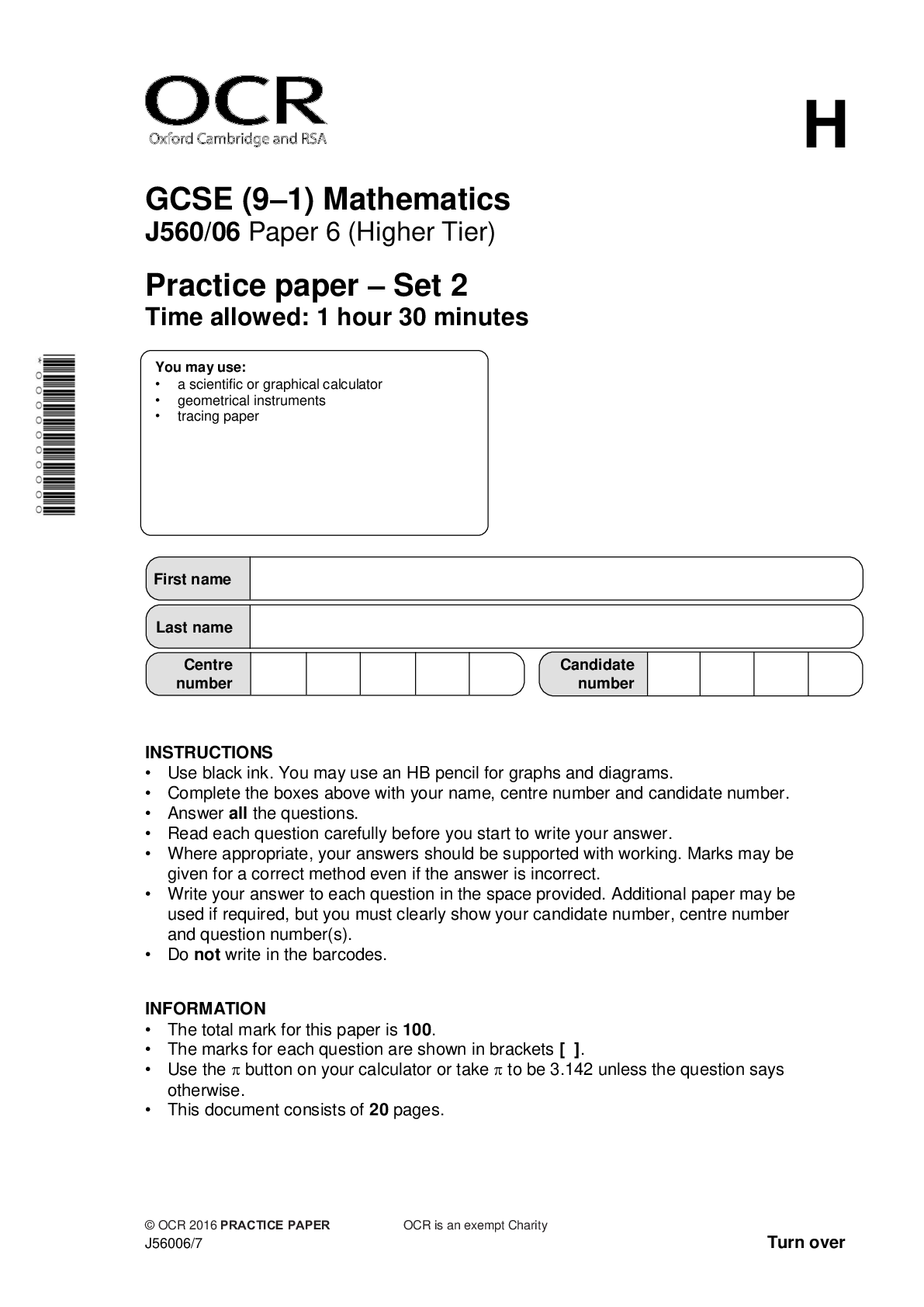
GCSE (9-1) MATHEMATICS
J560/02 Paper 2 (Foundation Tier)
PRACTICE PAPER (SET 2) MARK SCHEME
MAXIMUM MARK 100
DRAFT
This document consists of 11 pages
F
Date – Morning/Afternoon
GCSE (9-1) MATHEMATICS
J560/02 P
...
GCSE (9-1) MATHEMATICS
J560/02 Paper 2 (Foundation Tier)
PRACTICE PAPER (SET 2) MARK SCHEME
MAXIMUM MARK 100
DRAFT
This document consists of 11 pages
F
Date – Morning/Afternoon
GCSE (9-1) MATHEMATICS
J560/02 Paper 2 (Foundation Tier)
PRACTICE PAPER (SET 2) MARK SCHEME
Duration: 1 hour 30 minutesJ560/02 Mark Scheme Practice Paper (Set 2)
2
Subject-Specific Marking Instructions
1. M marks are for using a correct method and are not lost for purely numerical errors.
A marks are for an accurate answer and depend on preceding M (method) marks. Therefore M0 A1 cannot be awarded.
B marks are independent of M (method) marks and are for a correct final answer, a partially correct answer, or a correct intermediate stage.
SC marks are for special cases that are worthy of some credit.
2. Unless the answer and marks columns of the mark scheme specify M and A marks etc, or the mark scheme is ‘banded’, then if the correct
answer is clearly given and is not from wrong working full marks should be awarded.
Do not award the marks if the answer was obtained from an incorrect method, i.e. incorrect working is seen and the correct answer clearly
follows from it.
3. Where follow through (FT) is indicated in the mark scheme, marks can be awarded where the candidate’s work follows correctly from a
previous answer whether or not it was correct.
Figures or expressions that are being followed through are sometimes encompassed by single quotation marks after the word their for clarity,
e.g. FT 180 × (their ‘37’ + 16), or FT 300 – (their ‘52 + 72’). Answers to part questions which are being followed through are indicated by e.g.
FT 3 × their (a).
For questions with FT available you must ensure that you refer back to the relevant previous answer. You may find it easier to mark these
questions candidate by candidate rather than question by question.
4. Where dependent (dep) marks are indicated in the mark scheme, you must check that the candidate has met all the criteria specified for the
mark to be awarded.
5. The following abbreviations are commonly found in GCSE Mathematics mark schemes.
- figs 237, for example, means any answer with only these digits. You should ignore leading or trailing zeros and any decimal point e.g.
237000, 2.37, 2.370, 0.00237 would be acceptable but 23070 or 2374 would not.
- isw means ignore subsequent working after correct answer obtained and applies as a default.
- nfww means not from wrong working.
- oe means or equivalent.
- rot means rounded or truncated.
- seen means that you should award the mark if that number/expression is seen anywhere in the answer space, including the answer
line, even if it is not in the method leading to the final answer.
- soi means seen or implied.J560/02 Mark Scheme Practice Paper (Set 2)
3
6. In questions with no final answer line, make no deductions for wrong work after an acceptable answer (i.e. isw) unless the mark scheme says
otherwise, indicated by the instruction ‘mark final answer’.
7. In questions with a final answer line following working space,
(i) if the correct answer is seen in the body of working and the answer given on the answer line is a clear transcription error allow full marks
unless the mark scheme says ‘mark final answer’. Place the annotation next to the correct answer.
(ii) if the correct answer is seen in the body of working but the answer line is blank, allow full marks. Place the annotation next to the
correct answer.
(iii) if the correct answer is seen in the body of working but a completely different answer is seen on the answer line, then accuracy marks
for the answer are lost. Method marks could still be awarded. Use the M0, M1, M2 annotations as appropriate and place the annotation
next to the wrong answer.
8. In questions with a final answer line:
(i) If one answer is provided on the answer line, mark the method that leads to that answer.
(ii) If more than one answer is provided on the answer line and there is a single method provided, award method marks only.
(iii) If more than one answer is provided on the answer line and there is more than one method provided, award zero marks for the question
unless the candidate has clearly indicated which method is to be marked.
9. In questions with no final answer line:
(i) If a single response is provided, mark as usual.
(ii) If more than one response is provided, award zero marks for the question unless the candidate has clearly indicated which response is
to be marked.
10. When the data of a question is consistently misread in such a way as not to alter the nature or difficulty of the question, please follow the
candidate’s work and allow follow through for A and B marks. Deduct 1 mark from any A or B marks earned and record this by using the MR
annotation. M marks are not deducted for misreads.J560/02 Mark Scheme Practice Paper (Set 2)
4
11. Unless the question asks for an answer to a specific degree of accuracy, always mark at the greatest number of significant figures even if this
is rounded or truncated on the answer line. For example, an answer in the mark scheme is 15.75, which is seen in the working. The
candidate then rounds or truncates this to 15.8, 15 or 16 on the answer line. Allow full marks for the 15.75.
12. Ranges of answers given in the mark scheme are always inclusive.
13. For methods not provided for in the mark scheme give as far as possible equivalent marks for equivalent work. If in doubt, consult your Team
Leader.
14. Anything in the mark scheme which is in square brackets […] is not required for the mark to be earned, but if present it must be correct.J560/02 Mark Scheme Practice Paper (Set 2)
5
Question Answer Marks Part marks and guidance
1 (a) 63
100
7
100
, 7%
0.8[0] 80%
3
3 AO1.3a B1 for 63
100
B1 for two or three correct in second and
third lines
(b) 1.08, 1.5, 17.06, 17.3 1
1 AO1.3a
(c) (i) 3
2
4
or
11
4
or 2.75
1
1 AO1.3a
(ii) 6
2
7
2
2 AO1.3a M1 for 20
7
oe
2 (a) (i) 23 1
1 AO2.1b
(ii) 15 1
1 AO2.1b
(b) (i) 6, 3 1
1 AO1.3a
(ii) 5, 14 1
1 AO1.3a
Following no marks in part (b)
SC1 for first term correct in each part
3 9 4
1 AO1.3b
2 AO3.1d
1 AO3.3
B2 for 17 games won
Or M1 for 51 ÷ 3
AND
M1 for 32 – (6 + their ‘51 ÷ 3’)
4 (a) 1, 2, 4, 5, 10, 20 2
2 AO1.3a
B1 for four correctJ560/02 Mark Scheme Practice Paper (Set 2)
6
Question Answer Marks Part marks and guidance
(b) Valid reason 1
1 AO2.4a
e.g. prime numbers only have one
and themselves as factors
(c) Square numbers have an odd
number of factors
1
1 AO2.5a
Can be given as a counterexample
e.g. factors of 9 are 1, 3, 9
5 (a) 30 and 42 2
1 AO1.3a
1 AO3.1a
M1 for equivalent ratio to 5 : 7 soi
(b) 13 and 7 and 7 2
1 AO1.3a
1 AO3.1a
M1 for two of three numbers given as 7
or for three numbers that total 27
6 (a) (i) 341.54 1
1 AO1.3a
(ii) 300 1
1 AO1.3a
(b) 6 or 6.6 2
2 AO1.3a M1 for 30 4
20
or
33 4
20
7 (a) 8 1
1 AO1.2
(b) Harvey should have multiplied 4 by 9
6
1 1
1 AO1.2
1 AO3.4a
soi
8 (a) Correct pie chart labelled
appropriately
4
2 AO1.3a
2 AO2.3b
B1 for correct 90° sector
M1 for 144[° ± 2] or 54[° ± 2] soi
B1 for correct labelling
90°, 144°, 54°, 72°
Accuracy – each sector ± 2°
Only 3 sectors need to be ‘correct’
(b) 1
5
or
72
360
oe
1
1 AO2.3a FT from angle
360
their
[± 2°]J560/02 Mark Scheme Practice Paper (Set 2)
7
Question Answer Marks Part marks and guidance
9 (a) 4.85 1
1 AO1.3a
(b) (i) 45 2
2 AO1.3a
M1 for 25 ÷ 10 × 18 soi
Or B1 for [SF] 2.5
(ii) 27.5 2
2 AO1.3a
M1 for 10 km is 6.25 [miles] soi
or 4 km is 2.5 [miles] soi
or 1 km is 0.625 [miles] soi
10 (a) 35 2
2 AO1.3a
M1 for [total] 9 [parts] soi
(b) (i) 36 2
2 AO1.3a
M1 for 54 ÷ 6 × 4 soi
(ii) 11
21
oe
1
1 AO1.3a
(c) x
x y
2
1 AO3.1b
1 AO3.2
M1 for fraction with x as the numerator
or x + y seen
11 (a) Valid assumption 1
1 AO2.5b
e.g. his speeds are constant
e.g. he changes speed
instantaneously at the changeovers
(b) 5 1
1 AO2.3a
(c) 40 1
1 AO2.3aJ560/02 Mark Scheme Practice Paper (Set 2)
8
Question Answer Marks Part marks and guidance
(d) 30 3
1 AO2.3a
1 AO3.1c
1 AO3.3
M1 for 20 km in 40 minutes
M1 for 20 ÷ 2
3
oe
or some equivalent distance/time that
may lead to the answer
e.g. 60 km in 120 minutes
or
1 2
km per minute
12 (a) 144 3
1 AO1.3a
1 AO3.1d
1 AO3.2
M2 for 60 ÷ 2.5 × 6 oe
Or B1 for 12 miles in half an hour
or 24 miles in an hour
(b) 3 2
2 AO1.3a
M1 for xy = 60 soi
13 45 5
1 AO1.3b
2 AO3.1d
2 AO3.2
B2 for 0.9 [m3] or 1.2 [m3]
Or M1 for 2 × 1.5 × 0.3 or 2 × 1.5 × 0.4
AND
M1 for their ‘0.9’ [m3] = 900 [litres]
M1 for their ‘volume’ ÷ 20
14 (a) Tree diagram completed correctly 2
2 AO2.3b B1 for Josef loses 3
7
or Clare loses 2
5
seen on tree diagram
(b) 12
35
2
2 AO1.3a M1 for 4
7
×
3 5
(c) 17
35
3
2 AO1.3a
1 AO2.3a
M2 for 4
7
×
2 5
+
3 7
×
3 5
oe
Or M1 for 4
7
×
2 5
or
3 7
×
3 5
oeJ560/02 Mark Scheme Practice Paper (Set 2)
9
Question Answer Marks Part marks and guidance
15 (a) a b 5 4 1
1 AO1.3a
(b) x x 6 6 1
1 AO1.3a
(c) (i) x x 5 3 2
2 AO1.3a
M1 for sum of two constant terms is -2
or product of two constant terms is -15
(ii) 5 or -3 1
1 AO1.3a
FT from linear expressions in their (c)(i)
16 15 000 3
3 AO1.3b M2 for 18 000 ÷
100
100 20
oe
Or M1 for 18 000 associated with (100 +
20)%
17 (a) (i) Triangle at (-6, -3), (-6, -5),
(-2, -5)
2
2 AO2.3b
B1 for correct reflection in x = 0
or reflection in y = k
(ii) Triangle at (5, 2), (5, 6), (3, 6) 2
2 AO2.3b
B1 for correct orientation and size but
incorrect position
or correct anticlockwise rotation about
(0, 0) by 90°
(b) (i)
Translation 8
-6
2
1 AO2.1a
1 AO2.3b
B1 for either More than one transformation given
spoils all marks
(ii) Enlargement
[SF] 1
2
oe
[Centre] (2, 3)
3
1 AO2.1a
2 AO2.3b
B1 for each More than one transformation given
spoils all marksJ560/02 Mark Scheme Practice Paper (Set 2)
10
Question Answer Marks Part marks and guidance
(c) Incorrect with correct example 1
1 AO2.5a
e.g. enlargement gives a similar
shape
Accept stretch, shear also
18 3, 12 and 12 6
1 AO1.3b
1 AO2.1a
2 AO3.1d
2 AO3.2
B1 for 3
AND
B5 for 12 and 12
OR
M2 for x = 150
Or M1 for x + x + 60 = 360
AND
M2 for 360 ÷ (180 – their x) oe
dependent on previous M1
Or M1 for 360 ÷ n (0 < n < 180)
or for 180 – their x
19 128 6
1 AO1.3b
2 AO3.1b
2 AO3.2
1 AO3.3
M2 for (48 ÷ 2) ÷ 3 × 2 oe
Or M1 for (48 ÷ 2) ÷ 3
AND
A1 for 8
A1 for 16
M1 for 8 × 16
Alternative method:
B4 for x = 3
OR
M1 for 2(x + 5) + 4(x + 5) = 48
M1 for correct collection to ax + b =
48 oe (FT their equation in x)
M1 for (48 – their b)/a (FT their ax +
b = 48)
After 0 scored, SC1 for use of two
other variables in ratio 1 : 2
AND
B1FT for 2(their x + 5)(their x + 5)
evaluated (FT their solution for x)J567/02 Practice Paper (Set 2)
11
Assessment Objectives (AO) Grid
Question AO1 AO2 AO3 Total
1(a) 3 0 0 3
1(b) 1 0 0 1
1(c)(i) 1 0 0 1
1(c)(ii) 2 0 0 2
2(a)(i) 0 1 0 1
2(a)(ii) 0 1 0 1
2(b)(i) 1 0 0 1
2(b)(ii) 1 0 0 1
3 1 0 3 4
4(a) 2 0 0 2
4(b) 0 1 0 1
4(c) 0 1 0 1
5(a) 1 0 1 2
5(b) 1 0 1 2
6(a)(i) 1 0 0 1
6(a)(ii) 1 0 0 1
6(b) 2 0 0 2
7(a) 1 0 0 1
7(b) 1 0 1 2
8(a) 2 2 0 4
8(b) 0 1 0 1
9(a) 1 0 0 1
9(b)(i) 2 0 0 2
9(b)(ii) 2 0 0 2
10(a) 2 0 0 2
10(b)(i) 2 0 0 2
10(b)(ii) 1 0 0 1
10(c) 0 0 2 2
11(a) 0 1 0 1
11(b) 0 1 0 1
11(c) 0 1 0 1
11(d) 0 1 2 3
12(a) 1 0 2 3
12(b) 2 0 0 2
13 1 0 4 5
14(a) 0 2 0 2
14(b) 2 0 0 2
14(c) 2 1 0 3
15(a) 1 0 0 1
15(b) 1 0 0 1
15(c)(i) 2 0 0 2
15(c)(ii) 1 0 0 1
16 3 0 0 3
17(a)(i) 0 2 0 2
17(a)(ii) 0 2 0 2
17(b)(i) 0 2 0 2
17(b)(ii) 0 3 0 3
[Show More]


, 3e by Steven Krantz.png)