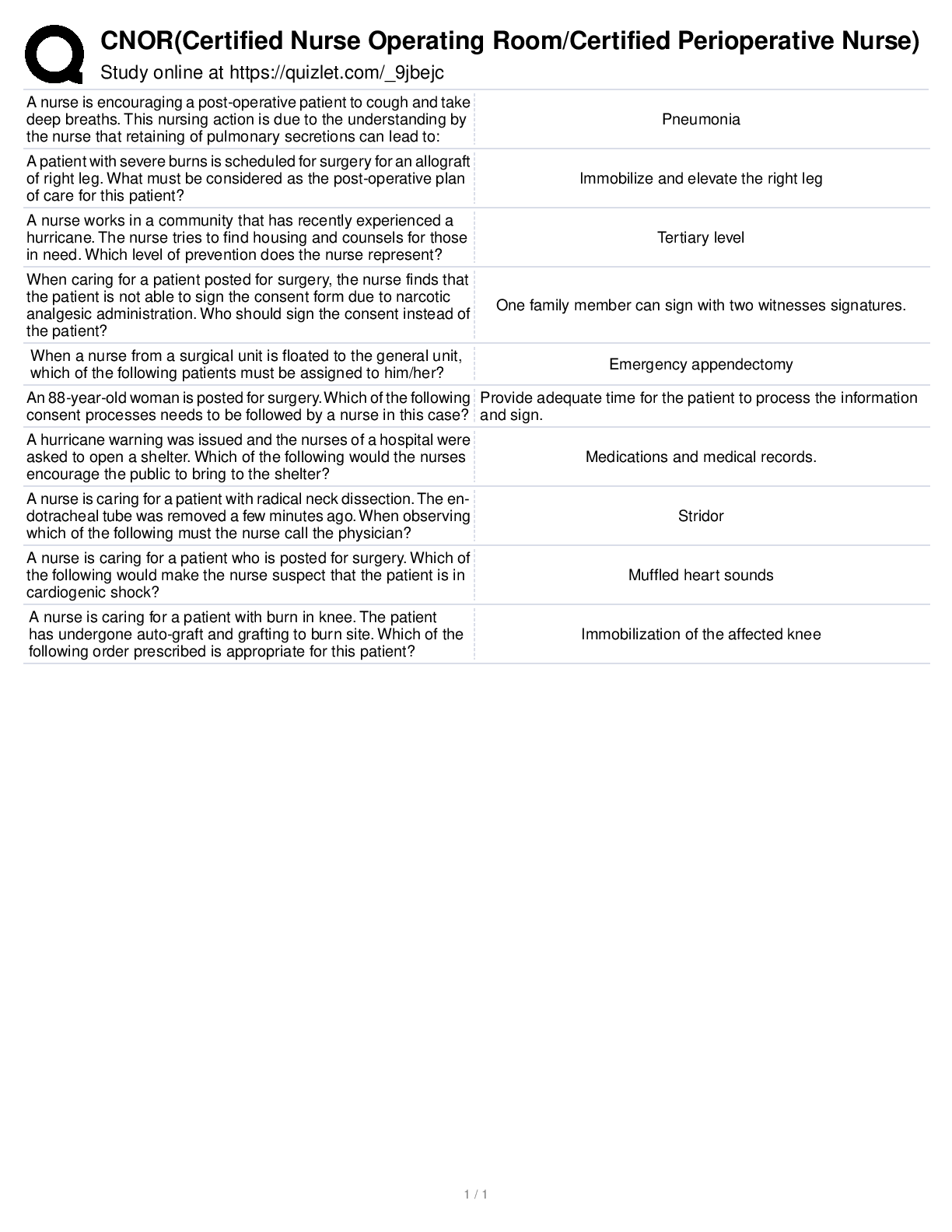
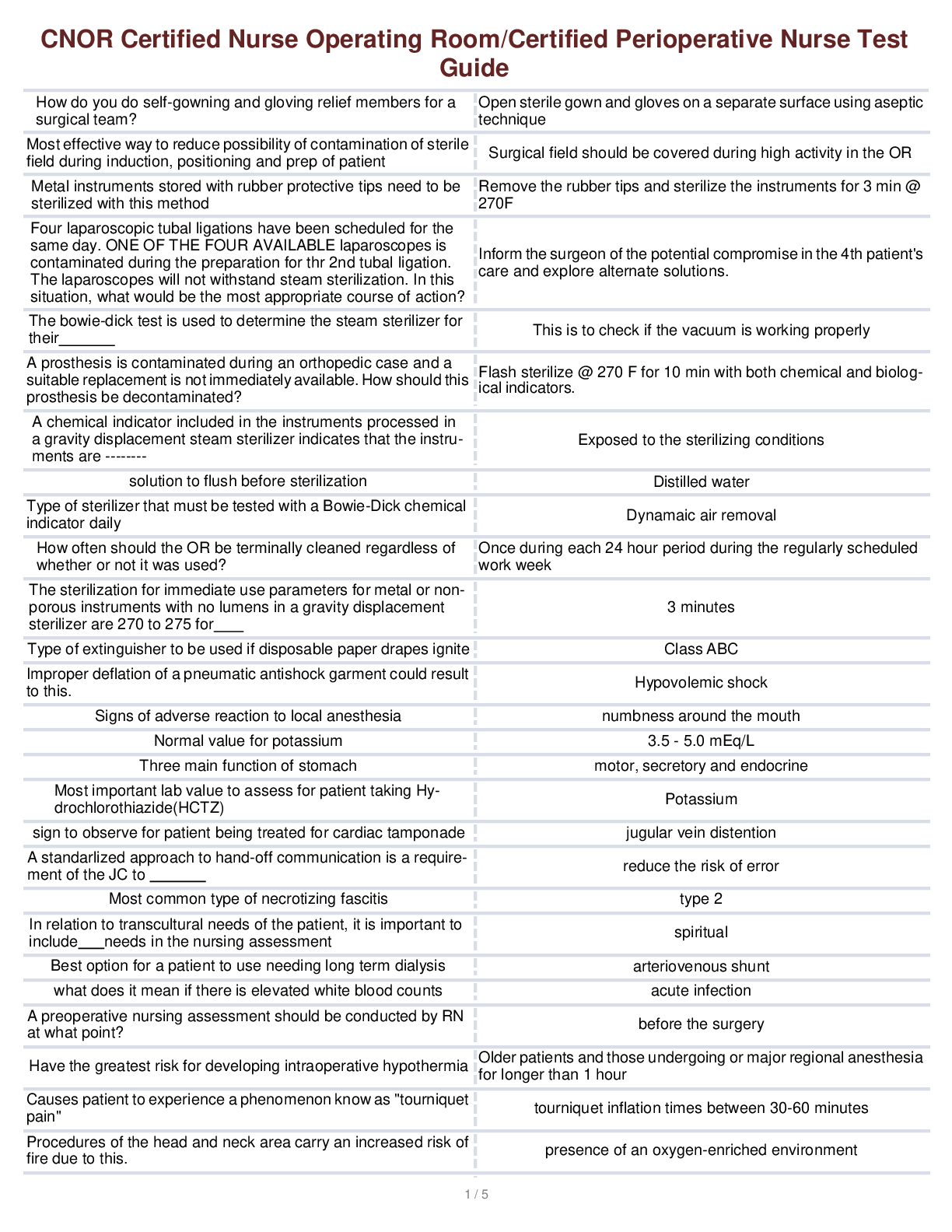
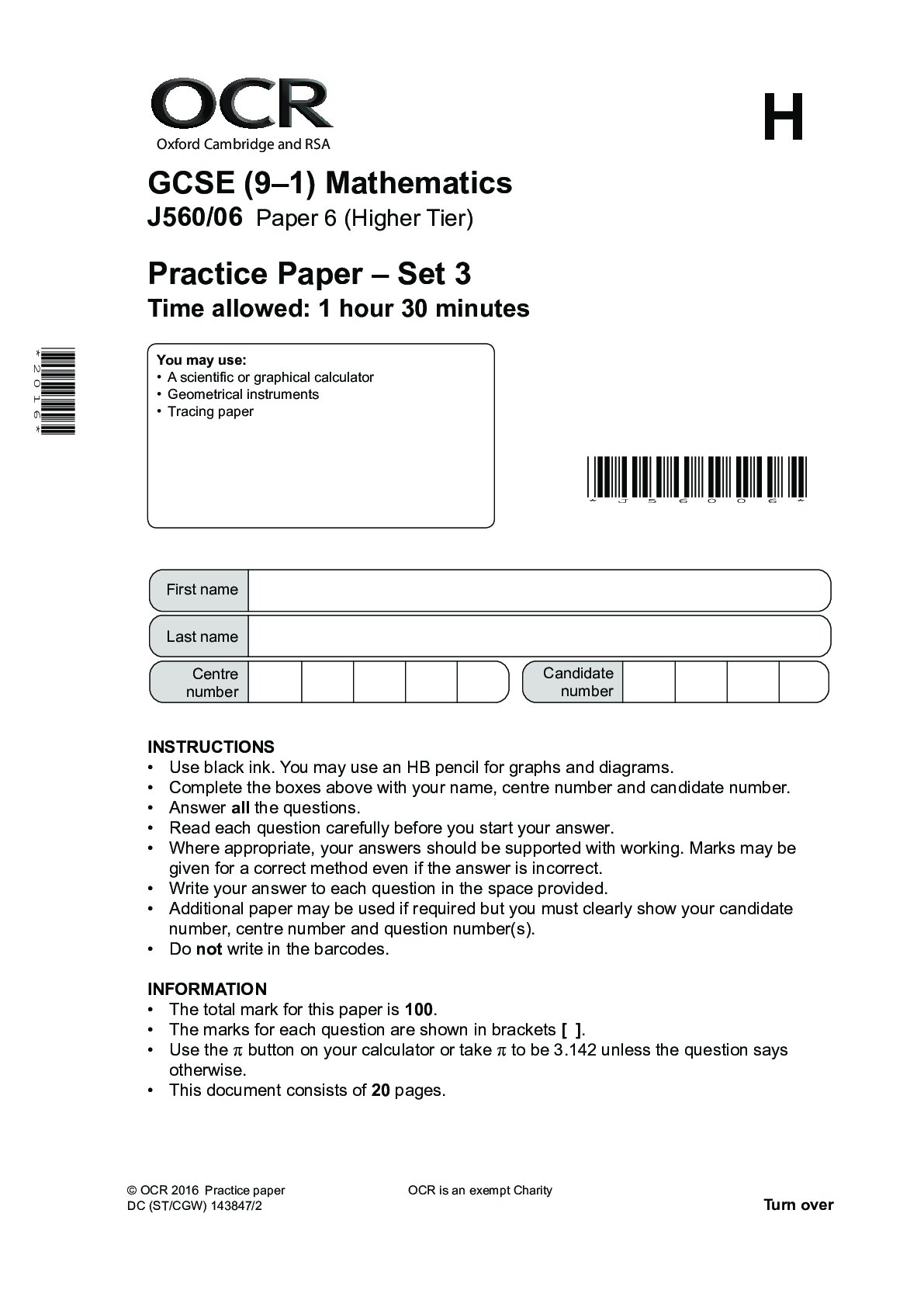
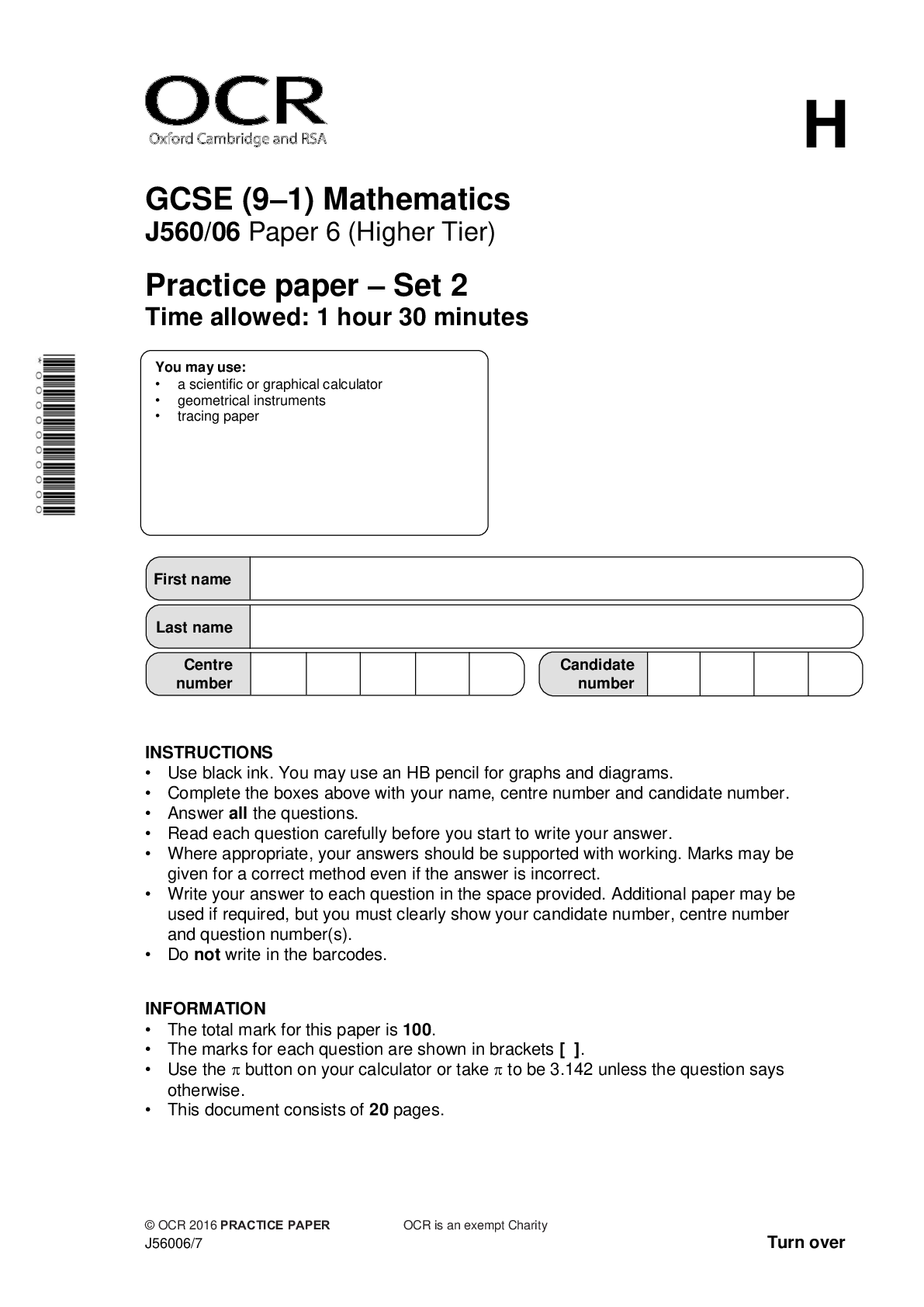
GCSE (9–1) Mathematics
J560/02 Paper 2 (Foundation Tier)
Practice Paper – Set 3
INSTRUCTIONS
• Use black ink. You may use an HB pencil for graphs and diagrams.
• Complete the boxes above with your name, centre n
...
GCSE (9–1) Mathematics
J560/02 Paper 2 (Foundation Tier)
Practice Paper – Set 3
INSTRUCTIONS
• Use black ink. You may use an HB pencil for graphs and diagrams.
• Complete the boxes above with your name, centre number and candidate number.
• Answer all the questions.
• Read each question carefully before you start your answer.
• Where appropriate, your answers should be supported with working. Marks may be
given for a correct method even if the answer is incorrect.
• Write your answer to each question in the space provided.
• Additional paper may be used if required but you must clearly show your candidate
number, centre number and question number(s).
• Do not write in the barcodes.
INFORMATION
• The total mark for this paper is 100.
• The marks for each question are shown in brackets [ ].
• This document consists of 20 pages.
Turn over
© OCR 2016 Practice paper
DC (LEG/CGW) 143844/4
Last name
First name
Candidate
number
Centre
number
Oxford Cambridge and RSA
GCSE (9–1) Mathematics
J560/02 Paper 2 (Foundation Tier)
Practice Paper – Set 3
Time allowed: 1 hour 30 minutes
You may use:
• Geometrical instruments
• Tracing paper
Do not use:
• a Calculator
* 2 0 1 6 *
F
OCR is an exempt Charity
* J 5 6 0 0 2 *2
© OCR 2016 Practice paper J560/02
Answer all the questions
1 Work out.
Give each answer as a fraction in its simplest form.
(a) 4
27
-
(a) ........................................................... [1]
(b)
12
16
+
(b) ........................................................... [2]
(c)
35
78
#
(c) ........................................................... [1]
2 Wilfred runs in six races.
These are his times, in seconds.
10.5 10.6 10.1 10.6 10.0 9.9
(a) Write down the mode of his times.
(a) ............................................ seconds [1]
(b) Work out the range of his times.
(b) ............................................ seconds [1]
(c) Work out the median of his times.
(c) ............................................ seconds [2]3
© OCR 2016 Practice paper J560/02 Turn over
3 (a) Points A, B and C are marked on the grid below.
1
1 2 3
A
B
C
0 4 5 6 7 8 9
2
-2
-3
-1
-2 -1
8 7 6 5 4 3
y
x
(i) Write down the coordinates of point A and point B.
(a)(i) A ( ............... , ............... )
B ( ............... , ............... ) [2]
(ii) Plot the point D so that ABCD is a rectangle. [1]
(b) PQRS is a square.
P has coordinates (56, 3). Q has coordinates (56, -1).
Find a possible pair of coordinates for R and S.
(b) R ( ............... , ............... )
S ( ............... , ............... ) [2]4
© OCR 2016 Practice paper J560/02
4 This diagram shows how a council disposed of waste in 2016.
The total amount of waste was 500 thousand tonnes.
100
200
Recycled
Amount of
waste
(thousand
tonnes)
300
Combusted
for energy
Sent to
landfill
(a) How much waste was recycled?
(a) ............................... thousand tonnes [1]
(b) The council had a target to send less than 30% of the waste to landfill in 2016.
Did the council meet its target in 2016?
Justify your answer.
.............................................................................................................................................. [3]5
© OCR 2016 Practice paper J560/02 Turn over
5 George is going to make biscuits for a party.
He buys:
• two 250g packs of butter at £1.30 per pack
• one 1.5kg bag of flour at £0.80 per bag
• one 500g bag of sugar at £0.99 per bag.
(a) (i) How much does he spend altogether?
(a)(i) £ ....................................................... [1]
(ii) He pays with a £10 note.
How much change should he receive?
(ii) £ ....................................................... [1]
(b) These are the ingredients for making 16 biscuits.
16 Biscuits
100g butter
150g flour
40g sugar
George makes as many biscuits as he can, with the ingredients he bought.
Show that George can make 80 biscuits. [3]6
© OCR 2016 Practice paper J560/02
6 In the diagram, CDE is parallel to FG.
ADG and BDF are straight lines.
A
C
F G
E
Not to scale
D
39°
67°
B
y
x
(a) Complete the sentence with a reason.
Angle x = 39° because ........................................................................................................ [1]
(b) Work out angle y.
(b) .........................................................° [3]7
© OCR 2016 Practice paper J560/02 Turn over
7 (a) Work out.
(i) 112
(a)(i) ........................................................... [1]
(ii) 400
(ii) ........................................................... [1]
(b) Simplify.
m m
2 6
#
(b) ........................................................... [1]
8 (a) By converting each fraction to a percentage, show that
20
9
is bigger than
25
11
. [2]
(b) A holiday is advertised at £900.
The price of the holiday is then reduced by 20%.
How much does the holiday cost now?
(b) £ ........................................................ [3]8
© OCR 2016 Practice paper J560/02
9 (a) Omar has a game.
In his game there are two fair spinners.
Spinner A has four sides, labelled 1, 2, 3, 4. 1 2
3
Dragon
Lion Turtle
4
Spinner B has three sides, labelled Dragon, Lion and Turtle.
Omar spins the two spinners and records the result.
(i) Complete the table showing all the possible outcomes.
You may not
need to use all
the lines.
Spinner A Spinner B
1 D(ragon)
[2]
(ii) What is the probability that Omar spins a 3 and a Lion?
(a)(ii) ........................................................... [1]9
© OCR 2016 Practice paper J560/02 Turn over
(b) Lizzie spins two fair coins.
Lizzie says
There are three possible outcomes: two heads, two tails or a head and a tail.
So the probability that I will get two heads is
13
.
Explain the error that Lizzie has made in her reasoning.
...................................................................................................................................................
.............................................................................................................................................. [1]
10 (a) Write down all the factors of 20.
(a) ........................................................... [2]
(b) (i) A number has exactly four factors.
Two of the factors are 1 and 9.
Find the number.
(b)(i) ........................................................... [1]
(ii) A different number has exactly three factors.
One of the factors is 7.
Find the number.
(ii) ........................................................... [1]10
© OCR 2016 Practice paper J560/02
11 This is a conversion graph for gallons and litres.
0 1
5 0
10
15
20
25
Litres
30
35
40
45
50
2 3 4 5
Gallons
6 7 8 9 10
(a) Use the graph to convert 4 gallons to litres.
(a) .................................................. litres [1]
(b) Millie is planning a journey.
She assumes her car will travel 40 miles per gallon of petrol.
The fuel tank in her car contains 36 litres of petrol.
(i) Use the graph to help work out how far she can travel using this petrol.
(b)(i) ................................................. miles [3]
(ii) Millie decides not to fill up with petrol until she has travelled the distance found in
part (b)(i).
Explain why this may not be sensible.
...........................................................................................................................................
...................................................................................................................................... [1]11
© OCR 2016 Practice paper J560/02 Turn over
12 (a) Work out.
Give your answers in standard form.
(i)
3 1 # # 0 2 4 2 + .7 10
(a)(i) ........................................................... [2]
(ii) 5 1 # # 0 7 6 8 # 10
(ii) ........................................................... [2]
(b) Estimate.
.
. .
0 334
0 621 # 7 94
(b) ........................................................... [2]12
© OCR 2016 Practice paper J560/02
13 (a) Here are the first four terms of a sequence.
10 13 16 19
(i) What is the fifth term?
(a)(i) ........................................................... [1]
(ii) Write an expression for the nth term.
(ii) .......................................................... [2]
(iii) What is the 40th term?
(iii) ........................................................... [1]
(b) Here are the first four terms of a different sequence.
2 5 10 17
(i) What is the next term of this sequence?
(b)(i) ........................................................... [1]
(ii) Explain how you can work out the next term of this sequence.
...........................................................................................................................................
...................................................................................................................................... [1]13
© OCR 2016 Practice paper J560/02 Turn over
14 (a) A box contains only orange counters, purple counters and green counters.
A counter is taken, at random, from the box.
The probability that it is purple is
10
3
and the probability that it is green is
15
7
.
Find the ratio of orange to purple to green counters.
(a) ….…..…... : …...….….. : ….…...….... [3]
(b) A different box contains 42 red counters, 90 yellow counters and no other counters.
A group of students share these counters between them so that they each receive the same
number of red counters and the same number of yellow counters.
There are no counters left over.
How many students could be in the group?
Give all possible answers and show your reasoning.
(b) .............................................................................. [3]14
© OCR 2016 Practice paper J560/02
15 Describe the correlation shown in each of these scatter graphs.
Where there is correlation, state the strength.
..........................................................
..........................................................
..........................................................
.......................................................... [3]
16 Demi gives her dog
23
of a tin of food each day.
Work out the smallest number of tins of food that she needs to feed her dog for 10 days.
........................................................... [3]15
© OCR 2016 Practice paper J560/02 Turn over
17 Adil, Katie and Rebecca share £160 in the ratio 2 : 5 : 3.
(a) How much does Rebecca receive?
(a) £ ......................................................... [2]
(b) Katie says she receives 60% more than Rebecca.
Here is her reasoning.
I receive 5 parts and Rebecca receives 3 parts.
35
= 60%
So I receive 60% more than Rebecca.
(i) Explain what is wrong with Katie’s reasoning.
...........................................................................................................................................
...................................................................................................................................... [1]
(ii) Complete the following to give the correct percentage.
I receive 5 parts and Rebecca receives 3 parts.
............... = ............... %
So I receive ............... % more than Rebecca. [2]16
© OCR 2016 Practice paper J560/02
18 The diagram shows two views of a solid made from 14 one-centimetre cubes.
Front view Rear view
Not to scale
(a) On the centimetre grid below, draw a plan of the solid.
[2]
(b) Work out the smallest number of cubes that need to be added to the solid to make a cube.
(b) ........................................................... [2]17
© OCR 2016 Practice paper J560/02 Turn over
19 (a) Use the formula s ut at
12
2
= + to find s when u = 2, a = 10 and t = 5.
(a) ........................................................... [2]
(b) Expand and simplify.
_ _ x x + - 7 3 i i
(b) ........................................................... [2]
(c) Here are some graphs.
0
A
-3 4
x
y
0
B
-4 3
x
y
0
C
-3
4
x
y
0
D
-4 3
x
y
Complete the following:
Graph ............ is the graph of y x = - _ _ 3 4 i i x + . [1]
Not to scale18
© OCR 2016 Practice paper J560/02
20 (a) Rearrange this formula to make x the subject.
y =
x
5
2
(a) ........................................................... [2]
(b) Solve.
5x - 6 = 3x + 13
(b) x = ..................................................... [3]19
© OCR 2016 Practice paper J560/02
21 Dani has a silver bar.
The bar is a cuboid.
5 cm
4cm
10cm
Silver has a density of 10.5 grams per cm3.
Dani sells the bar and is paid 30p for each gram of silver.
How much is she paid?
Give your answer in pounds.
£ ........................................................... [5]
TURN OVER FOR QUESTION 2220
© OCR 2016 Practice paper J560/02
22 The diagram shows triangle ABC.
D is a point on AB such that DB = 6cm.
BC = 10cm, angle CAD = 30° and angle BDC = 90°.
10 cm
D 6cm B
Not to scale
A
C
30°
Work out the ratio length of AC : length of DB in its simplest form.
........................ : ........................ [5]
END OF QUESTION PAPER
Oxford Cambridge and RSA
Copyright Information
OCR is committed to seeking permission to reproduce all third-party content that it uses in its assessment materials. OCR has attempted to identify and contact all copyright holders
whose work is used in this paper. To avoid the issue of disclosure of answer-related information to candidates, all copyright acknowledgements are reproduced in the OCR Copyright
Acknowledgements Booklet. This is produced for each series of examinations and is freely available to download from our public website (www.ocr.org.uk) after the live examination series.
If OCR has unwittingly failed to correctly acknowledge or clear any third-party content in this assessment material, OCR will be happy to correct its mistake at the earliest possible
opportunity.
[Show More]


, 3e by Steven Krantz.png)