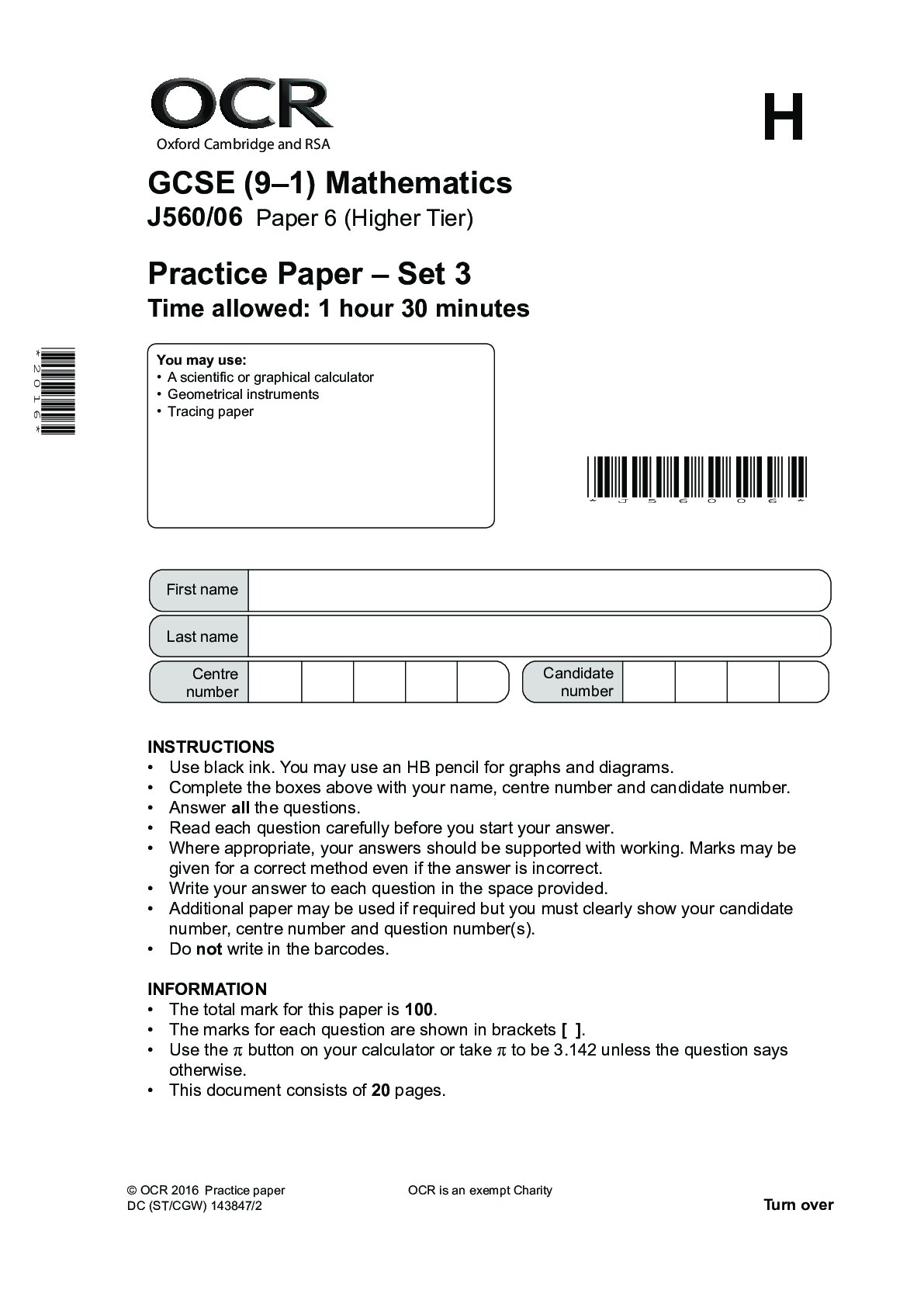
GCSE (9–1) Mathematics
J560/03 Paper 3 (Foundation Tier)
Practice Paper – Set 3
INSTRUCTIONS
• Use black ink. You may use an HB pencil for graphs and diagrams.
• Complete the boxes above with your name, centre num
...
GCSE (9–1) Mathematics
J560/03 Paper 3 (Foundation Tier)
Practice Paper – Set 3
INSTRUCTIONS
• Use black ink. You may use an HB pencil for graphs and diagrams.
• Complete the boxes above with your name, centre number and candidate number.
• Answer all the questions.
• Read each question carefully before you start your answer.
• Where appropriate, your answers should be supported with working. Marks may be
given for a correct method even if the answer is incorrect.
• Write your answer to each question in the space provided.
• Additional paper may be used if required but you must clearly show your candidate
number, centre number and question number(s).
• Do not write in the barcodes.
INFORMATION
• The total mark for this paper is 100.
• The marks for each question are shown in brackets [ ].
• Use the r button on your calculator or take r to be 3.142 unless the question says
otherwise.
• This document consists of 24 pages.
Turn over
© OCR 2016 Practice paper
DC (ST/CGW) 143845/2
Last name
First name
Candidate
number
Centre
number
Oxford Cambridge and RSA
GCSE (9–1) Mathematics
J560/03 Paper 3 (Foundation Tier)
Practice Paper – Set 3
Time allowed: 1 hour 30 minutes
You may use:
• A scientific or graphical calculator
• Geometrical instruments
• Tracing paper
* 2 0 1 6 *
F
OCR is an exempt Charity
* J 5 6 0 0 3 *2
© OCR 2016 Practice paper J560/03
Answer all the questions
1 (a) Complete.
The numbers 25 and 40 have two common factors, 1 and .................. . [1]
(b) Write down a multiple of 11 between 108 and 130.
(b) ........................................................... [1]
2 (a) Change
58
to a decimal.
(a) ........................................................... [1]
(b) Change 80% to a fraction in its lowest terms.
(b) ........................................................... [2]
(c) Write these in order, starting with the smallest.
43% 0.4
37
0 2 .
(c) .................... , .................... , .................... , .................... [3]
smallest3
© OCR 2016 Practice paper J560/03 Turn over
3 (a) A supermarket sells washing liquid in two sizes.
1.8 litres
£4.21
Large
750 ml
£1.70
Small
Which size is better value for money?
Show how you decide.
(a) ........................................................... [3]
(b) This is part of a label on a box of cereal.
Total fat
1.6 g
0.09 g
25g
contains
100 g
contains
..............g
..............g
Saturated fat
Complete this part of the label. [2]4
© OCR 2016 Practice paper J560/03
4 (a) Complete these number machines.
(i)
[1]
(ii)
[2]
INPUT
12 × 6 − 18
..................
INPUT
+ 2 × 4
OUTPUT
OUTPUT
6.4
............
(b) (i) Complete each number machine in a different way.
INPUT
8 + 8
.......
−
.......
OUTPUT
INPUT
8 + 8
.......
−
.......
OUTPUT
[3]
(ii) Explain why there are more ways to complete part (b)(i).
...........................................................................................................................................
...........................................................................................................................................
...........................................................................................................................................
...................................................................................................................................... [1]5
© OCR 2016 Practice paper J560/03 Turn over
5 (a) (i) Three people type 3600 labels in 8 hours.
How many hours should it take four people to type 3600 labels?
(a)(i) ................................................. hours [2]
(ii) Give a reason why it may take a different time than you found in part (a)(i) to type the
3600 labels.
...........................................................................................................................................
...................................................................................................................................... [1]
(b) Pierre and Alice are each paid the same amount for each hour they work.
Pierre is paid £240. He works for
45
of the time Alice works.
How much is Alice paid?
(b) £ ......................................................... [2]
(c) Pierre changes £250 into euros.
£1 is worth 1.26 euros.
How many euros does he receive?
(c) ................................................. euros [2]6
© OCR 2016 Practice paper J560/03
6 The line joining A (2, 1) to B (2, 5) is drawn on a one centimetre grid.
1
-1
-1 0 1 2 3 4 5 6
y 6 5 4 3 2
x
B A
(a) AB is the longest side of a right-angled isosceles triangle, ABC.
(i) Mark a position for point C on the diagram. [1]
(ii) Write down the coordinates of point C.
(a)(ii) (.......................... , ........................... ) [1]7
© OCR 2016 Practice paper J560/03 Turn over
(b) On this grid, AB is one side of a rectangle ABPQ with perimeter 12cm.
1
-1
-1 0 1 2 3 4 5 6
y 6 5 4 3 2
x
B A
Find the coordinates for the positions of P and Q.
Two different answers are possible.
(b) First answer: P (.............. , ..............) and Q (.............. , ..............)
Second answer: P (.............. , ..............) and Q (.............. , ..............) [3]
7 At the start of 2017 there are 4000 fish in a lake.
Each year, the number of fish increases by 20% of 4000.
Find the number of fish at the end of 2019.
........................................................... [3]8
© OCR 2016 Practice paper J560/03
8 Two fair 4-sided spinners are each numbered 1, 2, 3 and 4.
Both spinners are spun and the numbers landed on are added.
The possible totals are shown in the table.
+ 1
1 2 3 4
2
Spinner A
Spinner B
3 4
2 3 4 5
3 4 5 6
4 5 6 7
5 6 7 8
(a) What is the probability of getting a total of 2?
(a) ........................................................... [1]
(b) Spinner A lands on 3.
Explain why it is not possible to get a total of 3.
...................................................................................................................................................
.............................................................................................................................................. [1]
(c) Which total has a probability of
14
?
Show how you decide.
(c) ........................................................... [2]9
© OCR 2016 Practice paper J560/03 Turn over
9 (a) (i) By rounding each number correct to 1 significant figure, estimate the value of the following.
Show all your working.
. .
. .
9 6 0 625
12 3 7 92
#
+
(a)(i) ........................................................... [2]
(ii) Work out.
. .
. .
9 6 0 625
12 3 7 92
#
+
Give your answer correct to 1 decimal place.
(ii) ........................................................... [2]
(b) 20% of the mass of a cauliflower is 90 grams.
Find the mass of the cauliflower.
(b) ........................................................ g [2]10
© OCR 2016 Practice paper J560/03
10 Here are two rectangles.
63 cm
71 cm
48cm 56 cm
Not to scale
Are the rectangles mathematically similar?
Show your reasoning. [3]11
© OCR 2016 Practice paper J560/03 Turn over
11 The diagram shows an equilateral triangle.
4 cm 4 cm
4 cm
Not to scale
(a) (i) Show that the height of the equilateral triangle is 3.46cm, correct to 3 significant figures.
[3]
(ii) Find the area of the equilateral triangle.
(a)(ii) ....................................................cm2 [2]
(b) Two of these equilateral triangles are cut from a semi-circle with diameter 16cm.
Not to scale
Calculate the shaded area.
Give your answer correct to 3 significant figures.
(b) ....................................................cm2 [4]12
© OCR 2016 Practice paper J560/03
12 (a) Three schools provide this information.
•
37
of the pupils at Harwood are girls.
• 42% of the pupils at Crompton are girls.
• The ratio of girls to boys at Astley is 4 : 5.
Write the schools in the order of their proportion of girls, lowest to highest.
Show how you reached your answer.
(a) ........................................ ......................................... ........................................ [4]
lowest13
© OCR 2016 Practice paper J560/03 Turn over
(b) The pie charts below show the proportion of boys and girls at two other schools.
Beechfield Kenwood
Girls
Girls
Boys
Boys
Neil says
The pie charts show that there are more girls at Kenwood than at Beechfield.
Explain why Neil may be wrong.
...................................................................................................................................................
...................................................................................................................................................
.............................................................................................................................................. [1]14
© OCR 2016 Practice paper J560/03
13 These are two of the five ingredients used to make 50 chocolate truffles.
Dark chocolate 300g
Cream 200g
(a) (i) Felix says that 50 truffles weigh 500g so each truffle weighs 10g.
Explain why Felix is not correct.
...........................................................................................................................................
...................................................................................................................................... [1]
(ii) These sketch graphs show the weights of dark chocolate and cream
in two different mixtures.
Mixture A
Weight of
cream (g)
Weight of dark
chocolate (g)
Gradient = 3
–2
Mixture B
Weight of
cream (g)
Weight of dark
chocolate (g)
Gradient = 2
–3
Decide whether mixture A or mixture B is the mixture for chocolate truffles.
Show your reasoning.
...........................................................................................................................................
...........................................................................................................................................
...........................................................................................................................................
...................................................................................................................................... [3]15
© OCR 2016 Practice paper J560/03 Turn over
(b) Another recipe has these ingredients.
Dark chocolate 300g
Cream 175ml
100ml of cream weighs 99g.
The ratio of the weight of dark chocolate to the weight of cream can be written in the form 1 : n.
Find the value of n.
(b) n = .................................................... [3]16
© OCR 2016 Practice paper J560/03
14 The graph below shows the cost of aluminium by weight.
0
0
500
1000
1500
Cost (£)
Weight (tonnes)
2000
2500
3000
3500
2 4 6
(a) Write down the cost of 3 tonnes of aluminium.
(a) £ ......................................................... [1]
(b) (i) Work out the cost of 17 tonnes of aluminium.
(b)(i) £ ......................................................... [3]17
© OCR 2016 Practice paper J560/03 Turn over
(ii) What assumption have you made about the cost of aluminium in your calculations for
part (b)(i)?
...........................................................................................................................................
...........................................................................................................................................
...................................................................................................................................... [1]
15 The probability of each outcome of a computer game is shown in the table below.
Outcome Win Lose Draw
Probability 0.3 0.25
(a) Complete the table. [2]
(b) Cynthia plays the game 30 times.
(i) Calculate the number of times Cynthia should expect to win.
(b)(i) ........................................................... [2]
(ii) Cynthia wins the game 4 times.
She says
I should have won more times.
Explain why she may be wrong.
...........................................................................................................................................
...................................................................................................................................... [1]18
© OCR 2016 Practice paper J560/03
16 Edeston village has a population of 3500 people.
A new road is planned.
In a survey, school pupils are asked if they are for or against the new road.
Number of pupils
For 36
Against 24
Hugo assumes responses from the whole village will be in the same proportion as those
from the pupils.
(a) Use Hugo’s assumption to calculate how many people in Edeston are against the new road.
(a) ........................................................... [3]
(b) Explain why the responses from the whole village may not be in the same proportion as the
responses from the pupils.
...................................................................................................................................................
...................................................................................................................................................
.............................................................................................................................................. [1]19
© OCR 2016 Practice paper J560/03 Turn over
17 A mechanic tested the steering and lights of 50 cars.
• 20 cars did not have a fault.
• 6 cars had only faulty lights.
• 8 cars had both faults.
(a) Using this information, complete the Venn diagram below.
Faulty steering Faulty lights
6
20
............. ...........
E
[2]
(b) A car is chosen at random from the cars that had faulty lights.
What is the probability that this car also had faulty steering?
(b) ........................................................... [2]20
© OCR 2016 Practice paper J560/03
18 (a) Two disks each have a different number written on the other side.
The diagram shows the numbers on one side of each disk.
Disk A
5
Disk B
3
The disks are spun and the two numbers they land on are added.
The four possible totals are 1, 4, 5 and 8.
Find one possible solution for the number on the other side of each disk.
(a) Disk A .....................................................
Disk B ................................................ [3]
(b) Find the value of a, the value of b and the value of c.
a + a + a = 6
a + b - c = -4
a + b + b = -2
(b) a = ..........................................................
b = ..........................................................
c = ..................................................... [5]21
© OCR 2016 Practice paper J560/03 Turn over
(c) Simplify.
f f 2 4 #
(c) ........................................................... [1]22
© OCR 2016 Practice paper J560/03
19 Show that the mean of 5 consecutive numbers is always equal to the median of the 5 numbers.
[4]
END OF QUESTION PAPER23
© OCR 2016 Practice paper J560/03
BLANK PAGE
PLEASE DO NOT WRITE ON THIS PAGE24
© OCR 2016 Practice paper J560/03
PLEASE DO NOT WRITE ON THIS PAGE
Oxford Cambridge and RSA
Copyright Information
OCR is committed to seeking permission to reproduce all third-party content that it uses in its assessment materials. OCR has attempted to identify and contact all copyright holders
whose work is used in this paper. To avoid the issue of disclosure of answer-related information to candidates, all copyright acknowledgements are reproduced in the OCR Copyright
Acknowledgements Booklet. This is produced for each series of examinations and is freely available to download from our public website (www.ocr.org.uk) after the live examination series.
If OCR has unwittingly failed to correctly acknowledge or clear any third-party content in this assessment material, OCR will be happy to correct its mistake at the earliest possible
opportunity.
For queries or further information please contact the Copyright Team, First Floor, 9 Hills Road, Cambridge CB2 1GE.
[Show More]



.png)



, 3e by Steven Krantz.png)