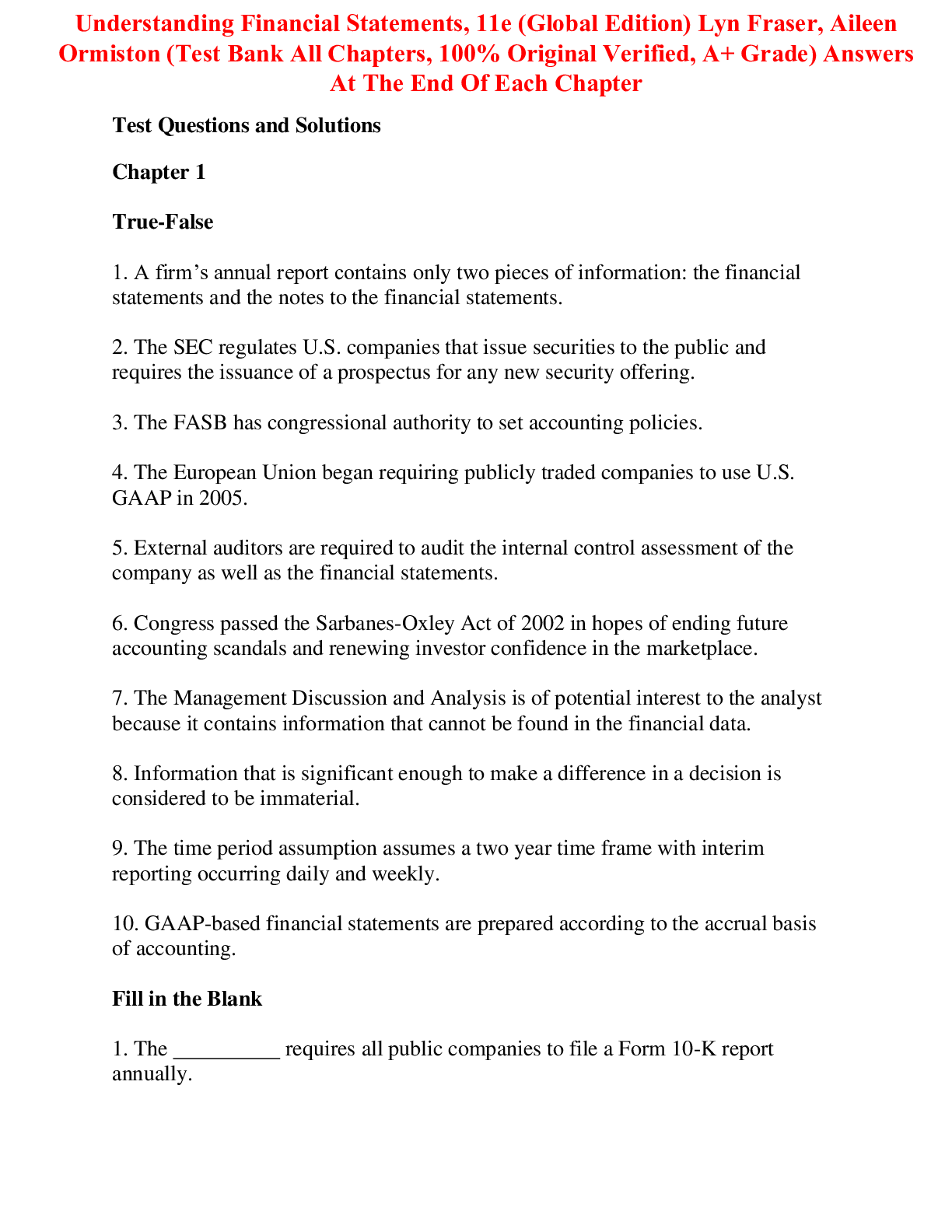
Test Bank For Understanding Financial Statements 11th Edition (Global Edition) By Lyn Fraser, Aileen Ormiston
$ 20

Influential_Anthropologists
Media Studies > MARK SCHEMES > GCE Media Studies H409/01: Media messages Advanced GCE Mark Scheme for Autumn 2021 (All)
GCE Media Studies H409/01: Media messages Advanced GCE Mark Scheme for Autumn 2021 Oxford Cambridge and RSA Examinations GCE Media Studies H409/01: Media messages Advanced GCE Mark Scheme ... for Autumn 2021Oxford Cambridge and RSA Examinations OCR (Oxford Cambridge and RSA) is a leading UK awarding body, providing a wide range of qualifications to meet the needs of candidates of all ages and abilities. OCR qualifications include AS/A Levels, Diplomas, GCSEs, Cambridge Nationals, Cambridge Technicals, Functional Skills, Key Skills, Entry Level qualifications, NVQs and vocational qualifications in areas such as IT, business, languages, teaching/training, administration and secretarial skills. It is also responsible for developing new specifications to meet national requirements and the needs of students and teachers. OCR is a not-for-profit organisation; any surplus made is invested back into the establishment to help towards the development of qualifications and support, which keep pace with the changing needs of today’s society. This mark scheme is published as an aid to teachers and students, to indicate the requirements of the examination. It shows the basis on which marks were awarded by examiners. It does not indicate the details of the discussions which took place at an examiners’ meeting before marking commenced. All examiners are instructed that alternative correct answers and unexpected approaches in candidates’ scripts must be given marks that fairly reflect the relevant knowledge and skills demonstrated. Mark schemes should be read in conjunction with the published question papers and the report on the examination. © OCR 2021H409/01 Mark Scheme October 2021 2 Annotations used in the detailed Mark Scheme (to include abbreviations and subject-specific conventions) Stamp Description Blank page N/A Highlight Off page comment Tick Cross Unclear Omission mark Task dealt with adequately Example/Reference Accurate Lengthy narrative Expandable vertical wavy lineH409/01 Mark Scheme October 2021 3 SUBJECT–SPECIFIC MARKING INSTRUCTIONS Introduction Your first task as an Examiner is to become thoroughly familiar with the material on which the examination depends. You should ensure that you have copies of these materials: • the specification, especially the assessment objectives • the question paper and its rubrics • the mark scheme. You should ensure also that you are familiar with the administrative procedures related to the marking process. These are set out in the OCR booklet Instructions for Examiners. If you are examining for the first time, please read carefully Appendix 5 Introduction to Script Marking: Notes for New Examiners. Please ask for help or guidance whenever you need it. Your first point of contact is your Team Leader. Information and instructions for examiners The co-ordination scripts provide you with examples of the standard of each band. The marks awarded for these scripts will have been agreed by the Team Leaders and will be discussed fully at the Examiners’ Co-ordination Meeting. The specific task-related indicative content for each question will help you to understand how the band descriptors may be applied. However, this indicative content does not constitute the mark scheme: it is material that candidates might use, grouped according to each assessment objective tested by the question. It is hoped that candidates will respond to questions in a variety of ways. Rigid demands for ‘what must be a good answer’ would lead to a distorted assessment. Candidates’ answers must be relevant to the question. Beware of prepared answers that do not show the candidate’s thought and which have not been adapted to the thrust of the question. Beware also of answers where candidates attempt to reproduce interpretations and concepts that they have been taught but have only partially understood. Using the Mark Scheme Please study this Mark Scheme carefully. The Mark Scheme is an integral part of the process that begins with the setting of the question paper and ends with the awarding of grades. Question papers and Mark Schemes are developed in association with each other so that issues of differentiation and positive achievement can be addressed from the very start. This Mark Scheme is a working document; it is not exhaustive; it does not provide ‘correct’ answers. The Mark Scheme can only provide ‘best guesses’ about how the question will work out, and it is subject to revision after we have looked at a wide range of scripts. The Examiners’ Standardisation Meeting will ensure that the Mark Scheme covers the range of candidates’ responses to the questions, and that all Examiners understand and apply the Mark Scheme in the same way. The Mark Scheme will be discussed and amended at the meeting, and administrative procedures will be confirmed. Co-ordination scripts will be issued at the meeting to exemplify aspects of candidates’ responses and achievements; the co-ordination scripts then become part of this Mark Scheme. Before the Standardisation Meeting, you should read and mark in pencil a number of scripts, in order to gain an impression of the range of responses and achievement that may be expected. Please read carefully all the scripts in your allocation and make every effort to look positively for achievement throughout the ability range. Always be prepared to use the full range of marks.H409/01 Mark Scheme October 2021 4 For answers marked by levels of response: a. To determine the level – start at the highest level and work down until you reach the level that matches the answer b. To determine the mark within the level, consider the following: Descriptor Award mark On the borderline of this level and the one below At bottom of level Just enough achievement on balance for this level Above bottom and either below middle or at middle of level (depending on number of marks available) Meets the criteria but with some slight inconsistency Above middle and either below top of level or at middle of level (depending on number of marks available) Consistently meets the criteria for this level At top of level Subject–specific marking Instructions Levels of Response targeting AO1 and AO2 Where a mark scheme targets marks at AO1 and AO2, there is no requirement for a response to be awarded in the same level for AO1 as for AO2, so for example a response could be awarded Level 3 for AO1 and Level 2 for AO2.H409/01 Mark Scheme October 2021 5 1 Analyse the media language used in Source A and Source B in relation to political contexts. Apply Levi-Strauss’ idea of the ‘binary opposition’ in your answer. Assessment Objectives AO2: 1 – Apply knowledge and understanding of the theoretical framework of media to analyse media products, including in relation to their contexts and through the use of academic theories. AO2 Total: 10 marks. Question Indicative Content 1 The content below is not prescriptive and all valid points should be credited. It is not expected that responses will include all of the points listed. AO2:1 • Both sources present a response to the failure of Change UK to make an impact in the European elections of 2019, with slightly different tones. Both demonstrate a range of ‘binary oppositions’, most notably between the MPs who stayed in the party and those who left. • The verbal codes within The Sun demonstrate a dismissive attitude to the party both in political contexts. The headline “Remainers Leave” has political connotations (as well as being typical of tabloid wordplay and a neat binary opposition) whilst the verbal codes (“flops in polls”, “tears itself apart”) emphasise political failure. The language is clearly oppositional (“pro-EU”, “Remainer”), with The Sun firmly on the ‘other’ side of the binary opposition (it is so confident in its readership that it does not need to mention its own stance). • The choice of imagery is interesting; the use of the “launch” photo suggests a degree of irony; the photographic codes connote a somewhat comedic quality given some of the paralanguage, suggesting a somewhat oppositional impression of supposedly serious politicians. • The caption, which emphasises the name change discussed later in the article also suggests a degree of irony. • The apparent harmony evident in the image is (deliberately) oppositional to the tone of the article, which emphasise failure and in-fighting. Several paragraphs emphasise a rivalry with the Liberal Democrats. This focuses on a number of political binary oppositions (whilst the references to the MPs’ previous parties is clearly aimed at their personal histories). • The Sun presents a negative perspective of the story, in political terms; the summary box emphasises this, being a digest of the party’s brief history of failure (the verbal codes “constant gaffes” and “never taken seriously” emphasise this). • The Guardian is a little more balanced in its coverage of the story, although the language it uses still emphasises failure rather than success (“loses” in the headline, “abandoned” and “dire” in the standfirst); this clearly presents an image of party on the wrong side of Levi-Strauss' “us and them” opposition; however, the paper is a lot more sympathetic than The Sun (understandable, considering its politics). • The article provides a far less biased view of Change UK in political terms, although the choice to lead with an image of Umunna (who has left the party) rather than Soubry (the new leader) suggests a slightly negative stance – as if Umunna was the political force of the party and that with him gone there is little chance that they will succeed (the caption emphasises their failure). The implicit message is that those who have left (“including interim leader Heidi Allen”) were more significant than those who remained. • The bulk of the article allows Change UK to speak for itself and does offer an opposition to more traditional political parties (the way their leader has been selected, for example). However, they are unfavourably compared to the “resurgent” Liberal Democrats, another binary.H409/01 Mark Scheme October 2021 6 Question Level Mark Scheme Mark 1 3 A comprehensive application of knowledge and understanding of media language in relation to political contexts and Levi-Strauss’ idea of the ‘binary opposition’ to analyse Source A and Source B. • Comprehensive, detailed and accurate application of knowledge and understanding of media language in relation to political contexts to analyse Source A and Source B. • Analysis of Source A and Source B consistently demonstrates logical connections and a good line of reasoning. • Precise and relevant reference to Levi-Strauss’ idea of the ‘binary opposition’ to support analysis of Source A and Source B. • References to Source A and Source B are detailed and accurate. 7–10 2 An adequate application of knowledge and understanding of media language in relation to political contexts and Levi-Strauss’ idea of the ‘binary opposition’ to analyse Source A and Source B. • An adequate and generally accurate application of knowledge and understanding of media language in relation to political contexts to analyse Source A and Source B. • Analysis of Source A and Source B demonstrates some logical connections and lines of reasoning, although, may be descriptive in parts. • Adequate and generally appropriate reference to Levi-Strauss’ idea of the ‘binary opposition’ to support analysis of Source A and Source B. • References to Source A and Source B are generally accurate. 4–6 1 A minimal application of knowledge and understanding of media language in relation to political contexts and Levi-Strauss’ idea of the ‘binary opposition’ to analyse Source A and Source B. • A minimal application of knowledge and understanding of media language in relation to political contexts to analyse Source A and Source B. • Analysis of Source A and Source B is minimal or brief, and is likely to be largely descriptive. • Reference to Levi-Strauss’ idea of the ‘binary opposition’ is minimal or brief, may not be relevant to Source A and Source B or may be absent. • References to Source A and Source B may be brief and/ or lack accuracy. 1–3 0 No response or no response worthy of credit. 0H409/01 Mark Scheme October 2021 7 2* Source A and Source B cover the same news event from two different newspaper websites, one tabloid and the other broadsheet. How far do the sources construct versions of reality? In your answer you must: • explain how news websites, through representation, construct versions of reality • analyse the representations in the sources • make judgements and reach conclusions about how far the sources construct versions of reality. Assessment Objectives AO1: 1a 1b – Demonstrate knowledge and understanding of the theoretical framework of media. AO1 Total: 5 marks. AO2: 1 – Apply knowledge and understanding of the theoretical framework of media to analyse media products. AO2: 3 – Apply knowledge and understanding of the theoretical framework of media to make judgements and draw conclusions. AO2 Total: 10 marks. Question Indicative Content 2* The content below is not prescriptive and all valid points should be credited. It is not expected that responses will include all of the points listed. AO1:1 • Understanding that newspapers do not present unbiased “reality” but present a version of a story which fits their own ideologies, politics and news agenda – an example might be The Sun’s headline, which leaves no doubt that the party has “flopped” despite this being only one interpretation of the events described (compared to The Guardian’s interpretation). • Understanding that a process of selection and editing is undertaken by all journalists and editors in order to construct a version of a story appropriate to the newspaper’s audience – the different ways in which The Sun and The Guardian present the relationship between the ex-Change MPs and the Liberal Democrats demonstrates two very different interpretations of the same groups and individuals which might appeal to the respective readerships of each paper. • Explain that the representations on newspaper websites are also influenced by the ideological position of the newspaper and by the assumed ideological position/ demographic of the audience (reference may be made to, for example, the choice of image of Umunna in The Guardian which emphasises his importance – he is one of the most prominent names in the article – or the choice of the group photo in The Sun, which is perhaps not particularly flattering or appropriate). • Explain that the selection of negative verbal codes constructs a version of a story which is not necessarily true (for example, The Guardian’s use of the word “dire” and the term “defecting; The Sun’s use of “confusing”, “bombed” and “humiliated” in the blue information box); newspapers deliberately use emotive language to steer readers towards an interpretation.H409/01 Mark Scheme October 2021 8 • Explain that the same information can be presented differently (for example, both articles feature Mike Gapes’ quote about being “in this for the long haul”, but The Sun describes it as a “dig”; The Guardian simply presents it as “a statement”). AO2:1 • It should be noted that this question is not asking for a comparison between the sources; rather for an analysis of each. However, some comparison may be seen given the nature of the two sources and the focus of the discussion. • Analysis of the representations are likely to recognise that The Sun represents Change UK in a more negative way than The Guardian, but that neither representation is particularly positive. • Discussion might identify that The Guardian’s representation focuses more on how Change UK intends to move forward after its failure, given that the bulk of the article is based on the group’s official statement. Candidates might also consider that there are some positive elements to the representation – the way the new leader has been selected, for example, seems to be represented in a more positive manner than the equivalent Conservative leadership competition. • The individual members of Change UK are not represented in a particularly negative light in The Guardian, although there is some suggestion towards the end of connivance with the Lib Dems; this, linked with the image of Umunna at the top of the page, could be seen as a tacit criticism (it is also worth considering that the choice of Umunna is interesting considering his position as a prominent BAME politician). • The Sun demonstrates a fairly conventional approach to tabloid representation, with more of a focus on negativity and attacks (some veiled, some overt) – for example, the mention of a “blazing row” in the sub-head (which is not, in fact, mentioned again; it is later described – somewhat mockingly – as “heated make-or-break talks”). • As noted elsewhere, the choice of image seems deliberately designed to present an ironic image – the party shown before its collapse contrasts mockingly with the text (“the party should dissolve”; “also walked out”; “another to quit”) – representing the party as a group of incompetents (the image includes several of the MPs looking in different directions). • The negative representation is overt within the blue information box, which bullet points the many perceived failings of the party; the heading is unambiguous in its representation of Change UK as a political failure. • Candidates are likely to be aware that The Guardian is a centre-left socially liberal source which aims to present reasonably unbiased news whilst The Sun is a right-wing tabloid source which is known for presenting somewhat biased news. Both sources adhere to news values, particularly a focus on representing elite persons (in this case, the political upper class – several of the MPs would be known to Guardian readers whilst The Sun is careful to emphasise their exparty allegiances). • Candidates might reference theories linked to representation such as Hall and Gauntlett. However, candidates who do not refer to these theorists should not be penalised since the question is not explicitly testing theory. AO2:3 • Answers might conclude that neither of the two sources construct versions of reality. • Answers might conclude that less biased style of The Guardian is more “realistic” than The Sun.H409/01 Mark Scheme October 2021 9 Question Level AO1 Mark AO2 Mark 2* 3 A comprehensive response to the set question. • Comprehensive, detailed and accurate knowledge and understanding of how newspapers, through representation, construct versions of reality in relation to Source A and Source B. • Use of subject specific terminology is relevant and accurate. 4–5 A comprehensive response to the set question. • Comprehensive, detailed and accurate application of knowledge and understanding of representations to analyse Source A and Source B. • Convincing, perceptive and accurate analysis of the representations in Source A and Source B which consistently provides logical connections and a good line of reasoning. • Highly developed and accomplished judgements and conclusions regarding how far candidates think that the sources construct versions of reality. Response demonstrates a well-developed and detailed line of reasoning which is coherent and logically structured. The information presented is entirely relevant and substantiated. 7–10 2 An adequate response to the set question. • Adequate and generally accurate knowledge and understanding of how newspapers, through representation, construct versions of reality in relation to Source A and Source B. • Use of subject specific terminology is mostly accurate. 2–3 An adequate response to the set question. • Adequate and generally successful application of knowledge and understanding of representations to analyse Source A and Source B. • Adequate and generally successful analysis of the representations in Source A and Source B which provides some logical connections and lines of reasoning, although may be descriptive in parts. • Adequate and generally well-reasoned judgements and conclusions regarding how far candidates think that the sources construct versions of reality. 4–6 • Answers might conclude that The Sun’s webpage demonstrates more “construction” than The Guardian. • Answers might conclude that both sources construct versions of reality. • Answers might conclude that the idea of reality being constructed within the sources is not relevant given the nature of bias within newspaper journalism – all newspaper stories are biased since newspapers have a definite agenda.H409/01 Mark Scheme October 2021 10 Question Level AO1 Mark AO2 Mark Response demonstrates a line of reasoning presented with some structure. The information presented is in the most-part relevant and supported by some evidence. Candidates who do not refer to both sources cannot be placed higher than the bottom of level 2 1 A minimal response to the set question. • Knowledge of how newspapers, through representation, construct versions of reality in relation to the sources is minimal, demonstrating little understanding. • Use of subject specific terminology is minimal. 1 A minimal response to the set question. • Minimal application of knowledge and understanding of representation to analyse Source A and/or Source B. • Analysis of the representations in Source A and/or Source B, if present, is minimal and/or largely descriptive and may not be relevant. • Judgements and conclusions, if present, are minimal with limited support. Information presented is basic and may be ambiguous or unstructured. The information is supported by limited evidence. 1–3 0 • No response or no response worthy of credit. 0 No response or no response worthy of credit. 0H409/01 Mark Scheme October 2021 11 3 Explain how cultural contexts influence the ways audiences interact with print and/or online news. Refer to The Guardian and the Daily Mail to support your answer. Assessment Objectives AO1: 2a 2b – Demonstrate knowledge and understanding of contexts of media and their influence on media products and processes. AO1 Total: 10 marks. Question Indicative Content 3 The content below is not prescriptive and all valid points should be credited. It is not expected that responses will include all of the points listed. AO1:2 • Online versions of newspapers appeal more directly to audiences used to accessing information online – reflecting cultural changes in news consumption/ expectations of what audience might expect to pay for. The Guardian utilises a subscription model directly targeting its website readership; the Mail is more focused on “clickbait” articles and advertising/ sponsorship revenue. This makes for a more “interactive” experience for the reader when compared to “traditional” newspaper consumption, which is losing its cultural significance. • The changing needs of audiences - wanting news immediately rather than traditionally the day after events - links to a ‘now’ culture of instant status updates – both newspapers run “live” feeds and update online articles regularly (sometimes as a result of user comments). • Both The Guardian and the Mail use online formats to mirror the same content as their print editions as both a reflection of the impact of social media (with its own cultural codes) and to ensure they can offer a diverse range of traditional and online media to reach their core readership – including a range of exclusive content – to maintain their traditional cultural profiles. Online formats have the advantage that the audience can leave comments, which has become part of the accepted cultural capital of news journalism. • Both newspapers focus mainly on stories that support their social, cultural and political ideologies, which is key to maintaining audience loyalty, and reinforcing their respective cultural identities; this is linked both to demographic and psychographic profiles. • The notion of citizen journalists/ contributors has been embedded in newspapers since before the move online; the opportunities presented by the internet and social media (polls, surveys, reader stories, videos etc.) have developed this into a crucial element of newspaper publication; the increase in interactivity with the media invited by sites such as YouTube, Facebook and Instagram has created a culture where non-journalists feel more able to contribute to news websites (although linked to this is perhaps a slight downturn in quality, particularly with regard to the content of the Mail compared to the “stack ‘em high, sell ‘em cheap” mentality demonstrated by MailOnline. • Candidates may also discuss that both newspapers, recognising the importance of social media, have exploited the potential of online formats to reach, address and tailor content to their respective audiences, by offering feeds on a range of social and participatory media platforms and allowing users to link to and between those feeds. This allows audiences to customise their news feeds (in some cases allowing for a personalised news experience) and disseminate news where stories have captured their imagination using the social mediaH409/01 Mark Scheme October 2021 12 Question Level Mark Scheme Mark 3 3 A comprehensive demonstration of knowledge and understanding of how cultural contexts influence the ways audiences interact with print and/or online news. • Comprehensive, detailed and accurate knowledge and understanding of how cultural contexts influence the ways audiences interact with print and/or online news. • Answer is well supported by detailed and accurate reference to The Guardian and the Daily Mail. 7–10 2 An adequate demonstration of knowledge and understanding of how cultural contexts influence the ways audiences interact with print and/or online. • Adequate and generally accurate knowledge and understanding of how cultural contexts influence the ways audiences interact with print and/or online news. • Answer is supported by generally accurate reference to The Guardian and the Daily Mail. 4–6 1 A minimal demonstration of knowledge and understanding of how cultural contexts influence the ways audiences interact with print and/or online. • Knowledge of the ways cultural contexts influence how audiences interact with print and/or online news is minimal and/or largely descriptive, demonstrating little understanding. • Reference to The Guardian and the Daily Mail to support the answer is minimal, inaccurate or may be absent. 1–3 0 No response or no response worthy of credit. 0 links embedded in their articles. This ability to cross-link and post has become part of online culture and demonstrates how newspapers have learned from less traditional media.H409/01 Mark Scheme October 2021 13 4 Evaluate the effectiveness of one of the following theories in understanding how newspapers are produced: EITHER • Curran and Seaton on power and media industries OR • Hesmondhalgh on cultural industries. Assessment Objectives AO2: 2 – Apply knowledge and understanding of the theoretical framework of media to evaluate academic theories. AO2 Total 10 marks. Question Indicative Content 4 The content below is not prescriptive and all valid points should be credited. It is not expected that responses will include all of the points listed. AO2:2 Responses will apply knowledge and understanding of the theoretical framework of media to evaluate academic theories such as: • identifying and discussing the value of theories of media industries including the theory of Curran and Seaton on power and media industries or Hesmondhalgh on cultural industries in the context of newspaper production and the effect on the content of news stories – do the theories provide/ support/ explain an understanding of why newspapers are the way they are? • discussing whether and/ or how these theories can be applied to newspaper production – are the theories helpful when applied to the newspaper industry? How relevant or appropriate are they, given the broader ideas being explored? • evaluating the effectiveness of these theories of media ownership in relation to newspapers, e.g. do they offer an insight into a discussion of how the construction of news stories might or might not be consistent in the print and online media? • exploring whether the theories might be of any value when considering how media ownership influences news agendas/ agenda setting and thus the production of newspapers. • considering whether the theories can explain how media ownership might influence how news agendas affect news production. • discussing the extent to which these theories might support the argument for tighter (or less tight) newspaper regulation to protect social groups/ journalistic freedoms and how this might influence newspaper production. • considering how helpful the theories are in considering how newspaper messages are likely to be contradicted by messages from politically and socially opposing newspapers (e.g. The Guardian and the Mail), especially in areas of social or political conflict.H409/01 Mark Scheme October 2021 14 • exploring whether the theories can help understand that newspapers, whilst important, are perhaps less important in a transforming online world since audiences do have more choice in the level of engagement with news agenda (for example, user generated content and user generated filtering of news stories). Curran and Seaton: • Curran and Seaton offered a “political economy” approach to the media – arguing that patterns of ownership and control are the most significant factors in how the media operate. In these terms, newspaper production could be seen as an aspect of how media industries follow the normal capitalist pattern of increasing concentration of ownership in fewer and fewer hands leading to a narrowing of the range of opinions represented and a pursuit of profit at the expense of quality or creativity. This is demonstrated by the gradual shrinkage of newspaper owners (the takeover of Northern and Shell by Trinity Mirror in 2018 to form Reach; the purchase of The i by DMGT in 2019) and thus fundamental shifts in newspaper production/ jobs. • Curran and Seaton suggested that the internet does not represent a break with the past in that it does not offer a level playing field for diverse voices to be heard. They consider that it is constrained by nationalism and state censorship which in itself could be seen as a critical element of newspaper production, depending upon geographic location. Although this is true to some extent (for example in China) it is perhaps not as true for the West, where press freedoms are generally enshrined in law; therefore, the theory could be said to be somewhat invalid on a national level (although it might explain self-censorship by some newspapers on a global level). • Curran and Seaton note that news is still controlled by powerful news organisations, which have successfully defended their oligarchy; in this case, it could be argued that there is some usefulness in understanding that this might explain why newspaper production is dominated by a comparatively small number of titles/ organisations. • The theory draws attention to issues such as forms and effects of ownership and control and the working practices of journalists and other creators, all of which are significant factors in newspaper production. • It also takes into account issues of risk and profitability (see notes about economy). These are fundamental to the success (or otherwise) of newspapers and so are endemic to understanding why newspapers are produced in the ways they are. • The theory applies primarily to the long history of ‘press barons’ owning newspapers in order to achieve status and wield political power – many of the arguments about the content of newspapers, particularly those raised by Leveson in 2012, link to this point. • In prioritising the effects of ownership and control on the content of newspapers this theory may not aid in understanding how ideologies, audience choice or media language conventions may determine content. See below for HesmondhalghH409/01 Mark Scheme October 2021 15 Hesmondhalgh: • The concept of the cultural industries draws attention to newspapers as an industry – its forms and effects of ownership and control, the working practices of journalists and other creators, and issues of risk and profitability. All of these elements are influenced by regulatory concerns (making sure that IPSO’s Editors’ Code is followed, maintaining the line between content and invasion of privacy/ inaccuracy etc.) although these concerns may not directly impact on profit or growth. • The theory applies particularly to the response of newspapers to competition for readers and advertising revenue from the ‘new’ media and may explain why some newspapers are willing to include ethically-dubious content (particularly MailOnline) in order to maintain or extend audience share (for example, publishing stories which are sensationalist or inaccurate in order to achieve an audience boost). • It could also be argued that, with regard to the online presence of news organisations, the theory corrects over-optimistic views of the internet as an arena for freedom and unlimited creativity since (for those organisations regulated by IPSO and IMPRESS) there are some limitations for what might be published, although Hesmondhalgh is more concerned with the general growth of a small number of organisations. • Hesmondhalgh suggests that cultural industries follow normal capitalist pattern of increasing concentration and integration – newspaper production is owned and controlled by a few conglomerates who integrate across a range of media to reduce risk – recent years have seen several mergers/ changes of ownership (e.g. formation of Reach PLC; purchase of The I by DMGT). • Since risk is particularly high in the cultural industries because of the difficulty in predicting success, high production costs, low reproduction costs and the fact that media products are ‘public goods’ (they are not destroyed on consumption but can be further reproduced) it could be argued that the theory explains both why news organisations are willing to take risks with content (see note above) but why they are so keen to protect their own content from being shared online. • Hesmondhalgh notes that the cultural industries rely on “tentpole products” to cover the costs of failure leading to industry reliance on repetition to sell formats to audiences, then industries and governments try to impose scarcity, especially through copyright laws – a key element of newspaper production and the dissemination of news. • The internet has created new powerful IT corporations and has not transformed cultural production in a liberating and empowering way – digital technology has sped up work, commercialised leisure time and increased surveillance by government and companies – this might explain the shift of newspaper production online. • The concept of risk and the internet is also useful in understanding how newspapers are produced as online news platforms have reduced risk for owners as a way to offset falling print circulation sales • A limitation to this theory might be that, since it prioritises the effects of ownership and control on the content of newspapers, it might not really provide much of an insight into the deeper ideological issues of why news organisations produce content or how conventions of media language are influenced.H409/01 Mark Scheme October 2021 17 Question Level Mark Scheme Mark 4 3 A comprehensive application of knowledge and understanding of the theoretical framework of media to evaluate academic theories. • Comprehensive, detailed and accurate application of knowledge and understanding of newspaper production to evaluate either Curran and Seaton on power and media industries or Hesmondhalgh on cultural industries. • Convincing, perceptive and accurate evaluation of the effectiveness of either Curran and Seaton on power and media industries or Hesmondhalgh on cultural industries in understanding how newspapers are produced. 7–10 2 An adequate application of knowledge and understanding of the theoretical framework of media to evaluate academic theories. • An adequate and generally accurate application of knowledge and understanding of newspaper production to evaluate either Curran and Seaton on power and media industries or Hesmondhalgh on cultural industries. • Adequate and generally successful evaluation of the effectiveness of either Curran and Seaton on power and media industries or Hesmondhalgh on cultural industries in understanding how newspapers are produced. 4–6 1 A minimal application of knowledge and understanding of the theoretical framework of media to evaluate academic theories. • A minimal application of knowledge and understanding of newspaper production to evaluate either Curran and Seaton on power and media industries or Hesmondhalgh on cultural industries. • Evaluation of the effectiveness of either Curran and Seaton on power and media industries or Hesmondhalgh on cultural industries in understanding how newspapers are produced is minimal or brief and is likely to be largely descriptive of the theory. 1–3 0 No response or no response worthy of credit. 0H409/01 Mark Scheme October 2021 18 5 Explain how adverts can communicate multiple meanings. Refer to Source C (Lucozade advert “I Believe”) to support your answer Assessment Objectives AO1: 1a 1b – Demonstrate knowledge and understanding of the theoretical framework of media. AO1 Total: 10 marks Question Indicative Content 5 The content below is not prescriptive and all valid points should be credited. It is not expected that responses will include all of the points listed. AO1:1 Responses will demonstrate knowledge and understanding of the ways in which media language is used in advertising to communicate multiple meanings, for example: • the use of media language in advertising to construct a range of viewpoints addressing different target audiences. • the different elements of media language used in print advertising - choices of camera shots and angles, uses of mise-enscene, lighting, layout, typography, verbal codes etc. – and how these might be interpreted in different ways. • the multiple meanings constructed through the combination of different media language elements. • understanding that advertising often constructs a variety of aspirational viewpoints which may reinforce a range of meanings, for example in relation to masculinity, equating wealth and/ or physical attractiveness with success, implying that a product is responsible for a particular outcome by juxtaposing it with a successful/ powerful individual (or conversely transferring their power/ status/ success to the product through connotation/ endorsement). • the ways in which conventions of print advertising (Z-rule, rule of thirds, slogans, call to action etc.) may influence interpretation. • recognising that different ideological messages might be communicated within the same advert (such as in relation to gender roles, capitalist values, and viewpoints) when interpreted by different social groups which might consume that advert. • understanding that although meanings within adverts are likely to be uncontroversial to avoid alienating the audience, and may attempt to reflect the viewpoints and ideologies of the intended audience, there is the potential for a range of meanings to be ascribed to an advert due to how it is interpreted by different audiences. • understanding that the positioning of both the advert and the audience can alter the meaning (for example, a billboard outside a hospital is going to have a very different effect to one positioned outside a football stadium). Although not a requirement of this question, answers may refer to Hall’s reception theory, which covers different audience interpretations of the same media product. Appropriate reference to Hall in relation to media language should be credited but lack ofH409/01 Mark Scheme October 2021 19 reference to Hall should not be penalised. See below for specific examples relating to the Lucozade advert. Presentation of examples of use of media language in Source C: • identifying that the advert was part of a £4m mass market campaign to educate consumers about how the soft drink brand can help improve people’s sports performance, using footballer Gareth Bale as a key brand ambassador. • explaining that the use of the medium close-up of Bale is designed to communicate strength, power and success through paralanguage (facial expression, direct address) which is implicitly linked to the superimposed pack shot of the soft drink. • identifying examples of the use of media language in relation to the image and text in the advertisement; and how messages are composed through the media language elements of print advertising (the use of a slogan/ ”Z rule”/ use of pack shot, etc.) following a standard advertising viewpoint and unchallenging ideology. • identifying the intended lifestyle being sold in the advert - elements such as sweat, steely expression, the yellow matrixed background of the slogan, the blue/ yellow badge colours could all be cited as ways in which a healthy lifestyle linked to ‘scientifically proven’ solutions are represented, since physical health is clearly the focus here - and the branding of the product • explaining that the respective size of the images of Bale and the soft drink bottle might connote that Bale is the focus of the promotion, not the soft drink (considering that adverts are often only briefly noted by consumers). • explaining that the advert uses a combination of soft sell (indirect marketing) techniques to suggest effectiveness of the product. • understanding that soft-sell as a strategy relies on connotation and decoding which (in this case) depends upon understanding that the slogan (“In a different league”) might refer to both the footballer and the drink; this slogan would be decoded differently by a consumer who knew what Bale’s role was compared to one who did not, or did not feel positive about Bale/ footballers. • understanding that the use of a fit, white, young male (sportsman) might have different implications for different audiences in relation to elements such as race, gender, age and sexuality – the preferred reading is clearly that Bale’s success (connoted by the stats at the top right of the advert) is due to the drink (positioned at the end of the “Z” and thus in the most powerful place). • explaining that some audiences will take a more critical perspective on the advert – there is no evidence that Bale has drunk the drink; the word “yes” offers a positive affirmation even though it has no context; the term “scientifically proven” is basically meaningless as there is no information about what has been proven or how – the advert is vague and (possibly) misleading. • explaining how the positive images constructed about the product suggest an uncontroversial ideological stance from the producers, albeit a knowing and self-referential one based on the product’s heritage as an energy drink • explaining the ways media language is used to associate Lucozade with an aspirational lifestyle and the viewpoints/ideologiesH409/01 Mark Scheme October 2021 20 Question Level Mark Scheme Mark 5 3 A comprehensive explanation of how adverts can communicate multiple meanings. • Comprehensive, detailed and accurate knowledge and understanding of how adverts can communicate multiple meanings. • Clear, precise and balanced explanation of how media language in adverts can communicate multiple meanings. • Answer is supported by detailed and accurate reference to Source C. 7–10 2 An adequate explanation of how adverts can communicate multiple meanings. • Adequate and generally accurate knowledge and understanding of how adverts can communicate multiple meanings. • Generally accurate explanation of how media language in adverts can communicate multiple meanings. • Answer is supported by generally accurate reference to Source C. 4–6 1 A minimal explanation of how adverts can communicate multiple meanings. • Minimal knowledge of the importance of how adverts can communicate multiple meanings. • Explanation of how media language in adverts can communicate multiple meanings is minimal and/or largely descriptive and may not always be accurate. • Reference to Source C to support the answer is minimal and may be inaccurate. 1–3 0 No response or no response worthy of credit. 0 associated with this, considering how audiences might respond to/ interpret above aspects of media language in different ways Answers are likely to focus on what Hall describes as the “preferred” meaning (basically, the meaning the advert is supposed to have, outlined in the first few bullets) but should also mention some of the “negotiated” or “oppositional” readings suggested above.H409/01 Mark Scheme October 2021 21 6 Analyse how effective the front cover of The Big Issue in Source D is in creating representations of issues, individuals and social groups, which are alternative to the commercial mainstream. In your answer you must: • analyse the representations in the source in relation to the impact of industry contexts on the choices media producers make about how to represent issues, individuals and social groups • make judgements and draw conclusions on the effectiveness of these representations. Assessment Objectives AO2: 1 – Apply knowledge and understanding of the theoretical framework of media to analyse media products. AO2: 3 – Apply knowledge and understanding of the theoretical framework of media to make judgements and draw conclusions. AO2 Total: 15 marks. Question Indicative Content 6 The content below is not prescriptive and all valid points should be credited. It is not expected that responses will include all of the points listed. AO2:1 • Analysis might discuss how typical elements of magazine covers – images, main cover line, masthead, price and date, references to elite persons (and in this case products, given the nature of the design and its heritage) - are all present, creating a representation of The Big Issue which is fairly mainstream (albeit formatted in a slightly unconventional manner) – this is possibly beyond producer choice since they are standard conventions of the form and thus required for recognition, although they are somewhat subverted. These might all be regarded as “typical” industry contexts which have influenced the design of the cover. • Candidates might also consider that these conventional elements are presented in a somewhat unconventional manner – the masthead is comparatively small, there is only one coverline, the design is (deliberately) amateurish, the focus is on the vendors rather than the stars, the image is fragmented and somewhat low-resolution as opposed to being one clear, slick, high resolution image (typical for The Big Issue as well as most other magazines), all of which combine to create a cover which challenges and subverts mainstream representations, traditional industry contexts and expectations of what aH409/01 Mark Scheme October 2021 22 magazine should look like. • Answers might discuss the "collage” nature of the cover which (even without having seen the original LP cover it is based on) implies an attempt to appeal to an atypical audience, an unconventional audience or an audience “in” with social/ cultural iconography – the magazine is clearly trying to represent itself and its readership as an alternative to the mainstream (since this is one of the critical USPs of The Big Issue as identified by the spec, it is clearly an essential aspect of producer choice). There might be some consideration that these elements have been influenced by the owner/ editor since the choice is so esoteric. • Similarly, answers might discuss the representations suggested by the choice of typeface: those “in the know” will recognise a 1960s/ explicit Sgt Pepper reference whilst even those not familiar with the cover might identify a “retro” quality which suggests that the magazine is representing itself and its content as being outside of the mainstream; since these elements are part of The Big Issue’s USP, these might be considered in the broader industry context of the magazine’s specific niche. • Answers might consider how the juxtaposition and choice of figures creates an explicit ideological message – Big Issue vendors being given “a hand up, not a handout” literally side by side with the rich, famous and fantastic. The implicit representation is one of equality, although the main (and only) coverline suggests that either “we” are the magazine (in which case the representation is one of overwhelming support) or “we” are the vendors (in which case the celebrities are being represented as supportive “friends”). It might also be considered that this representation emphasises the industry context of sales: the need for vendors to sell the magazine directly rather than using a more traditional retail sales point may have impacted the choice of representations • Candidates might focus on the choice of particular iconographies and their representational implications – Cumberbatch/ Sherlock helping to “solve” the implicit problem, James Bond/ the Doctor “fighting” poverty, The Pope/ Dalai Lama bringing a spiritual dimension, Dylan representing counterculture, thus symbolising the magazine’s non-mainstream bona fides etc. Although students may be able to decode these based on specific references (assuming they recognise the figures), this is not a requirement – it is enough to identify that the cover juxtaposes cultural references with the vendors and that these are representationally linked by the design (they have been given guidance as to the reasons the cover is designed as it is and who some figures on the cover are). There might be some consideration that the choice of figures, many of whom are very famous, is a mainstream choice in terms of industry context, since this is what the majority of magazine covers do to attract attention. • The choice of a range of different social groups on the cover is notable, particularly in terms of the types of people who are representing Big Issue vendors, which encapsulates both stereotypes and countertypes of the homeless community. • Candidates might focus on the positive connotations of the paralanguage – the body language and facial expressions of almost all of the vendors are positive, suggesting a counter-typical representation to the mainstream image of the homeless (although not, it should be said, of how The Big Issue itself chooses to represent them, emphasised by the strapline). • As noted above, it is not a requirement of the analysis that candidates be able to identify particular individuals or theH409/01 Mark Scheme October 2021 23 deeper implications of the Sgt Pepper cover; depending upon the level of social/ cultural knowledge candidates have, they might ascribe meanings to some of the imagery which is not necessarily accurate but could be regarded as valid producer choice (for example, “the scary looking man in the suit at the back looks like he is being pushed back by the crowd of vendors, representing how The Big Issue challenges the mainstream”). However, supporting notes have been given to assist interpretation. AO2:3 • Candidates might decide that the cover is very effective in challenging mainstream representations and industry contexts, given that a range of imagery, some of it contradictory, is used (for example, the Pope juxtaposed with the Dalai Lama) leading to a variety of alternative representations being evident; some very specific choices of selection and rejection are evident (no politicians, for example). • Similarly, candidates might consider the implicit layers of meaning created by the juxtapositions of the different figures which present a number of challenging and contrasting representations (the implication that both the Doctor and James Bond read The Big Issue, for example), as well as fictional icons rubbing shoulders with real-life figures – these choices are clearly deliberate and are somewhat more challenging than the typical magazine cover, suggesting a lack of adherence to the mainstream. • The positive representation of the vendors (as discussed above) might be seen to be a successful challenge to mainstream representations since the image is not ambiguous despite not being particularly mainstream (it is not typical for a magazine to use its vendors as its cover stars, although this is slightly mitigated by the montage including well-known faces as well). • Candidates might consider that, as with almost all magazine covers, Source D provides information about content both visually and verbally, working on at least two different levels and thus providing a typical mainstream representation which is clearly in accordance with the requirements and expectations of the industry. • It might be considered that Source D is not effective since the cover is very “busy” and might overwhelm the casual reader, who might not able to fully decode the amount of information being presented leading to meanings being lost. • It might be discussed that Source D is not effective because it relies on cultural/ social knowledge which the casual reader might not have (why is the strapline on a drum? Why is there a bust? What does the cover line mean?) and that therefore representations are not clear – the choices the producers have made are too esoteric and therefore undermine the cover’s effectiveness. • It might be decided that Source D is not effective because the nature of the homage might be lost on some readers who see the initial design and do not delve deeper into the subtext (particularly if they are not regular readers of The Big Issue), which might cost the magazine potential readers, thus defeating the representational purpose of a magazine cover.H409/01 Mark Scheme October 2021 24 Question Level Mark Scheme Mark 6 3 A comprehensive response to the set question. • Convincing, perceptive and accurate analysis of how producers have used media representations in Source D which includes consistently accurate application of knowledge and understanding, consistently logical connections and a good line of reasoning. • Highly developed and accomplished judgements and conclusions regarding how effective the front cover of The Big Issue in Source D is in creating representations which are alternative to the commercial mainstream. 11–15 2 An adequate response to the set question. • Adequate and generally successful analysis of how producers have used media representations in Source D which demonstrates generally accurate application of knowledge and understanding, provides some connections and has an adequate line of reasoning. • Adequate and generally well-reasoned judgements and conclusions regarding how effective the front cover of The Big Issue in Source D is in creating representations which are alternative to the commercial mainstream. 6–10 1 A minimal response to the set question. • Analysis of how producers have used media representations in Source D, if present, demonstrates minimal application of knowledge and understanding, is largely descriptive and may not be relevant. • Judgements and conclusions, if present, are minimal with limited support. 1–5 0 No response or no response worthy of credit. 0OCR (Oxford Cambridge and RSA Examinations) The Triangle Building Shaftesbury Road Cambridge CB2 8EA [Show More]
Last updated: 3 years ago
Preview 1 out of 25 pages
Buy this document to get the full access instantly
Instant Download Access after purchase
Buy NowInstant download
We Accept:

Can't find what you want? Try our AI powered Search
Connected school, study & course
About the document
Uploaded On
Oct 07, 2022
Number of pages
25
Written in
All
This document has been written for:
Uploaded
Oct 07, 2022
Downloads
0
Views
142
Scholarfriends.com Online Platform by Browsegrades Inc. 651N South Broad St, Middletown DE. United States.
We're available through e-mail, Twitter, Facebook, and live chat.
FAQ
Questions? Leave a message!
Copyright © Scholarfriends · High quality services·






.png)