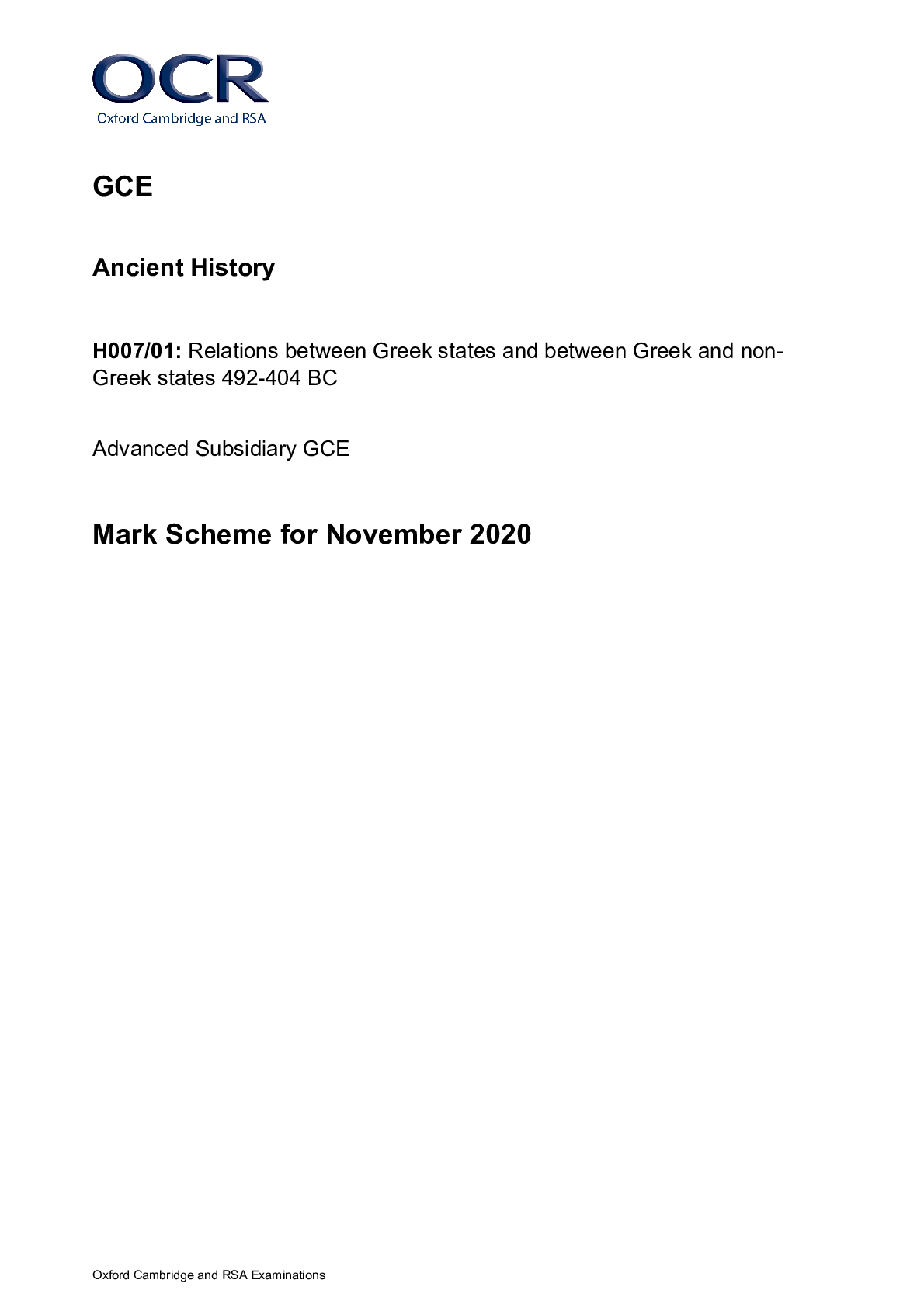
GCE
Religious Studies
H173/03: Developments in Christian thought
Advanced Subsidiary GCE
Mark Scheme for November 2020
Oxford Cambridge and RSA Examinations
GCE
Religious Studies
H173/03: Developments in Christ
...
GCE
Religious Studies
H173/03: Developments in Christian thought
Advanced Subsidiary GCE
Mark Scheme for November 2020
Oxford Cambridge and RSA Examinations
GCE
Religious Studies
H173/03: Developments in Christian thought
Advanced Subsidiary GCE
Mark Scheme for November 2020Oxford Cambridge and RSA Examinations
OCR (Oxford Cambridge and RSA) is a leading UK awarding body, providing a wide range of
qualifications to meet the needs of candidates of all ages and abilities. OCR qualifications
include AS/A Levels, Diplomas, GCSEs, Cambridge Nationals, Cambridge Technicals,
Functional Skills, Key Skills, Entry Level qualifications, NVQs and vocational qualifications in
areas such as IT, business, languages, teaching/training, administration and secretarial skills.
It is also responsible for developing new specifications to meet national requirements and the
needs of students and teachers. OCR is a not-for-profit organisation; any surplus made is
invested back into the establishment to help towards the development of qualifications and
support, which keep pace with the changing needs of today’s society.
This mark scheme is published as an aid to teachers and students, to indicate the requirements
of the examination. It shows the basis on which marks were awarded by examiners. It does not
indicate the details of the discussions which took place at an examiners’ meeting before marking
commenced.
All examiners are instructed that alternative correct answers and unexpected approaches in
candidates’ scripts must be given marks that fairly reflect the relevant knowledge and skills
demonstrated.
Mark schemes should be read in conjunction with the published question papers and the report
on the examination.
© OCR 20202
Indicative content – Responses might include: Guidance
1. Discuss Augustine’s view that, without God's grace,
humans can never be morally good.
AO1 Candidates may demonstrate knowledge and understanding
through the use of some of the following ideas:
• before the Fall humans lived in harmony with one another and
with God as friends, this is the ideal or good state
• the Fall was caused by human evil will which desires to
possess power for itself; the act caused humans to fall from
grace or the state of goodness and to pass on this act of
rebellion to all future generations
• Augustine gives many examples of the way in which the
rebellious will manifests itself, especially through erotic
dreams and the inability to act unselfishly. He refers to St Paul
when he describes the divided will as not doing the thing one
wills but doing the very thing one does not will
• Augustine describes the vision of purity (Lady Continence) and
how he much desires it but realises that his wayward will
(concupiscence) constantly thwarts his best efforts
• true moral goodness, therefore, is not attainable except
through God’s grace and His willingness to forgive human sin
through the gift of Jesus Christ
• the ‘happy fault’ of the Fall is God’s gift of Jesus Christ to the
world, but this emphasises all the more the seriousness of sin
and its effect on human moral goodness.
AO2 Candidates may demonstrate evaluation and analysis through
the use of some of the following arguments.
• Some candidates might argue that Augustine is right because:
o wars, political disputes, human violence all indicate that left
to their own devices, humans are not capable of achieving
moral goodness
o even if some individuals are capable of living morally
virtuous lives, in society and in groups humans fight for
survival
o social contracts and other political devices don’t achieve
moral goodness, they merely establish low-level social
stability
o many philosophers argue that free will is an illusion, in
which case humans are not able to choose morally good
lives
o human failings can only be rectified by God’s generosity.
• Some candidates might argue that Augustine is wrong because:
o he puts too much emphasis on the effects of the Fall and
sin which reduces human responsibility; his motivation is to
emphasise God’s grace, but this distorts the human
condition3
Indicative content – Responses might include: Guidance
o the Fall is not an actual event but a metaphor of the
struggle each person undergoes in life to overcome
obstacles and setbacks
o many scholars reject Augustine’s denial of free will;
humans have sufficient free will to follow the example of
Christ and achieve moral goodness
o moral goodness does not require perfection; there are
many examples of people who have acted selflessly
towards others with small acts of kindness such as charity
work, sacrifices made in war and care for the vulnerable.
• Some candidates may combine these views and argue that:
o it depends on how ‘good’ is to be defined; in Christian
terms no one can be good except God
o God’s grace takes account of human shortfalls, it does not
mean human nature is incapable of good.4
Indicative content – Responses might include: Guidance
2. Evaluate the claim that human knowledge of God’s
existence is innate.
AO1 Candidates may demonstrate knowledge and understanding
through the use of some of the following ideas:
• almost every human society throughout civilisation has developed
a form of religion which suggests that knowledge of God is
ubiquitous
• the biblical view is that as all humans are made in the image of
God, then they are capable of knowing God by reflecting on who
they are
• discerning right from wrong through conscience also suggests that
humans have a moral knowledge of God
• knowledge of God may also be variously defined as: knowing that
God exists, knowing about God, being in relationship with God,
being saved
• humans have an inbuilt sense of the divine/God (a ‘sensus
divinitatis’) which responds to the beauty and order of nature and
is more clearly known in prayer or meditation.
AO2 Candidates may demonstrate evaluation and analysis through
the use of some of the following arguments.
• Some candidates might argue that humans do have an innate
knowledge of God’s existence because:
o if God is the creator of everything, then humans through
reason and experience are capable of knowing God’s
existence by reflecting on their own nature
o the Bible frequently describes people who know about God
by reflecting on nature and seeing the hand of God in its
design
o scientists may experience wonder and awe when
observing the structure and complexity of the universe;
these experiences may lead to a sense of the ‘other’ or the
divine.
• Some candidates might argue that humans do have an innate
knowledge of God’s existence because:
o those who argue that humans have a natural sense of the
divine have under-estimated the effects of the Fall on the
image of God
o human reason does not naturally lead humans to know
God through the beauty of the world but in fact just reflects
their own desires
o humans are more innately sinful and egoistical than they
are innately religious or spiritual
o many people classify themselves as atheists and regard
any sense they might have or wonder or awe in the natural
world simply as expressions of emotion and nothing else5
Indicative content – Responses might include: Guidance
o although human cultures have religions, this does not
mean all individuals have an innate knowledge of God.
• Some candidates may combine these views and argue that:
o it might be true that humans have an innate knowledge of
God’s existence but they might not express it in these
terms.
o being made in the image of God suggests an innate
knowledge of God and makes theological sense; but being
merely knowing about God is not sufficient to know God in
the proper sense, given the Fall and human nature.6
Indicative content – Responses might include: Guidance
3. Assess the view that Bonhoeffer’s community at
Finkenwalde is a useful example for Christian
communities.
AO1 Candidates may demonstrate knowledge and understanding
through the use of some of the following ideas:
• Finkenwalde was founded to train men to become pastors for
the Confessing Church in 1935
• Bonhoeffer was its director and set out to run it on egalitarian
lines
• he ran it on a monastic type model and encouraged selfreflection and analysis of everyone including himself
• reading the Bible life including lectures on it and critical
reflection was at the heart of daily
• he wrote to former students to update them on life in the
community
• Christian communities today can a lot from the principles of
Finkenwalde and adapt them to different situations and needs.
AO2 Candidates may demonstrate evaluation and analysis through
the use of some of the following arguments.
• Some candidates might argue that Finkenwalde is a useful
example for Christian communities because:
o it was based on Bonhoeffer’s notion of ‘religionless
Christianity’, that is Christianity without all the baggage
of institution such as hierarchy, bureaucracy and
affiliation to political powers
o it put grace at the centre of daily life and by studying
the Bible members learnt how to model themselves on
Christ and the idea of ‘costly grace’ as practised by the
early Christian communities
o it focused on outward-looking Christianity – the idea of
ethics as action
o it developed the life of the disciple as one who lives in
solidarity with others and places sacrifice at the heart
of the practical life.
Some candidates might argue that Finkenwalde is not a useful
example for Christian communities because:
o it only trained young men to be ministers and did not
include women. The very early Church (as depicted in Acts
of the Apostles), by contrast, included men and women in
their communities.
o Bonhoeffer argued that the directorship should change
frequently but this didn’t happen; he was more concerned7
Indicative content – Responses might include: Guidance
with his own role than he was in a genuine brotherhood of
equals
o Finkenwalde suffered from some of the same failings
of the Confessing Church, i.e. it was over-concerned with
its own processes and not with the external realities of the
world
o its creation during WW2 was very specific and not
suitable for different Christian situations and in the world
today.
• Some candidates may combine these views and argue that:
o despite its failings it had very little time to develop and
learn from its mistakes as it was closed down in 1937 by
the Third Reich
o Bonhoeffer argued that Christianity is for the forgiven not
for the righteous, so any Christian community must
realise that it will have its failings; the failure of
Finkenwalde acts as a useful reminder to Christian
communities today.1
Level
(Mark)
Levels of Response for AS Level Religious Studies: Assessment Objective 1 (AO1)
Demonstrate knowledge and understanding of religion and belief, including:
• Religious, philosophical and/or ethical thought and teaching
• Approaches to the study of religion and belief
Note: The descriptors below must be considered in the context of all listed
strands of Assessment Objectives 1 (AO1) and the indicative content in the
mark scheme.
5
(13–
15)
A very good demonstration of knowledge and understanding in response to the question :
• focuses on the precise question throughout
• very good selection of relevant material which is used appropriately
• accurate, and detailed knowledge which demonstrates very good understanding through either the breadth or depth of material used
• accurate and appropriate use of technical terms and subject vocabulary.
• a very good range of scholarly views, academic approaches, and/or sources of wisdom and authority are used to demonstrate knowledge and understanding
4
(10–
12)
A good demonstration of knowledge and understanding in response to the question:
• addresses the question well
• good selection of relevant material, used appropriately on the whole
• mostly accurate knowledge which demonstrates good understanding of the material used, which should have reasonable amounts of depth or breadth
• mostly accurate and appropriate use of technical terms and subject vocabulary.
• a good range of scholarly views, academic approaches, and/or sources of wisdom and authority are used to demonstrate knowledge and understanding
3
(7–9)
A satisfactory demonstration of knowledge and understanding in response to the question:
• generally addresses the question
• mostly sound selection of mostly relevant material
• some accurate knowledge which demonstrates sound understanding through the material used, which might however be lacking in depth or breadth
• generally appropriate use of technical terms and subject vocabulary.
A satisfactory range of scholarly views, academic approaches, and/or sources of wisdom and authority are used to demonstrate knowledge and understanding with only
partial success
2
(4–6)
A basic demonstration of knowledge and understanding in response to the question:
• might address the general topic rather than the question directly
• limited selection of partially relevant material
• some accurate, but limited, knowledge which demonstrates partial understanding
• some accurate, but limited, use of technical terms and appropriate subject vocabulary.
a limited range of scholarly views, academic approaches, and/or sources of wisdom and authority are used to demonstrate knowledge and understanding with little success
1
(1–3)
A weak demonstration of knowledge and understanding in response to the question:
• almost completely ignores the question
• very little relevant material selected
• knowledge very limited, demonstrating little understanding
• very little use of technical terms or subject vocabulary.
• very little or no use of scholarly views, academic approaches and/or sources of wisdom and authority to demonstrate knowledge and understanding
0
(0)
No creditworthy response2
Level
(Mark)
Levels of Response for AS Level Religious Studies: Assessment Objective 2 (AO2)
Analyse and evaluate aspects of, and approaches to, religion and belief, including their
significance, influence and study
Note: The descriptors below must be considered in the context of all elements of
Assessment Objective 2 (AO2) and the indicative content in the mark scheme.
5
(13–15)
A very good demonstration of analysis and evaluation in response to the question:
• clear and convincing argument
• successful and clear analysis and evaluation
• views very well stated, coherently developed and justified
• answers the question set competently
• accurate and appropriate use of technical terms and subject vocabulary.
• a very good range of scholarly views, academic approaches and sources of wisdom and authority used to support analysis and evaluation
Assessment of Extended Response: There is a well–developed and sustained line of reasoning which is coherent, relevant and logically structured.
4
(10–12)
A good demonstration of analysis and evaluation in response to the question:
• argument is generally successful and clear
• generally successful analysis and evaluation
• views well stated, with some development and justification
• answers the question set well
• mostly accurate and appropriate use of technical terms and subject vocabulary.
• a good range of scholarly views, academic approaches and sources of wisdom and authority are used to support analysis and evaluation
Assessment of Extended Response: There is a well–developed line of reasoning which is clear, relevant and logically structured
3
(7–9)
A satisfactory demonstration of analysis and/evaluation in response to the question:
• some successful argument
• partially successful analysis and evaluation
• views asserted but often not fully justified
• mostly answers the set question
• generally appropriate use of technical terms and subject vocabulary.
• a satisfactory range of scholarly views, academic approaches and sources of wisdom and authority are used to support analysis and evaluation with only partial success
Assessment of Extended Response: There is a line of reasoning presented which is mostly relevant and which has some structure.
2
(4–6)
A basic demonstration of analysis and evaluation in response to the question:
• some argument attempted, not always successful
• little successful analysis and evaluation
• views asserted but with little justification
• only partially answers the question
• some accurate, but limited, use of technical terms and appropriate subject vocabulary.
• a limited range of scholarly views, academic approaches and sources of wisdom and authority to support analysis and evaluation with little success
Assessment of Extended Response: There is a line of reasoning which has some relevance and which is presented with limited structure.
1
(1–3)
A weak demonstration of analysis and evaluation in response to the question:
• very little argument attempted
• very little successful analysis and evaluation
• views asserted with very little justification
• unsuccessful in answering the question
• very little use of technical terms or subject vocabulary.
• very little or no use of scholarly views, academic approaches and sources of wisdom and authority to support analysis and evaluation
Assessment of Extended Response: The information is communicated in a basic/unstructured way.
0 (0) No creditworthy response1
Annotations
Annotation Meaning
Level one – to be used at the end of each part of the response in the margin.
Level two – to be used at the end of each part of the response in the margin.
Level three – to be used at the end of each part of the response in the margin.
Level four – to be used at the end of each part of the response in the margin.
Level five – to be used at the end of each part of the response in the margin.
(H573 only) Level six - to be used at the end of each part of the response in the
margin.
Highlighting a section of the response that is irrelevant to the awarding of the mark.
Point has been seen and noted, e.g. where part of an answer is at the end of the script.
SUBJECT–SPECIFIC MARKING INSTRUCTIONS
H173, H573 AS and A Level Religious Studies
Introduction
Your first task as an Examiner is to become thoroughly familiar with the material on which the examination
depends. You should ensure that you have copies of these materials:
• the specification, especially the assessment objectives
• the question paper and its rubrics
• the mark scheme.
Please ask for help or guidance whenever you need it. Your first point of contact is your Team Leader.
Information and instructions for examiners
The practice scripts provide you with examples of the standard of each band. The marks awarded for these
scripts will have been agreed by the Lead Marker and Team Leaders.2
The specific task-related indicative content for each question will help you to understand how the band
descriptors may be applied. However, this indicative content does not constitute the mark scheme: it is
material that candidates might use, grouped according to each assessment objective tested by the
question. It is hoped that candidates will respond to questions in a variety of ways. Rigid demands for ‘what
must be a good answer’ would lead to a distorted assessment. Candidates’ answers must be relevant to
the question. Beware of prepared answers that do not show the candidate’s thought and which have not
been adapted to the thrust of the question. Beware also of answers where candidates attempt to reproduce
interpretations and concepts that they have been taught but have only partially understood.
Using the Mark Scheme
Please study the Mark Scheme carefully. The Mark Scheme is an integral part of the process that begins
with the setting of the question paper and ends with the awarding of grades. Question papers and Mark
Schemes are developed in association with each other so that issues of differentiation and positive
achievement can be addressed from the very start.
This Mark Scheme is a working document; it is not exhaustive; it does not provide ‘correct’ answers. The
Mark Scheme can only provide ‘best guesses’ about how the question will work out, and it is subject to
revision after we have looked at a wide range of scripts.
Please read carefully all the scripts in your allocation and make every effort to look positively for
achievement throughout the ability range. Always be prepared to use the full range of marks.
The Mark Scheme contains a description of possible/content only; all legitimate answers and approaches
must be credited appropriately. Learners are expected to make use of scholarly views, academic
approaches and sources of wisdom and authority to support their argument.
The Levels of Response must be used in conjunction with the outlined indicative content.
Assessment Objectives
Two Assessment Objectives are being assessed in all questions:
AO1 (Demonstrate knowledge and understanding of religion and belief) and
AO2 (Analyse and evaluate aspects of, and approaches to, religion and belief, including their significance,
influence and study).
Responses are credited for AO1 for selection, detail and accuracy of the knowledge and understanding of
religion and belief deployed.
Responses are credited for AO2 for how well the response addresses the question, for candidates using their
knowledge and understanding to draw, express and support conclusions in relation to the question posed.
Candidates will be assessed on the quality of the conclusions and points they argue and the clarity and
success of their argument.
Levels of Response
Questions in this paper are marked using a levels of response grid. When using this grid examiners must use
a best fit approach. Where there are both strengths and weaknesses in a particular response or particularly
imbalanced responses in terms of the assessment objectives, examiners must carefully consider which level
is the best fit for the performance.
Note that candidates can achieve different levels in each assessment objective, for example a Level 3 for
AO1, and a Level 2 for AO2.3
Please note that the Assessment Objectives being assessed are listed at the top of the mark scheme.
Where a candidate does not address all of the Assessment Objective strands listed, the candidate cannot
achieve the top level of response.
Assessment of Extended Response
The GCE General Conditions of Recognition state that:
GCE 5.1 In designing and setting the assessments for a GCE qualification which it makes available,
or proposes to make available, and awarding organization must ensure that, taken together, those
assessments include questions or tasks which allow Learners to -
a) provide extended responses
As such, the quality of extended responses are assessed in all questions. While marks are not specifically
given for this, descriptors for extended responses can be found in the AO2 Levels of Response in italics.OCR (Oxford Cambridge and RSA Examinations)
The Triangle Building
Shaftesbury Road
Cambridge
CB2 8EA
[Show More]





.png)