Insurance
(General concept) - ANSWER - transfers the risk of loss from an individual to an insurer
- based on the principle of indemnity
- based on the principle of risk (risk pooling)
insurable interest
(Gene
...
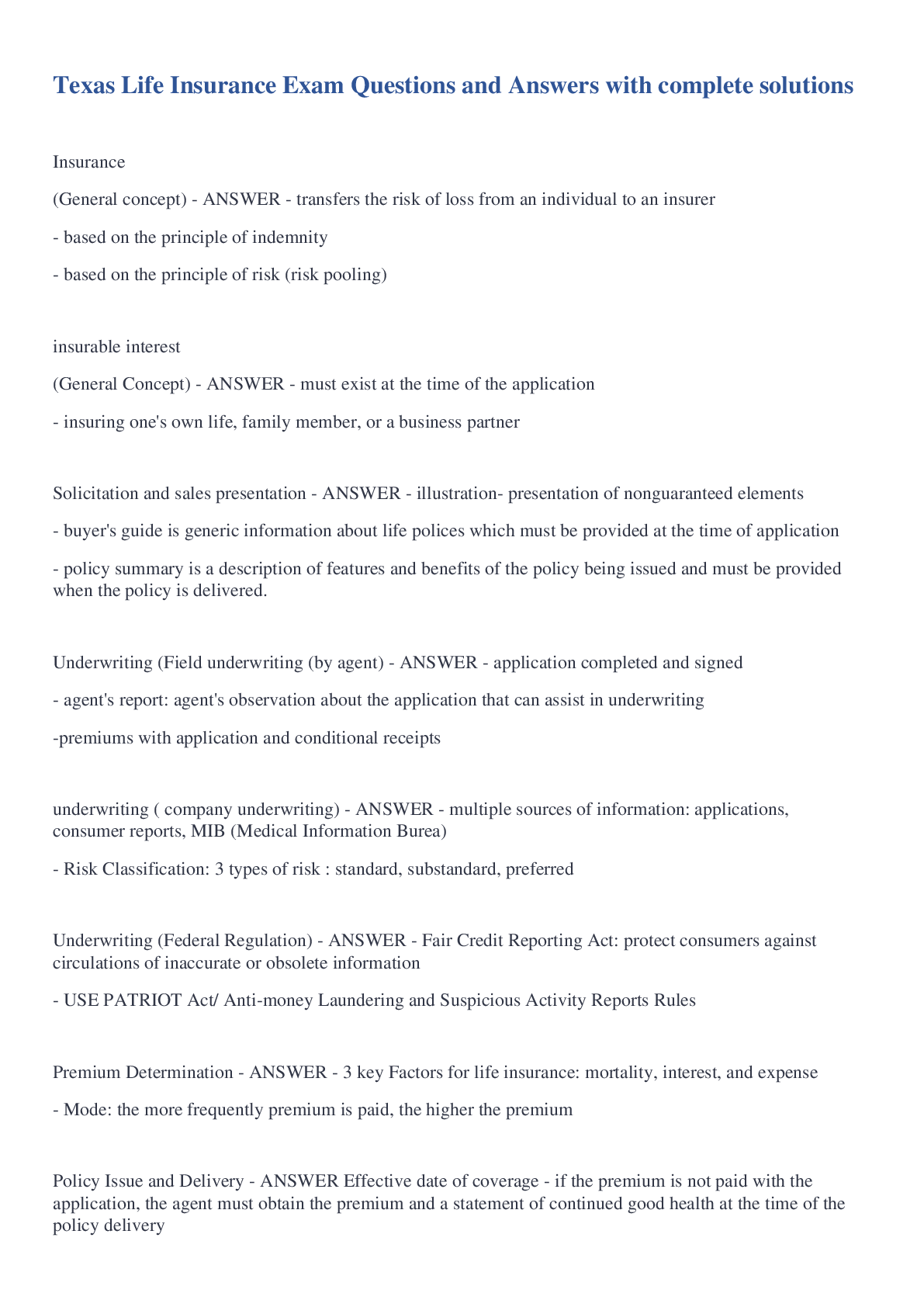
Insurance
(General concept) - ANSWER - transfers the risk of loss from an individual to an insurer
- based on the principle of indemnity
- based on the principle of risk (risk pooling)
insurable interest
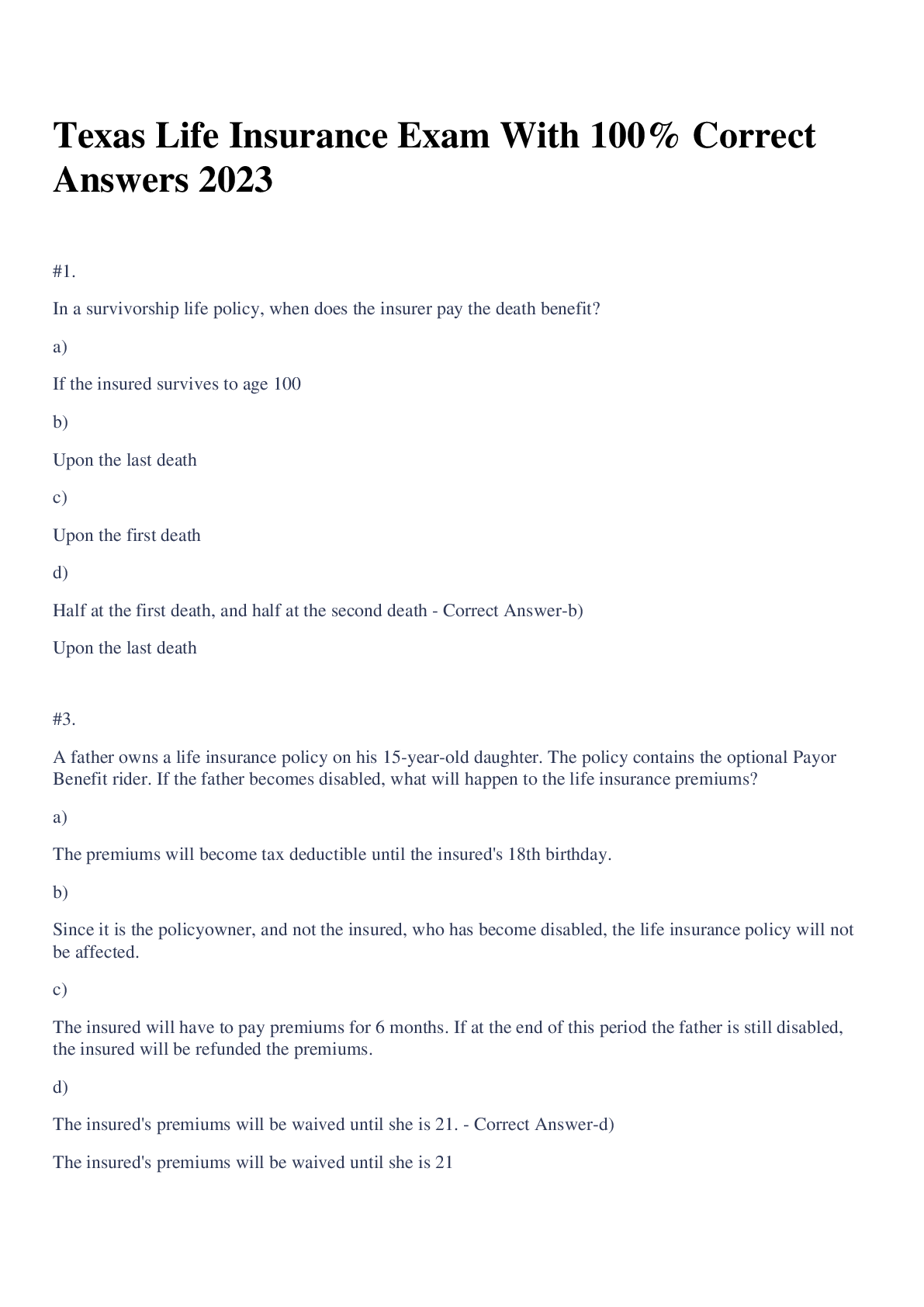
(General Concept) - ANSWER - must exist at the time of the application
- insuring one's own life, family member, or a business partner
Solicitation and sales presentation - ANSWER - illustration- presentation of nonguaranteed elements
- buyer's guide is generic information about life polices which must be provided at the time of application
- policy summary is a description of features and benefits of the policy being issued and must be provided when the policy is delivered.
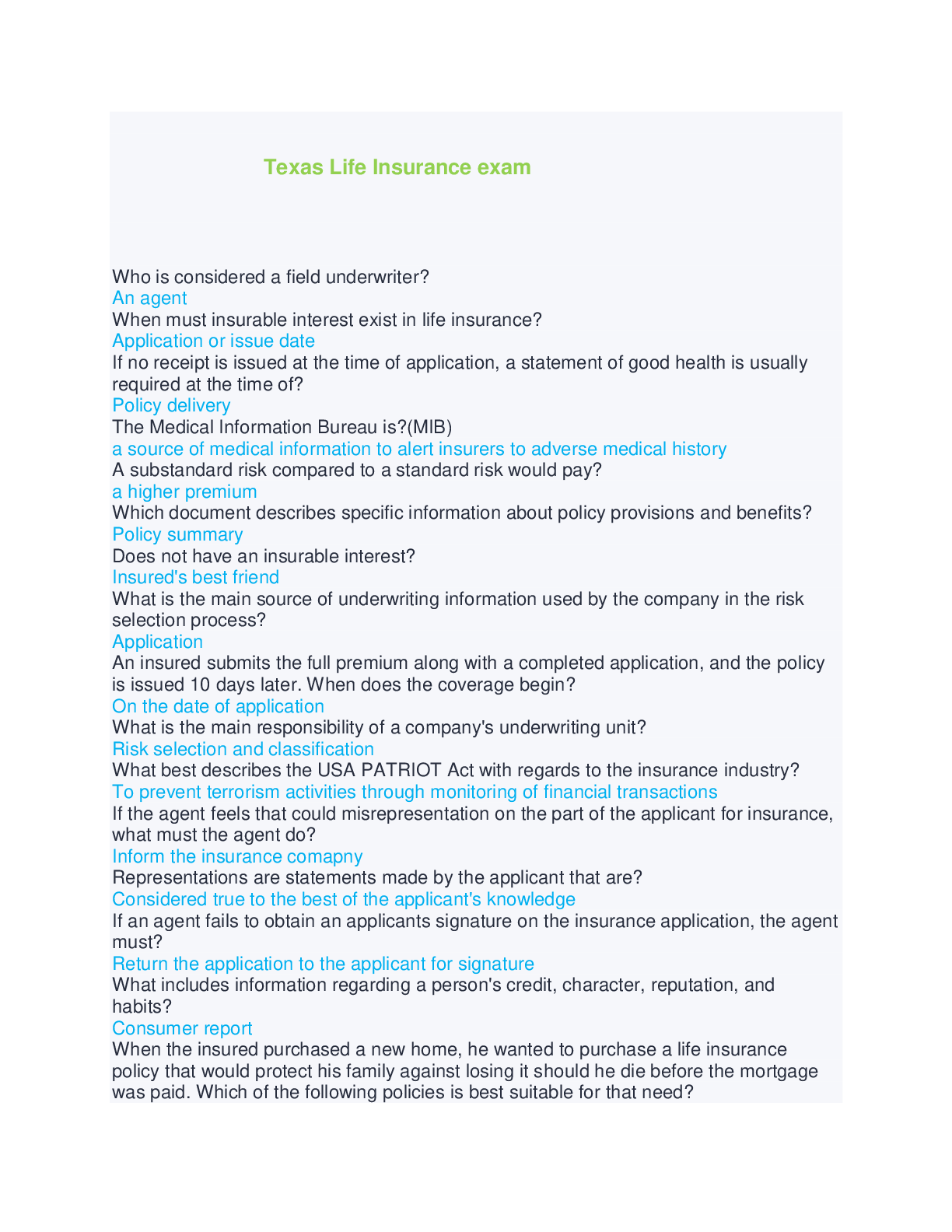
Underwriting (Field underwriting (by agent) - ANSWER - application completed and signed
- agent's report: agent's observation about the application that can assist in underwriting
-premiums with application and conditional receipts
underwriting ( company underwriting) - ANSWER - multiple sources of information: applications, consumer reports, MIB (Medical Information Burea)
- Risk Classification: 3 types of risk : standard, substandard, preferred
Underwriting (Federal Regulation) - ANSWER - Fair Credit Reporting Act: protect consumers against circulations of inaccurate or obsolete information
- USE PATRIOT Act/ Anti-money Laundering and Suspicious Activity Reports Rules
Premium Determination - ANSWER - 3 key Factors for life insurance: mortality, interest, and expense
- Mode: the more frequently premium is paid, the higher the premium
Policy Issue and Delivery - ANSWER Effective date of coverage - if the premium is not paid with the application, the agent must obtain the premium and a statement of continued good health at the time of the policy delivery
Agent/ Producer - ANSWER a legal representative of an insurance company; the classification of producers usually includes agents and brokers' agents are the agents of the insurer
Applicant of proposed insured - ANSWER a person applying for insurance
Beneficiary - ANSWER a person who receives the benefits of an insurance policy
Broker - ANSWER an insurance producer who is not appointed by an insurance company and who represents the client
Death benefits - ANSWER the amount paid upon death of the insured in a life insurance policy
Estate - ANSWER a person's net worth
Insurance policy - ANSWER a contact between a policyowner (and/or insured) and an insurance company which agrees to pay insured or the beneficiary for loss caused by specific events.
Insured - ANSWER a person covered by the insurance policy; may or may not be the policyowner
insurer (principal) - ANSWER the company who issues an insurance policy
Lapse - ANSWER policy termination due to nonpayment of premium
Life insurance - ANSWER coverage on human lives
Policyowner - ANSWER the person entitled to exercise the rights and privileges in the policy
Premium - ANSWER the money paid to the insurance company for the insurance policy
Underwriting - ANSWER is the risk selection and classification process
Attained age - ANSWER the insured's age at the time the policy is issued or renewed
cash value - ANSWER a policy's saving element or living benefit
Face amount - ANSWER the amount of benefits stated in the life insurance policy
Fixed life insurance - ANSWER contracts that offer guaranteed minimum or fixed benefits
Deferred - ANSWER withheld or postponed until a specified time or event in the future
Endow - ANSWER the cash value of a whole life policy has reached the contractual face amount
Level premium - ANSWER the premium that does not change throughout the life of a policy
Liquidation of an estate - ANSWER converting a person's net worth into a cash flow
Mature - ANSWER the time when the policy's face amount is paid out upon the death of the insured or policy endowment
Nonforfeiture values - ANSWER benefits in a life insurance policy that the policyowner cannot lose even if the policy is surrendered or lapses
Policy Maturity - ANSWER in life polices, the time when the face value is paid out
Qualified Plan - ANSWER a retirement plan that meets IRS guidelines for receiving favorable tax treatment
Securities - ANSWER financial instrument that may trade for value (for example, stock, bonds options
Suitability - ANSWER a requirement to determine if an insurance product is appropriate for a customer
Variable life insurance - ANSWER contracts in which the cash value accumulate based upon a specific portfolio of stocks without guarantees of performance
Types of insurance - ANSWER -term/temporary
- permanent/ whole life
Types of term policies - ANSWER -level term
- annually renewable term
- decreasing term
- increasing term
Whole Life insurance - ANSWER - straight life
- limited payment
- single premium
Flexible- premium policies - ANSWER - adjustable life
- universal life : options A, option B
- Variable Life insurance
- Variable Universal life insurance
other polices - ANSWER Joint Life
Survivorship life
Basic Annuity Terms - ANSWER Annuity
Annuitant
Accumulation/Pay-in period
Annuitization/liquidation/pay-out period
Beneficiary
Owner
Types of Annuities - ANSWER Deferred Annuity
fixed annuity
general account
immediate annuity
indexed annuity
separate account
variable annuity
General characteristics (Term life) - ANSWER - pure protection
- lasts for specific term
- no cash value
Level premium Term (Term life) - ANSWER level death benefit and level premium
Annually Renewable Term (Term life) - ANSWER - renews each year without proof of insurability
- premiums increase due to attained age
Decreasing Term (Term life) - ANSWER coverage gradually decrease at predetermined times; best used when the need for protection declines from year to year
Increasing Term (Term life) - ANSWER coverage increase each year
Features of term policies (term life) - ANSWER - renewable: renew the policy without evidence of insurability
- convertible: right to convert a term policy to a permanent policy without evidence of insurability
General characteristics (whole life) - ANSWER - permanent protection
- guaranteed elements (face amount, premium, and cash value) until death or age 100
- level premium
- cash value and other living benefits
Straight life (whole life) (continuous premium) - ANSWER - basic policy
- level death benefits
- insured pays premiums for life or until age 100
Limited payment - ANSWER premiums paid until a certain time; coverage in effect to age 100
Single Premium - ANSWER premiums paid in one lump sum; coverage continues to age 100
General Characteristics (Flexible Premium) - ANSWER - types of whole life insurance
- flexible premium
Adjustable life (Flexible premium) - ANSWER - policyowner may adjust the premium and premium- paying period, the face amount, and the period of protection
- can be converted from term to whole life and vice versa
- cash value only develops if the premiums paid are more than the cost of the policy
Universal life (Flexible premium) - ANSWER - an insurance component in the form of annually renewable term
- 2 death benefit options: options A level death benefits, and options B- increasing death benefit
- can make partial surrender/ cash withdrawal
Variable Life (other types of polices) - ANSWER - fixed premium, minimum death benefits
- cash value and the actual amount of the death benefits are not guaranteed
- assets in separate accounts
- agents must be dually licensed in insurance and in securities
Combination Plans (other types of polices) - ANSWER - Joint life: - premium is based on the joint average age of the insured ;death benefit upon the first death only
- Survivorship Life: - premium is based on the joint average of the insured; death benefit upon the last death
Phases (Annuities) - ANSWER - accumulation (pay-in): payment made into the annuity
- annuitization (pay-out): payment made to the annuitant from the annuity
parties (annuities) - ANSWER - annuitant: insured (must be a person); policy issued on annuitant's life
- Beneficiary: will receive any amount contributed to annuity (plus any gain) if annuitant dies during accumulation period
- Owner- has all rights to policy (usually annuitant); can be corporation or trust
Types of Annuities - ANSWER - fixed annuities: guaranteed, fixed payment amount; premiums in general account
- variable annuities:payment not guaranteed; premiums in separate account, and invested in stock and bonds.
- indexed annuities: interest rate tied to an index; earn higher rate than fixed annuities, not as risky as variable annuities or mutual funds
Premium Payments (annuities) - ANSWER - Single premium: One lumps- sum payment; the principal is created immediately (both immediate and deferred annuities)
- Periodic (Flexible) premium: multiple payments; the principal is created over time (used for deferred annuity only)
Income Payment (annuities) - ANSWER - Immediate: purchased with a single premium; income payments start within 12 months from the date of purchase
- Deferred: purchase with either lump sum or periodic: payment, premium; benefit start sometimes after 1 year from the date of purchase (often used to accumulate funds for retirement)
Activities of daily living (ADLs) - ANSWER a person's essential activities that include bathing, dressing, eating, transferring, toileting, continence
Assignment - ANSWER transfer of right of policy ownership
Consideration - ANSWER something of value that each party gives to the other (binding force in any contract)
Indemnity - ANSWER a principle of reimbursement of which insurance is based; in the event of loss, an insurer reimburses the insureds or beneficiaries for the loss
Lump sum - ANSWER payment of the entire benefit in one sum
Minor - ANSWER a person under legal age
NAIC - ANSWER National Association of Insurance Commissioners, an organization composed of insurance commissioners from all states and jurisdictions formed to resolve insurance regulatory issues
Principal - ANSWER the face value of the policy; the original amount invested before the earnings
Nonforfeiture options - ANSWER - cash
- extended terms (automatic)
- reduced paid up
Dividend options - ANSWER - cash
- reduction of premium
- accumulation at interest
- paid up additions (automatic)
-paid up insurance
- one year term
Settlement options - ANSWER -cash (automatic)
- Life income
- interest only
- fixed period
- fixed amount
Life policy provisions - ANSWER - assignment
- consideration
- entire contract
- free look
- grace period
- incontestability
- insuring clause
- misstatement of Age and gender
- Ownership
- Payment of Premiums
- Reinstatement
Beneficiaries - ANSWER Primary Vs. Contingent
Revocable Vs. Irrevocable
Common disater clause
Accessing cash value - ANSWER policy loan
automatic premium loan
withdrawal
partial surrender
Policy options - ANSWER - nonforfeiture
- dividend
- settlement
consideration (standard provision ) - ANSWER parties to a contact exchange something of value
entire contact (standard provision) - ANSWER policy (with riders and amendments) and copy of the application
Grace period (standard provision) - ANSWER time period after the premium is due during which the policy will not lapse
incontestability (standard provision) - ANSWER insurer cannot contest misstatements on the application after a time period
Insuring clause (standard provision) - ANSWER basic agreement between the insurer and the policyowner
misstatement of age or gender (standard provision) - ANSWER death benefits is adjusted according to the correct age and gender at policy issue
payment of premiums (standard provisions) - ANSWER premiums are paid in advance
Reinstatement - ANSWER a policy can be restored within a specified period of time with proof of insurability
Assignment (other provisions) - ANSWER absolute or collateral
Exclusions (other provisions) - ANSWER aviation (noncommercial), hazardous occupation, war or military service, suicide within a specific time period
Free Look (other provisions) - ANSWER policy can be returned for a refund or premium within a specified time period
Ownership - ANSWER policyowner's right
Designation (beneficiaries) - ANSWER - designation: individuals (including minors) classes, estates
Succession ( beneficiaries) - ANSWER - the level of priority. each level in the succession is only eligible if the beneficiary in the level above has died:
- primary: first claim to the policy proceeds
- contingent (secondary, tertiary): next claim after primary
Policyowner's right to change a beneficiary: - ANSWER - revocable: can be change at any time
- irrevocable: can be changed with the beneficiary's consent
Common disaster clause (beneficiaries) - ANSWER protects the right of contingent beneficiaries; if the insured and the primary beneficiary died at approximately the same time, it is assumed that the primary beneficiary died first
Cash loans available (Policy loans, withdrawals and partial surrenders) - ANSWER policy's cash value minus any unpaid loans and interest
Automatic premium loans (Policy loans, withdrawals and partial surrenders ) - ANSWER prevent unintentional policy lapse due to nonpayment of premium
withdrawals and partial surrenders (Policy loans, withdrawals and partial surrenders) - ANSWER available in Universal life; a charge may apply
Wavier of premium (Disability ) - ANSWER waves the premium if the insured becomes totally disabled; 6 months waiting period before benefits begin
Waiver of cost insurance (Disability ) - ANSWER in universal life policies; waives the cost of insurance in the event of the insured's disability
Disability income (Disability) - ANSWER waives the premium and pays monthly income
Accelerated Benefits - ANSWER - early payment if insured is diagnosed with a specified catastrophic illness
-a portion of the death benefits
- death benefit is reduced by the amount paid plus earnings lost by the insurer
Spouse/other insured (Additional insured) - ANSWER term rider (limited time, limited coverage): usually expires when spouse turns age 65
Children's term (Additional insured) - ANSWER covers all children of the insured (limited time, limited coverage): can be converted to a permanent policy
nonfamily insured (Additional insured) - ANSWER used by business (e.g. key person insurance)
Accidental death (riders affect the death benefits) - ANSWER pays double or triple indemnity if accidental death occurs as defined in the policy; death must occur within 90 days of accident
Guaranteed insurability (riders affect the death benefits) - ANSWER allows for purchase of additional insurance at specified times without evidence of insurability, at the insured's attained age
Return of premium (riders affect the death benefits) - ANSWER increasing term is added to a whole life policy that provides that if death occurs prior to a given age, not only is the death benefits payable to the beneficiary, but all premiums paid as well
cash surrender value (Nonforfeiture) - ANSWER after all that, no more insurance,
extended term (Nonforfeiture) - ANSWER automatic optional; uses cash value to convert to term insurance
reduced paid (Nonforfeiture) - ANSWER uses cash value as a single premium to purchase a permanent policy with a reduced face amount
Cash (Dividend ) - ANSWER insurer sends a check to the insured
Reduction of premium (Dividend ) - ANSWER dividend is applied to the next year's premium
Accumulation at interest (Dividend ) - ANSWER insurers keeps the dividend in an account where its accumulates interest
Paid up addition (Dividend ) - ANSWER dividend is used to increase the face amount
Paid- up insurance (Dividend ) - ANSWER dividend is used to pay up a policy early
One year term (Dividend ) - ANSWER dividend is used to buy additional insurance
Cash (settlement) - ANSWER lump sum payment; usually not taxable
Life income (settlement) - ANSWER provides an income the beneficiary cannot outlive; no guarantee that the entire principle will be paid out (if the beneficiary dies too soon); available as single life or as joint and survivor
Interest only (settlement) - ANSWER insurer retains the principal and only pays out interest
Fixed period (settlement) - ANSWER payments for a specified time period until all the proceeds are paid out
Fixed amount (settlement) - ANSWER payments in specified amounts until all the
[Show More]