RNSG 2331 exam 4 capstone 1The client has been working on weight loss for 8 months and has been successful in
losing 35 lbs (15.9 kg). The client is now entering the maintenance phase of the health
promotion plan. Whic
...
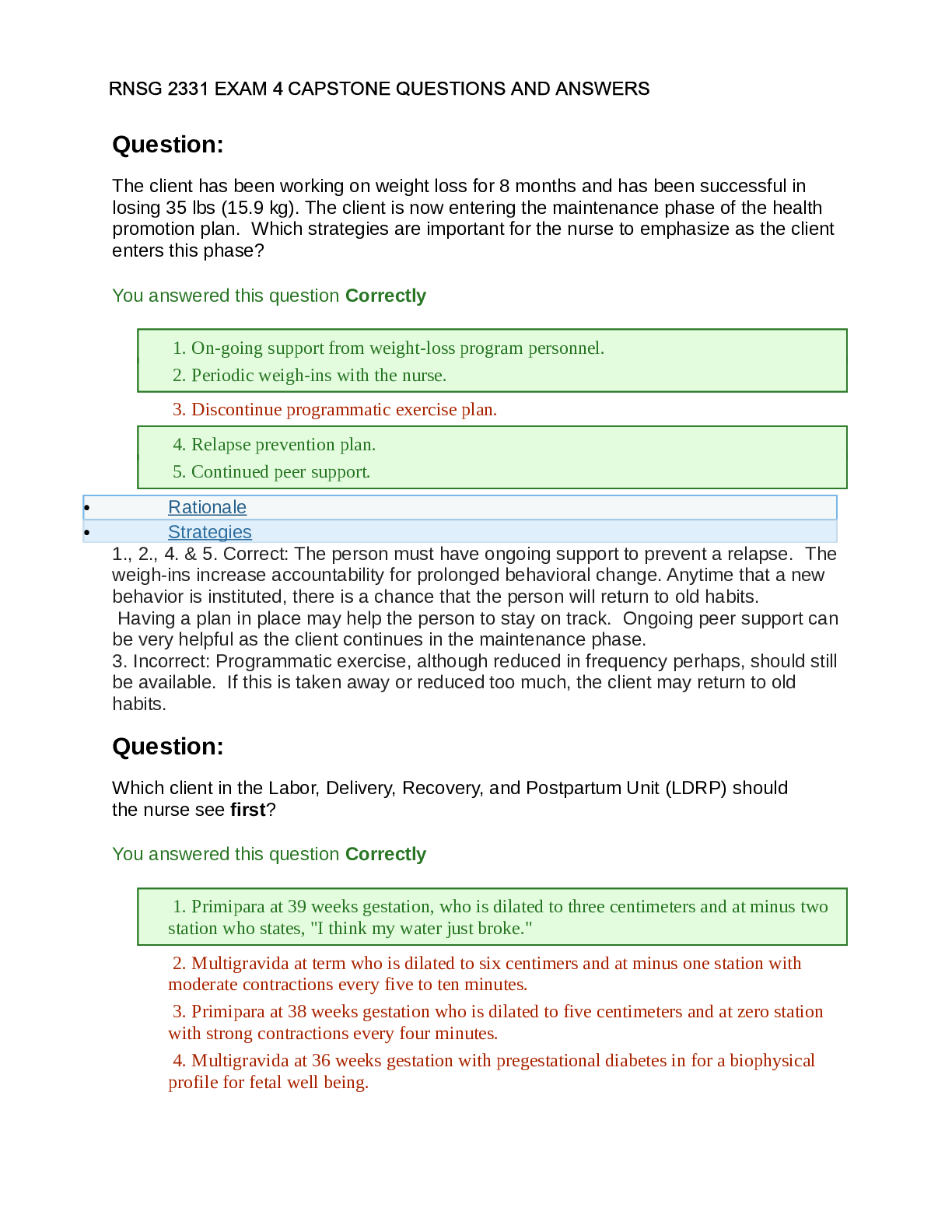
RNSG 2331 exam 4 capstone 1The client has been working on weight loss for 8 months and has been successful in
losing 35 lbs (15.9 kg). The client is now entering the maintenance phase of the health
promotion plan. Which strategies are important for the nurse to emphasize as the client
enters this phase?
You answered this question Correctly
3. Discontinue programmatic exercise plan.
1., 2., 4. & 5. Correct: The person must have ongoing support to prevent a relapse. The
weigh-ins increase accountability for prolonged behavioral change. Anytime that a new
behavior is instituted, there is a chance that the person will return to old habits.
Having a plan in place may help the person to stay on track. Ongoing peer support can
be very helpful as the client continues in the maintenance phase.
3. Incorrect: Programmatic exercise, although reduced in frequency perhaps, should still
be available. If this is taken away or reduced too much, the client may return to old
habits.
Question:
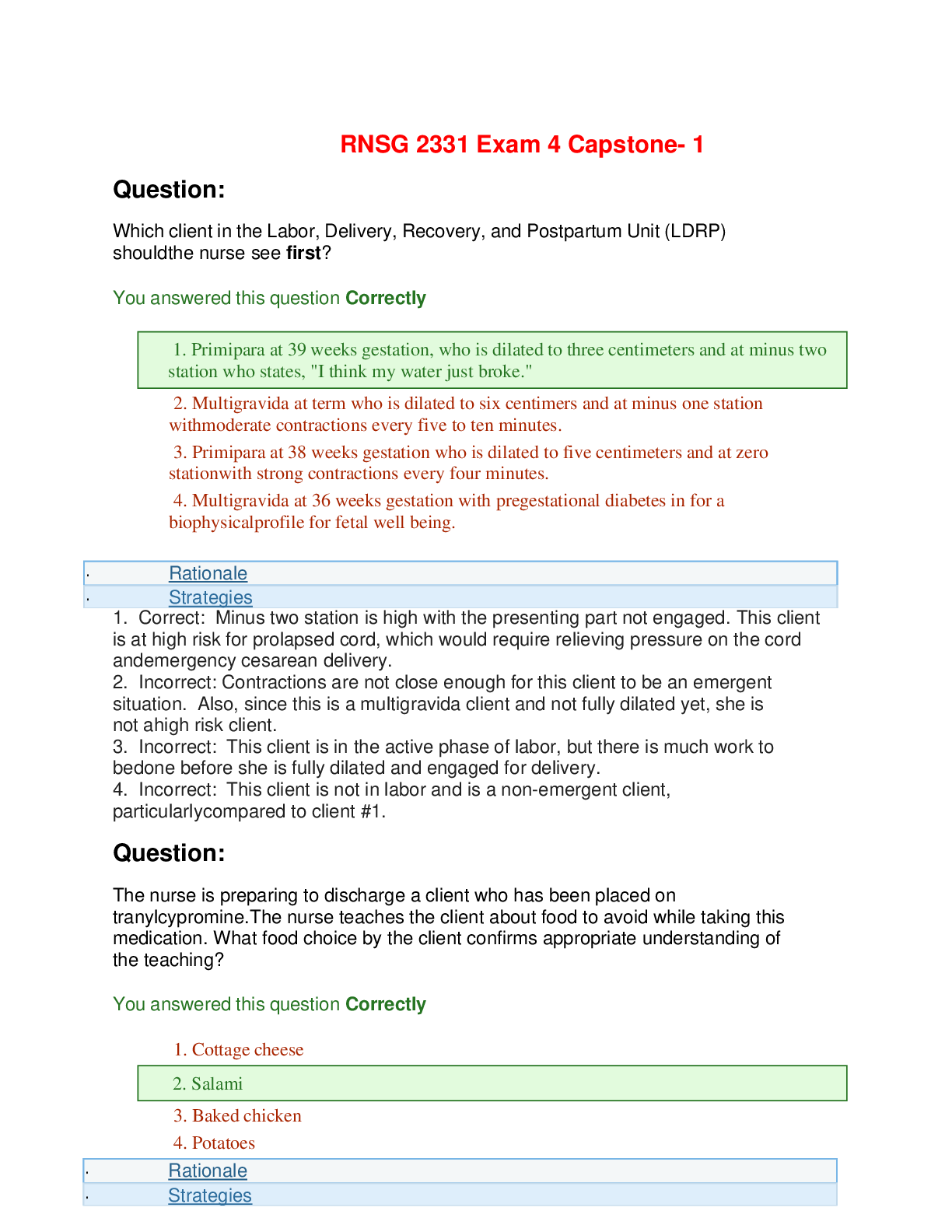
Which client in the Labor, Delivery, Recovery, and Postpartum Unit (LDRP) should
the nurse see first?
You answered this question Correctly
2. Multigravida at term who is dilated to six centimers and at minus one station with
moderate contractions every five to ten minutes.
3. Primipara at 38 weeks gestation who is dilated to five centimeters and at zero station
with strong contractions every four minutes.
4. Multigravida at 36 weeks gestation with pregestational diabetes in for a biophysical
profile for fetal well being.
4. Relapse prevention plan.
5. Continued peer support.
RNSG 2331 exam 4 capstone 1
2. Salami
• Strategies
• Rationale
1. Correct: Minus two station is high with the presenting part not engaged. This client
is at high risk for prolapsed cord, which would require relieving pressure on the cord and
emergency cesarean delivery.
2. Incorrect: Contractions are not close enough for this client to be an emergent
situation. Also, since this is a multigravida client and not fully dilated yet, she is not a
high risk client.
3. Incorrect: This client is in the active phase of labor, but there is much work to be
done before she is fully dilated and engaged for delivery.
4. Incorrect: This client is not in labor and is a non-emergent client, particularly
compared to client #1.
Question:
The nurse is preparing to discharge a client who has been placed on tranylcypromine.
The nurse teaches the client about food to avoid while taking this medication. What
food choice by the client confirms appropriate understanding of the teaching?
You answered this question Correctly
1. Cottage cheese
3. Baked chicken
4. Potatoes
2. Correct: The client taking a monoamine oxidase inhibitor (MAOI) such as
tranylcypromine should avoid foods rich in tyramine or tryptophan. These include:
cured foods, those that have been aged, pickled, fermented, or smoked. These can
precipitate a hypertensive crisis.
1. Incorrect: Clients taking MAOIs can eat cottage cheese in reasonable amounts.
3. Incorrect: Clients taking MAOIs can eat baked chicken.
4. Incorrect: Clients taking MAOIs can eat potatoes.
Question:
What task by the RN should be performed first?
You answered this question Correctly
1. Changing a burn dressing that is scheduled every four hours.
2. Administering scheduled IV antibiotic.
3. Teaching a new diagnosed diabetic about diet and exercise
[Show More]