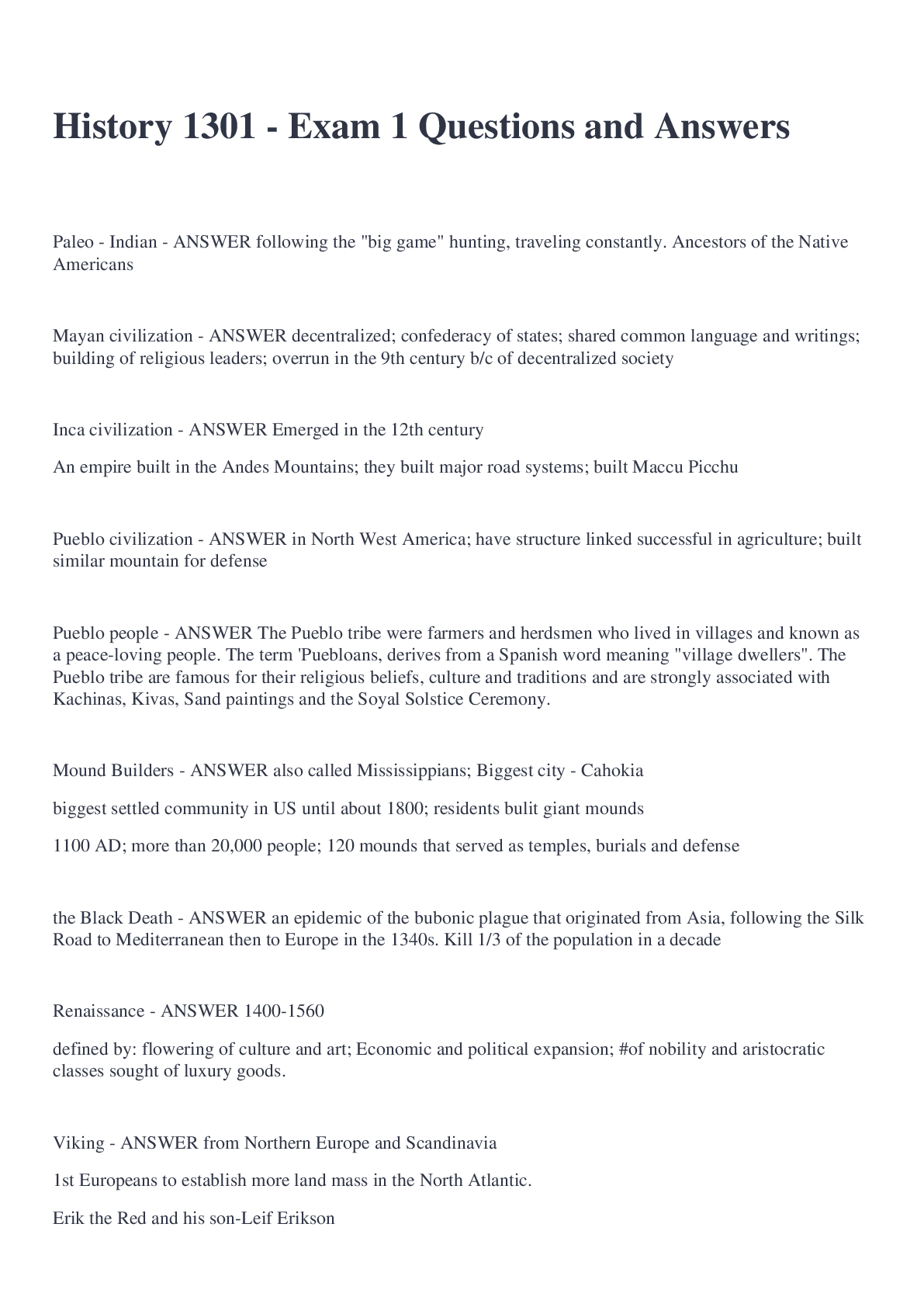
Paleo - Indian - ANSWER following the "big game" hunting, traveling constantly. Ancestors of the Native Americans
Mayan civilization - ANSWER decentralized; confederacy of states; shared common language and writings;
...
Paleo - Indian - ANSWER following the "big game" hunting, traveling constantly. Ancestors of the Native Americans
Mayan civilization - ANSWER decentralized; confederacy of states; shared common language and writings; building of religious leaders; overrun in the 9th century b/c of decentralized society
Inca civilization - ANSWER Emerged in the 12th century
An empire built in the Andes Mountains; they built major road systems; built Maccu Picchu
Pueblo civilization - ANSWER in North West America; have structure linked successful in agriculture; built similar mountain for defense
Pueblo people - ANSWER The Pueblo tribe were farmers and herdsmen who lived in villages and known as a peace-loving people. The term 'Puebloans, derives from a Spanish word meaning "village dwellers". The Pueblo tribe are famous for their religious beliefs, culture and traditions and are strongly associated with Kachinas, Kivas, Sand paintings and the Soyal Solstice Ceremony.
Mound Builders - ANSWER also called Mississippians; Biggest city - Cahokia
biggest settled community in US until about 1800; residents bulit giant mounds
1100 AD; more than 20,000 people; 120 mounds that served as temples, burials and defense
the Black Death - ANSWER an epidemic of the bubonic plague that originated from Asia, following the Silk Road to Mediterranean then to Europe in the 1340s. Kill 1/3 of the population in a decade
Renaissance - ANSWER 1400-1560
defined by: flowering of culture and art; Economic and political expansion; #of nobility and aristocratic classes sought of luxury goods.
Viking - ANSWER from Northern Europe and Scandinavia
1st Europeans to establish more land mass in the North Atlantic.
Erik the Red and his son-Leif Erikson
Vasco da Gama's - ANSWER 1st European sailed around the tip of Africa. From Europe-Cape of Good Hope-India
1st voyage 1498
Aztec civilization - ANSWER Powerful tribe located near today's Mexico City
Civilization that built the city of Tenochtitlan
Christopher Colombus - ANSWER Italian explorer in service with Spain who arrived in the Americas in 1492. Start with 3 ships to go to the East India
Amerigo Vespucci - ANSWER Italian explorer who set out and search around the continent. (1497-1498)
He came to the South first (Costa Rica) then Meso America -> Realized they are not in East Indies
Treaty of Tordesillas - ANSWER A treaty between Spain and Portugal (signed 1494) that drew an imaginary line between the New World. Portugal = East and Spain = West
Conquistador - ANSWER Spanish and Portuguese soliders who fought for conquest in the 16th century. Seeking 3 things: distinction, wealth, and expand religion.
Ponde de Leon - ANSWER searched the fountain of Youth and city of Gold.
1st person to push in to the Florida peninsula
Hernan Cortez - ANSWER A Spanish Conquistador who defeated and conquered the Aztec Empire
Montezuma III - ANSWER greeted Cortez in Tenochitlan as he planned to make friend with Cortez. Leading the war against the Spanish and died of disease. Aztez failed in 1590
Francisco Pizarro - ANSWER invaded Cuzco (Inca) in 1532. Over number by the empire; But defeated the empire due to the disease which made the defense weaken
Hernando de Soto - ANSWER voyage in 1539; pushing from Florida to the East Texas nowadays; ended in 1544
Fransisco de Coronado - ANSWER pushed furthest to the West (1540-1542); was the 1st European to see the Grand Canyon.
The Black Legend - ANSWER The Black Legend is a negative stereotype of the Spanish that resulted from the decimation of the Indian peoples during the conquest period.
Bartolome de Lascasas - ANSWER reported all the brutal scenes of Spanish on the Slave that he witnessed
The Columbian Exchange - ANSWER the exchange of European products to the Americas and vice-versa- is one of the most significant results of the Age of Exploration and the First Global Age.
Food products, livestock, and diseases are three of the most notable elements of the Columbian Exchange.
Jacques Cartier - ANSWER French Explorer; set out the French colonization
Henry Hudson - ANSWER was hired by the Dutch East India Company to find a shorter route to Asia by pushing furthest to North West
Joint Stock Company - ANSWER It was formed by wealthy investors who wanted to finance colonization. The investors expected to get back their investments plus large profits quickly and then to dissolve the company. Most of these companies went bankrupt.
Pocahontas - ANSWER 1595-1617) was the daughter of the local tribal Chief Powhattan. She converted to Christianity, took the English name Rebecca, and married Englishman John Rolfe
Roanoke - ANSWER Founded by Sir Walter Raleigh in 1535 off the coast of North Carolina; the first settlement was abandoned in 1586; the second settlement, established in 1586, was found mysteriously abandoned in 1590
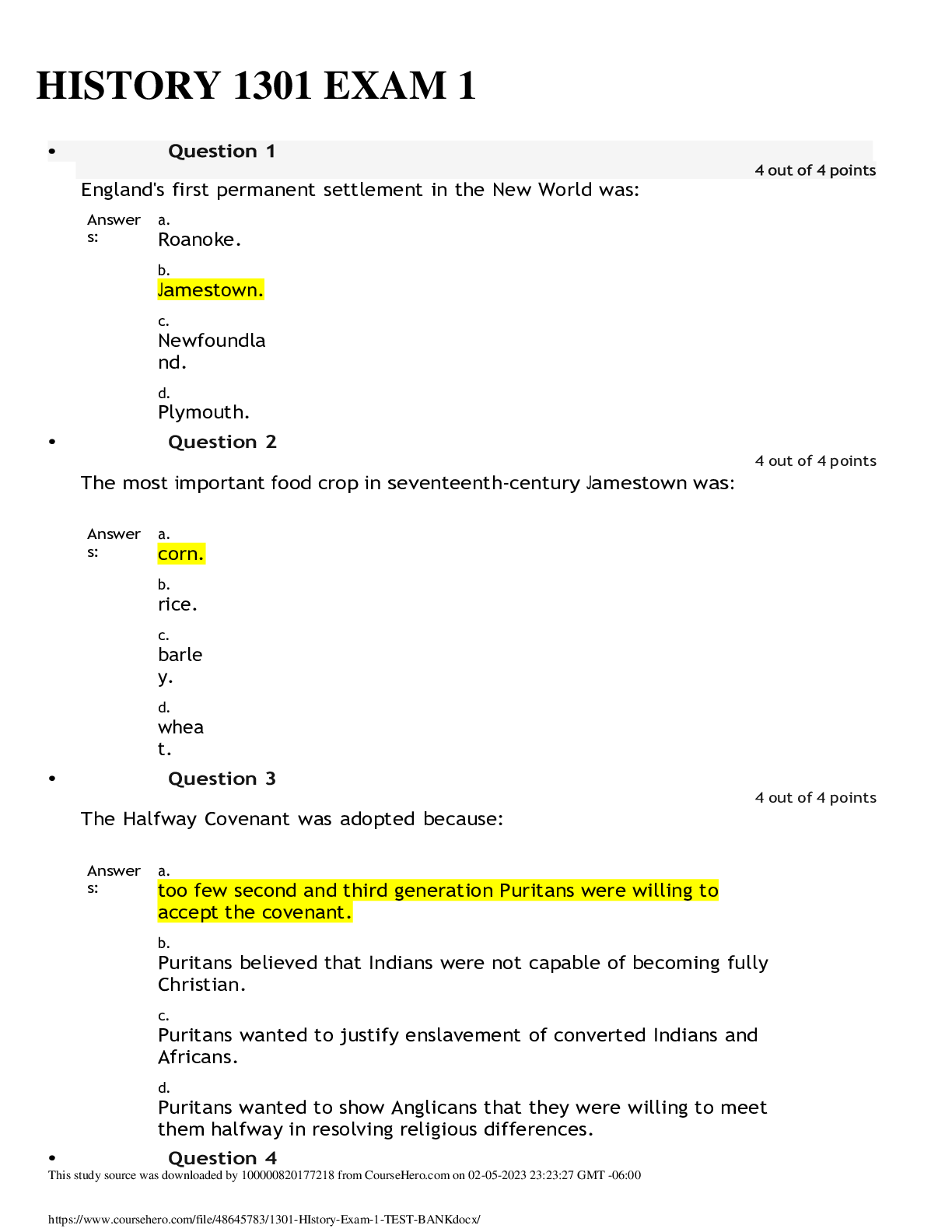
Jamestown - ANSWER *located in Virginia
~started with 500 settlers, went to 60 ~due to starving, disease
Survived thank for Powhatan, teaching how to grow corn, tobacco crops
~1st permeant English settlement
Indentured Servitude - ANSWER A settler who signed on for a temporary period of servitude to a master in exchange for passage to the New World; Virginia and Pennsylvania were largely peopled in the seventeenth and eighteenth centuries by English and German indentured servants.
Pilgrims (separatists) - ANSWER felt that the church was lost, and therefore, "separated" and formed their own church. Left England and went to Holland, eventually went to America.
aboard the Mayflower, founding Plymouth Colony on Cape Cod in 1620.
Puritans (non-separatists) - ANSWER English religious group that sought to purify the Church of England; founded the Massachusetts Bay Colony under John Winthrop in 1630
Roger Williams - ANSWER He founded Rhode Island for separation of Church and State. He believed that the Puritans were too powerful and was ordered to leave the Massachusetts Bay Colony for his religious beliefs.
Anne Hutchinson - ANSWER Puritan dissenter who challenged the authority of the ministers, exposing the subordination of women in the culture of colonial Massachusetts; tried, convicted, & banished from the colony in 1637.
Proprietary Colony - ANSWER a type of settlement in which awarded huge tracts of land in the New World to supervise and develop
William Penn - ANSWER founded the Province of Pennsylvania, the British North American colony that became the U.S. state of Pennsylvania.
Mercantilism - ANSWER Policy of Great Britain and other imperial powers of regulating the economies of colonies to benefit the mother country.
colonies produced raw materials-->mother countries-->finished goods-->colonies
Colonies cannot get material/goods from other countries w/o mother countries' permission
The Navigation Act - ANSWER passed (1651-1673) were created to regulate trade with countries outside of England and control trade with the colonies.
Restricted trade between England and its colonies to English or colonial ships, required certain colonial goods to pass through England before export, provided subsidies for the production of certain raw goods in the colonies, and banned colonial competition in large-scale manufacturing.
Bacon's Rebellion - ANSWER an armed rebellion in 1676 by Virginia settlers led by Nathaniel Bacon against the rule of Governor William Berkeley; end of indentured servants because they couldn't be trusted
King Phillips War - ANSWER Metacom=King Phillips
The war Began in 1675 and ended at Aug 1676 with an Indian uprising against white colonists; a multi-year conflict, the end result was broadened freedoms for white New Englanders and the dispossession of the region's Indians.
Salem Witch Trials - ANSWER A crisis of trials and executions in Salem, Massachusetts in 1692 that resulted from anxiety over witchcraft.
The Stono Rebellion - ANSWER was a slave rebellion that began on 9 September 1739, in the colony of South Carolina. It w
[Show More]


.png)