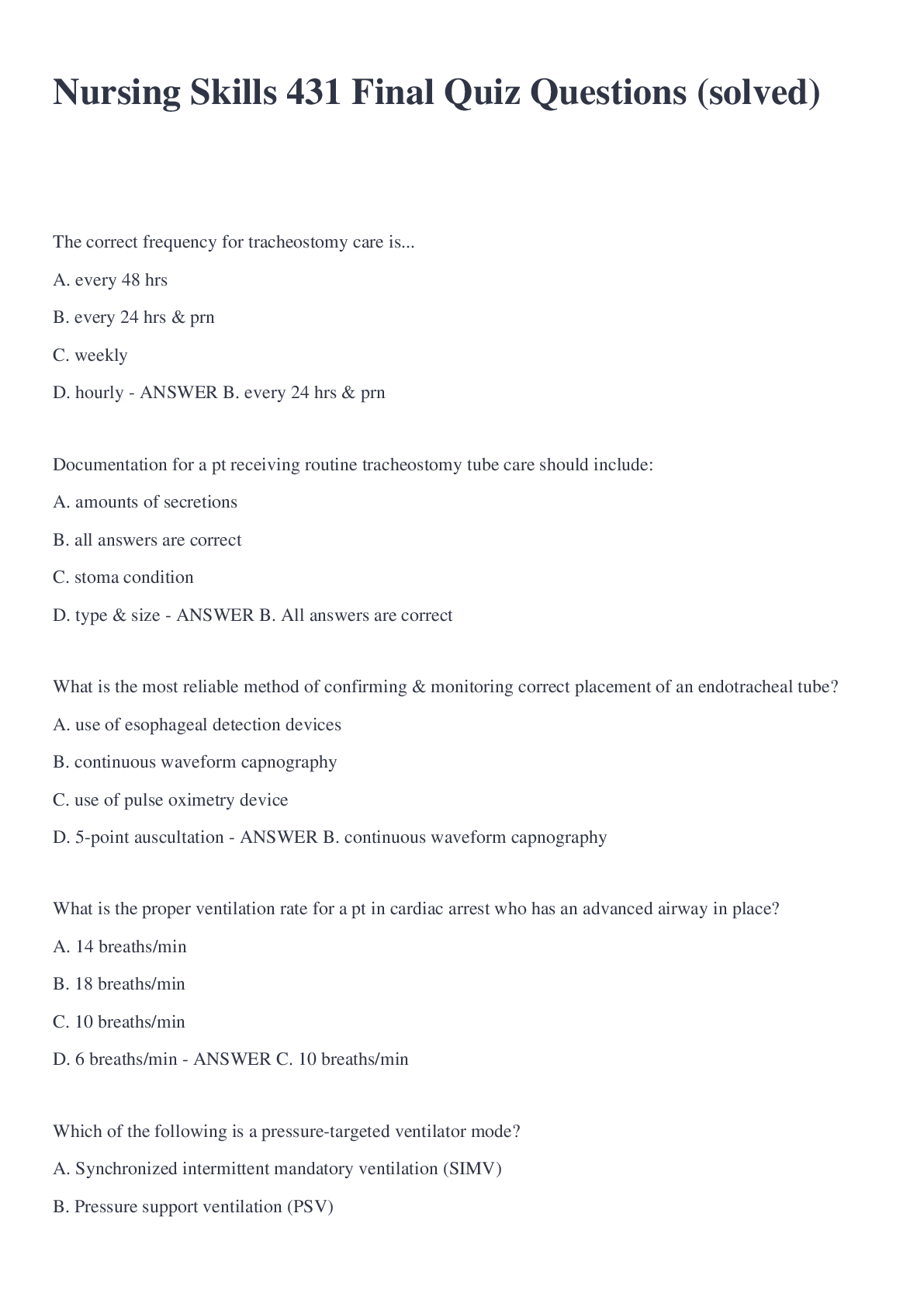
The correct frequency for tracheostomy care is...
A. every 48 hrs
B. every 24 hrs & prn
C. weekly
D. hourly - ANSWER B. every 24 hrs & prn
Documentation for a pt receiving routine tracheostomy tube care should inc
...
The correct frequency for tracheostomy care is...
A. every 48 hrs
B. every 24 hrs & prn
C. weekly
D. hourly - ANSWER B. every 24 hrs & prn
Documentation for a pt receiving routine tracheostomy tube care should include:
A. amounts of secretions
B. all answers are correct
C. stoma condition
D. type & size - ANSWER B. All answers are correct
What is the most reliable method of confirming & monitoring correct placement of an endotracheal tube?
A. use of esophageal detection devices
B. continuous waveform capnography
C. use of pulse oximetry device
D. 5-point auscultation - ANSWER B. continuous waveform capnography
What is the proper ventilation rate for a pt in cardiac arrest who has an advanced airway in place?
A. 14 breaths/min
B. 18 breaths/min
C. 10 breaths/min
D. 6 breaths/min - ANSWER C. 10 breaths/min
Which of the following is a pressure-targeted ventilator mode?
A. Synchronized intermittent mandatory ventilation (SIMV)
B. Pressure support ventilation (PSV)
C. Assist Control Ventilation (AC)
D. Assisted Mandatory Ventilation (AMV) - ANSWER B. Pressure support ventilation (PSV)
Which of the following is a volume-targeted ventilator mode?
A. Pressure support ventilation (PSV)
B. Airway Pressure Release Ventilation (APRV)
C. Synchronized Intermittent Mandatory Ventilation (SIMV)
D. Pressure-control inverse Ratio Ventilation (PC-IRV) - ANSWER C. Synchronized Intermittent Mandatory Ventilation (SIMV)
What is the appropriate ventilation strategy for an adult in respiratory arrest w/ a pulse rate of 80/min?
A. 1 breath every 3-4 seconds
B. 2 breaths every 5-6 seconds
C. 1 breath every 5-6 seconds
D. 2 breaths every 6-8 seconds - ANSWER 1 breath every 5-6 seconds
Which of the following alarm problems is caused by a blocked or kinked endotracheal tube?
A. high pressure
B. low exhaled tidal volume
C. Low inspiratory pressure
D. apnea - ANSWER A. High pressure
Which of the following is a likely cause of a low pressure alarm?
A. biting the endotracheal tube
B. Circuit disconnect
C. Secretion built up
D. Coughing - ANSWER B. Circuit disconnect
The nurse monitors the pt w/ positive pressure mechanical ventilation for...
A. Paralytic ileus bc pressure on the abdominal contents affects bowel motility
B. Diuresis & sodium depletion bc of increased release of atril natriuretic peptide
C. Signs of cardiovascular insufficiency bc pressure in the chest impedes venous return
D. Respiratory acidosis in a pt w/ COPD bc of alveolar hyperventilation & increased PaO2 levels - ANSWER C. Signs of cardiovascular insufficiency bc pressure in the chest impedes venous return
You are checking for a pulse in an unresponsive patient. How long do you continue to check for a pulse before starting chest compressions?
A. 3-5 seconds
B. 1-3 seconds
C. at least 10 seconds
D. 5-10 seconds - ANSWER D. 5-10 seconds
What is the preferred method of access for epinephrine administration during cardiac arrest in most patients?
A. Intraosseous
B. Endotracheal
C. Peripheral Intravenous
D. Central Intravenous - ANSWER C. Peripheral Intravenous
You find an unresponsive patient who is not breathing. After activating the emergency response system, you determine that there is no pulse. What is your next action?
A. Deliver 2 rescue breaths each over 1 second
B. Start chest compressions at a rate of 100-120/min
C. Open the airway with a head tilt-chin lift
D. Administer epinephrine at a dose of 1 mg/kg - ANSWER B. Start chest compressions at a rate of 100-120/min
What is a common but sometimes fatal mistake in cardiac arrest management?
A. Failure to perform endotracheal intubation
B. Failure to obtain vascular access
C. Prolonged interruption in chest compressions
D. Prolonged periods of no ventilations - ANSWER C. Prolonged interruption in chest compressions
What action is a component of high-quality chest compressions?
A. Chest compressions without ventilation
B. Allowing complete chest recoil
C. Uninterrupted compressions at a depth of ⅕ inches
D. 60-100 compressions/min w/ a 15:2 ratio - ANSWER B. Allowing complete chest recoil
You have completed your first 2-min period of CPR. You see an organized, nonshockable rhythm on the ECG monitor. What is the next action?
A. Administer normal saline at 20 mL/kg
B. Obtain a BP & O2 sat
C. Administer epinephrine at 1 mg/kg IV
D. Have a team member attempt to palpate a carotid pulse - ANSWER D. Have a team member attempt to palpate a carotid pulse
Which of the following is a sign of effective CPR?
A. Measured UOP of 1 mL/kg/hr
B. PETCO2 > 10 mmHg
C. Pt temp > 32 oC
D. BP of 120/80 mmHg - ANSWER B. PETCO2 > 10 mmHg
What is the purpose of a medical emergency team (MET) or rapid response team (RRT)?
A. Providing online consultation to EMS personnel in the field
B. Providing diagnostic consultation to emergency department pts
C. Improving pt outcomes by identifying & treating early clinical deterioration
D. Improving care for deteriorating pts admitted to critical care units - ANSWER C. Improving pt outcomes by identifying & treating early clinical deterioration
Which treatment or medication is appropriate for the treatment of a pt in asystole?
A. epinephrine
B. Defibrillation
C. Atropine
D. Transcutaneous pacing - ANSWER A. epinephrine
What is the recommended next step after a defibrillation attempt?
A. Check the ECG for evidence of a rhythm
B. Determine if a carotid pulse is present
C. Open the pts airway
D. Begin CPR, starting w/ chest compressions - ANSWER D. Begin CPR, starting w/ chest compressions
The nurse is unable to flush a central venous access device and suspects occlusion. The best nursing intervention would be to:
A. Apply warm moist compresses to the insertion site
B. Place the patient on the left side with the head-down position
C. Attempt to force 10mL of normal saline into the device
D. Instruct the patient to change positions, raise arm and cough - ANSWER B. Place the patient on the left side with the head-down position
To establish hemodynamic monitoring for a patient, the nurse zeros the:
A. Cardiac output monitoring system to the level of the left ventricle
B. Pressure monitoring system to the level of the atrium, identified as the phlebostatic axis
C. Pressure monitoring system to the level of the catheter tip located in the patient
D. Pressure monitoring system to the level of the atrium, identified as the midclavicular line - ANSWER B. Pressure monitoring system to the level of the atrium, identified as the phlebostatic axis
In order to maintain catheter patency and adequate waveforms, the pressure bag should be inflated to:
A. 400 mmhg
B. 100 mmhg
C. 200 mmhg
D. 300 mmhg - ANSWER D. 300 mmhg
Steps to remove CVL include:
A. Forcibly removing the catheter when meeting resistance
B. Letting the site openly bleed for a few minutes after removal
C. Having the patient perform the Valsalva maneuver during removal
D. Positioning patient so that the insertion site is above the heart - ANSWER C. Having the patient perform the Valsalva maneuver during removal
In order to prevent nosocomial infection of a CVL, the nurse should:
a. Perform CVL dressing changes every 10 days
b. Always discard 20mL of blood prior to obtaining sample
C. group multiple blood draws together
d. Leave the port on the CVL open to air - ANSWER C. group multiple blood draws together
After the placement of a central line in the right subclavian vein, the patient starts complaining of shortness of breath and their O2 saturation begins to drop. Which of the following complications is most likely?
a. Pneumothorax
b. Sepsis
c. Catheter migration
d. Anxiety - ANSWER a. Pneumothorax
The optimal position to place a patient in during the discontinuation of a subclavian or jugular central line is:
a. High fowlers
b. Reverse Trendelenburg
c. Semi-fowlers
d. Trendelenburg - ANSWER d. Trendelenburg
If your patient accidentally removes his chest tube, should immediately:
a. Cover with gauze dressing taped on three sides
b. Scold the patient for removing the chest tube
c. Apply an occlusive dressing
d. Call the healthcare provider from the nurses station - ANSWER a. Cover with gauze dressing taped on three sides
1. The tip of the CVL catheter should be placed just above the:
a. Right ventricle
b. Right atrium
c. Left atrium
d. Left ventricle - ANSWER b. Right atrium
If continuous bubbling is noted in the water seal chamber, this could indicate:
a. That the patient has a new pneumothorax
b. Has no significant meaning
c. That the chest tube is working
d. An air leak - ANSWER d. An air leak
Which of the following properties of cardiac cells describes their ability to initiate an impulse spontaneously and continuously?
a. Conductivity
b. Excitability
c. Contractility
d. Automaticity - ANSWER d. Automaticity
The nurse is monitoring the ECG of a patient admitted with acute coronary syndrome (ACS). Which ECG characteristics would be most suggestive of myocardial ischemia:
a. Sinus rhythm with premature atrial contraction
b. Sinus rhythm with a depressed ST segment
c. Sinus rhythm with a prolonged QT segment
d. Sinus rhythm with pathologic Q waves - ANSWER b. Sinus rhythm with a depressed ST segment
The nurse prepares a patient for synchronized cardioversion knowing that cardioversion differs from defibrillation in that:
a. Defibrillation requires the use of the "sync" button
b. Cardioversion is indicated to treat atrial brady dysrhythmias
c. Defibrillation requires a lower dose of electrical energy
d. Cardioversion is synchronized to deliver a shock during the QRS complex - ANSWER d. Cardioversion is synchronized to deliver a shock during the QRS complex
The EKG provides a comprehensive picture of the heart's:
a. Electrical activity
b. Four chambers
c. Coronary arteries
d. Valvular activity - ANSWER a. Electrical activity
1. A good quality EKG is indicated by:
a. Artifact
b. Wandering baseline
c. Clear QRS complexes
d. All answers are correct - ANSWER c. Clear QRS complexes
1. When using a biphasic defibrillator, the first shock should be delivered at:
a. 300 joules
b. 200 joules
c. 360 joules
d. 50 joules - ANSWER b. 200 joules
The nurse is preparing to transcutaneously pace a patient with symptomatic bradycardia in the emergency department. He or she demonstrates proper knowledge of this function by:
a. Placing the patient in prone position to apply the pads
b. Always using the lowest current that results in ventricular contraction (capture) to minimize patient discomfort
c. Charging the device by using the button on the defibrillator or the paddles
d. Checking to see that the synchronizer switch is turned on - ANSWER b. Always using the lowest current that results in ventricular contraction (capture) to minimize patient discomfort
Use of the continuous ECG (telemetry) monitoring can provide:
a. A record of the patient's rhythm
b. A way to measure complexes and intervals
c. All answers are correct
d. Assessment of dysrhythmias - ANSWER c. All answers are correct
The nurse knows that the immediate result of external defibrillation is:
a. Myocardial depolarization
b. Atrial contraction
c. Myocardial repolarization
d. Sinus bradycardia - ANSWER c. Myocardial repolarization
A patient on the unit develops supraventricular tachycardia and becomes hemodynamically unstable. The nurse is preparing to perform an electrical intervention on the patient. Which of the following would be the most appropriate?
a. Transcutaneous pacing
b. None of the answers are correct
c. Synchronized cardioversion
d. Defibrillation - ANSWER c. Synchronized cardioversion
[Show More]