1.
When repositioning an immobile patient, the nurse notices redness over the hip bone. What is indicated when a reddened area blanches on fingertip touch?
A local skin infection requiring antibiotics
Sensitive skin
...
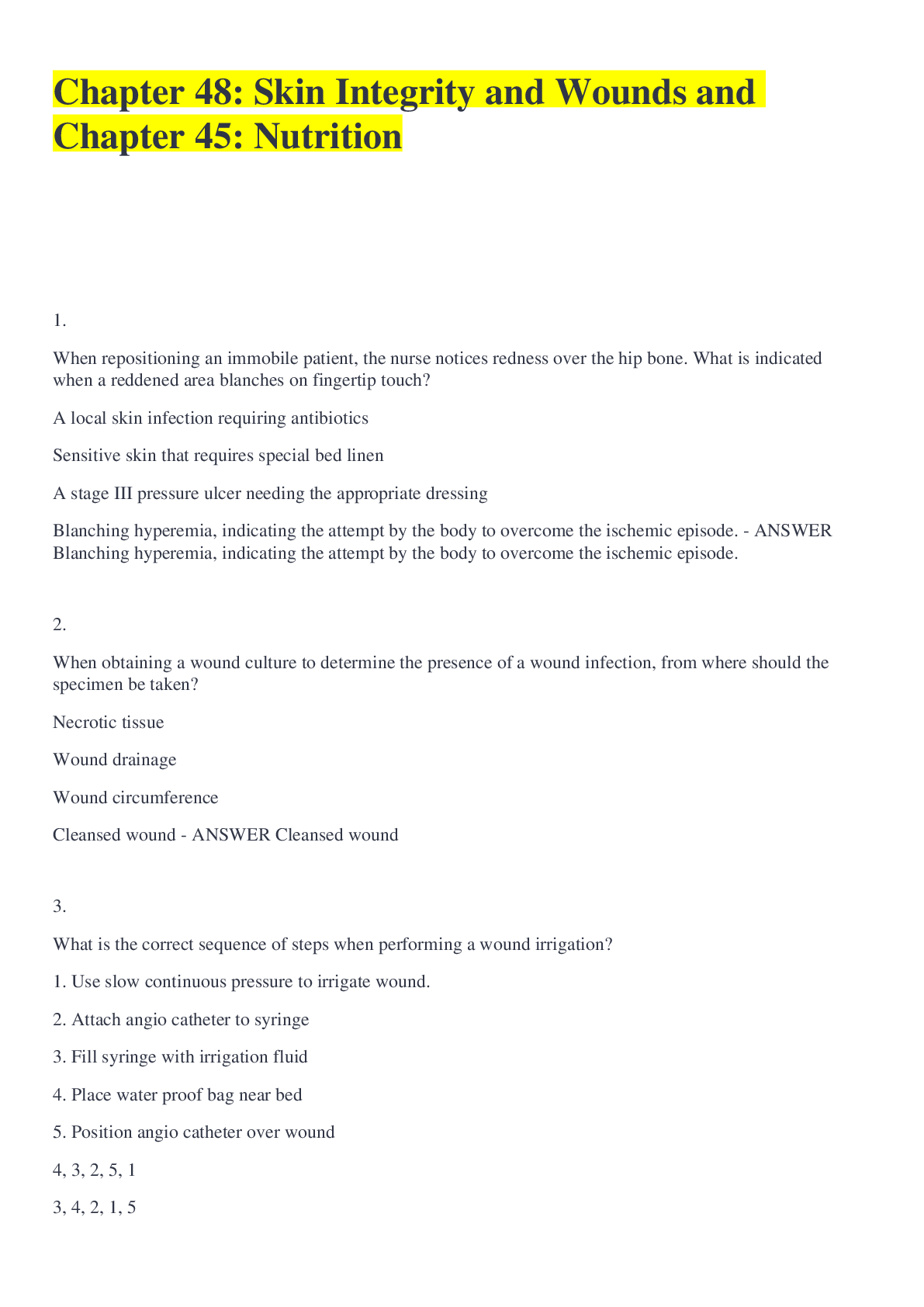
1.
When repositioning an immobile patient, the nurse notices redness over the hip bone. What is indicated when a reddened area blanches on fingertip touch?
A local skin infection requiring antibiotics
Sensitive skin that requires special bed linen
A stage III pressure ulcer needing the appropriate dressing
Blanching hyperemia, indicating the attempt by the body to overcome the ischemic episode. - ANSWER Blanching hyperemia, indicating the attempt by the body to overcome the ischemic episode.
2.
When obtaining a wound culture to determine the presence of a wound infection, from where should the specimen be taken?
Necrotic tissue
Wound drainage
Wound circumference
Cleansed wound - ANSWER Cleansed wound
3.
What is the correct sequence of steps when performing a wound irrigation?
1. Use slow continuous pressure to irrigate wound.
2. Attach angio catheter to syringe
3. Fill syringe with irrigation fluid
4. Place water proof bag near bed
5. Position angio catheter over wound
4, 3, 2, 5, 1
3, 4, 2, 1, 5
4, 2, 3, 5, 1
2, 3, 4, 5, 1 - ANSWER 4, 3, 2, 5, 1
4.
For a patient who has a muscle sprain, localized hemorrhage, or hematoma, which wound care product helps prevent edema formation, control bleeding, and anesthetize the body part?
Binder
Ice bag
Elastic bandage
Absorptive dressing - ANSWER Ice bag
5.
Which of the following describes a hydrocolloid dressing?
A seaweed derivative that is highly absorptive
Premoistened gauze placed over a granulating wound
A debriding enzyme that is used to remove necrotic tissue
A dressing that forms a gel that interacts with the wound surface - ANSWER A dressing that forms a gel that interacts with the wound surface
6.
What is the removal of devitalized tissue from a wound called?
Debridement
Pressure reduction
Negative pressure wound therapy
Sanitization - ANSWER Debridement
7.
What does the Braden Scale evaluate?
Skin integrity at bony prominences, including any wounds
Risk factors that place the patient at risk for skin breakdown
The amount of repositioning that the patient can tolerate
The factors that place the patient at risk for poor healing - ANSWER Risk factors that place the patient at risk for skin breakdown
8.
On assessing your patient's sacral pressure ulcer, you note that the tissue over the sacrum is dark, hard, and adherent to the wound edge. What is the correct category/stage for this patient's pressure ulcer?
Category/Stage II
Category/Stage IV
Unstageable
Suspected deep tissue damage - ANSWER Unstageable
Nonblanchable redness of intact skin. Discoloration, warmth, edema, or pain may also be present. - ANSWER Category Stage 1
Full thickness skin loss, subcutaneous fat may be visible. May include undermining - ANSWER Category Stage III
Full thickness tissue loss, muscle and bone visible. May include undermining. - ANSWER Category Stage IV
Partial thickness skin loss or intact blister with serosanginous fluid. - ANSWER Category Stage II
10.
After surgery the patient with a closed abdominal wound reports a sudden "pop" after coughing. When the nurse examines the surgical wound site, the sutures are open, and pieces of small bowel are noted at the bottom of the now-opened wound. Which are the priority nursing interventions? (Select all that apply.)
Notify the surgeon
Allow the area to be exposed to air until all drainage has stopped
Place several cold packs over the area, protecting the skin around the wound
Cover the area with sterile, saline-soaked towels and immediately.
Cover the area with sterile gauze and apply an abdominal binder - ANSWER Notify the surgeon
Cover the area with sterile, saline-soaked towels and immediately.
11.
Which skin care measures are used to manage a patient who is experiencing fecal and/or urinary incontinence? (Select all that apply.)
Frequent position changes.
Keeping the buttocks exposed to air at all times
Using a large absorbent diaper, changing when saturated
Using an incontinence cleaner
Frequent cleaning, applying an ointment, and covering the areas with a thick absorbent towel
Applying a moisture barrier ointment - ANSWER Frequent position changes.
Using an incontinence cleaner
Applying a moisture barrier ointment
12.
Which of the following is an indication for a binder to be placed around a surgical patient with a new abdominal wound? (Select all that apply.)
Collection of wound drainage
Provides support to abdominal tissues when coughing or walking
Reduction of abdominal swelling
Reduction of stress on the abdominal incision
Stimulation of peristalsis (return of bowel function) from direct pressure - ANSWER Provides support to abdominal tissues when coughing or walking
Reduction of stress on the abdominal incision
13.
When is an application of a warm compress to an ankle muscle sprain indicated? (Select all that apply.)
To relieve edema
To reduce shivering
To improve blood flow to an injured part
To protect bony prominences from pressure ulcers
To immobilize area - ANSWER To relieve edema
To improve blood flow to an injured part
14.
Which of the following are measures to reduce tissue damage from shear? (Select all that apply.)
Use a transfer device, e.g. transfer board
Have head of bed elevated when transferring patient
Have head of bed flat when re positioning patients
Raise head of bed 60 degrees when patient positioned supine
Raise head of bed 30 degrees when patient positioned supine - ANSWER Use a transfer device, e.g. transfer board
Have head of bed flat when re positioning patients
Raise head of bed 30 degrees when patient positioned supine
1.
The nurse evaluates which laboratory values to assess a patient's potential for wound healing?
Fluid status
Potassium
Lipids
Nitrogen balance - ANSWER Nitrogen balance
2.
The nurse is caring for a patient with dysphagia and is feeding her a pureed chicken diet when she begins to choke. What is the priority nursing intervention?
Suction her mouth and throat
Turn her on their side
Put on oxygen at 2-L nasal cannula
Stop feeding her and place on NPO - ANSWER Suction her mouth and throat
3.
A patient who is receiving parenteral nutrition (PN) through a central venous catheter (CVC) has an air embolus. What would the nurse do first?
Have the patient perform a Valsalva procedure
Clamp the intravenous (IV) tubing to prevent more air from entering the line
Have the patient take a deep breath and hold it
Notify the health care provider immediately - ANSWER Have the patient perform a Valsalva procedure
4.
A patient is receiving both parenteral (PN) and enteral nutrition (EN). When would the nurse collaborate with the health care provider and request discontinuing parenteral nutrition?
When 25% of the patient's nutritional needs are met by the tube feedings
When bowel sounds return
When central line has been in for 10 days
When 75% of the patient's nutritional needs are met by the tube feedings - ANSWER When 75% of the patient's nutritional needs are met by the tube feedings
5.
The nurse is inserting a small-bore nasoenteric tube before starting enteral feedings. What is the correct order of steps to perform this procedure?
1. Place patient in high-Fowler's position.
2. Have patient flex head toward chest.
3. Assess patient's gag reflex.
4. Determine length of the tube to be inserted.
5. Obtain radiological confirmation of tube placement.
6. Check pH of gastric aspirate for verifying placement.
7. Identify patient with two identifiers.
7, 1, 3, 4, 2, 5, 6
1, 3, 4, 7, 2, 6, 5
7, 1, 3, 2, 4, 6, 5
1, 7, 3, 2, 4, 5, 6 - ANSWER 7, 1, 3, 4, 2, 5, 6
6.
A patient's gastric residual volume was 250 mL at 0800 and 350 mL at 1200. What is the appropriate nursing action?
Assess bowel sounds
Raise the head of the bed to at least 45 degrees
Position the patient on his or her right side to promote stomach emptying
Do not reinstall aspirate and hold the feeding until you talk to the primary care provider - ANSWER Do not reinstall aspirate and hold the feeding until you talk to the primary care provider
7.
The patient's blood glucose level is 330 mg/dL. What is the priority nursing intervention?
Recheck by performing another blood glucose test.
Call the primary health care provider.
Check the medical record to see if there is a medication order for abnormal glucose levels.
Monitor and recheck in 2 hours. - ANSWER Check the medical record to see if there is a medication order for abnormal glucose levels.
8.
Which statement made by a patient of a 2-month-old infant requires further education?
I'll continue to use formula for the baby until he is a least a year old.
I'll make sure that I purchase iron-fortified formula.
I'll start feeding the baby cereal at 4 months.
I'm going to alternate formula with whole milk starting next month. - ANSWER I'm going to alternate formula with whole milk starting next month.
9.
The nurse sees the nursing assistive personnel (NAP) perform the following intervention for a patient receiving continuous enteral feedings. Which action would require immediate attention?
Fastening tube to the gown with new tape
Placing patient supine while giving a bath
Hanging a new container of enteral feeding
Ambulating patient with enteral feedings still infusing - ANSWER Placing patient supine while giving a bath
10.
A patient is receiving total parenteral nutrition (TPN). What is the primary intervention the nurse should follow to prevent a central line infection?
Institute isolation precautions
Clean the central line port through which the TPN is infusing with alcohol
Change the TPN tubing every 24 hours
Monitor glucose levels to watch and assess for glucose intolerance - ANSWER Clean the central line port through which the TPN is infusing with alcohol
11.
The nurse is caring for a patient with pneumonia who has severe malnutrition. The nurse recognizes that, because of the nutritional status, the patient is at increased risk for: (Select all that apply.)
Heart disease.
Sepsis.
Pleural effusion.
Cardiac arrhythmias.
Diarrhea. - ANSWER Sepsis.
Pleural effusion.
Cardiac arrhythmias.
12.
The nurse is educating the patient and his family about the parenteral nutrition. Which aspect related to this form of nutrition would be appropriate to include? (Select all that apply.)
The purpose of the fat emulsion in parenteral nutrition is to prevent a deficiency in essential fatty acids.
We can give you parenteral nutrition through your peripheral intravenous line to prevent further infection.
The fat emulsion will help control hyperglycemia during periods of stress.
The parenteral nutrition will help your wounds heal.
Since we just started the parenteral nutrition, we will only infuse it at 50% of your daily needs for the next 6 hours. - ANSWER The purpose of the fat emulsion in parenteral nutrition is to prevent a deficiency in essential fatty acids.
The fat emulsion will help control hyperglycemia during perio
[Show More]

.png)
.png)
.png)

.png)
 Med Surg test Latest Verified Questions and all Correct Answers with Explanations Chapter 48 Assessment and Management of Patients with Ob.png)