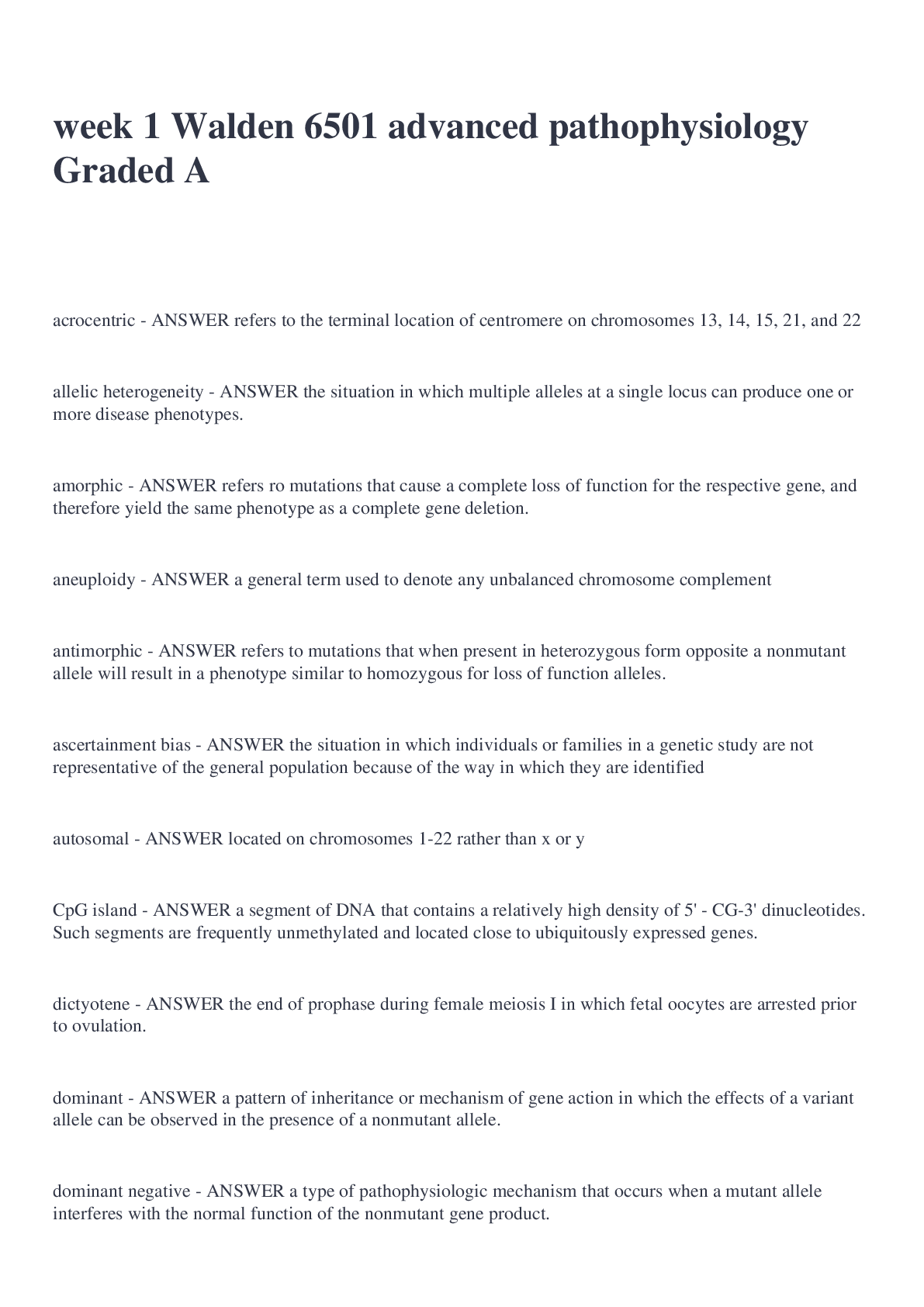
acrocentric - ANSWER refers to the terminal location of centromere on chromosomes 13, 14, 15, 21, and 22 allelic heterogeneity - ANSWER the situation in which multiple alleles at a single locus can ... produce one or more disease phenotypes. amorphic - ANSWER refers ro mutations that cause a complete loss of function for the respective gene, and therefore yield the same phenotype as a complete gene deletion. aneuploidy - ANSWER a general term used to denote any unbalanced chromosome complement antimorphic - ANSWER refers to mutations that when present in heterozygous form opposite a nonmutant allele will result in a phenotype similar to homozygous for loss of function alleles. ascertainment bias - ANSWER the situation in which individuals or families in a genetic study are not representative of the general population because of the way in which they are identified autosomal - ANSWER located on chromosomes 1-22 rather than x or y CpG island - ANSWER a segment of DNA that contains a relatively high density of 5' - CG-3' dinucleotides. Such segments are frequently unmethylated and located close to ubiquitously expressed genes. dictyotene - ANSWER the end of prophase during female meiosis I in which fetal oocytes are arrested prior to ovulation. dominant - ANSWER a pattern of inheritance or mechanism of gene action in which the effects of a variant allele can be observed in the presence of a nonmutant allele. dominant negative - ANSWER a type of pathophysiologic mechanism that occurs when a mutant allele interferes with the normal function of the nonmutant gene product. dosage compensation - ANSWER mechanismby which a difference in gene dosage between two cells is equalized. For XX cells in mammals, decreased expression from one of the two X chromosomes results in a concentration of gene product similar to am XY cell. End-product deficiency - ANSWER a pathologic mechanism in which absence or reduction in the product of a particular enzymatic reaction leads to disease. epigenetic - ANSWER refers to a phenotypic effect that is heritable, through somatic cell division and/or across organisms generations, but that does not depend on variation in DNA sequence. instead, it is associated with alterations in chromatin structure such as DNA methylation or histone modification that can be transmitted during cell division. expressivity - ANSWER the extent to which a mutant genotype affects phenotype, including the tissues that are affected, and the severity if those effects. fitness - ANSWER the effect of a mutant allele on an individual's abilityto produce offspring [Show More]
Last updated: 3 years ago
Preview 1 out of 2 pages
Buy this document to get the full access instantly
Instant Download Access after purchase
Buy NowInstant download
We Accept:
Can't find what you want? Try our AI powered Search
Connected school, study & course
About the document
Uploaded On
Oct 10, 2022
Number of pages
2
Written in
All
This document has been written for:
Uploaded
Oct 10, 2022
Downloads
0
Views
42
Scholarfriends.com Online Platform by Browsegrades Inc. 651N South Broad St, Middletown DE. United States.
We're available through e-mail, Twitter, and live chat.
FAQ
Questions? Leave a message!
Copyright © Scholarfriends · High quality services·