CCDS Test Questions & Answers
A. Bleeding gastric ulcer - ANS - A patient is admitted from the emergency department (ED)
with a diagnosis of weakness and anemia. After admission and further treatment with packed red
b
...
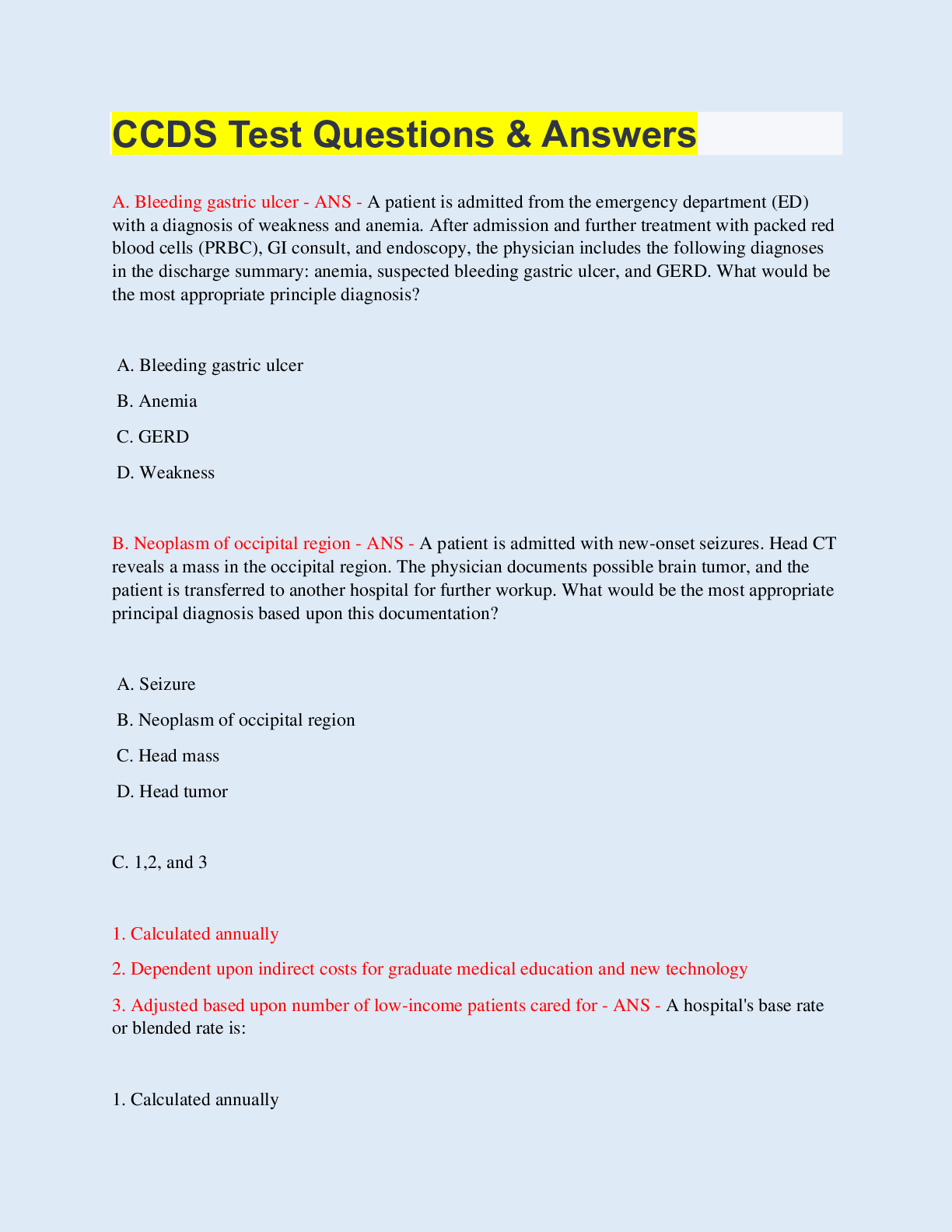
CCDS Test Questions & Answers
A. Bleeding gastric ulcer - ANS - A patient is admitted from the emergency department (ED)
with a diagnosis of weakness and anemia. After admission and further treatment with packed red
blood cells (PRBC), GI consult, and endoscopy, the physician includes the following diagnoses
in the discharge summary: anemia, suspected bleeding gastric ulcer, and GERD. What would be
the most appropriate principle diagnosis?
A. Bleeding gastric ulcer
B. Anemia
C. GERD
D. Weakness
B. Neoplasm of occipital region - ANS - A patient is admitted with new-onset seizures. Head CT
reveals a mass in the occipital region. The physician documents possible brain tumor, and the
patient is transferred to another hospital for further workup. What would be the most appropriate
principal diagnosis based upon this documentation?
A. Seizure
B. Neoplasm of occipital region
C. Head mass
D. Head tumor
C. 1,2, and 3
1. Calculated annually
2. Dependent upon indirect costs for graduate medical education and new technology
3. Adjusted based upon number of low-income patients cared for - ANS - A hospital's base rate
or blended rate is:
1. Calculated annually
2. Dependent upon indirect costs for graduate medical education and new technology
3. Adjusted based upon number of low-income patients cared for
4. Not adjusted based upon capital expenses
A. 1 and 2
B. 2 and 3
C. 1,2, and 3
D. 1,2,3, and 4
D. Reflect the severity of illness (SOI) and resource consumption of the patient's care - ANS -
The final MS-DRG assigned to a patient's medical record should:
A. Reflect the amount of time the physician spent with the patient
B. Depend upon the patient's length of stay
C. Be assigned by the physician
D. Reflect the severity of illness (SOI) and resource consumption of the patient's care
C. Poisoning - ANS - A patient is admitted from the emergency department with the diagnosis of
acute respiratory failure due to overdose of pain medication and an aspiration pneumonia. What
is the principal diagnosis?
A. Acute respiratory failure
B. Aspiration pneumonia
C. Poisoning
D. Adverse effect of medication
D. All of the conditions should be coded - ANS - A patient is admitted with pneumonia, stage 1
chronic renal failure, chronic anemia, and COPD, While hospitalized the patient receives IV
antibiotics, inhalers, oxygen, IV fluids at 50mL/hr, and iron tablets. Keeping the guidelines for
coding of secondary diagnoses in mind, which condition should be coded?
A. Pneumonia only
B. Pneumonia and COPD only
C. Pneumonia, COPD, and anemia
D. All of the conditions should be coded
D. Fractured ulna - ANS - Which of the following is an example of a hospital-acquired
condition?
A. Fat embolism
B. IV phlebitis
C. Pneumonia
D. Fractured ulna
C. A diagnosis that is listed as possible in the history and physical - ANS - Which of the
following is an example of documentation that would meet the present on admission criteria for
coding?
A. A diagnosis that is indicated in the history and physical and ruled out in the discharge
summary
B. A diagnosis found in a previous medical record
C. A diagnosis that is listed as possible in the history and physical
D. An acute condition identified on the third day of admission
A. Colon cancer - ANS - A patient is admitted with abdominal pain and the history and physical
indicated a diagnosis of probable colon cancer. On day two, the physician documents acute renal
failure in the progress notes and the patient receives IV fluids. The discharge summary lists
possible metastatic colon cancer and acute renal failure. The principal diagnosis would be:
A. Colon cancer
B. Acute renal failure
C. Abdominal pain
D. Metastatic neoplasm of the colon
D. 1,2, and 3
1. Include identification of the patient's SOI
2. Identify conditions that are present on admission
3. Support medical necessity - ANS - Accurate documentation should:
1. Include identification of the patient's SOI
2. Identify conditions that are present on admission
3. Support medical necessity
A. 1 and 2
B. 2 and 3
C. 1 and 3
D. 1,2, and 3
B. Anemia - ANS - A patient with a history of metasta
[Show More]