CIPP/US Practice Questions
The U.S. Constitution establishes what three branches of government? - ANS - Legislative,
Executive, Judicial
What establishes the three branches of the U.S. Government? - ANS - The U.S. Con
...
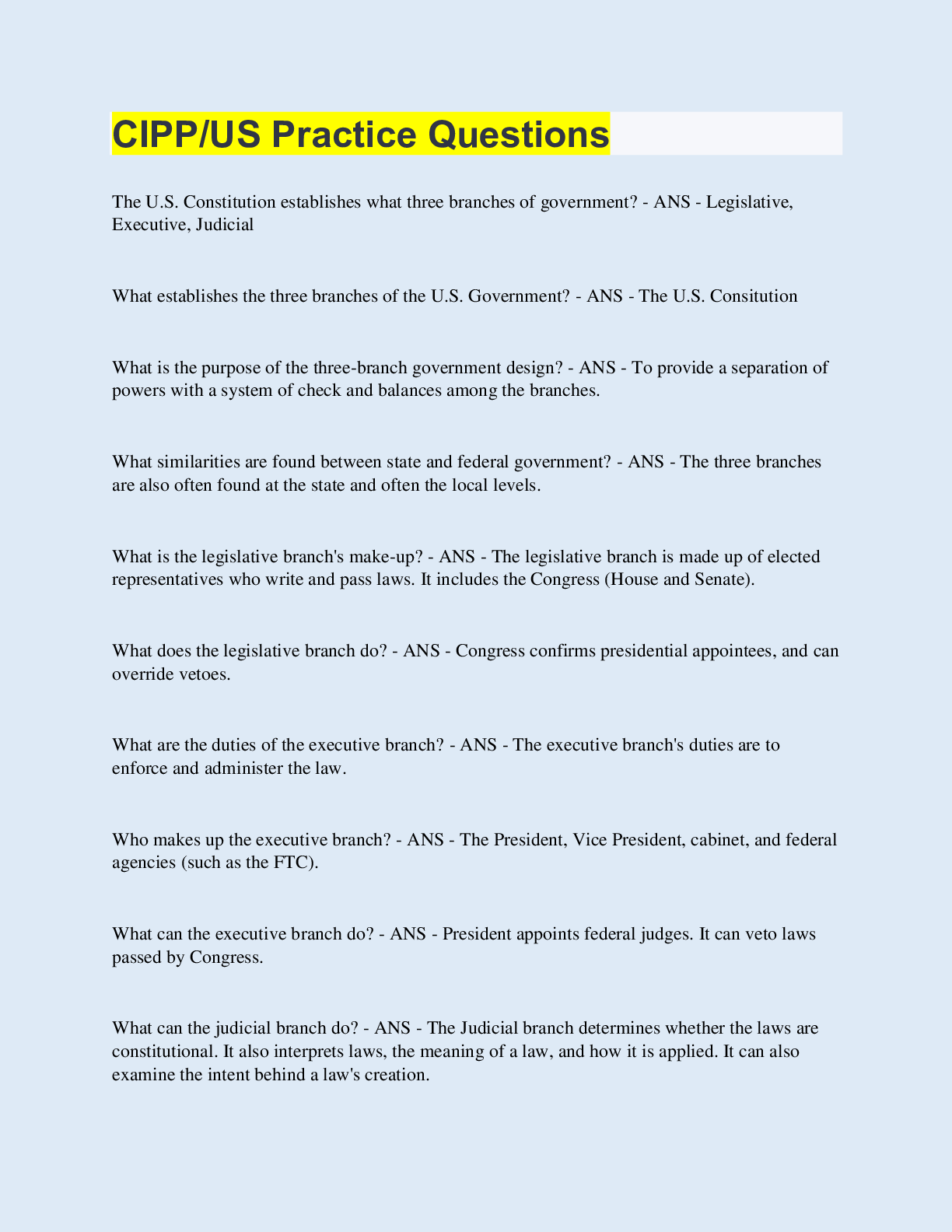
CIPP/US Practice Questions
The U.S. Constitution establishes what three branches of government? - ANS - Legislative,
Executive, Judicial
What establishes the three branches of the U.S. Government? - ANS - The U.S. Consitution
What is the purpose of the three-branch government design? - ANS - To provide a separation of
powers with a system of check and balances among the branches.
What similarities are found between state and federal government? - ANS - The three branches
are also often found at the state and often the local levels.
What is the legislative branch's make-up? - ANS - The legislative branch is made up of elected
representatives who write and pass laws. It includes the Congress (House and Senate).
What does the legislative branch do? - ANS - Congress confirms presidential appointees, and can
override vetoes.
What are the duties of the executive branch? - ANS - The executive branch's duties are to
enforce and administer the law.
Who makes up the executive branch? - ANS - The President, Vice President, cabinet, and federal
agencies (such as the FTC).
What can the executive branch do? - ANS - President appoints federal judges. It can veto laws
passed by Congress.
What can the judicial branch do? - ANS - The Judicial branch determines whether the laws are
constitutional. It also interprets laws, the meaning of a law, and how it is applied. It can also
examine the intent behind a law's creation.
What is the judicial branch? - ANS - The Federal Courts.
What two parts make up the U.S. Congress? - ANS - The Senate and the House of
Representatives (legislative branch)
What can Congress do when enacting legislation? - ANS - Congress can delegate the power to
promulgate regulations to federal agencies (such as the FTC).
What laws has Congress enacted involving the FTC? - ANS - Congress has enacted several laws
that give the U.S. Federal Trade Commission the authority to issue regulations to implement the
laws.
Does the executive branch include federal agencies that report directly to the President? - ANS -
Yes
What do federal agencies in the executive branch do? - ANS - They implement the laws through
rule making and enforce the laws through civil and criminal procedures.
What are the lowest courts called in the federal court system (judicial branch)? - ANS - District
Courts. These serve as federal trial courts.
Cases decided by a district court can be referred to what? - ANS - A federal appellate court (also
called a "circuit court").
What do federal circuit courts do? - ANS - They are not trial courts; they serve as appeals courts
for federal cases.
The federal appeals courts are divided into how many circuits? - ANS - 12 regional circuits; each
district court is assigned to a appeals court which decides the appeals for that circuit.
What are the other federal courts called? - ANS - Special courts include the U.S. Court of
Federal Claims and the U.S. Tax Court.
What is the top court in the judicial branch? - ANS - The U.S. Supreme Court.
What does the U.S. Supreme Court do? - ANS - Hears appeals from the circuit courts and
decides questions of federal law; also interprets the U.S. Constitution. May also hear appeals
from the highest state courts or function as a trial court in rare instances.
In what circumstances do federal agencies wield power that is characteristic of all three branches
of government? - ANS - When they are given authority by Congress to promulgate and enforce
rules pursuant to law. This means they operate under statutes that give them legislative power to
issue rules, executive power to investigate and enforce violations of rules/statutes, and judicial
power to settle particular disputes.
What are the sources of law in the U.S.? - ANS - Federal and state constitutions, legislation, case
law (contracts and torts), and agency-issued regulations.
What is the supreme law in the U.S.? - ANS - The Constitution.
Who drafted the Constitution and when? - ANS - The Constitutional Convention drafted the
Constitution in 1787.
True/False: The U.S. Constitution does not contain the word "Privacy". - ANS - True.
Which parts of the Constitution directly affect privacy? - ANS - The Fourth Amendment limits
on government searches.
Which Supreme Court decisions affect privacy? - ANS - The S.C. has held that a person has a
right to privacy over personal issues such as contraception and abortion, arising from more
general protections of due process of law.
What are other sources of law affecting privacy? - ANS - State constitutions may create stronger
rights than are provided in the U.S. Constitution.
Which state expressly recognizes a right to privacy in its constitution? - ANS - California.
What areas are regulated by laws enacted by federal Congress and state legislatures? - ANS -
applications of information (use of information for marketing or pre-employment screening),
certain industries (such as financial institutions or healthcare providers), certain data elements
(SSNs or driver's license info), or specific harms (identity theft or children's online privacy)
How is law-making power distributed in the U.S.? - ANS - Law-making power is shared
between the national and state governments.
What does the U.S. Constitution say about laws under the Constitution? - ANS - It states that the
Constitution and the laws passed pursuant to it, is "the supreme law of the land."
When do states have the power to make laws? - ANS - Where federal law does not prevent it,
states have the power to make law.
Which Amendment to the Constitution states "the powers not delegated to the United States by
the Constitution, nor prohibited by it to the States, are reserved to the States respectively, or to
the people."? - ANS - The Tenth Amendment to the Constitution.
What is one area of law where states may pass privacy/other laws with stricter requirements than
federal law? - ANS - HIPAA medical privacy rule.
In which areas do federal laws pre-empt state laws, preventing states from passing stricter
provisions? - ANS - Limits on commercial e-mails in the CAN-SPAM Act.
What is the CAN-SPAM Act? - ANS - Controlling the Assault of Non-Solicited Pornography
and Marketing Act.
Aside from the ability to make and enforce laws an
[Show More]

.png)
.png)
.png)
.png)
.png)













