LCDC Test Exam Questions & Answers
A major method of reinforcing the therapeutic alliance and spirit of collaboration between the ct
and the couselor is: - ANS - setting mutually-established goals
A mental status exam
...
LCDC Test Exam Questions & Answers
A major method of reinforcing the therapeutic alliance and spirit of collaboration between the ct
and the couselor is: - ANS - setting mutually-established goals
A mental status exam does not assess:
1. Educational Level
2. Appearance
3. Speech
4. Thought Process - ANS - 1. Educational level
The provision of information concerning alcohol and other drug abuse and the available servces
and resources, is termed: - ANS - client education
Significant others should be involved in the treatment porcess: (when) - ANS - From the clients
first contact with the treatment center
The NIDA-financed Drug Abuse reporting Program found that: (having to do with therapeutic
communities) - ANS - Therapeutic communities do reduce drug use relative to untreated clients
or those who are simply detoxified and released.
Your dually-diagnosed client, stablized on medicatin for his psychatric disorder, decides he
wants to quit smoking. You should: - ANS - Consult with his physician reguarding
nicotine/medication interaction.
The following is a cognitive-based therapy, developed by Ellis, which is designed to confront a
clients irrational thinking - ANS - Rational-Emotive Therapy
A "release of information" form must include, in addition to the clients name, address and date of
birth: - ANS - The purpose of the release of information
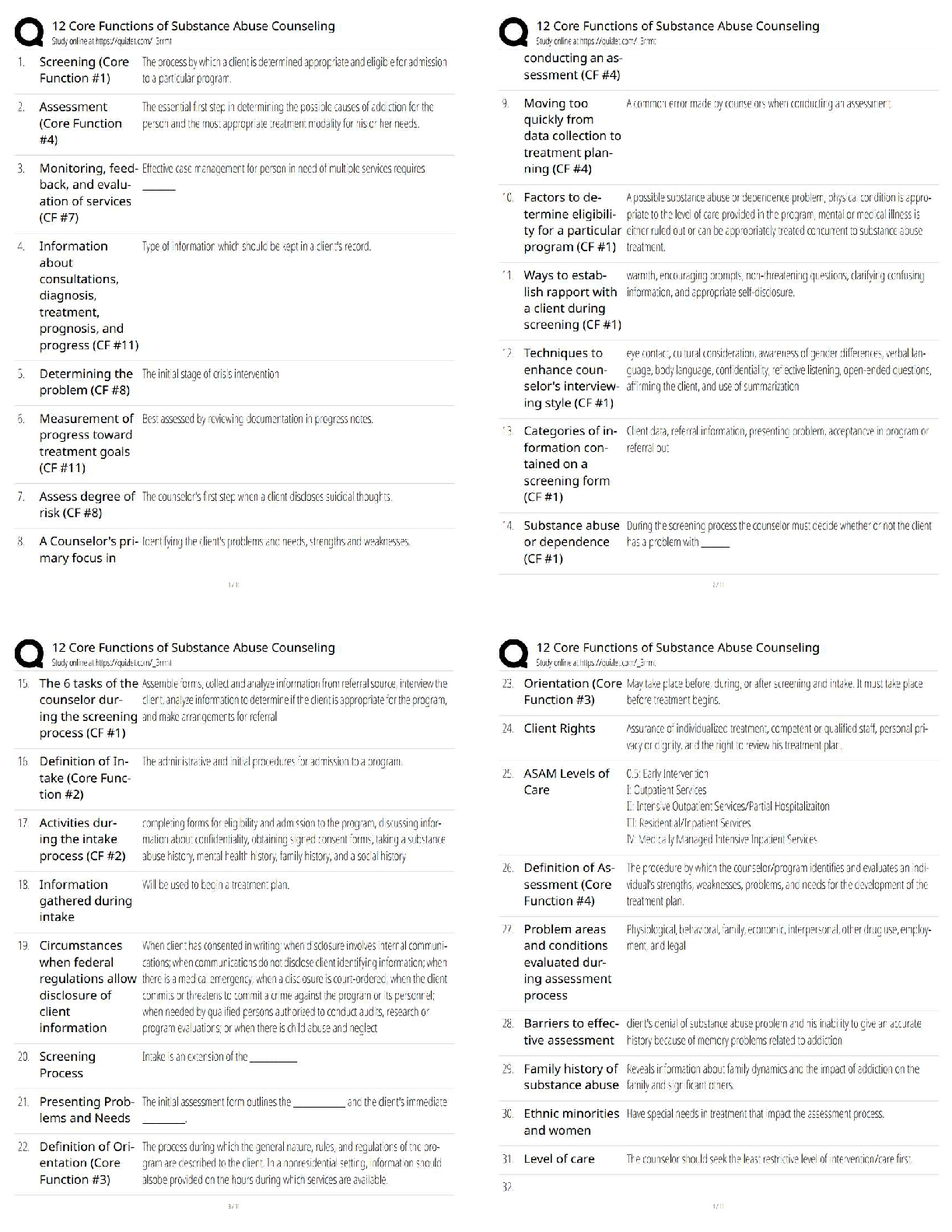
When a client discloses suicidal thougths, the counselor's first step is to: - ANS - Assess the
degree of risk
When conducting an assessment what is the couselor's primary focus? - ANS - Identifying the
clients problems and needs, strengths and weaknessess.
The BEST indicator if an individual is physically dependent upon alcohol or another drug is: -
ANS - The presence of withdrawal symptoms.
Is the following statement TRUE or FALSE.
Guilt and anger are painful emotions that are part of grieving. - ANS - TRUE
Despite vast personality differences, virtually all substance abusers experience: - ANS - remorse,
self-hatred and shame
You are having difficultiy with a client early on in the case. The BEST thing for you to do is: -
ANS - Seek out supervision with a colleage or supervisor
A self report screening instrument consisting of 4 yes/no questions. Requires approximately 1
minute to complete - ANS - CAGE questionnaire
Drug Offender Profile Evaluation/Refferal Strategies - ANS - DOPERS
Michigan Alcoholism Screening Test - ANS - MAST
Self Administered Alcoholism Screening Test - ANS - SAAST
Short Michigan Alcoholism Screening Test - ANS - SMAST
Substance Abuse Subtle Screening Inventory - Adult or Adolescent Version - ANS - SASSI
Addiction Severity Index - ANS - ASI
Diagnostic and Statistical Manual of Mental Disorders - ANS - DSM
Adapted Short Michigan Alcoholism Screening Test for Fathers - ANS - F-SMAST
Global Appraisal of Individual Needs - ANS - GAIN
Minnesota Multiphasic Personality Inventory - ANS - MMPI
Minnosota Substance Abuse Problems Scale - ANS - MSAPS
Readiness To Change Questionnair - ANS - TRCQ
Substance Abuse Subtle Screening Invnetory for Adolescents - ANS - SASSI-A
Human Immunodeficiency Virus - ANS - HIV
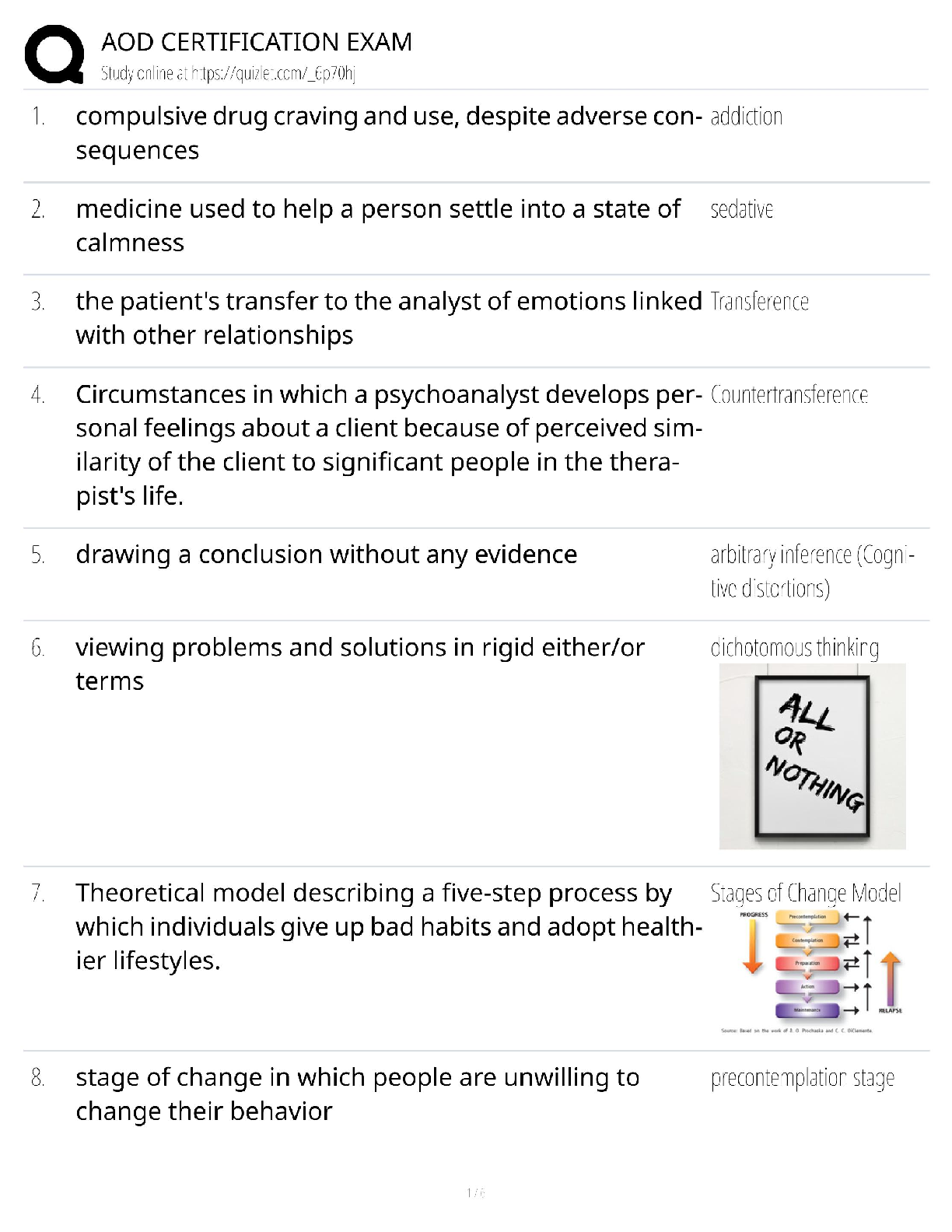
The Stages of Change are: - ANS - pre-contemplation, comtemplation, preparation, action,
maintenance and relapse
(SCM) Not yeat acknowledging that there is a problem behavoir that needs to be changed - ANS
- Pre-Contemplation
(SCM) Acknowledging that there is a problem but not yet ready or sure of wanting to make a
change - ANS - Contemplation
(SCM) Getting ready to change - ANS - Preparation
(SCM) Changing behavior - ANS - Action
SCM) Maintaining the behavior change - ANS - Maintenance
(SCM) Returning to older behaviors and abandoning the new changes - ANS - relapse
The Stages of Change Model was originally developed in the late 1970's and early 1980's by... -
ANS - James Prochaska, Carlo DiClemente
The 6 stages of counseling are: Information Gathering, Evaluation, Feedback, Counseling
Agreement,... - ANS - Termination
The 3 stages of Drug/Alcohol Counseling are: Medical, Psychosocial and _________. - ANS -
Aftercare
[Show More]