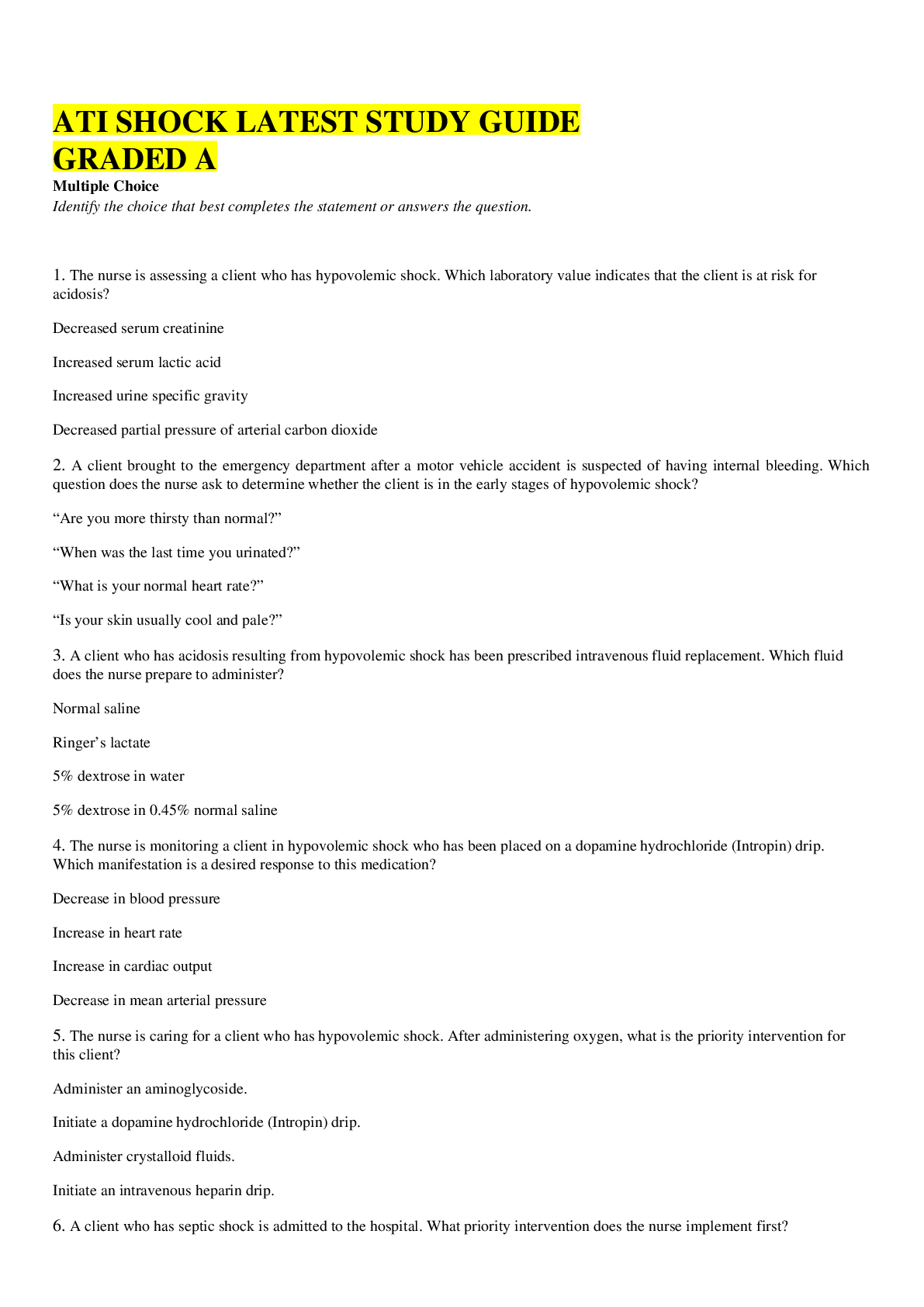
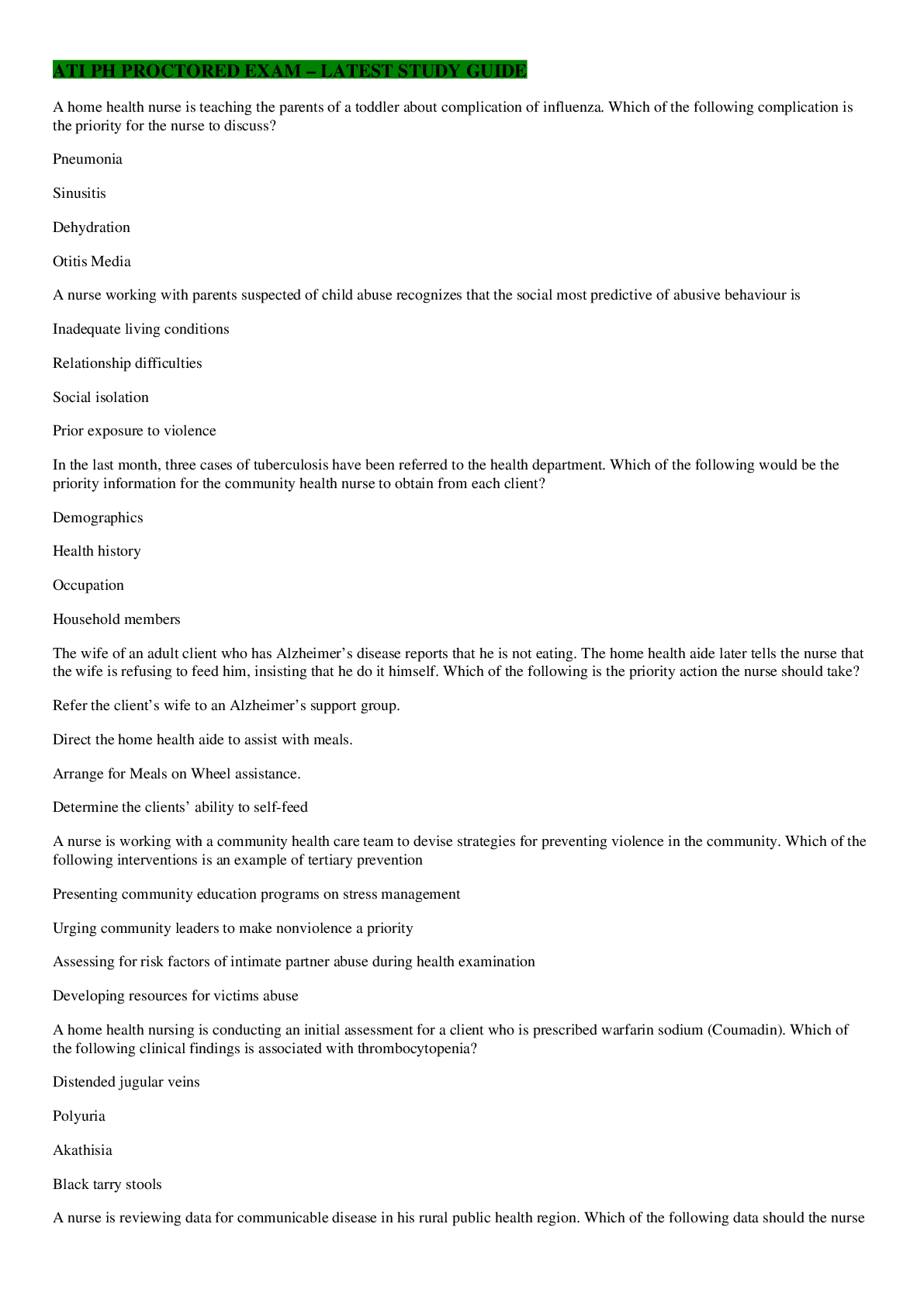
ATI LEADERSHIP PROCTORED EXAM 2022- UPDATED STUDY GUIDE
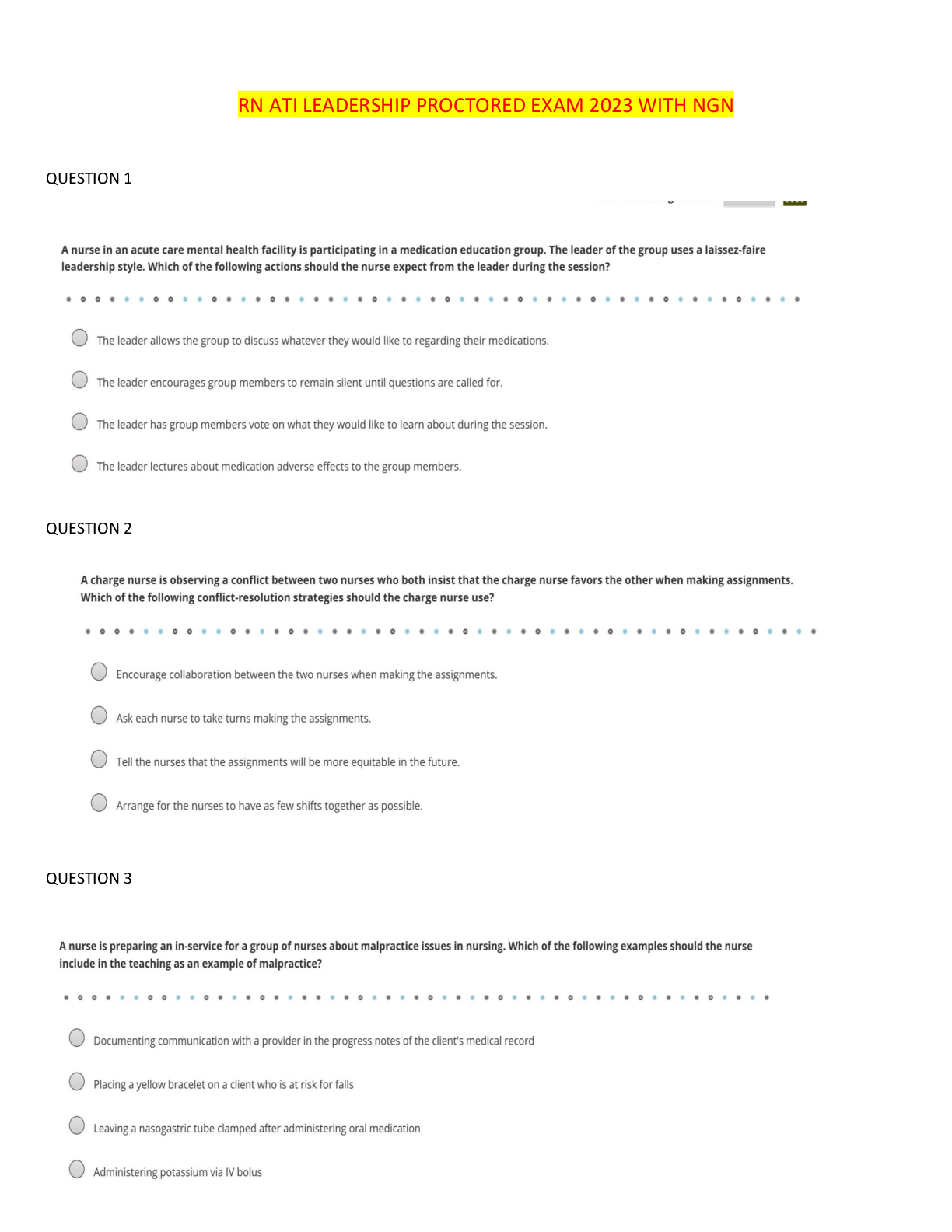
2. A nurse manager observes an assistive personnel (AP) incorrectly transferring a client to the bedside commode. Which of the following should the nurse take fi
...
ATI LEADERSHIP PROCTORED EXAM 2022- UPDATED STUDY GUIDE
2. A nurse manager observes an assistive personnel (AP) incorrectly transferring a client to the bedside commode. Which of the following should the nurse take first?
a. Refer the AP to the facility procedure manual
b. Demonstrate the proper client transfer technique for the AP?
c. Instruct the AP to request assistance when unsure about a task d. Help the AP assist the client with the transfer
3. A nurse enters a client room to witness an informed consent for a gastroscopy. The client states he does not understand the procedure. Which of the following actions should the nurse take?
a. Educate the client about the risks of refusing medications
b. Complete an incident report
c. Answer the client question concerning the procedure
d. Inform the provider that the client requires clarification about the procedure
4. A nurse is developing a discharge plan for a client who is postoperative and will require a wheelchair in the home. The nurse should place a referral to which of the following resources to assist the client with this need?
a. Physical therapy b. Social services
c. Occupational therapy
d. Home health
5. A nurse is preparing a teaching session with a client who speaks a different language than the nurse. Which of the following interventions should the nurse plan to make?
a. Provider an interpreter when obtaining consent from the client
b. Validate understanding by interpreting the client’s body language
c. Include the client’s partner to assist with the teaching session
d. Incorporate gestures and hand signals when presenting information
6. A nurse on a surgical unit is preparing to transfer a client to a rehabilitation facility. Which of the following information should the nurse include in the change of shift report?
a. The steps to follow when providing wound care
b. The clients preferred time for bathing
c. The belief that client has a difficult relationship with his son d. The time the client received his last dose of pain medication
7. A nurse is preparing to discharge a client who as end stage heart failure. The client’s partner tells the nurse she can no longer handle caring for the client. Which of the following action should the nurse take?
a. Request another family member assist the client’s partner with care
b. Recommend the partner place the client in long term-care facility c. Contact the case manager to discuss discharge options
d. Ask the provider to delay the clients discharge home for a few more days
8. A nurse working in an emergency department is performing triage. To which of the following clients should the nurse assign priority?
a. A client who reports night sweats and fever for the last week
b. A client who has compound fractures of the tibia and humerus
c. A client who reports severe vomiting and diarrhea
d. A client who has soot markings around each naris following a house fire
9. To resolve a conflict between staff members regarding potential changes in policy, a nurse manager decides to implement the changes regardless of the feelings of those who oppose those changes. Which of the following conflict resolution strategies is the nurse manager using?
a. Competing
b. Collaborating.
c. Compromising.
d. Cooperating.
10. A nurse is assessing an older adult client who was brought to the emergency department by his son, who reports that that client fell at home. The nurse suspects elder abuse. Which of the following actions should the nurse take?
a. File an incident report.
b. Ask the client about his injuries with the son present. c. Ask the clients son to go to the waiting area .
d. Treat and discharge the client
11. A nurse in the emergency department is assessing a client who is unconscious following a motor-vehicle crash. the client requires immediate surgery. Which of the following actions should the nurse take?
a. a. Transport the client to the operating room without verifying informed consent
b. b. ask the anesthesiologist to sign the consent
c. c. obtain telephone consent from the facility administrator before the surgery
d. d. delay the surgery until the nurse can obtain informed consent
12. A nurse in a prenatal clinic is caring for a group of clients. Which of the following clients should the nurse recommend for conference?
a. A. A client who is at 28 weeks gestation and has a negative Coombs’ titer
b. B. A client who is 39 weeks of gestation and has a negative contraction stress test c. C. A client who is at 35 weeks of gestation and has a biophysical profile of 6
d. D. A client who is at 37 weeks of gestation and has an L/S ratio of 2:1
13. A nurse is receiving a verbal prescription from the provider for a client who is having increased pain. The nurse should transcribe which of the following prescriptions in the clients medical record?
a. A. Morphine sulfate 10 mg IV q 4 IV prn for pain
b. B. MS 10 mg IV every 4 ‘ prn for pain
c. C. MSO4 10 mg IVP q 4 ‘ prn for pain
d. D. Morphine sulfate 10.0 mg every 4 hours IV prn for pain
14. A nurse is assessing a client who has meningitis. Which of the following findings should the nurse report to the provider immediately?
a. A. Generalized rash over trunk
b. B. Increased temperature
c. C. Decreased level of consciousness
d. D. Report of photophobia
15. A nurse in the emergency department is performing triage for a group of clients who were in a train crash. Which of the following clients should the nurse tag as emergent?
a. A. A client who has an open fracture of the femur
b. B. A client who has periorbital ecchymosis c. C. A client who has asymmetrical thorax
d. D. A client who has a deep-partial thickness burn on the lower extremities
16. A nurse manager is leading a discussion about ethical dilemmas. Which of the following situations should the nurse manager include as an example of ethical dilemma?
a. A. A visitor experiences a minor burn after spilling coffee
b. B. A client receives an operation on the wrong side of her body
c. C. A parent wants her 14-year-old adolescent to receive radiation treatment against his will
d. D. A nurse witnesses another nurse administer an incorrect medication
17. A nurse is supervising an assistive personnel (AP) who is feeding a client who has dysphagia. Which of the following actions by the AP should the nurse identify as correct technique?
a. A. Elevating the head of the clients bed to 30 degrees during mealtime
b. B. Withholding fluids until the end of the meal
c. C. Providing a 10 min rest period prior to meals
d. D. Instructing the client to place her chin toward her chest when swallowing
18. A nurse is caring for a client who has a prescription for a transcutaneous electrical nerve stimulation (TENS). Which of the following members of the interdisciplinary team should the nurse contact for assistance.
a. a. Physical Therapist
b. b. Pharmacist
c. c. Respiratory therapist
d. D. Occupational Therapist
19. A nurse is caring for a client who reports acute pain but refuses IM medication. The nurse distracts the client and quickly administers the injection. This illustrates which of the following?
a. A. Assault
b. B. False imprisonment c. C. Battery
d. D. Libel
20. A nurse is orientating a newly licensed nurse about client confidentiality. Which of the following statements by the newly licensed nurse indicates an understanding of the teaching?
a. A. “I can use another nurse’s password as long as I log off after using the computer”
b. B. “I should encrypt personal health information when sending emails”
c. C. “I can post the client’s vital signs in the client’s room”
d. D. “I should discard personal health information documents in the trash before leaving
the unit”
21. A case manager is preparing discharge plan for a client following coronary artery bypass grafting surgery. Which of the following client issues should the nurse address first?
a. A. Inadequate food supply
b. B. Low pain tolerance
c. C. Limited social support
d. D. Decreased self-esteem
22. A charge nurse is making staff assignments on a medical-surgical unit. Which of the following tasks should the nurse plan to delegate to an assistive personnel?
a. A. Measuring oxygen saturation for a client who has dyspnea
b. B. Inserting a rectal suppository for a client who is vomiting c. C. Performing nasal hygiene for a client who has an NG tube
d. D. Pouching a client’s ostomy bag for a new colostomy
CONTINUED.....................DOWNLOAD FOR BEST SCORES
[Show More]



 (2100+ Q & A).png)








.png)