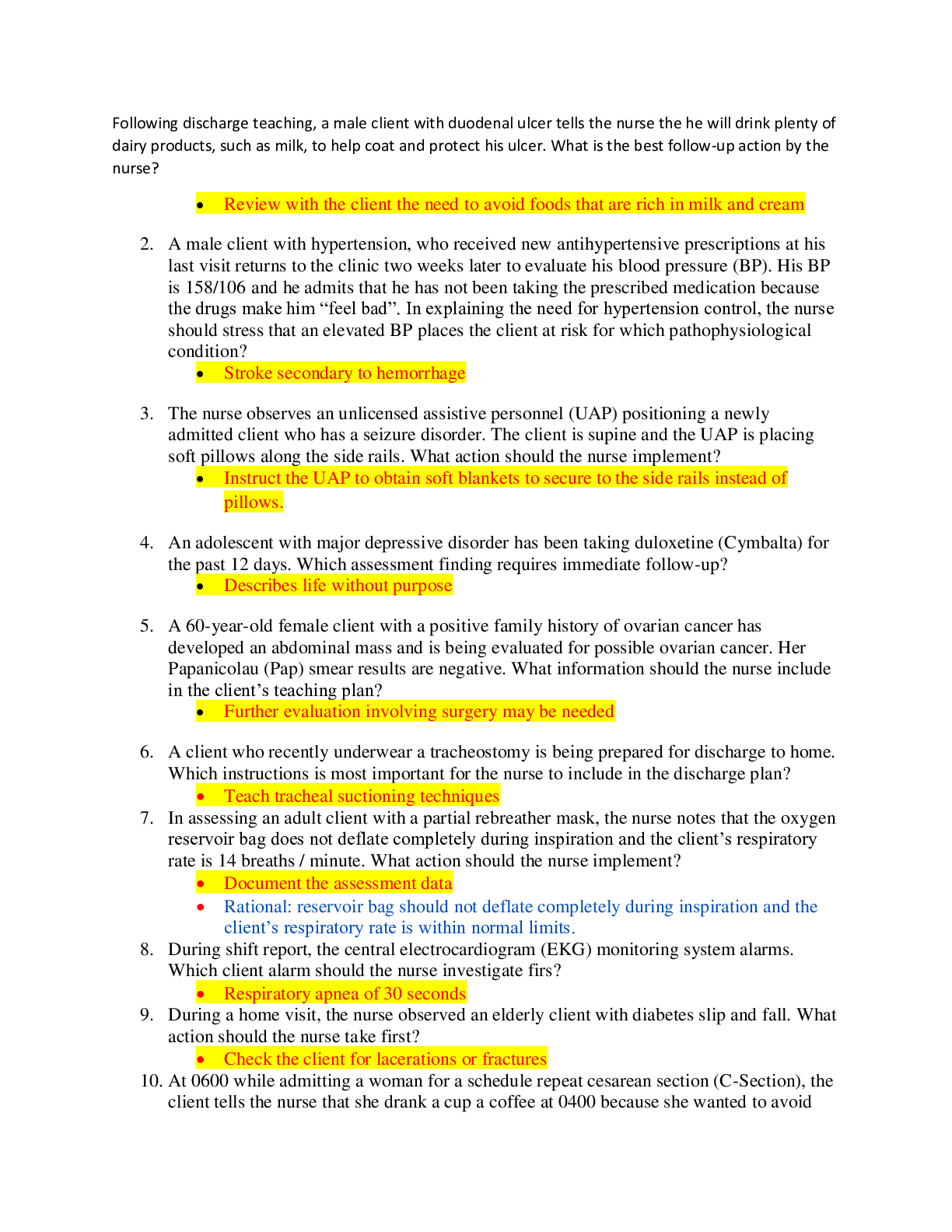
Pharmacology Exam: RN
Time Remaining (Minutes): 25
1. Which is the smallest?
a. 0.0001 g = .1 mg
b. 0.01 mg = 10 mg??
c. 0.1 g = 100 mg
d. 10 mg
2. The provider ordered a heparin bolus of 5,000
...
Pharmacology Exam: RN
Time Remaining (Minutes): 25
1. Which is the smallest?
a. 0.0001 g = .1 mg
b. 0.01 mg = 10 mg??
c. 0.1 g = 100 mg
d. 10 mg
2. The provider ordered a heparin bolus of 5,000 units IV followed by a heparin drip at 1,000 units per hour.
The standard mixture of heparin is 25,000 units/500 ml of D5W. At what rate in milliliters per hour should the pump be set?
a. 15 mL/hr
b. 20 mL/hr
c. 25 mL/hr
d. 30 mL/hr
3. The nurse reviews the patient's drug history prior to giving 0900 meds and asks the patient about medication allergies.
The patient reports that clindamycin (Cleocin®) causes an angry-looking red rash.
Since this is one of the medications the nurse was scheduled to give this patient, the nurse should:
a. call the provider, report this patient's statement, and ask for new orders.
b. delay the administration of this medication until the provider makes rounds.
c. give the medication, because something else might have caused the rash.
d. give the medication with diphenhydramine (Benadryl®).
4. Cyclophosphamide (Cytoxan®) 4 mg/kg per day po has been ordered.
The patient weighs 154 lbs. How many milligrams should be given each day?
a. 100 mg
b. 120 mg
c. 240 mg
d. 280 mg
5. Digoxin (Lanoxin®) 0.25 mg is ordered.
Digoxin (Lanoxin®) is available as 0.125 mg per tablet.
How many tablets should be administered?
a. ½ tablet
b. 1 tablet
c. 1½ tablets
d. 2 tablets
6. Infection prevention is a primary focus when caring for a patient with a central vascular access device (VAD),
especially if the patient has cancer or is otherwise immunocompromised. What should the nurse do to prevent
infection when finshed using an accessed VAD?
a. Clamp the extension tubing; cover the open tubing end with a sterile 4x4 gauze pad.
b. Clamp the extension tubing; leave its distal end uncovered.
c. Flush the VAD with an antibiotic; cover the open tubing with a gauze pad.
d. Flush the VAD with normal saline and heparin; remove the access needle.
7. The nurse has an adult patient with bilateral ear infections and the provider has prescribed CortisporinOtic®
3 drops into each ear q 6-8 h x 7 days. What should the nurse remember about giving this medication?
a. No special instructions are needed.
b. Pull the pinna down and back.
c. Pull the pinna up and back.
d. Stop the medication when the patient feels better.
8. _________________ is the term used for an unwanted negative response, predictable or unpredictable, to any
medication given for therapeutic, diagnostic, or prophylactic reasons.
a. Adverse drug reaction
b. Anaphylaxis
c. Side effect
d. Toxicology
9. A provider order states, “Meperidine (Demerol®) 45 mg, Atropine Sulfate (Atropine®) 0.3 mg IM now.”
The meperidine (Demerol®) comes in a pre-filled syringe containing 50 mg/mL, and the atropine sulfate (Atropine®)
comes in a vial containing 400 mcg/mL. What is the total volume that the nurse will be injecting?
a. 0.78 mL
b. 1 mL
c. 1.65 mL
d. 2.13 mL
10. As long as the patient is receiving intravenous heparin therapy, the nurse should ensure that which of the
following drugs is available on the unit?
a. Acetylcysteine
b. Flumazenil
c. Phytonadione
d. Protamine sulfate
11. Cephalexin (Keflex®) has been ordered for an adult patient; 3 grams are to be given over the next 24 hours,
divided into 6 equally spaced doses. How many milligrams should be in each dose?
a. 300 mg
b. 500 mg
c. 1000 mg
d. 2000 mg
12. The nurse has received an order for penicillin v potassium (Penicillin-VK®) suspension 0.75 g.
The drug is available as 250 mg/5 mL. How many milliliters should be given?
a. 3 mL
b. 10 mL
c. 15 mL
d. 20 mL
13. A provider order has been received for MS 4 mg IV q4h prn. Within this order, what appears on
The Joint Commission's Official "Do Not Use" List?
a. IV
b. MS
c. prn
d. q4h
14. The provider orders a bolus of 250 mL NS over 20 minutes. At what rate (mL/hr) should the pump be set?
a. 725 mL/hr
b. 750 mL/hr
c. 775 mL/hr
d. 800 mL/hr
15. The nurse must give an IM injection to a 6-month-old child. The most appropriate site for this injection is the:
a. deltoid muscle.
b. dorsogluteal muscle.
c. vastus lateralis muscle.
d. ventrogluteal muscle.
16. Hydrocortisone (Solu-Cortef®) 35 mg IM is ordered to treat inflammation.
Hydrocortisone (Solu-Cortef®) is available as 250 mg/10 mL. How many milliliters should be administered?
a. 1 mL
b. 1.4 mL
c. 2 mL
d. 2.6 mL
17. A patient with borderline personality disorder is being treated with carbamazepine (Tegretol®).
Which of the following laboratory results indicate that this patient is experiencing an adverse reaction to the medication?
a. Blood urea nitrogen (BUN) - 12 mg/dL
b. Hemoglobin - 15 g/dL
c. Platelet count - 85,000
d. Potassium - 4.2 mEq/l
18. The patient would like to know why blood is being drawn before and after his scheduled dose of
gentamycin (Garamycin®). The nurse tells him that drawing these blood samples will:
a. allow for medication adjustment to ensure correct dosing of this drug.
b. allow him to reach the correct drug level quickly.
c. prevent this drug's side effects.
d. provide his provider with information about the kind of medication he should be taking.
19. A provider order is written for prochlorperazine (Compazine®) 7.5 mg IV q 4 hrs prn N/V.
Prochlorperazine (Compazine®) is available in a prefilled syringe labeled 10 mg/2 mL.
How many milliliters should be given?
a. 0.88 mL
b. 1 mL
c. 1.5 mL
d. 1.65 mL
20. A provider order is written for insulin at 3 units/hr; the premixed solution is composed of
50 units of insulin in 100 mL in normal saline. At which rate (mL/hr) should the infusion run?
a. 2 mL/hr
b. 3 mL/hr
c. 6 mL/hr
d. 12 mL/hr
21. A procainamide (Pronestyl®) drip is ordered for 2 mg/min. The standard mixture of procainamide (Pronestyl®)
is 2 g in 500 mL. At what rate (mL/hr) should the IV pump be set?
a. 15 mL/hr
b. 22 mL/hr
c. 30 mL/hr
d. 38 mL/hr
22. A provider order has been received for a dobutamine (Dobutrex®) drip at 7 mcg/kg/min.
The patient's weight is 220 lbs. How many milligrams per hour should be given?
a. 32 mg/hr
b. 38 mg/hr
c. 42 mg/hr
d. 46 mg/hr
23. The patient is receiving lactated Ringer's solution via peripheral IV and asks for pain medication.
Prior to giving the medication, the nurse discovers that the site is cool and blanched, edematous with taut skin,
and there is fluid leaking from the site. The patient reports that the area is tender and uncomfortable and that the
IV pump keeps beeping. The nurse knows that this patient's IV site is likely displaying signs of:
a. extravasation.
b. infiltration.
c. normality.
d. phlebitis.
24. A provider order states, “Kanamycin (Kantrex®) 700 mg IM now."
The kanamycin (Kantrex®) label states, “Add 5 mL sterile H2O to 1 g kanamycin (Kantrex®); 0.5 g = 2 mL."
How many milliliters should be given?
a. 2.1 mL
b. 2.5 mL
c. 2.8 mL
d. 3.2 mL
25. A regular insulin drip at 7 units/hour is ordered for a patient with DKA.
The IV of 1000 mL NS contains 50 units of regular insulin.
At what rate (mL/hr) should the infusion pump be set?
a. 140 mL/hr
b. 160 mL/hr
c. 180 mL/hr
d. 200 mL/hr
[Show More]
.png)




.png)


.png)