the nurse is caring for a patient with a diagnosis of heart failure who suddenly complains about shortness of breath and dyspnea. the nurse should take which immediate action - ANSWER elevate the head of the patients bed
...
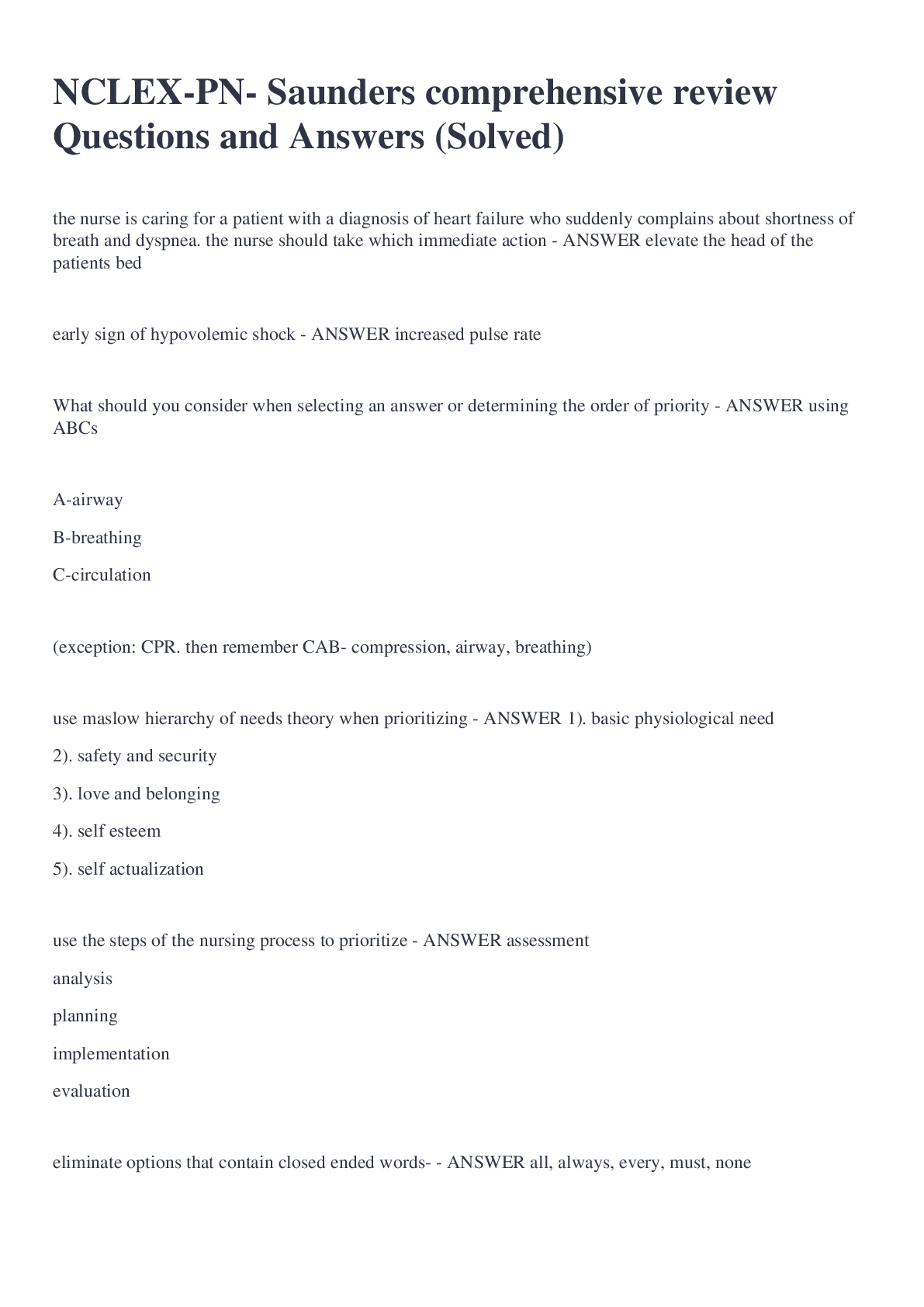
the nurse is caring for a patient with a diagnosis of heart failure who suddenly complains about shortness of breath and dyspnea. the nurse should take which immediate action - ANSWER elevate the head of the patients bed
early sign of hypovolemic shock - ANSWER increased pulse rate
What should you consider when selecting an answer or determining the order of priority - ANSWER using ABCs
A-airway
B-breathing
C-circulation
(exception: CPR. then remember CAB- compression, airway, breathing)
use maslow hierarchy of needs theory when prioritizing - ANSWER 1). basic physiological need
2). safety and security
3). love and belonging
4). self esteem
5). self actualization
use the steps of the nursing process to prioritize - ANSWER assessment
analysis
planning
implementation
evaluation
eliminate options that contain closed ended words- - ANSWER all, always, every, must, none
open-ended words could possible be the correct answer - ANSWER may, usually, normal, commonly, or generally
look for the umbrella option - ANSWER a broad or universal option
respect for an individuals right to self-determination - ANSWER Autonomy
the obligation to do or cause no harm to another - ANSWER nonmaleficence
the duty to do good to others and to maintain a balance between benefits and harm - ANSWER beneficence
the duty to do what one has promised - ANSWER fidelity
obligation to tell the truth - ANSWER veracity
examples of negligent acts - ANSWER medication errors that result in injury to client
IV administration errors, such as incorrect flow rates or failure to monitor flow rate, that results in injury to client...
pg. 136
instructional directives - ANSWER living wills
required to be written and signed by the client
defamation - ANSWER false communication
writing- libel
verbally- slander
determines whether the client has a conductive or sensorineural hearing loss - ANSWER weber test
air conduction is normally hear twice as long than bone conduction - ANSWER rinne test
equilibrium test - ANSWER romberg test
swaying is a postive romberg sign
palpable vibration of the chest wall resulting from speech - ANSWER Tactile Fremitus
abnormal breath sounds - ANSWER adventitious sounds
high pitched crackling and popping noises (discontinuous sounds) heard during the end of inspiration. not cleared by cough
-clinical example: - ANSWER fine crackles (fine rales)
-may be heard in pneumonia, heart failure, asthma, restrictive pulmonary disease
medium pitched, moist sound heard about halfway through inspiration. not cleared by cough
-clinical examples - ANSWER medium crackles (medium rales)
-same as fine crackles but conditions have worsen
low-pitched, bubbling or gurgling sounds that start early in inspiration and extend into the first part of expiration
-clinical examples: - ANSWER coarse crackles (coarse rales)
-same as medium and fine but is even worse than both or is heard in terminally ill clients with diminished gag reflex. also heard in pulmonary edema and pulmonary fibrosis
high-pitched, musical sound similar to a squeak. heard more commonly during expiration, but may also be heard during inspiration. occurs only in small airway
-clinical examples: - ANSWER Wheeze (sibilant wheeze)
-heard in narrowed airway diseases such as asthma
low-pitched, coarse, loud, low snoring or moaning tone. heard primarily during expiration but may be heard during inspiration. coughing my clear - ANSWER Rhonchi (sonorous wheeze)`
-heard in disorders causing obstruction of the trachea or bronchus, such as chronic bronchitis
a superfical, low-pitched, coarse rubbing or gathering sound. sounds like two surfaces rubbing together. heard throughout inspiration and expiration. loudest over lower anterolateral surface. not cleared by cough - ANSWER pleural friction rub
-heard individual with pleurisy (inflammation on the pleural surfaces)
bedwetting - ANSWER nocturia
located in the groove between the trachea and sternocleidomastoid muscle - ANSWER carotid artery
what would be an abnormal finding when auscultating the carotid artery - ANSWER presence of a bruit (a blowing, swishing, or buzzing, humming sound)
assessing the cranial never 1: olfactory - ANSWER have your client close their eyes and occlude one nostril with one finger and have them identify odors
-controls sense of smell
what cranial nerve would you be assessing if your using a snellen chart - ANSWER cranial nerve II: optic nerve
controls pupillary constriction, upper-eyelid elevation, and most eye movement - ANSWER cranial nerve III: Oculomotor
controls downward and inward eye movement - ANSWER cranial nerve IV: trochlear
controls lateral eye movement - ANSWER cranial nerve VI: abducens
controls sensation in the cornea, nasal and oral mucosa, and facial skin, as well as mastication - ANSWER Cranial nerve V: triggeminal
pg. 418
is a drooping or falling of the upper eyelid - ANSWER Ptosis
controls movement of the face and taste sensation - ANSWER cranial nerve VII: facial
ex: smile, puff out cheeks
hearing loss occurs as a result of a physical obstruction to the transmission of sound waves - ANSWER a conductive hearing loss
come back to sensorineural hearing loss
pg 425 – ANSWER
A client arrives in the emergency department after an automobile crash. The client's forehead hit the steering wheel, and a hyphema has been diagnosed. Which position should the nurse prepare to position the client?
1. Flat on bed rest
2. On bed rest in a semi-Fowler's position
3. In lateral position on the unaffected side
4. In the lateral position on the affected side - ANSWER 2; A hyphema is the presence of blood in the anterior chamber. It is produced when a force is sufficient to break the integrity of the blood vessels in the eye. It can be caused by direct injury, such as penetrating injury from a BB pellet, or indirectly, such as from striking the forehead on a steering wheel during an accident. The client is treated by bed rest in a semi-Fowler's position to assist gravity in keeping the hyphema away from the optical center of the cornea.
The nurse is caring for a client who is hearing-impaired and should take which approach to facilitate communication?
1. Speak loudly.
2. Speak frequently.
3. Speak in a normal tone.
4. Speak directly into the impaired ear. - ANSWER 3; It is important to speak in a normal tone to the client with impaired hearing and avoid shouting. The nurse should talk directly to the client while facing the client and should speak clearly. If the client does not seem to understand what is said, the nurse should express it differently. Moving closer to the client and toward the better ear may facilitate communication, but it is important to avoid talking directly into the impaired ear.
A client arrives at the emergency department with a foreign body in the left ear that has been determined to be an insect. Which initial intervention should the nurse anticipate to be prescribed?
1. Irrigation of the ear
2. Instillation of antibiotic eardrops
3. Instillation of corticosteroid ointment
4. Instillation of mineral oil or diluted alcohol - ANSWER 4; Insects are killed before removal unless they can be coaxed out by a flashlight or a humming noise. Mineral oil or diluted alcohol is instilled into the ear to suffocate the insect, which is then removed by using ear forceps. When the foreign object is vegetable matter, irrigation is not used because this material expands with hydration and the impaction becomes worse. Options 1, 2, and 3 may be prescribed after the initial treatment if necessary and if inflammation or infection is a concern.
The nurse notes that the health care provider has documented a diagnosis of presbycusis on the client's chart. The nurse understands that this condition is accurately described as which?
1. Tinnitus that occurs with aging
2. Nystagmus that occurs with aging
3. A conductive hearing loss that occurs with aging
4. A sensorineural hearing loss that occurs with aging - ANSWER 4; Presbycusis is a type of hearing loss that occurs with aging. It is a gradual sensorineural loss caused by nerve degeneration in the inner ear or auditory nerve. Options 1, 2, and 3 are not accurate descriptions.
The nurse is assigned to care for a client hospitalized with Ménière's disease. The nurse expects that which would most likely be prescribed for the client?
1. Low-fat diet
2. Low-sodium diet
the nurse is caring for a patient with a diagnosis of heart failure who suddenly complains about shortness of breath and dyspnea. the nurse should take which immediate action - ANSWER elevate the head of the patients bed
early sign of hypovolemic shock - ANSWER increased pulse rate
What should you consider when selecting an answer or determining the order of priority - ANSWER using ABCs
A-airway
B-breathing
C-circulation
(exception: CPR. then remember CAB- compression, airway, breathing)
use maslow hierarchy of needs theory when prioritizing - ANSWER 1). basic physiological need
2). safety and security
3). love and belonging
4). self esteem
5). self actualization
use the steps of the nursing process to prioritize - ANSWER assessment
analysis
planning
implementation
evaluation
eliminate options that contain closed ended words- - ANSWER all, always, every, must, none
open-ended words could possible be the correct answer - ANSWER may, usually, normal, commonly, or generally
look for the umbrella option - ANSWER a broad or universal option
respect for an individuals right to self-determination - ANSWER Autonomy
the obligation to do or cause no harm to another - ANSWER nonmaleficence
the duty to do good to others and to maintain a balance between benefits and harm - ANSWER beneficence
the duty to do what one has promised - ANSWER fidelity
obligation to tell the truth - ANSWER veracity
examples of negligent acts - ANSWER medication errors that result in injury to client
IV administration errors, such as incorrect flow rates or failure to monitor flow rate, that results in injury to client...
pg. 136
instructional directives - ANSWER living wills
required to be written and signed by the client
defamation - ANSWER false communication
writing- libel
verbally- slander
determines whether the client has a conductive or sensorineural hearing loss - ANSWER weber test
air conduction is normally hear twice as long than bone conduction - ANSWER rinne test
equilibrium test - ANSWER romberg test
swaying is a postive romberg sign
palpable vibration of the chest wall resulting from speech - ANSWER Tactile Fremitus
abnormal breath sounds - ANSWER adventitious sounds
high pitched crackling and popping noises (discontinuous sounds) heard during the end of inspiration. not cleared by cough
-clinical example: - ANSWER fine crackles (fine rales)
-may be heard in pneumonia, heart failure, asthma, restrictive pulmonary disease
medium pitched, moist sound heard about halfway through inspiration. not cleared by cough
-clinical examples - ANSWER medium crackles (medium rales)
-same as fine crackles but conditions have worsen
low-pitched, bubbling or gurgling sounds that start early in inspiration and extend into the first part of expiration
-clinical examples: - ANSWER coarse crackles (coarse rales)
-same as medium and fine but is even worse than both or is heard in terminally ill clients with diminished gag reflex. also heard in pulmonary edema and pulmonary fibrosis
high-pitched, musical sound similar to a squeak. heard more commonly during expiration, but may also be heard during inspiration. occurs only in small airway
-clinical examples: - ANSWER Wheeze (sibilant wheeze)
-heard in narrowed airway diseases such as asthma
low-pitched, coarse, loud, low snoring or moaning tone. heard primarily during expiration but may be heard during inspiration. coughing my clear - ANSWER Rhonchi (sonorous wheeze)`
-heard in disorders causing obstruction of the trachea or bronchus, such as chronic bronchitis
a superfical, low-pitched, coarse rubbing or gathering sound. sounds like two surfaces rubbing together. heard throughout inspiration and expiration. loudest over lower anterolateral surface. not cleared by cough - ANSWER pleural friction rub
-heard individual with pleurisy (inflammation on the pleural surfaces)
bedwetting - ANSWER nocturia
located in the groove between the trachea and sternocleidomastoid muscle - ANSWER carotid artery
what would be an abnormal finding when auscultating the carotid artery - ANSWER presence of a bruit (a blowing, swishing, or buzzing, humming sound)
assessing the cranial never 1: olfactory - ANSWER have your client close their eyes and occlude one nostril with one finger and have them identify odors
-controls sense of smell
what cranial nerve would you be assessing if your using a snellen chart - ANSWER cranial nerve II: optic nerve
controls pupillary constriction, upper-eyelid elevation, and most eye movement - ANSWER cranial nerve III: Oculomotor
controls downward and inward eye movement - ANSWER cranial nerve IV: trochlear
controls lateral eye movement - ANSWER cranial nerve VI: abducens
controls sensation in the cornea, nasal and oral mucosa, and facial skin, as well as mastication - ANSWER Cranial nerve V: triggeminal
pg. 418
is a drooping or falling of the upper eyelid - ANSWER Ptosis
controls movement of the face and taste sensation - ANSWER cranial nerve VII: facial
ex: smile, puff out cheeks
hearing loss occurs as a result of a physical obstruction to the transmission of sound waves - ANSWER a conductive hearing loss
come back to sensorineural hearing loss
pg 425 – ANSWER
A client arrives in the emergency department after an automobile crash. The client's forehead hit the steering wheel, and a hyphema has been diagnosed. Which position should the nurse prepare to position the client?
1. Flat on bed rest
2. On bed rest in a semi-Fowler's position
3. In lateral position on the unaffected side
4. In the lateral position on the affected side - ANSWER 2; A hyphema is the presence of blood in the anterior chamber. It is produced when a force is sufficient to break the integrity of the blood vessels in the eye. It can be caused by direct injury, such as penetrating injury from a BB pellet, or indirectly, such as from striking the forehead on a steering wheel during an accident. The client is treated by bed rest in a semi-Fowler's position to assist gravity in keeping the hyphema away from the optical center of the cornea.
The nurse is caring for a client who is hearing-impaired and should take which approach to facilitate communication?
1. Speak loudly.
2. Speak frequently.
3. Speak in a normal tone.
4. Speak directly into the impaired ear. - ANSWER 3; It is important to speak in a normal tone to the client with impaired hearing and avoid shouting. The nurse should talk directly to the client while facing the client and should speak clearly. If the client does not seem to understand what is said, the nurse should express it differently. Moving closer to the client and toward the better ear may facilitate communication, but it is important to avoid talking directly into the impaired ear.
A client arrives at the emergency department with a foreign body in the left ear that has been determined to be an insect. Which initial intervention should the nurse anticipate to be prescribed?
1. Irrigation of the ear
2. Instillation of antibiotic eardrops
3. Instillation of corticosteroid ointment
4. Instillation of mineral oil or diluted alcohol - ANSWER 4; Insects are killed before removal unless they can be coaxed out by a flashlight or a humming noise. Mineral oil or diluted alcohol is instilled into the ear to suffocate the insect, which is then removed by using ear forceps. When the foreign object is vegetable matter, irrigation is not used because this material expands with hydration and the impaction becomes worse. Options 1, 2, and 3 may be prescribed after the initial treatment if necessary and if inflammation or infection is a concern.
The nurse notes that the health care provider has documented a diagnosis of presbycusis on the client's chart. The nurse understands that this condition is accurately described as which?
1. Tinnitus that occurs with aging
2. Nystagmus that occurs with aging
3. A conductive hearing loss that occurs with aging
4. A sensorineural hearing loss that occurs with aging - ANSWER 4; Presbycusis is a type of hearing loss that occurs with aging. It is a gradual sensorineural loss caused by nerve degeneration in the inner ear or auditory nerve. Options 1, 2, and 3 are not accurate descriptions.
The nurse is assigned to care for a client hospitalized with Ménière's disease. The nurse expects that which would most likely be prescribed for the client?
1. Low-fat diet
2. Low-sodium diet
[Show More]