NSCA CPT Practice Questions
Which of the following changes in muscle length and tension are associated with a muscle
spindle and a golgi tendon?
A. MS - rapid muscle length change, GT - increase in muscle tension
B.
...
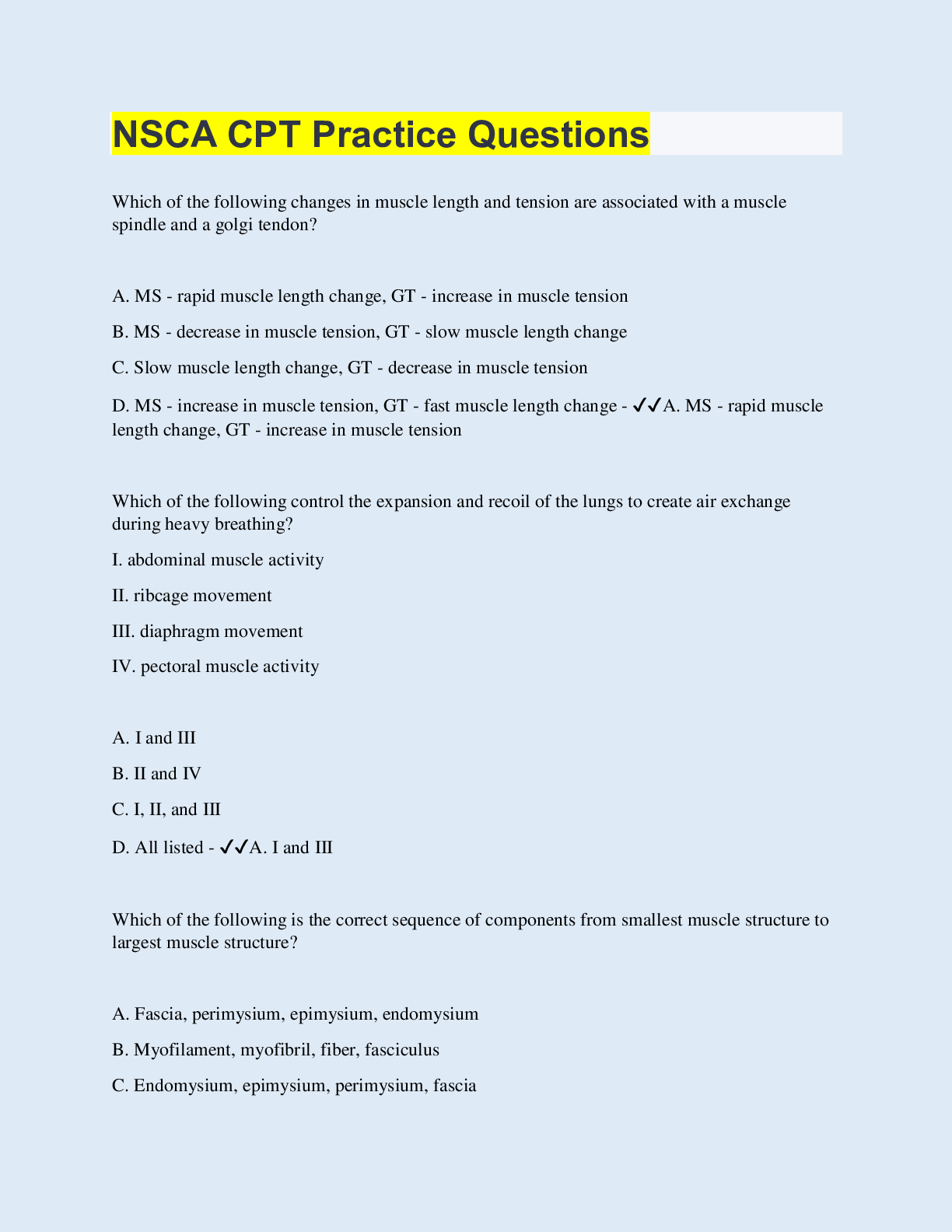
NSCA CPT Practice Questions
Which of the following changes in muscle length and tension are associated with a muscle
spindle and a golgi tendon?
A. MS - rapid muscle length change, GT - increase in muscle tension
B. MS - decrease in muscle tension, GT - slow muscle length change
C. Slow muscle length change, GT - decrease in muscle tension
D. MS - increase in muscle tension, GT - fast muscle length change - ANS - A. MS - rapid
muscle length change, GT - increase in muscle tension
Which of the following control the expansion and recoil of the lungs to create air exchange
during heavy breathing?
I. abdominal muscle activity
II. ribcage movement
III. diaphragm movement
IV. pectoral muscle activity
A. I and III
B. II and IV
C. I, II, and III
D. All listed - ANS - A. I and III
Which of the following is the correct sequence of components from smallest muscle structure to
largest muscle structure?
A. Fascia, perimysium, epimysium, endomysium
B. Myofilament, myofibril, fiber, fasciculus
C. Endomysium, epimysium, perimysium, fascia
D. Muscle cell, fasciculus, myofibril, fiber - ANS - B. Myofilament, myofibril, fiber, fasciculus
A 30 year old female client is an avid 5K runner but she would like to improve her time. Which
of the following tests is the most appropriate to estimate the client's VO2 max?
A. Astrand-Rhyming cycle ergometer test
B. YMCA cycle ergometer test
C. Rockport walking test
D. 1.5-mile run - ANS - D. 1.5-mile run
A 21 year old male client had the following results during his initial assessment:
Height: 72 inches
Body Weight: 210 pounds
Bench Press 1RM: 200 lbs.
Leg Press 1RM: 400 lbs.
Sit-ups (1 minute): 50
Sit and reach (using S & R box): 15 inches
Which of the following should he make his primary goal?
A Core strength
B. Lower body strength
C. Muscular endurance
D. Upper Body Strength
E. Hip/ low back flexibility - ANS - D. Upper Body Strength
Which of the following compose total lung capacity?
I. minute ventilation
II. residual lung volume
III. forced vital capacity
IV. tidal volume
A. I and II only
B. II and IV only
C. I and III only
D. II and III only - ANS - D. II and III only
Using 220lb (100kg) for each and allowing 90 degrees of knee flexion at the bottom of each
movement, which of the following exercises produces the most work?
A. Back squat
B. Horizontal leg press
C. 15 degree leg press
D. 60 degree leg press - ANS - A. Back squat
All of the following describe how exercise provides cognitive benefits EXCEPT:
A. Enhanced oxygen supply to the brain
B. Greater genetic variation
C. Improved neurotransmitter function
D. Heightened neural efficiency - ANS - B. Greater genetic variation
Which of the following is most likely to occur as a result of aerobic endurance overtraining?
A. Decreased VO2 max
B. Increased muscle glycogen
C. Increased body fat percentage
D. Decreased sympathetic stress response - ANS - A. Decreased VO2 max
Which of the following points along the self-determination or regulation continuum is a client
who is highly intrinsically motiv
[Show More]