Social Sciences  >  QUESTIONS & ANSWERS  >  PADI Open Water - Being a Diver I (All)

PADI Open Water - Being a Diver I

Document Content and Description Below

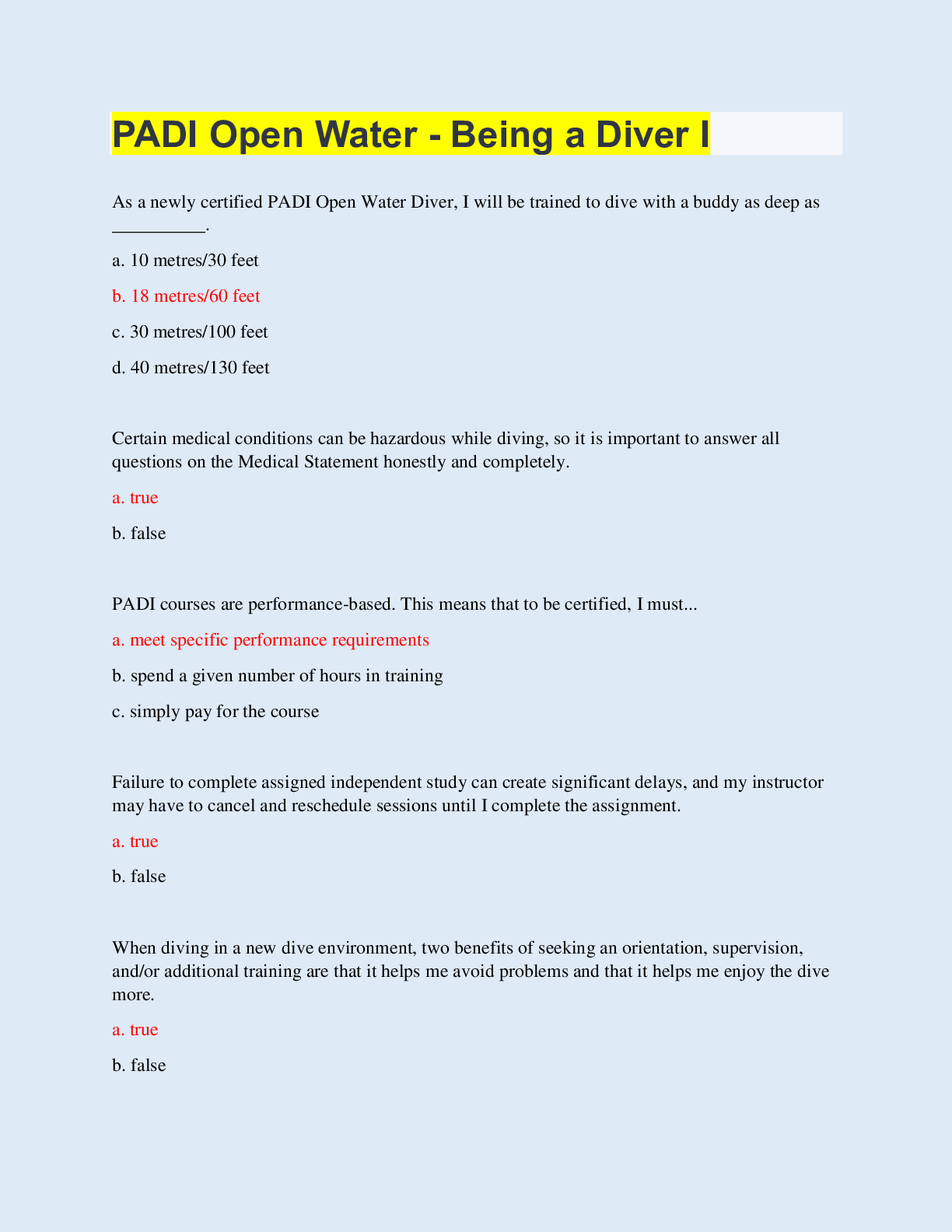
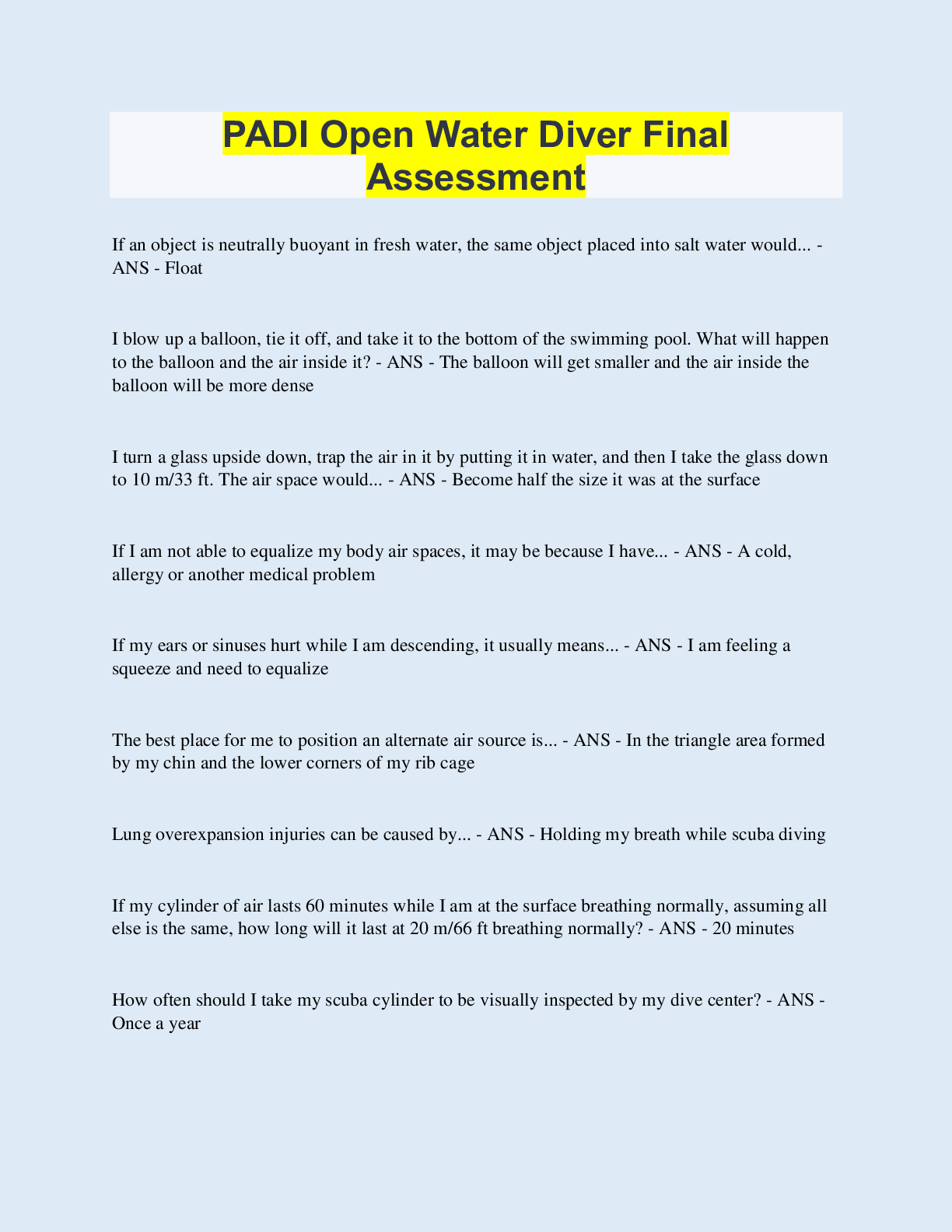
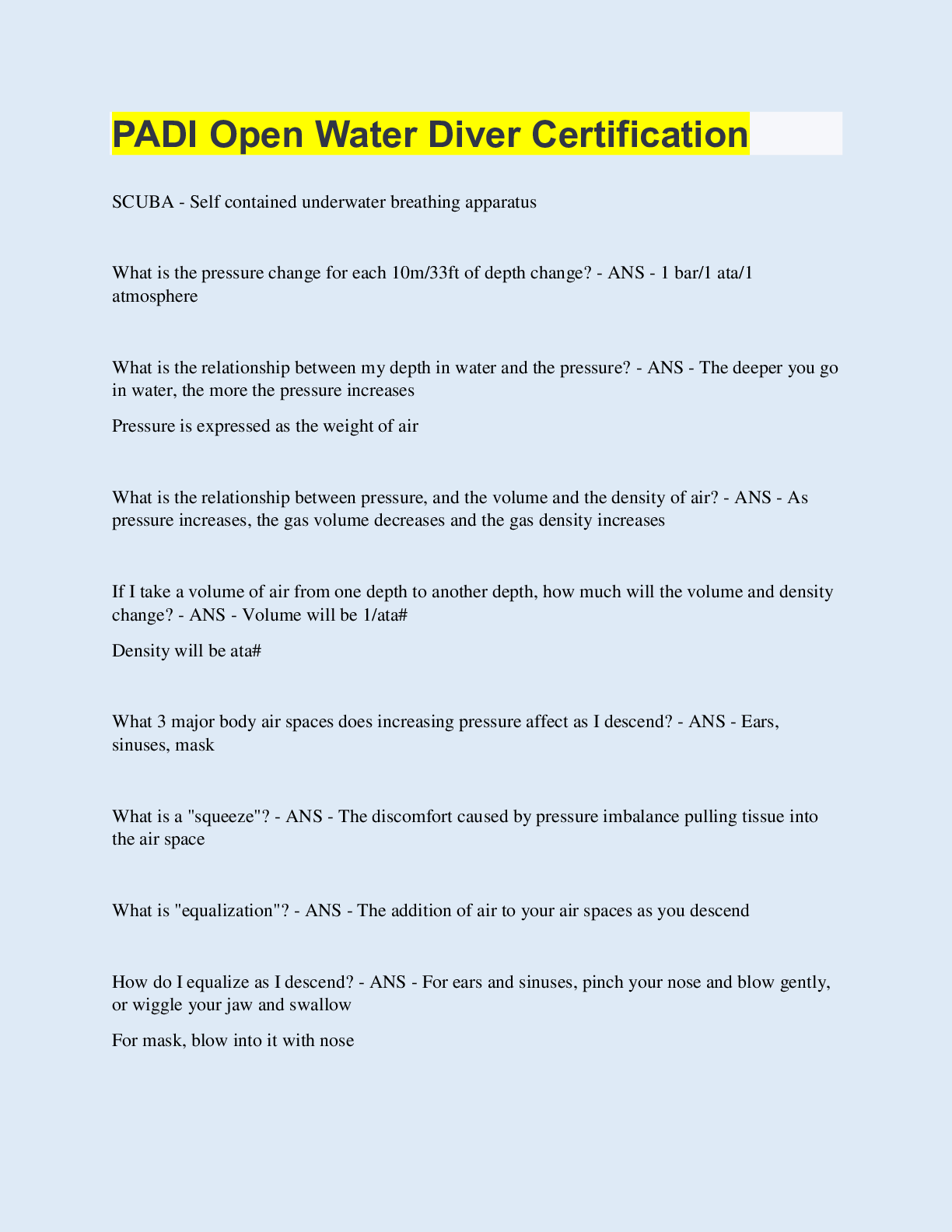
PADI Open Water - Being a Diver I As a newly certified PADI Open Water Diver, I will be trained to dive with a buddy as deep as __________. a. 10 metres/30 feet b. 18 metres/60 feet c. 30 metres/ ... 100 feet d. 40 metres/130 feet Certain medical conditions can be hazardous while diving, so it is important to answer all questions on the Medical Statement honestly and completely. a. true b. false PADI courses are performance-based. This means that to be certified, I must... a. meet specific performance requirements b. spend a given number of hours in training c. simply pay for the course Failure to complete assigned independent study can create significant delays, and my instructor may have to cancel and reschedule sessions until I complete the assignment. a. true b. false When diving in a new dive environment, two benefits of seeking an orientation, supervision, and/or additional training are that it helps me avoid problems and that it helps me enjoy the dive more. a. true b. false What is the pressure change for each 10 metres/33 feet of depth change? There is a pressure change of 1 bar/ata for every 10 metres/33 feet of depth change. As pressure increases, gas volume decreases and gas density increases. - ANS - What is the relationship between pressure and the volume and density of air? weight - ANS - Right now, you are under pressure exerted by the air in the atmosphere that surrounds you. This is actually the __________ of the air. weight - ANS - Underwater, you're under more pressure because water also has __________, which combines with the atmosphere's pressure. one bar (metric) or one atmosphere (imperial — abbreviated ata) - ANS - At sea level the pressure is fairly uniform, and is expressed as... As depth in water increases, pressure increases. As depth in water decreases, pressure decreases. - ANS - What is the relationship between my depth in water and the pressure? 10 metres/33 feet - ANS - Because water is much denser and heavier than air, __________ feet exerts the same pressure as the whole atmosphere. Pressure increases by one bar/ata for each 10 metres/33 feet you descend (go down). - ANS - How does pressure increase underwater? Pressure decreases one bar/ata for every 10 metres/33 feet you ascend (come up). - ANS - How does pressure decrease underwater? 1 bar/ata - ANS - At 0 metres/feet (sea level), what is the total pressure? 2 bar/ata — one of air plus one of water - ANS - At 10 metres/33 feet, what is the total pressure? 3 bar/ata — one of air plus two of water - ANS - At 20 metres/66 feet, what is the total pressure? 4 bar/ata - ANS - At 30 metres/99 feet, what is the total pressure? A gas volume decreases because the gas molecules get compressed. Gas density increases because all the molecules are there, but they're packed into a smaller area. - ANS - Pressure changes affect the volume and density of air (or any other gas). As the pressure increases — as you go deeper — why does a gas volume decrease? Why does gas density increase? Your air volume decreases by 1/2, and your air density will be doubled. - ANS - If you go from the surface to 10 metres/33 feet, what happens to your air volume and air density? Your air volume decreases by 1/3 the surface volume, and your air density will be 3 times the surface density. - ANS - If you go from 10 metres/33 feet to 20 metres/66 feet, what happens to your air volume and air density? Your air volume decreases by 1/4 the surface volume, and your air density will be 4 times the surface density. - ANS - If you go from 20 metres/66 feet to 30 metres/99 feet, what happens to your air volume and air density? Your air volume decreases by 1/5 the surface volume, and your air density increases by 5 times the surface density. - ANS - If you go from 30 metres/99 feet to 40 metres/132 feet, what happens to your air volume and air density? The balloon expands, growing larger until it stretches past its failure point and bursts. To prevent this, you'd leave the balloon unsealed and vent some of the expanding air as you ascend. - ANS - Suppose you fill a balloon completely and seal it at 10 metres/33 feet. What happens as you ascend? How would you prevent this? a. increases - ANS - As you descend in w [Show More]

Last updated: 3 years ago

Preview 1 out of 13 pages

Buy Now

Instant download

We Accept:

Payment methods accepted on Scholarfriends (We Accept)
Preview image of PADI Open Water - Being a Diver I document

Buy this document to get the full access instantly

Instant Download Access after purchase

Buy Now

Instant download

We Accept:

Payment methods accepted on Scholarfriends (We Accept)

Reviews( 0 )

$10.00

Buy Now

We Accept:

Payment methods accepted on Scholarfriends (We Accept)

Instant download

Can't find what you want? Try our AI powered Search

95
0

Document information


Connected school, study & course


About the document


Uploaded On

Oct 13, 2022

Number of pages

13

Written in

All

Seller


Profile illustration for Nutmegs
Nutmegs

Member since 4 years

607 Documents Sold

Reviews Received
77
14
8
2
21
Additional information

This document has been written for:

Uploaded

Oct 13, 2022

Downloads

 0

Views

 95

Document Keyword Tags


$10.00
What is Scholarfriends

Scholarfriends.com Online Platform by Browsegrades Inc. 651N South Broad St, Middletown DE. United States.

We are here to help

We're available through e-mail, Twitter, and live chat.
 FAQ
 Questions? Leave a message!


Copyright © Scholarfriends · High quality services·