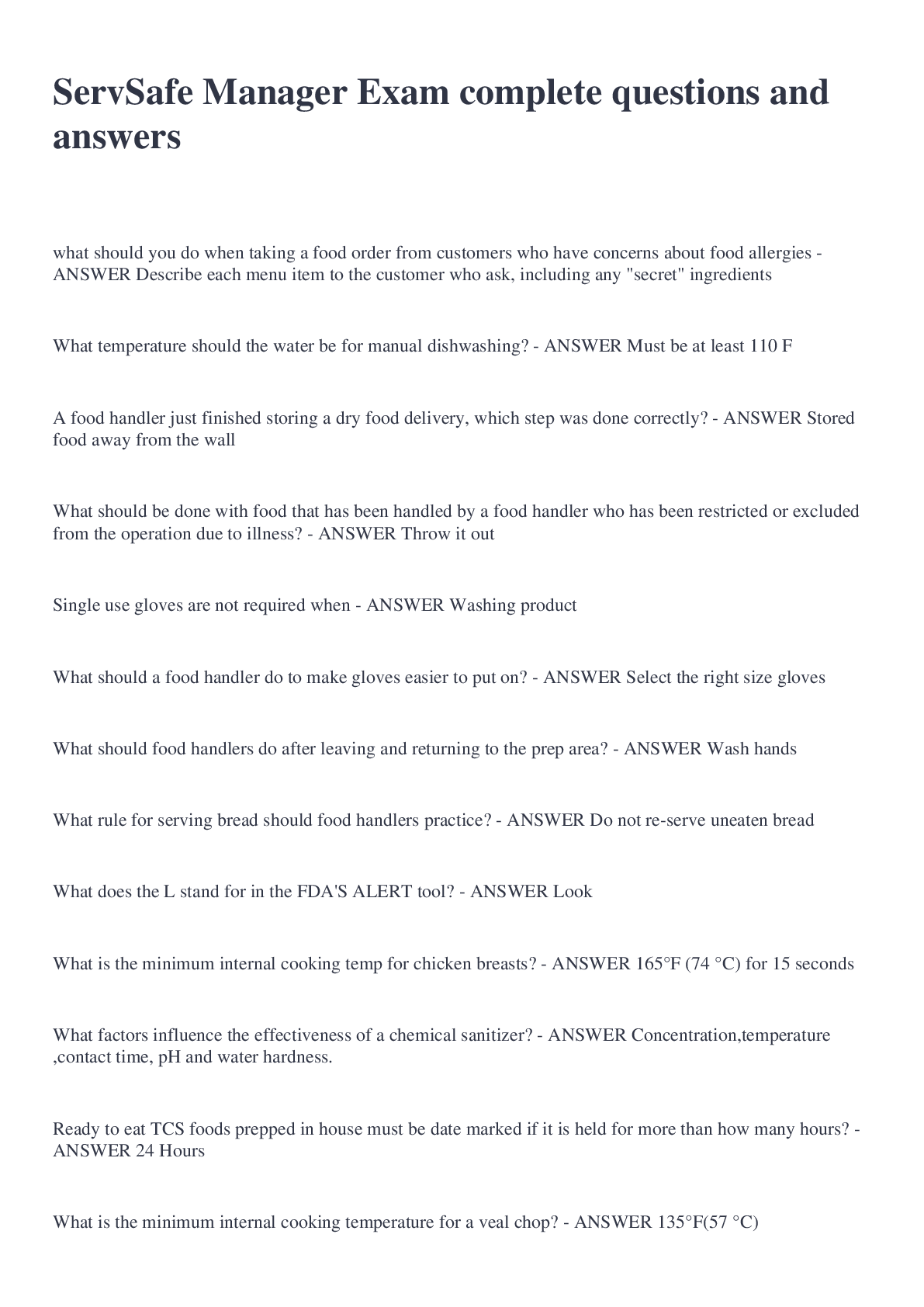
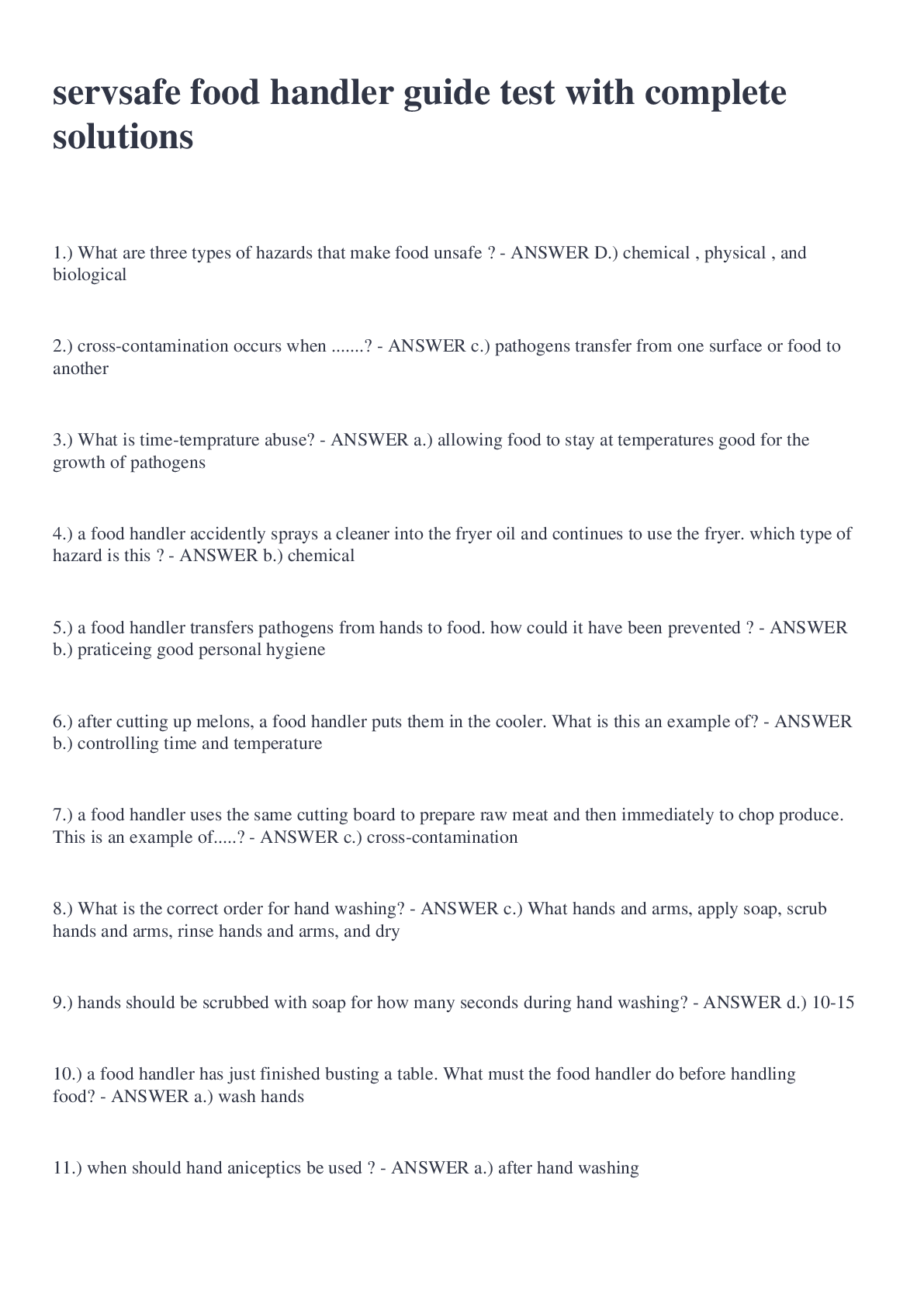
Which group of individuals has a higher risk of foodborne illness?
A. Teenagers
B. Elderly people
C. Women
D. Vegetarians - ANSWER B. Elderly people
Parasites are commonly associated with
A. seafood.
B. eggs.
...
Which group of individuals has a higher risk of foodborne illness?
A. Teenagers
B. Elderly people
C. Women
D. Vegetarians - ANSWER B. Elderly people
Parasites are commonly associated with
A. seafood.
B. eggs.
C. potatoes.
D. ready-to-eat food. - ANSWER A. seafood.
Ciguatera toxin is commonly found in
A. amberjack.
B. pollock.
C. tuna.
D. cod. - ANSWER A. amberjack.
Which is a TCS food?
A. Saltines
B. Bananas
C. Baked potato
D. Coffee - ANSWER C. Baked potato
Metal shavings are which type of contaminant?
A. Biological
B. Physical
C. Chemical
D. Microbial - ANSWER B. Physical
What should food service operators do to prevent the spread of hepatitis A?
A. Cook food to minimum internal temperatures
B. Freeze fish for 36 hours before serving
C. Exclude staff with jaundice from the operation
D. Purchase mushrooms from approved, reputable suppliers - ANSWER C. Exclude staff with jaundice from the operation
To wash hands correctly, a food handler must first
A. apply soap.
B. wet hands and arms vigorously.
C. scrub hands and arms vigorously.
D. use a single-use paper towel to dry hands - ANSWER B. wet hands and arms.
What should food service operators do to prevent customer illness from Singella spp.?
A. Freeze food at temperatures below 0 degrees
B. Exclude food handler diagnosed with jaundice
C. Purchase shellfish from approved suppliers
D. Control flies inside and outside the operation - ANSWER D. Control flies inside and outside the operation
What must a food handler with a hand wound do to safely work with food?
A. Bandage the wound with an impermeable cover and wear a single-use glove
B. Bandage the wound and avoid contact with food for the rest of the shift
C. Wash the wound and wear a single-use glove
D. Apply iodine solution and a permeable bandage - ANSWER A. Bandage the wound with an impermeable cover and wear a single-use glove
What item is considered acceptable work attire for a food handler?
A. False eyelashes
B. Nail polish
C. Plain band ring
D. Antimicrobial plastic watch band - ANSWER C. Plain band ring
What task requires food handlers to wash their hands before and after doing it?
A. Taking out the garbage
B. Touching clothing or aprons
C. Handling raw meat, poultry, or seafood
D. Using chemicals that might affect food safety - ANSWER C. Handling raw meat, poultry, or seafood
Which action requires a food handler to change gloves?
A. The food handler is working with raw seafood at temperatures above 41 degreesF
B. The food handler is prepping raw chicken on a yellow cutting board
C. The food handler has been working with raw ground beef for and hour
D. The food handler is wearing gloves that have been torn - ANSWER D. The food handler is wearing gloves that have been torn
How should the temperature of a shipment of cottage cheese be taken when it arrives at an operation?
A. Use an air probe to check the temperature of the delivery truck
B. Hold an infrared thermometer to the outside of the case or carton
C. Place the thermometer stem between shipping boxes for a reading
D. Place the thermometer stem into an opened container - ANSWER D. Place the thermometer stem into an opened container
When should a shipment of fresh chicken be rejected?
A. The flesh of the chicken appears moist.
B. Shellstock identification tags are not attached to the container.
C. The flesh of the chicken is firm and springs back when touched.
D. The receiving temperature is 50 degrees F - ANSWER D. The receiving temperature is 50
degrees F
Where should ground fish be stored in a cooler?
A. Above shellfish
B. Below ground poultry
C. Above ready-to-eat food
D. Below pork roasts - ANSWER D. Below pork roasts
What is the maximum number of days that ready-to-eat food prepared on-site can be stored if held at 41 degrees F?
A. 3 days
B. 5 days
C. 7 days
D. 10 days - ANSWER C. 7 days
In top-to-bottom order, how should fresh beef roast, fresh halibut, fresh lettuce and a pan of ground chicken be stored in a cooler?
A. Lettuce, fresh beef roast, ground chicken, fresh halibut
B. Lettuce, fresh halibut, fresh beef roast, ground chicken
C. Fresh halibut, lettuce, ground chicken, fresh beef roast
D. Fresh halibut, fresh beef roast, ground chicken, lettuce - ANSWER B. Lettuce, fresh halibut, fresh beef roast, ground chicken
What organization requires Material Safety Data Sheets?
A. Food and Drug Administration
B. Occupational Safety and Health Administration
C. Environmental Protection Agency
D. National Restaurant Association - ANSWER B. Occupational Safety and Health Administration
What is the minimum internal cooking temperature for green beans that are hot-held for service?
A. 165 degrees F
B. 155 degrees F
C. 145 degrees F
D. 135 degrees F - ANSWER D. 135 degrees F
What food item does the Food and Drug Administration advise against offering on a children's menu?
A. Rare cheeseburgers
B. Egg salad
C. Peanut butter and jelly sandwiches
D. Fried shrimp - ANSWER A. Rare cheeseburgers
TCS food reheated for hot-holding must reach what temperature?
A. 135 degrees F
B. 145 degrees F
C. 155 degrees F
D. 165 degrees F - ANSWER D. 165 degrees F
What method should never be used to thaw food?
A. Place the item in a cooler
B. Place the item on a prep counter
C. Microwave the item
D. Cook the item - ANSWER B. Place the item on a prep counter
When partial cooking food to be finished later, what is the maximum cooking time allowed during initial cooking?
A. 60 minutes
B. 45 minutes
C. 30 minutes
D. 15 minutes - ANSWER A. 60 minutes
Food held at 41 degrees F or lower before being removed from refrigeration can be held without temperature control for up to how many hours?
A. 2
B. 4
C. 6
D. 8 - ANSWER C. 6
Hot TCS food can be held without temperature control for a maximum of
A. 2 hours.
B. 4 hours.
C. 6 hours.
D. 8 hours. - ANSWER B. 4 hours.
Which food may be re-served to customers?
A. Unused, uncovered condiments
B. Uneaten bread
C. Unopened pre-packaged food
D. Unused whole fruit garnish - ANSWER C. Unopened pre-packaged food
What is the purpose of setting critical limits in a HACCP plan?
A. To identify potential hazards
B. To identify where hazards can be eliminated
C. To reduce hazards to safe levels
D. To determine if the HACCP plan is working - ANSWER C. To reduce hazards to safe levels
What is the minimum water temperature required when using hot water to sanitize objects?
A. 171 degrees F
B. 173 degrees F
C. 176 degrees F
D. 179 degrees F - ANSWER A. 171 degrees F
What HACCP principle is being practiced when food handler rewash melons that have surface dirt?
A. Monitoring
B. Corrective action
C. Critical limit
D. Critical control point - ANSWER B. Corrective action
What is the final step in cleaning and sanitizing a prep table?
A. Sanitizing the surface
B. Allowing the surface to air-dry
C. Washing the surface
D. Rinsing the surface - ANSWER B. Allowing the surface to air-dry
What is the minimum time an iodine sanitizer solution must be in contact with the object being sanitized?
A. 15 seconds
B. 30 seconds
C. 45 seconds
D. 60 seconds - ANSWER B. 30 seconds
If a food-contact surface is in constant use, how often should it be cleaned and sanitized?
A. Every 2 hours
B. Every 4 hours
C. Every 6 hours
D. Every 8 hours - ANSWER B. Every 4 hours
What is the third step in cleaning and sanitizing items in a three-compartment sink?
A. Sanitizing
B. Air-drying
C. Rinsing
D. Washing - ANSWER C. Rinsing
What type of thermocouple probe should be used to check the internal temperature of a beef roast?
A. Air
B. Surface
C. Immersion
D. Penetration - ANSWER D. Penetration
What food safety practice can prevent cross-contact?
A. Using only food-grade equipment
B. Washing, rinsing, and sanitizing utensils before each use
C. Keeping food frozen until use
D. Purchasing food from approved, reputable suppliers - ANSWER B. Washing, rinsing, and sanitizing utensils before each use
What is the most likely cause of wheezing and hives?
A. Food allergies
B. Norovirus
C. Shingella spp.
D. Hepatitis A - ANSWER A. Food allergies
What is a basic characteristic of a virus?
A. Destroyed by cooking
B. Grows in food
C. Requires a living host to grow
D. Commonly found in cattle intestines - ANSWER C. Requires a living host to grow
Where should staff members eat, drink, smoke , or chew gum?
A. Where customers eat
B. In dishwashing areas
C. Outside the kitchen door
D. In designated areas - ANSWER D. In designated areas
When can a food handler with a sore throat and a fever return to work with or around food?
A. The fever is gone for 24 hours.
B. The sore throat is gone.
C. A written medical release is provided.
D. No symptoms are experienced for 24 hours. - ANSWER C. A written medical release is provided.
What should a foodservice operator do when responding to a foodborne-illness outbreak?
A. Notify the media
B. Segregate the product
C. Close the operation for the day
D. Ask customers for proof of their symptoms - ANSWER B. Se
[Show More]

![Preview of FDSC 1133 Exam 1 [Food Science Fundamentals] 140 Questions & 100% Verified Answers Grade A](https://browseimages.nyc3.digitaloceanspaces.com/paper-images/2026/04/01/znnLS2iB2026-04-01-01-4869cc4f56594bb.png)