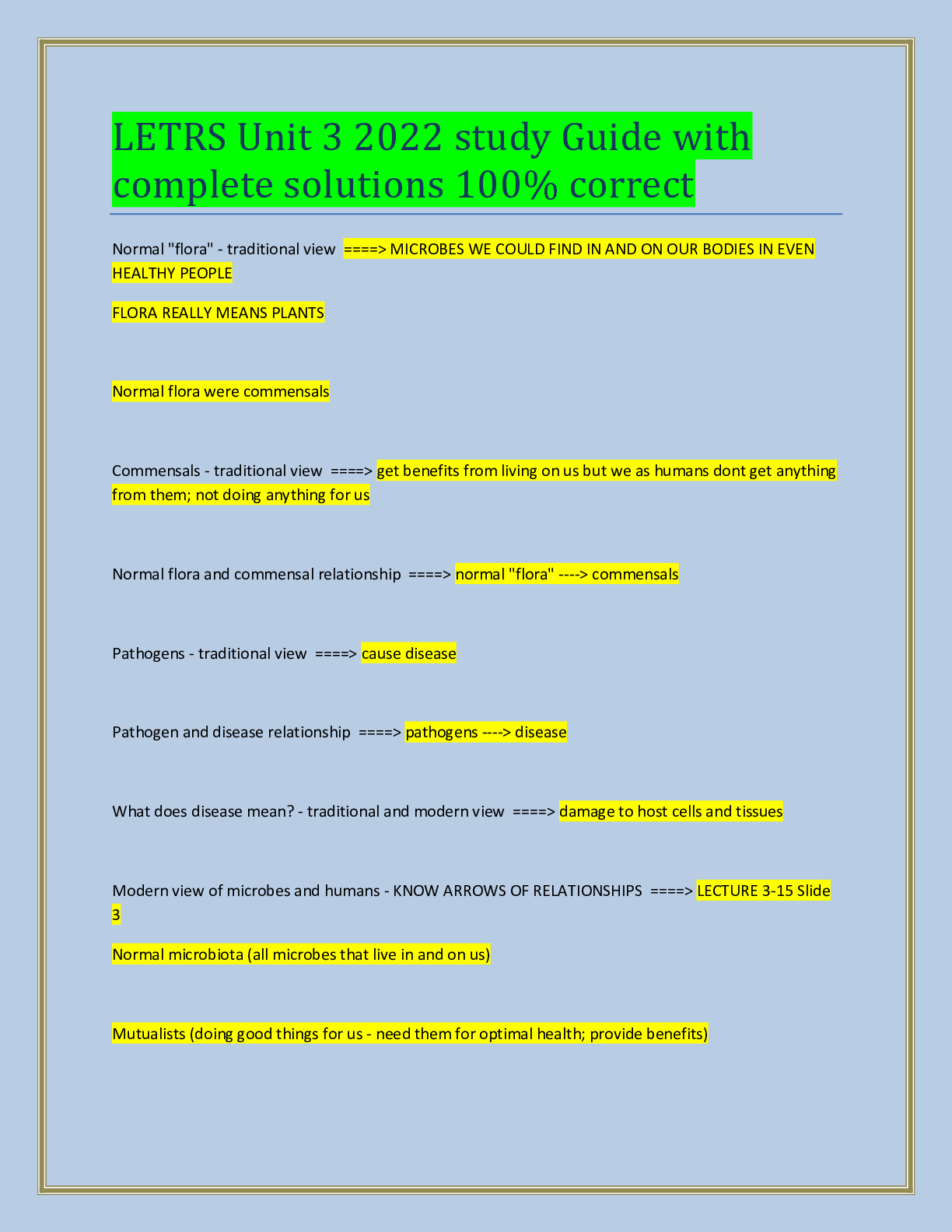
LETRS Unit 3 2022 study Guide with complete solutions 100% correct
Normal "flora" - traditional view ====> MICROBES WE COULD FIND IN AND ON OUR BODIES IN EVEN HEALTHY PEOPLE
FLORA REALLY MEANS PLANTS
Normal flora w
...
LETRS Unit 3 2022 study Guide with complete solutions 100% correct
Normal "flora" - traditional view ====> MICROBES WE COULD FIND IN AND ON OUR BODIES IN EVEN HEALTHY PEOPLE
FLORA REALLY MEANS PLANTS
Normal flora were commensals
Commensals - traditional view ====> get benefits from living on us but we as humans dont get anything from them; not doing anything for us
Normal flora and commensal relationship ====> normal "flora" ----> commensals
Pathogens - traditional view ====> cause disease
Pathogen and disease relationship ====> pathogens ----> disease
What does disease mean? - traditional and modern view ====> damage to host cells and tissues
Modern view of microbes and humans - KNOW ARROWS OF RELATIONSHIPS ====> LECTURE 3-15 Slide 3
Normal microbiota (all microbes that live in and on us)
Mutualists (doing good things for us - need them for optimal health; provide benefits)
Commensals (just hanging out there)
Pathogens (comensal pathogens - some normal microbiotia can cuase disease- commensals can be pathogens)
dysbiosis (can lead to disease - need to maintain optimal level of normal microbiota compostion of could cause disease)
what are humans colonized by microbes for? ====> life - the normal microbiota
why are normal microbiota hard to study? ====> because we all have them
normal microbiota questions:
are they commensals or mutualists?
are they residents or transients?
transients ====> short time but dont have permanent address on our bodies and make not be impacting us too much
what were normal microbiota initially called? ====> normal flora
what happens when the normal relationship is disrupted? - possible explanation ====> dysbiosis - could be a explanation for certain disease that have came up in the U.S.
what is the human microbiome project? ====> normal microobiota and all their genomic capabity - their function role/what theyre capable of doing; genomes of ALL the microbiota
NIH study to determine basic information about normal microbiota
what microbes are commonly found in healthy humans?
how do they vary across a lifetime and between people?
what is their role in health and disease?
what does the normal microbiota contain? ====> MANY BACTERIA
55 different phyla of bacteria are known
only 4-6 are predominate in humans (found on human body - selective environment; they are very abundant on humans)
firmicutes and actinobacteria ====> bacteria contained from normal microbiota
gram-positive
bacteroidetes and proteobacteria ====> bacteria contained from normal microbiota
gram-negative
what are other members of the microbiota besides bacteria? ====> archaea (few species of methanogens)
fungi (colonize skin and oral tract)
protists (GI tract)
animals (worms and mites)
viruses: human virome - even healthy people have viruses cirulating through their body at times
how do we acquire our microbiota? ====> initial colonization during birth - during birthing process; almost immediately colonized with microorganisms
ecological succession over time until mature community at adulthood - start to develop stable health community that will occur after puberty
autotrophs provide what to their animal? ====> carbon source to animal hosts
heterotrophs provide what to their animal? ====> degrade plant materials for their host to eat
what do microbes use biosynthetic capacity for? ====> provide amino acids and vitamins to animal hosts that love on an unbalanced diet
what do some microbes also do for their animal hosts? ====> fix nitrogen
good for those who have an unbalanced diet - ex. termites who eat wood
not limited to just carbon metabolism - micrboes can make amino acids and other food sources
what do microbes produce for their animal hosts? ====> antibiotics that protect their hosts from infectious disease
ex. ants coated in microorangisms that keep fungal healthy - carry around their own antibiotic producing microbes
ex. ants bring leaves to their fungi to degrade it and then the ants eat the fungi
[Show More]








![Preview of THE TEFL ACADEMY LEVEL 5 - ASSIGNMENT C - AUTHENTIC MATERIAL [2026]](https://browseimages.nyc3.digitaloceanspaces.com/paper-images/2026/04/10/HpVkRcWV2026-04-10-11-5769d96426bd64f.png)