ihuman case study with correct answers
$ 35.5
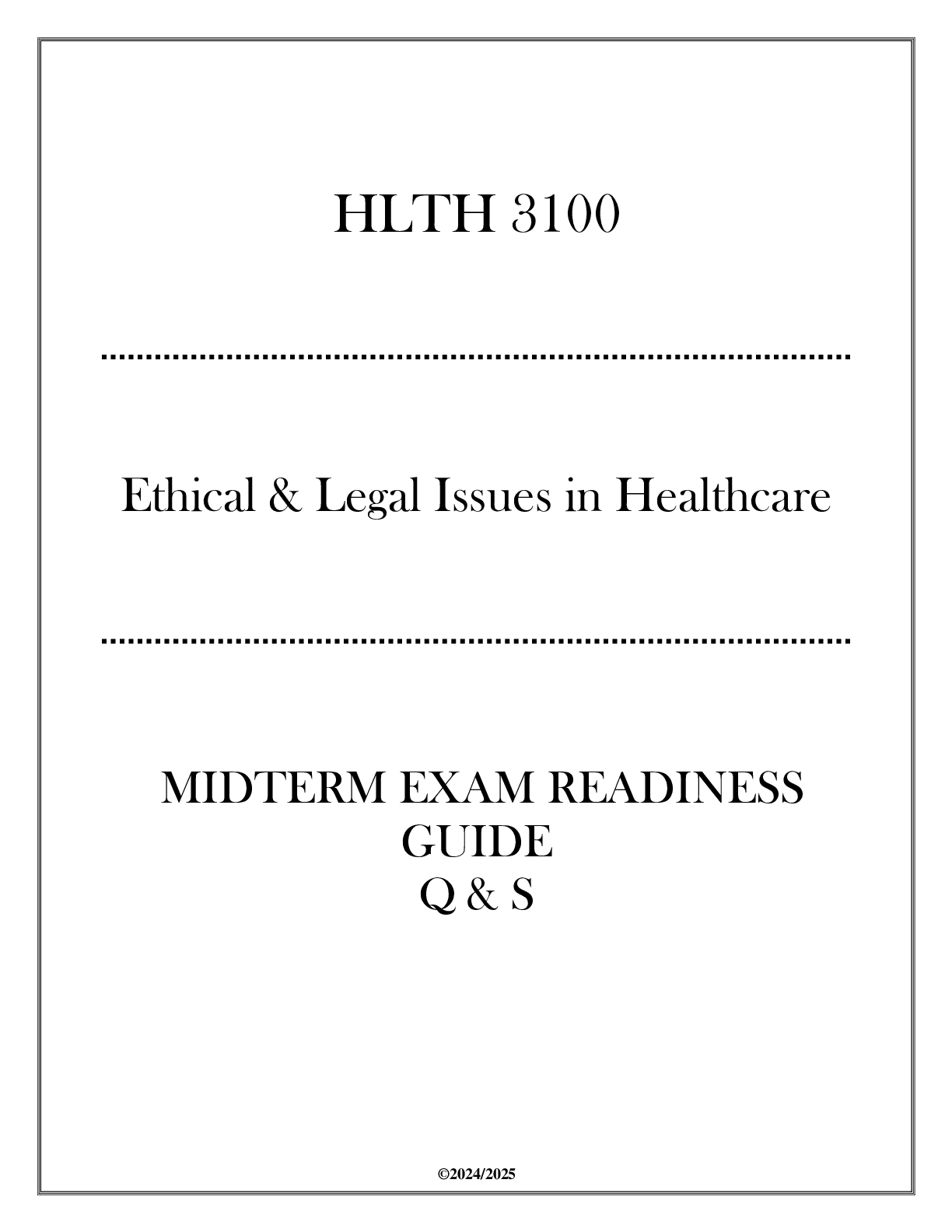
(WU) HLTH 3100 Ethical & Legal Issues in Healthcare - Midterm Exam Readiness Guide 2024
*NURSING > QUESTIONS & ANSWERS > ATI fundamentals Vital Signs Questions and Answers 100% Pass (All)
ATI fundamentals Vital Signs Questions and Answers 100% Pass Having recently moved into the area, a 56-year-old female is having her initial visit with the primary care provider she selected. The p ... atient denies any chronic or acute illnesses. You measure & record her vital sign data, whats next? The primary reason for assessing this patient's vital signs is to ✔✔establish a baseline when the patient reports no specific health-related problem. You got it right. Vital signs are assessed for various reasons that include determining the patient's response to medical and nursing therapy as well as identifying clinical problems. However, the primary reason for such assessment at an initial visit of an apparently well patient is to document baseline data. This information will be useful for comparison with vital-sign data obtained at subsequent visits. Which of the following accurately describes body temperature? ✔✔The difference between heat produced by and lost from the body rationale: Normal body temperature is the healthy balance between the amounts of heat the body produces as a byproduct of metabolism, muscle activity, thyroxine output, and sympathetic stimulation and the heat lost as a result of radiation, conduction, convection, and evaporation. Which of the following temperatures is within the normal range for adults and is documented correctly? A. T = 98.6º F B. T = 99.6º F (O) C. T = 101.0º F (O) ✔✔B. T = 99.6º F (O) Which of the following is true regarding assessing a patient's pulse? A. The human pulse is the palpable bounding of the blood flow in a peripheral artery. B. The normal pulse range for a resting adult is 50 to 110 beats/mi C. Three components that the nurse should include when documenting pulse (P) are the rate, rhythm, and depth. D. To calculate the pulse of a patient whose rhythm is irregular, the nurse should count the pulse rate for 30 seconds and multiply by two. ✔✔A. The human pulse is the palpable bounding of the blood flow in a peripheral artery. Will your assessment of respiration provide information about your patient's ability to intake carbon dioxide and to expel oxygen? ✔✔B. No You got it right. Respiration is the mechanism a person uses to introduce oxygen into the body while expelling carbon dioxide into the atmosphere. Which of the following is true regarding assessing a patient's respiration? A. It is best to inform the patient that you are assessing her respiration. B. "R = 14/min, normal, regular" is an appropriate documentation of a patient's respiration. C. Occurrence or periods of apnea in an older adult is a normal respiratory finding. D. Anxiety and acute pain are two factors that should not affect a patient's respiratory rate. ✔✔B. "R = 14/min, normal, regular" is an appropriate documentation of a patient's respiration. Which of the following describes systolic pressure? A. The force blood exerts on the wall of a blood vessel during both the contraction and relaxation phases of the heart B. The pressure exerted by the blood during the heart's contraction phase C. The pressure exerted by the blood during the heart's relaxation phase ✔✔B. The pressure exerted by the blood during the heart's contraction phase You recorded your patient's blood pressure as 166/88. Is this within the normal range for an adult? ✔✔no Your patient's blood pressure exceeds the upper limit of the normal range for an adult, so you measure it again. Which of the following questions would be appropriate to ask your patient before you reassess her blood pressure? select all that apply A. What is your usual blood-pressure reading? B. Have you eaten anything within the last hour C. Did you drink any tea, coffee, or soda within the last half hour? D. Are you currently experiencing any emotional stress such as fear or anxiety? E. Have you smoked within the last 15 to 30 minutes? ✔✔A, C, D, E How long would you wait before reassessing your patient's blood pressure on the same arm? A. 2 to 3 minutes B. 10 to 15 minutes ✔✔A Your patient is seated comfortably. You measure her blood pressure in her right arm and obtain a reading of 160/90. You ask her to return to have her blood pressure reassessed in 2 weeks, since this reading indicates a blood pressure above the normal adult range. The most appropriate way for you to document this patient's blood pressure is A. blood pressure is 160/90 B. BP = 160/90; right arm, sitting C hypertensive at 160/90 ✔✔B A 56-year-old female had her initial visit with a primary care provider (PCP) 2 weeks ago. At that appointment, her blood-pressure (BP) reading was above normal (160/90), so she returned today to have her BP evaluated [Show More]
Last updated: 3 years ago
Preview 1 out of 12 pages
.png)
Buy this document to get the full access instantly
Instant Download Access after purchase
Buy NowInstant download
We Accept:

.png)
ATI Fundamentals Bundled Exams Questions and Answers with Complete Solutions
By Nutmegs 2 years ago
$25
22
Can't find what you want? Try our AI powered Search
Connected school, study & course
About the document
Uploaded On
Oct 14, 2022
Number of pages
12
Written in
All
This document has been written for:
Uploaded
Oct 14, 2022
Downloads
0
Views
274
Scholarfriends.com Online Platform by Browsegrades Inc. 651N South Broad St, Middletown DE. United States.
We're available through e-mail, Twitter, Facebook, and live chat.
FAQ
Questions? Leave a message!
Copyright © Scholarfriends · High quality services·



.png)