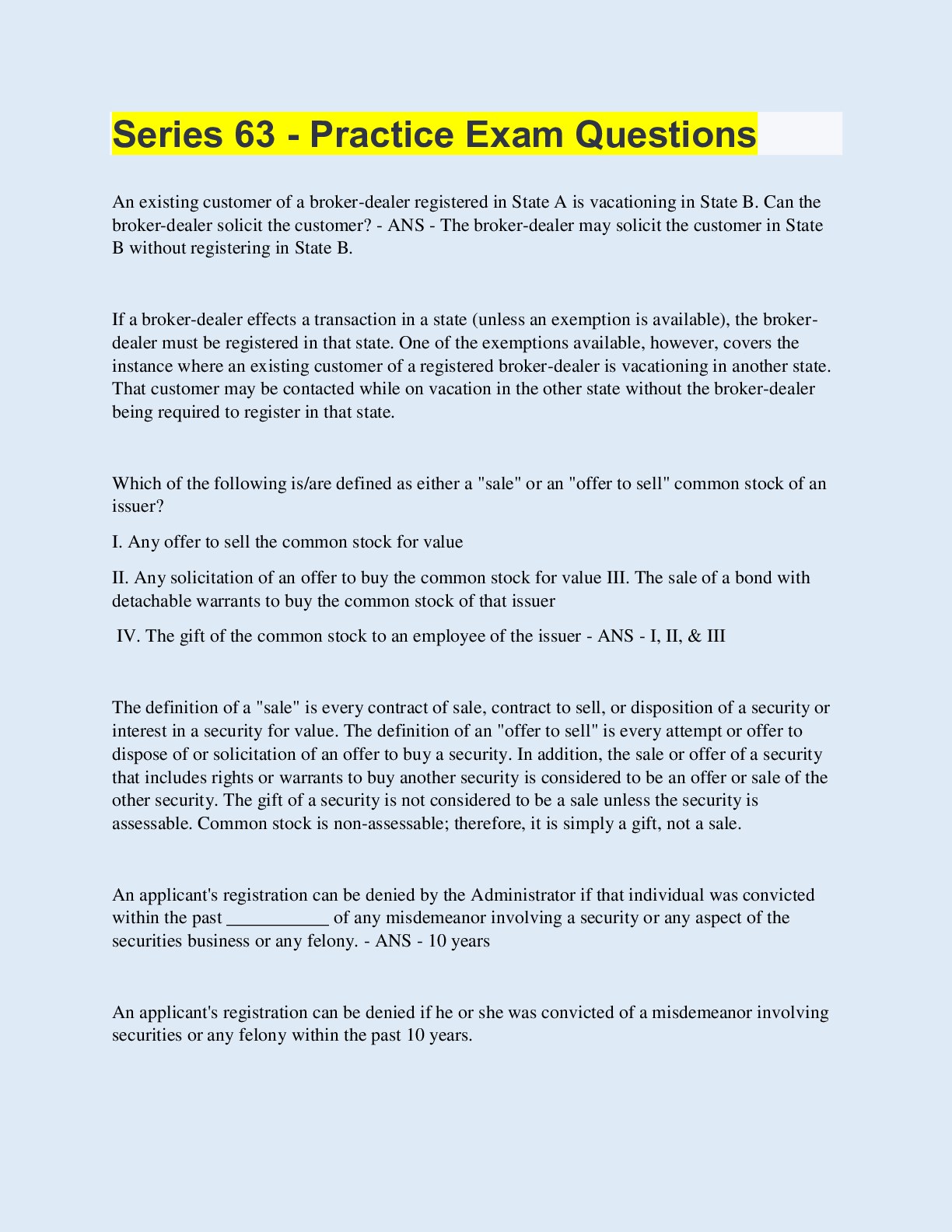
Series 63 - Practice Exam Questions
An existing customer of a broker-dealer registered in State A is vacationing in State B. Can the
broker-dealer solicit the customer? - ANS - The broker-dealer may solicit the custome
...
Series 63 - Practice Exam Questions
An existing customer of a broker-dealer registered in State A is vacationing in State B. Can the
broker-dealer solicit the customer? - ANS - The broker-dealer may solicit the customer in State
B without registering in State B.
If a broker-dealer effects a transaction in a state (unless an exemption is available), the brokerdealer must be registered in that state. One of the exemptions available, however, covers the
instance where an existing customer of a registered broker-dealer is vacationing in another state.
That customer may be contacted while on vacation in the other state without the broker-dealer
being required to register in that state.
Which of the following is/are defined as either a "sale" or an "offer to sell" common stock of an
issuer?
I. Any offer to sell the common stock for value
II. Any solicitation of an offer to buy the common stock for value III. The sale of a bond with
detachable warrants to buy the common stock of that issuer
IV. The gift of the common stock to an employee of the issuer - ANS - I, II, & III
The definition of a "sale" is every contract of sale, contract to sell, or disposition of a security or
interest in a security for value. The definition of an "offer to sell" is every attempt or offer to
dispose of or solicitation of an offer to buy a security. In addition, the sale or offer of a security
that includes rights or warrants to buy another security is considered to be an offer or sale of the
other security. The gift of a security is not considered to be a sale unless the security is
assessable. Common stock is non-assessable; therefore, it is simply a gift, not a sale.
An applicant's registration can be denied by the Administrator if that individual was convicted
within the past ___________ of any misdemeanor involving a security or any aspect of the
securities business or any felony. - ANS - 10 years
An applicant's registration can be denied if he or she was convicted of a misdemeanor involving
securities or any felony within the past 10 years.
It is prohibited for an investment adviser to be compensated only on the basis of __________
achieved. It is allowable for the adviser to receive a percentage of all assets under management
(even if this value includes capital gains) or for a fixed fee arrangement to be established. - ANS
- capital gains
Securities that are sold through a private placement _________. - ANS - are unregistered
Securities sold through a private placement are unregistered and are an exempt transaction.
Under Uniform State Law, a private placement is defined as an offer to no more than 10 persons
in a 12 month period.
The Administrator is NOT empowered to __________. - ANS - Issue injunctions
The Administrator can issue subpoenas even to persons outside the Administrator's state. It is
also possible for the Administrator to conduct investigations to determine if any securities laws
have been broken and to hold hearings. It is not possible, however, for the Administrator to issue
an injunction against the alleged violator. The Administrator may only petition the appropriate
court to issue an injunction.
Under the Uniform Securities Act, the term 'sale' or 'sell' includes which of the following? I. A
disposition of a security for consideration
II. A stock dividend given to stockholders in lieu of a cash dividend
III. An exchange of stock in a merger transaction which is approved by stockholders - ANS - I
only
To be considered to be a sale, there must be some consideration or exchange of value. Sales do
not include bona fide pledges of securities as collateral for loans, stock dividends, corporate
mergers approved by stockholders, the exchange of corporate assets in consideration of stock of
another corporation, or acts incidental to judicially-approved reorganizations in which securities
are issued in exchange for other outstanding securities.
Which of the following actions could constitute fraud?
I. Omission of any material fact II. Omission of any known fact
III. A deceptive statement made in connection with the sale of a government bond - ANS - I &
III only
The intentional omission of any material information is fraud. Even though government bonds
are exempt securities, they are not exempt from the anti-fraud provisions and deceptive
statements are always considered fraud. Immaterial facts need not be disclosed.
[Show More]



![Preview of [Wiley FINRA series] Securities Institute of America - Wiley series 63 exam review 2016 +](https://scholarfriends.com/storage/[Wiley FINRA series] Securities Institute of America - Wiley series 63 exam review 2016 + test bank_ the uniform securities state law examination (2016, John Wiley and Sons) - libgen.png)
 Securities Institute of America - Wiley series 63 exam review 2016 + test bank_ the uniform securities state law examination-John Wiley and Sons (2016).png)
 4th Edition.png)



.png)