SLU Biology Exam 1
order of the hierarchy of life including:
biosphere, macromolecule, community, molecule, atom, tissue, organ, organism, ecosystem,
organelle, organ system, population, cell - ANS - atom, molecule, m
...
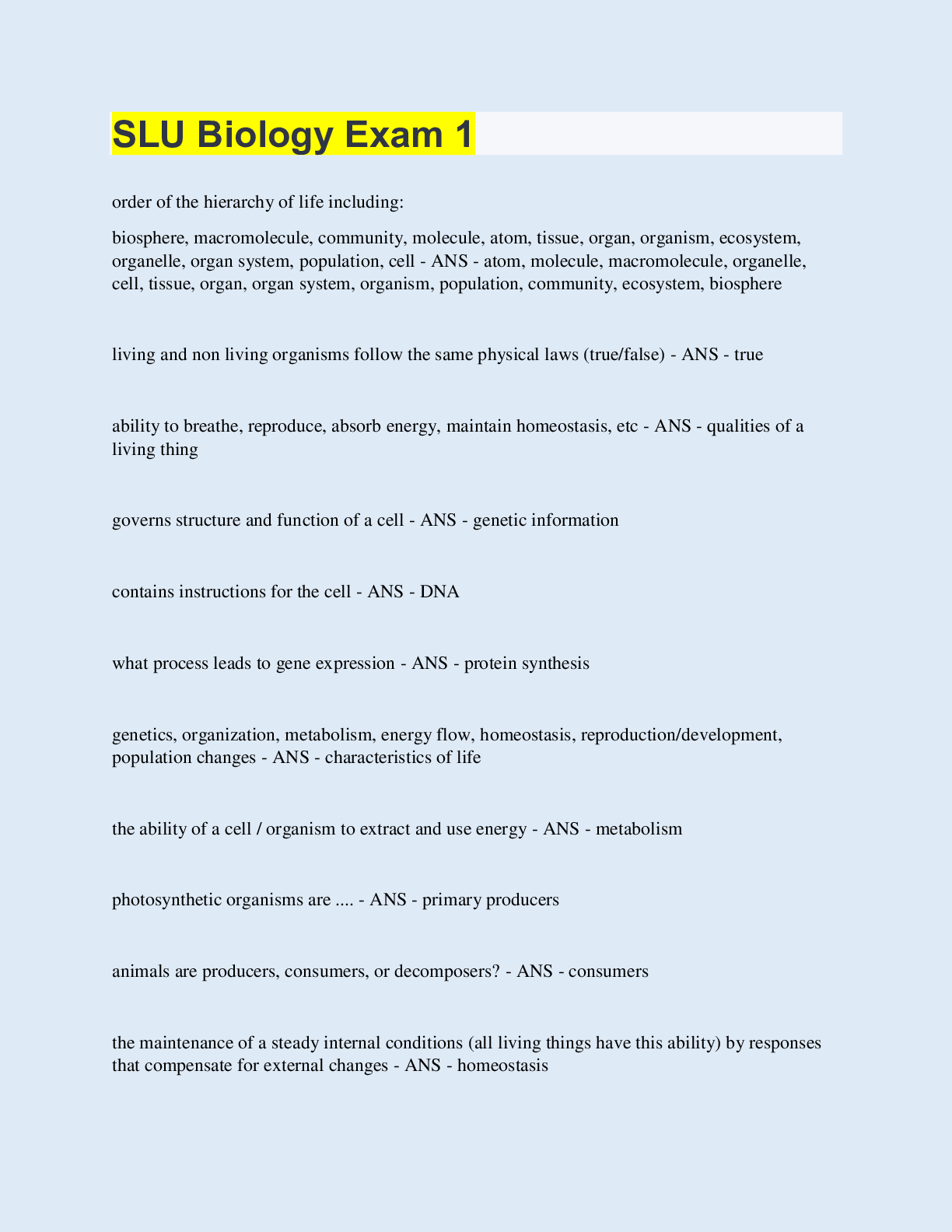
SLU Biology Exam 1
order of the hierarchy of life including:
biosphere, macromolecule, community, molecule, atom, tissue, organ, organism, ecosystem,
organelle, organ system, population, cell - ANS - atom, molecule, macromolecule, organelle,
cell, tissue, organ, organ system, organism, population, community, ecosystem, biosphere
living and non living organisms follow the same physical laws (true/false) - ANS - true
ability to breathe, reproduce, absorb energy, maintain homeostasis, etc - ANS - qualities of a
living thing
governs structure and function of a cell - ANS - genetic information
contains instructions for the cell - ANS - DNA
what process leads to gene expression - ANS - protein synthesis
genetics, organization, metabolism, energy flow, homeostasis, reproduction/development,
population changes - ANS - characteristics of life
the ability of a cell / organism to extract and use energy - ANS - metabolism
photosynthetic organisms are .... - ANS - primary producers
animals are producers, consumers, or decomposers? - ANS - consumers
the maintenance of a steady internal conditions (all living things have this ability) by responses
that compensate for external changes - ANS - homeostasis
allows gene information to be passed on - ANS - reproduction
-fundamental process of life
-changes over time
-unifying theme in biology - ANS - biological evolution
-produced mechanism for evolution
-went on a 5 year voyage around the world
-introduced natural selection - ANS - Darwin & Wallace
breeding specific groups / human choice - ANS - artificial selection
-mechanism of evolution
-changes what's found in DNA over generations
-nature's choice - ANS - natural selection
-random changes in DNA
-causes variability in the structure, number, or arrangement of DNA molecules - ANS - mutation
-favorable mutations
-helps organisms survive longer - ANS - adaptation
includes all populations of individuals that have very similar structure, biochemistry, and
behavior; can successfully interbreed - ANS - species
group of similar species that share recent common ancestry - ANS - genus
2 part scientific name:
-1st identifies ___________
-2nd identifies _____________________ - ANS - genus, species within that genus
what are the three domains? - ANS - prokaryotes, archaea, eukaryotes
unicellular/prokaryotes (domains) - ANS - bacteria and archaea
domain containing eukaryotes - ANS - eukarya
which domain is known as extreme and closely related to us? - ANS - archaea
what is included in the domain eukarya? - ANS - protists, plants, fungi, and animals
________________ don't have cell walls - ANS - animal cells
which is known generally as a decomposer?
protists, plants, fungi, or animals? - ANS - fungi
life as we know it would be impossible without __________ - ANS - water
-anything that occupies space and has mass
-composed of elements and combinations of elements - ANS - matter
pure substance - ANS - element
what are the four key elements? - ANS - carbon, hydrogen, oxygen, and nitrogen
molecules whose component atoms are different - ANS - compound
negative charge; circle around the nucleus - ANS - electrons
positive charge; located in the nucleus - ANS - protons
neutral charge; located in the nucleus - ANS - neutrons
atoms are identified by their ___________________ - ANS - atomi
[Show More]


.png)