Six Sigma Lean Test Questions &
Answers
What is Six Sigma? - ANS - A "sigma" is a term used to denote variance from the mean average
of an event. Six Sigma originally referred to the ability of manufacturing processes
...
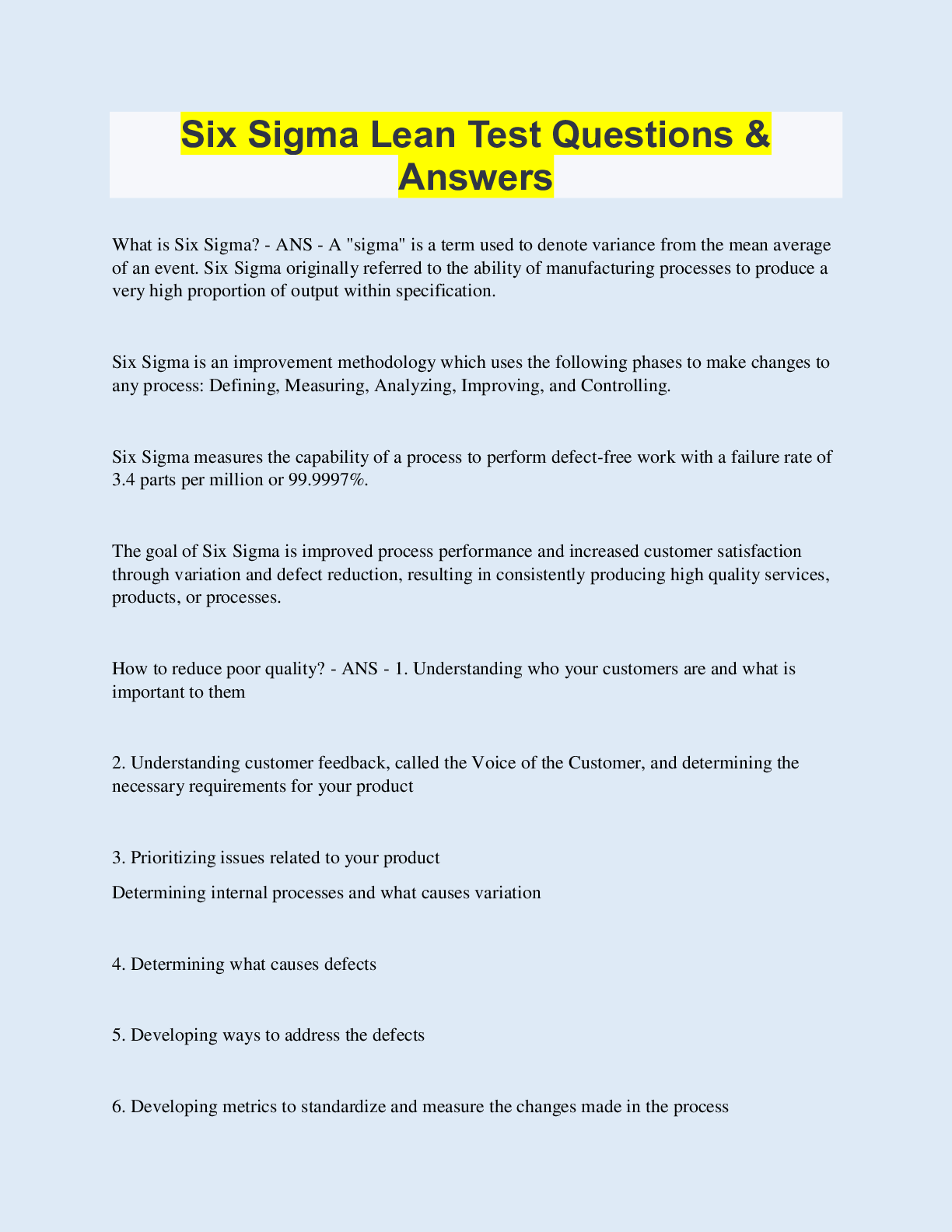
Six Sigma Lean Test Questions &
Answers
What is Six Sigma? - ANS - A "sigma" is a term used to denote variance from the mean average
of an event. Six Sigma originally referred to the ability of manufacturing processes to produce a
very high proportion of output within specification.
Six Sigma is an improvement methodology which uses the following phases to make changes to
any process: Defining, Measuring, Analyzing, Improving, and Controlling.
Six Sigma measures the capability of a process to perform defect-free work with a failure rate of
3.4 parts per million or 99.9997%.
The goal of Six Sigma is improved process performance and increased customer satisfaction
through variation and defect reduction, resulting in consistently producing high quality services,
products, or processes.
How to reduce poor quality? - ANS - 1. Understanding who your customers are and what is
important to them
2. Understanding customer feedback, called the Voice of the Customer, and determining the
necessary requirements for your product
3. Prioritizing issues related to your product
Determining internal processes and what causes variation
4. Determining what causes defects
5. Developing ways to address the defects
6. Developing metrics to standardize and measure the changes made in the process
What is DPMO - ANS - Defects per Million Opportunities, a standardized measure of the error
rate of a process
Deming's Theories: Theory of Optimization - ANS - In the theory of optimization, the objective
of an organization is the optimization of the total system and not the optimization of individual
subsystems.
Deming's Theories: Theory of Variation - ANS - In the theory of variation, his philosophy
focuses on improving the product and service variability in design and manufacturing processes.
Deming's Theories: Theory of Knowledge - ANS - In the theory of knowledge, Deming
emphasized that knowledge is not possible without theory, and experience does not establish a
theory by itself. He says copying a best practice without understanding the theory behind it could
be devastating for an organization.
Deming's Theories: Theory of Psychology - ANS - In the theory of psychology, he helped
explain how to understand people, interactions between people, and interactions between leaders
and employees in a system of management.
Who Is Dr. Deming? - ANS - Dr. W. Edwards Deming (1900-1993) is best known for reminding
management that most problems are systemic and that it is their (management's) responsibility to
improve the systems so that workers can do their jobs more effectively.
When developing better interactions between employees and managers, he noticed that workers
were responsible for 10 to 20 percent of the quality problems in a factory, and that the remaining
80 to 90 percent was under management's control. It was their responsibility to manage the
programs accordingly.
What is Deming Cycle? - ANS - The Deming Cycle is also known as the Plan-Do-Check-Act
(PDCA) Cycle or Plan-Do-Study-Act (PDSA) Cycle. It was invented by Walter Shewhart, but
popularized by and significantly enhanced by Deming.
PDCA and PDSA are cyclic processes for planning and testing improvement activities prior to
full-scale implementation.
What are the steps in a Deming Cycle? - ANS - The steps in the Deming PDCA or PDSA Cycle
are:
1.Plan a change or test it (P).
2.Do it (D) by carrying out the change or test on a small scale.
3.Check it (C) by observing the effects of the change or test.
4.Study it (S) by reviewing what you have done or changed.
5.Act on what you have learned (A).
6.Repeat and continuously evaluate the process.
What is the ultimate goal of Lean Six Sigma? - ANS - The ultimate goal is continued
improvement and sustained quality.
Deliverables in Define Phase - ANS - This first stage sets the context within which the Six
Sigma project is to be performed.
1. Fully trained project team
2. Customer expectations or Voice of the Customer (VOC): Requirements, Critical
characteristics (Critical to Quality elements (CTQs), key business drivers of internal and external
customer satisfaction. What is important to them? What do they perceive as a defect in a quality
or service?
3. Project charter
4. Known business process mapping
Deliverables in Measure Phase - ANS - The second stage is where the starting point metrics are
recorded to baseline the current performance level and constraints of the process to be worked
upon.
1. Key process metrics (KPOVs)
2. Data collection plan
3. A baseline for performance
4. Documentation of variation
5. Communications to team members and stakeholders
Deliverables in Analysis Phase - ANS - The third stage reviews the metrics, and using a variety
of tools, gains an understanding of the cause and effects interactivity within the system being
looked at.
1. Root cause analysis
2. Gap analysis
3. Top-to-bottom data and process analysis
Deliverables in Improve Phase - ANS - The fourth stag
[Show More]


.png)

![Preview of eBook [PDF] Mind on Statistics 6th Edition By Utts Heckard](https://browseimages.nyc3.digitaloceanspaces.com/paper-images/2026/04/29/YJskuJXm2026-04-29-08-2869f1970eda885.png)



![Preview of [SOLVED] EDCO 740 / EDCO740 Quiz 1 (LATES 2021/2022 Graded A)](https://scholarfriends.com/storage/EDCO_740_Quiz_1.png)