1 oz = - ANSWER 30 mL
1 cup = - ANSWER 8 oz / 240 mL
1 qt = - ANSWER 1000 mL
Active Range of Motion (AROM) - ANSWER done by the patient
Passive Range of Motion (PROM) - ANSWER health care worker moves the joi
...
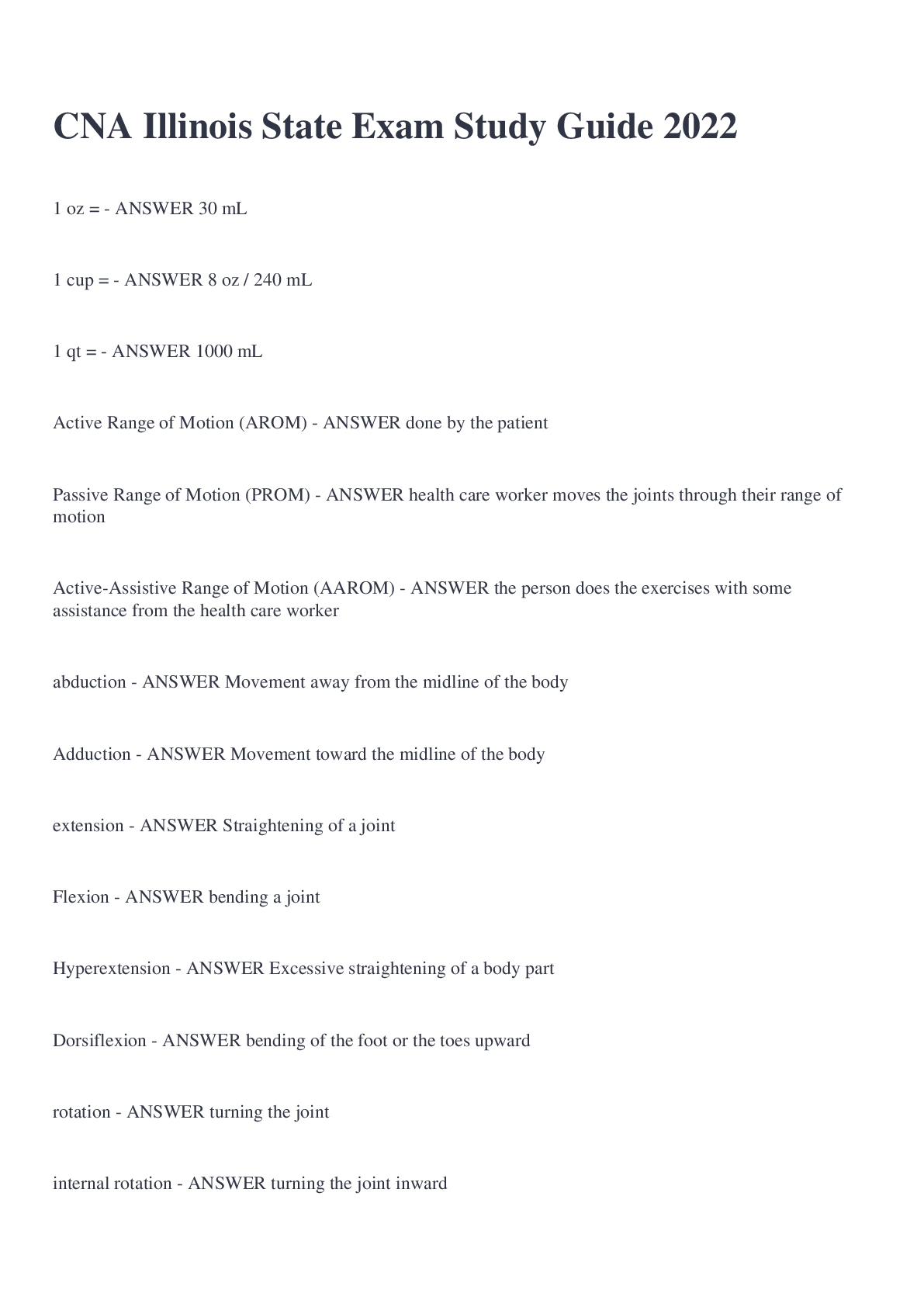
1 oz = - ANSWER 30 mL
1 cup = - ANSWER 8 oz / 240 mL
1 qt = - ANSWER 1000 mL
Active Range of Motion (AROM) - ANSWER done by the patient
Passive Range of Motion (PROM) - ANSWER health care worker moves the joints through their range of motion
Active-Assistive Range of Motion (AAROM) - ANSWER the person does the exercises with some assistance from the health care worker
abduction - ANSWER Movement away from the midline of the body
Adduction - ANSWER Movement toward the midline of the body
extension - ANSWER Straightening of a joint
Flexion - ANSWER bending a joint
Hyperextension - ANSWER Excessive straightening of a body part
Dorsiflexion - ANSWER bending of the foot or the toes upward
rotation - ANSWER turning the joint
internal rotation - ANSWER turning the joint inward
external rotation - ANSWER turning the joint outward
planter flexion - ANSWER bending the foot down at the ankle
Pronation - ANSWER palm down, turning joint downward
supination - ANSWER Palm up, turning joint upward
inversion - ANSWER supination
eversion - ANSWER pronation
T/F: A nurse has to be available at all times. - ANSWER T, if your nurse is at lunch a different nurse takes over
abuse - ANSWER willful infliction of injury, unreasonable confinement, intimidation or punishment with resulting physical harm, pain, or mental anguish
assault - ANSWER intentionally attempting or threatening to touch a person's body without the person's consent
battery - ANSWER touching a person's body without his or her consent
boundary crossing - ANSWER A brief act or behavior of being over-involved with the person; the intent of the act or behavior is to meet the person's needs
Examples of boundary crossing - ANSWER You hug a person because he or she is crying
boundary sign - ANSWER Acts, behaviors, or thoughts that warn of a boundary crossing or boundary violation
boundary violation - ANSWER an act or behavior that meets your needs, not the person's
Examples of boundary violations - ANSWER abuse, giving a lot of information about yourself, keeping secrets with the person
False Imprisonment - ANSWER unlawful restraint or restriction of a person's freedom of movement
fraud - ANSWER Saying or doing something to trick, fool, or deceive a person
intimate partner violence (IPV) - ANSWER physical, sexual, or psychological harm by a current or former partner or spouse
invasion of privacy - ANSWER violating a person's right not to have his or her name, photo, or private affairs exposed or made public without giving consent
libel - ANSWER Making false statements in print, writing, or through pictures or drawings
Malpractice - ANSWER Negligence by a professional person
neglect - ANSWER The failure of responsible persons to provide food, shelter, health care, or protection for a vulnerable elder
negligence - ANSWER An unintentional wrong in which a person did not act in a reasonable and careful manner and a person or the person's property was harmed
professional boundary - ANSWER that which separates helpful behaviors from behaviors that are not helpful
professional sexual misconduct - ANSWER an act, behavior, or comment that is sexual in nature
Protected Health Information (PHI) - ANSWER identifying information and information about the person's health care that is maintained or sent in any form (paper, electronic, oral)
self-neglect - ANSWER a person's behaviors and way of living that threaten his or her health, safety, and well-being
slander - ANSWER making false statements through the spoken word, sounds, sign language, or gestures
standard of care - ANSWER the skills, care, and judgments required by a health team member under similar conditions
What does the brain stem include? - ANSWER midbrain, pons, medulla
geriatrics - ANSWER medical treatment and care of old age
Gerontology - ANSWER study of old people/aging
Bath temperature - ANSWER Approx. 105 degrees (100-105) / ( 37.7-40.5C)
dangling - ANSWER sitting with the legs hanging down over the side of the bed, can become dizzy or faint from getting out of bed too fast, need to sit 1-5 min. before walking or transferring, common after surgery, moves legs to stimulate circulation
What is on an identification bracelet? - ANSWER name, room & bed number, birth date, age, doctor, and other identifying information
Colors on ID bracelets
Red:
Yellow:
Purple:
Pink:
Green: - ANSWER Red: Allergy
Yellow: Fall risk
Purple: DNR
Pink: Restricted extremity for blood draws or blood pressures
Green: latex allergy
pad rails - ANSWER for a person who has seizures
bed-ridden - ANSWER confined to bed, rotate every 2 hours, check if clean and dry
diabetic diets - ANSWER consistency, control protein and fats (no sugar)
wear gloves to protect from - ANSWER body fluids
where is a gaitbelt located? - ANSWER waist off centered
assisted bath - ANSWER nurse helps patient do bath - usually back and buttocks, legs
CPR - ANSWER adult 30:2
child 30:2 and then 15:2
after you make a bed what height do you put it at? - ANSWER sitting position for patient depending on height
armpit - ANSWER axillary
tympanic membrane - ANSWER eardrum
Normal body temperature - ANSWER 98.6 F (37 C)
Oral Normal Body Temperature Range - ANSWER 97.6 - 99.6 F
Rectal Normal Body Temperature Range - ANSWER 98.6 - 100.6 F
Axillary Normal Body Temperature Range (armpit) - ANSWER 96.6 - 98.6 F
Tympanic membrane Normal Body Temperature Range (ear) - ANSWER 98.6 F (37 C)
Temporal artery Normal Body Temperature Range (forehead) - ANSWER 99.6 F
children under the age of 3 get their temp taken by - ANSWER rectal
radial pulse - ANSWER wrist
Brachial pulse - ANSWER elbow
apical pulse - ANSWER chest
pulse range for adult - ANSWER 60-100 per min (decreases with age)
respiration range for adult - ANSWER 12-20 per min (decreases with age)
normal blood pressure - ANSWER 90-120/60-80 mmHg (systolic/diastolic)
1 kg = - ANSWER 2.2 lbs
Pre-Hypertension - ANSWER 120-139/80-89 mmHg
Hypertension - ANSWER 140/90 mmHg or higher
[Show More]